Ford maintenance schedule by mileage and age: what to do when
Use mileage for routine Ford service every 5,000–10,000 miles and age for time-based items at 3, 5, 6, and 10 years, then shorten those intervals for towing, short trips, or idle-heavy use. Miss the right interval and you can buy premature wear, weak fuel economy, dead batteries, and repair bills that start long before a VIN-specific reminder appears. This guide gives a Ford maintenance schedule by mileage and age, plus a due-now/next/soon matrix and severe-use adjustments.
This guide is part of our Ford car maintenance guide series.
How Ford maintenance schedules work by mileage and age
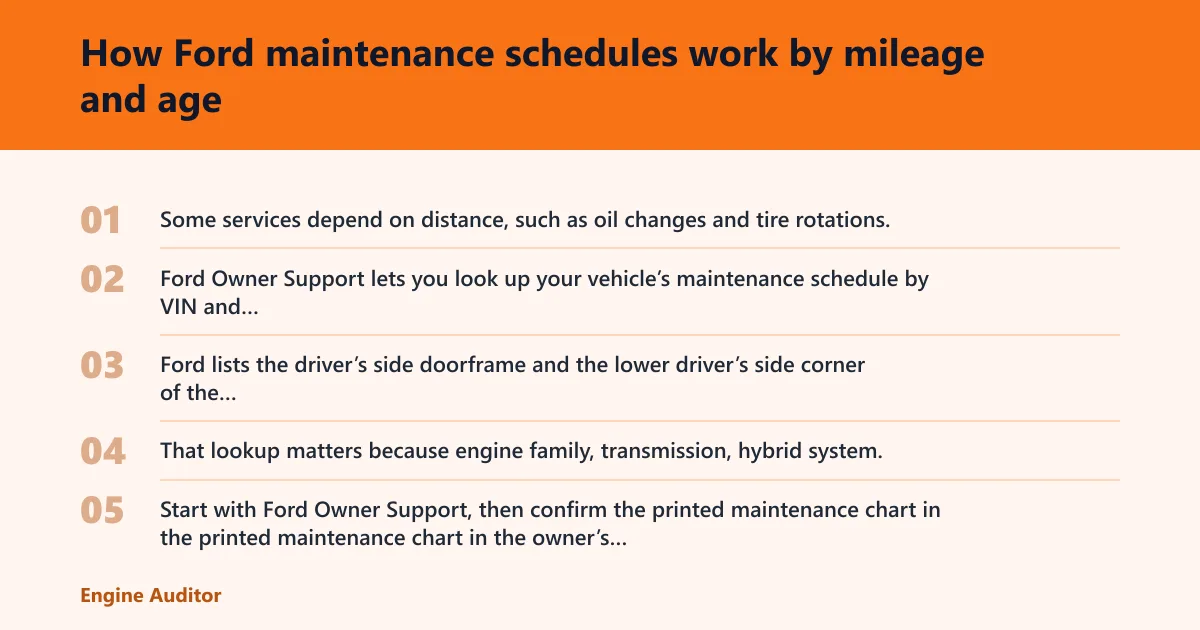


Ford maintenance is not mileage only. Some services depend on distance, such as oil changes and tire rotations, while others depend on time, such as coolant and brake fluid. Ford Owner Support lets you look up your vehicle’s maintenance schedule by VIN and mileage, and the owner’s manual should be the final check before you book service.
A Ford VIN is a 17-digit alphanumeric code. Ford lists the driver’s side doorframe and the lower driver’s side corner of the windshield as VIN locations. That lookup matters because engine family, transmission, hybrid system, and towing package can change the schedule.
Why the owner’s manual and VIN lookup both matter
Start with Ford Owner Support, then confirm the printed maintenance chart in the owner’s manual. The lookup is a guide, not a substitute for model-specific rules. A transmission with a filter may need different service than one that is sealed, and an EcoBoost engine can carry different spark plug timing than another Ford engine family.
When a low-mileage vehicle still needs service
Age alone can trigger service on a vehicle that barely moves. Brake fluid absorbs moisture over time. Coolant ages even when miles stay low. Batteries also age on the calendar, especially on vehicles that sit for long periods, so a low-mileage Ford can still be overdue for time-based maintenance.
| Interval | Mileage trigger | Age trigger | Service type | Notes for normal versus severe use |
|---|---|---|---|---|
| 5,000 miles | 5,000 to 7,500 miles for many baseline services | About 6 months for some driving patterns | Oil and filter, tire rotation, quick inspection | Short trips, stop-and-go traffic, towing, and dusty roads shorten the interval |
| 30,000 miles | 30,000 miles | About 2 to 3 years if time-based service comes first | Cabin air filter, engine air filter, brake inspection | Replace filters sooner in dusty or coastal humidity conditions |
| 60,000 miles | 60,000 miles | About 3 to 5 years for some fluid services | Brake fluid, transmission service where applicable, coolant | Severe use can move fluid service earlier |
| 100,000 miles | About 100,000 miles on many EcoBoost engines | About 7 to 10 years on some vehicles | Spark plugs, belt and tensioner inspection, hoses and mounts | Wear can make parts due before the mileage mark |
| Annual | Not mileage dependent | Every year | Battery, fluid, tire, brake, and warning-light check | Important for low-mileage vehicles and mixed-use fleets |
📊 A Ford VIN is a 17-digit alphanumeric code. Source: FORD.
What is due on a Ford at 5,000 miles?
At 5,000 miles, the usual focus is oil and filter, tire rotation where specified, and a basic inspection. Ford ties routine service to reliability and resale value, and the exact oil interval varies by model, engine, and driving pattern. For many Ford plans, this is the first recurring visit.
Oil and filter interval by model
Many service plans pair oil and filter with tire rotation every 6,000 to 7,500 miles, and some drivers will see a shorter interval under severe use. A dealer or owner’s manual can confirm whether your specific Ford points to a 5,000-mile, 7,500-mile, or other interval.
Tire rotation and basic inspection checks
Tire rotation helps even out wear, especially on front-heavy crossovers, trucks, and performance trims. A basic inspection should include tire tread depth, tire pressure, brake pad condition, fluid leaks, wiper blades, lights, and visible belt condition. That visit is also a good time to look for uneven wear that can hint at alignment issues.
What to inspect between visits
Between oil changes, inspect for warning lights, low fluid levels, odd noises, and changes in braking or steering feel. A common first-timer mistake is waiting for a reminder instead of checking tires and fluids when the vehicle starts pulling, vibrating, or using more fuel than usual.

What maintenance should I do on my Ford at 30,000 miles?
At 30,000 miles, the main items are the cabin air filter, engine air filter, and a stronger brake inspection. This is also a good point to confirm whether your mileage places you on a shorter severe-use interval. Some Ford models will add other mileage-based checks, so the VIN lookup still matters.
Cabin air filter and engine air filter
The cabin air filter is often replaced around that mileage. That helps HVAC airflow and interior freshness. The engine air filter is often replaced around that mileage, where it supports clean airflow to the engine, helps protect the MAF sensor, and may help fuel economy when the old filter is restricted.
Brake inspection and fluid checks
Brake pads, rotors, calipers, and brake fluid should be checked at this milestone. Brake fluid does more than transfer force; it is hygroscopic, which means it absorbs moisture over time. That is why age matters even if mileage is low.
Mileage items that may vary by model
Some Ford plans fold in additional inspections at 30,000 miles, while others do not. Trucks, turbocharged engines, and severe-use vehicles can get different timing for filters, fluids, and suspension checks. The owner’s manual should confirm what belongs on your exact model.
What changes at 60,000 miles on a Ford maintenance schedule?
At 60,000 miles, the schedule often shifts from basic upkeep to a system refresh. Brake fluid exchange often appears here, and transmission service or coolant service may also come due depending on the model, transmission, and age of the vehicle. This is where mileage and time start to overlap more clearly.
Brake fluid and why age matters
Brake fluid exchange is often due somewhere around that mileage, though time can make it come due sooner. Fresh fluid helps protect ABS operation and pedal feel. If the pedal feels soft or the fluid looks dark, the inspection should not wait for a mileage milestone.
Transmission service, fluid, and filter where applicable
Transmission service varies by model and transmission. Some Ford transmissions call for fluid and filter service; others do not. A VIN-specific check is needed before assuming a universal interval. That matters more on trucks, towing setups, and vehicles that see repeated stop-and-go driving.
Coolant service and mixed drivetrain notes
Coolant service is both time-based and mileage-based, and many schedules place it near 60,000 miles. Hybrid and EV cooling loops can differ from gasoline engine cooling systems, so the schedule may include separate loops for the engine, inverter, battery, or electronics. Confirm the system in the manual, not just the mileage.
Suppose a Ford Escape hybrid has only 22,000 miles after five years of short trips. It may still be due for time-based coolant or brake-fluid service even though the odometer looks low. That is exactly why the schedule must be read by both age and mileage.
What should be replaced around 100,000 miles on a Ford?
Around 100,000 miles, many Ford maintenance plans move into higher-wear items. Spark plugs are commonly due on many EcoBoost engines at about 100,000 miles, but the engine code should be confirmed. Belt, tensioner, hoses, and suspension parts also deserve close attention at this point.
Spark plugs on many EcoBoost engines
Many EcoBoost engines specify spark plugs at about 100,000 miles. That interval is not universal across all Ford engines, so the engine code matters. Misfires, rough idle, and hard starting are signs the plugs need attention sooner than the calendar suggests.
Serpentine belt and tensioner checks
The serpentine belt and tensioner are usually inspected around 100,000 miles, with replacement based on wear. Cracks, glazing, chirping, and edge wear are signs to act early. A failing tensioner can outlive the belt for a while, then create belt noise or charging problems.
Hoses, mounts, and suspension wear points
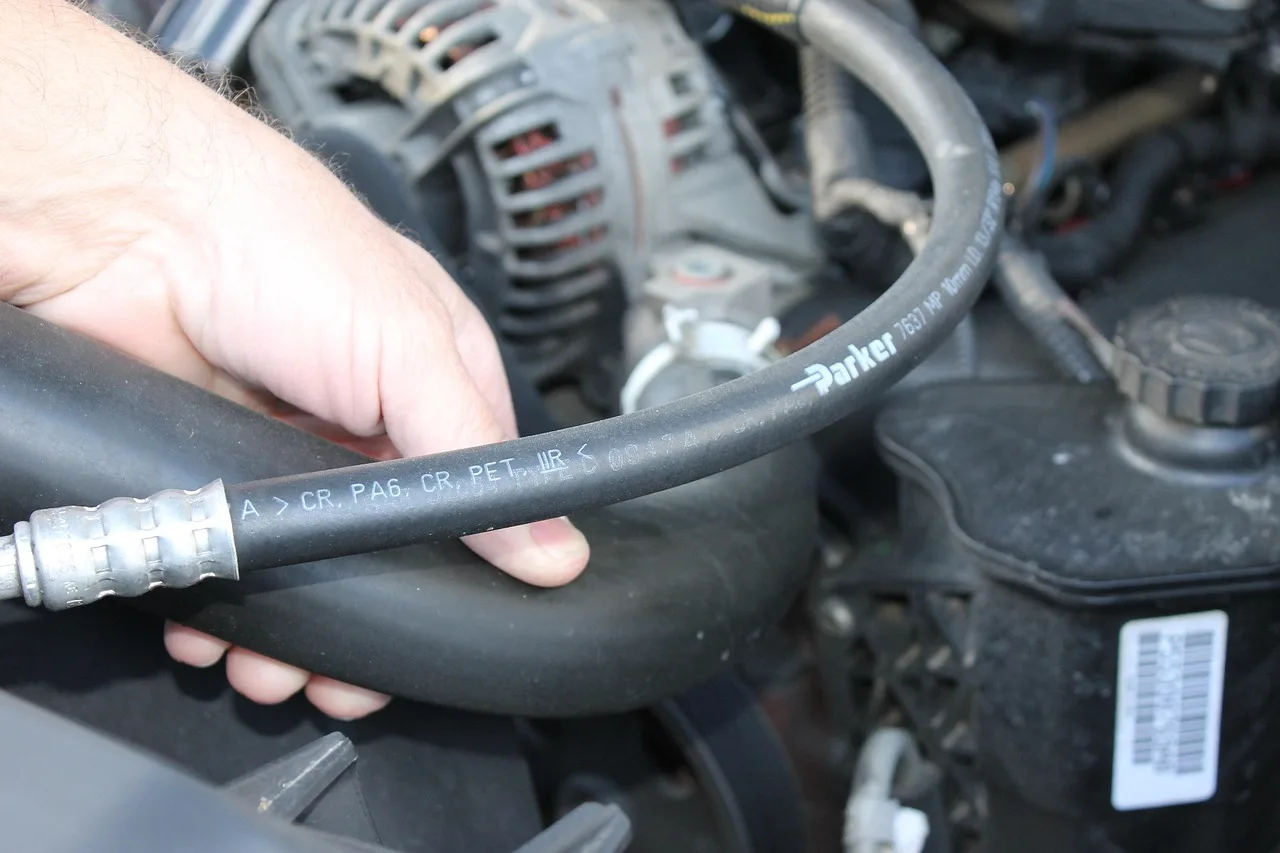
By this mileage, hoses, motor mounts, shocks, struts, ball joints, and steering parts deserve a careful inspection. Small leaks or soft mounts can turn into drivability complaints. The inspection is especially important on trucks, SUVs, and vehicles used for towing.
How do you know if your Ford needs severe service intervals?
You should consider the vehicle severe service if it regularly sees short trips, stop-and-go driving, towing, humid coastal conditions, or dirt roads. Those conditions shorten oil life, strain brakes, and load filters faster. Severe service is not a vague label; it is a specific use pattern that changes the clock.
Short trips and stop-and-go use
Short-trip driving prevents full warm-up and leaves more condensation in fluids and exhaust components. Stop-and-go traffic adds heat cycles and brake wear. If most drives are only a few miles, the calendar matters almost as much as the odometer.
Towing, dirt roads, and coastal humidity
Towing raises heat in the engine, transmission, and brakes. Dirt roads load the air filter and cabin filter faster. Coastal humidity can speed corrosion and moisture-related fluid degradation. Any of those conditions can justify a shorter service interval than the standard plan.
How severe use changes the service clock
Severe use often means earlier oil changes, more frequent rotations, more frequent filter replacement, and earlier fluid inspections. If the vehicle has mixed use, such as low annual mileage but repeated towing, the severe-service clock should win over the mileage-only chart.
One-page mileage-versus-age matrix and printable checklist
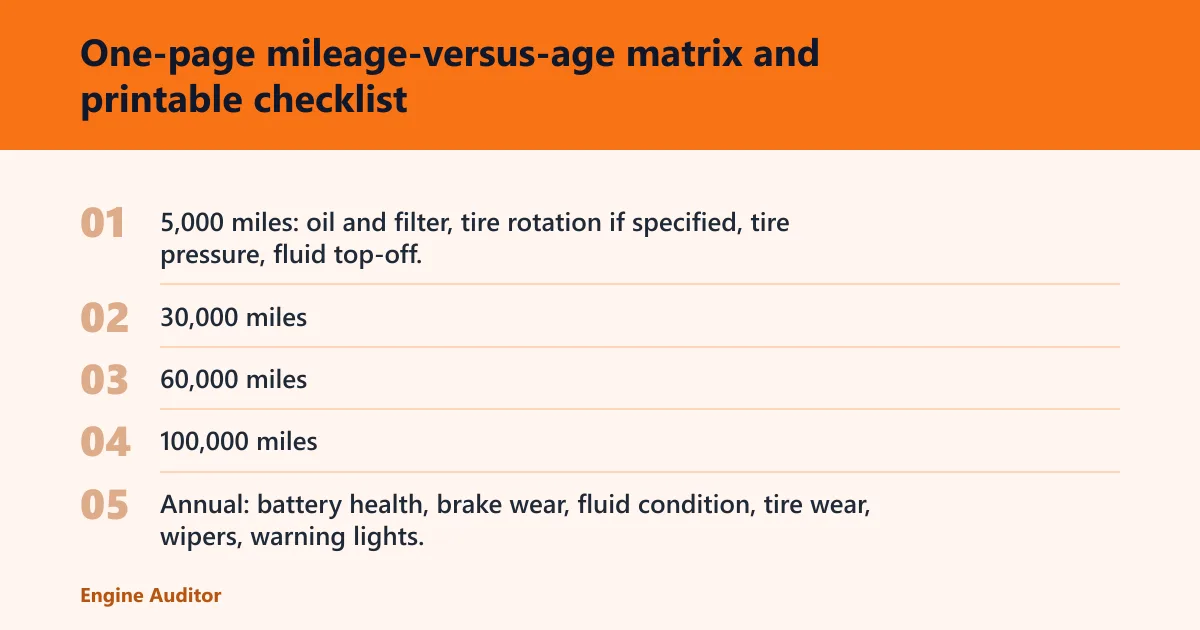
Use this matrix to sort each item into due now, next, or soon. The point is to separate interval-driven work from time-driven work so a low-mileage Ford does not miss age-based service and a high-mileage Ford does not wait on calendar-based items.
Matrix columns to include
Mark each line with the interval, mileage trigger, age trigger, service type, and a note for normal versus severe use. If the owner’s manual or VIN lookup changes an item, use the vehicle-specific rule.
| Item | Interval | Mileage trigger | Age trigger | Service type | Normal versus severe use |
|---|---|---|---|---|---|
| Oil and filter | Recurring | 6,000 to 7,500 miles for many plans | About 6 months on some schedules | Interval-driven | Short trips, towing, and idle-heavy use shorten the interval |
| Tire rotation | Recurring | Often paired with oil service | Not primary | Interval-driven | Front-heavy wear and towing can make rotation more urgent |
| Cabin air filter | About every 30,000 miles | 30,000 miles | About 2 to 3 years if contamination is heavy | Mostly mileage-driven | Dust, pollen, and coastal humidity can shorten life |
| Engine air filter | About every 30,000 miles | 30,000 miles | Inspection at annual service | Mostly mileage-driven | Dust roads can require early replacement |
| Brake fluid | Often around 60,000 miles | 60,000 miles | About 3 to 5 years on many schedules | Time and mileage-based | Stop-and-go use and moisture exposure shorten life |
| Transmission service | Model-specific | VIN-specific | Model-specific | Mixed | Check fluid and filter requirements by transmission |
| Coolant | Model-specific | Often near 60,000 miles | Time-based on many schedules | Time and mileage-based | Hybrid and EV cooling loops can differ from gasoline systems |
| Spark plugs | About 100,000 miles on many EcoBoost engines | 100,000 miles | About 7 to 10 years on some vehicles | Mostly mileage-driven | Confirm by engine code |
| Serpentine belt and tensioner | Inspection around 100,000 miles | Wear-based | Annual inspection after higher mileage | Wear-driven | Replace if cracked, glazed, noisy, or loose |
Printable checklist for 5K, 30K, 60K, 100K, and annual items
- 5,000 miles: oil and filter, tire rotation if specified, tire pressure, fluid top-off, brake inspection, lights, wipers, leak check.
- 30,000 miles: cabin air filter, engine air filter, brake inspection, tire rotation, battery check, alignment look-over, HVAC airflow check.
- 60,000 miles: brake fluid, transmission service where applicable, coolant service if due by age or mileage, suspension and steering inspection, battery and charging system check.
- 100,000 miles: spark plugs on many EcoBoost engines, serpentine belt and tensioner inspection, hoses, mounts, cooling-system check, suspension wear check.
- Annual: battery health, brake wear, fluid condition, tire wear, wipers, warning lights, and any time-based service that the manual lists first.
Ford Mobile Service can perform oil changes, brakes, batteries, and tire rotation, and Ford offers Pickup & Delivery service for dealer maintenance. Ford Rewards points can be earned on Ford service, parts, and accessories, which can help if multiple age-based items come due in the same year.
Frequently asked questions
What service is due on a Ford at 5,000 miles?
At 5,000 miles, many Ford schedules call for oil and filter, a tire rotation if specified, and a basic inspection. The exact interval varies by model, engine, and driving pattern, so the owner’s manual and Ford Owner Support lookup should confirm the next due item before service is booked.
What maintenance should I do on my Ford at 30,000 miles?
At 30,000 miles, plan for the cabin air filter, engine air filter, brake inspection, and a full check of tires, fluids, and wipers. This is also a good point to ask whether severe use shortens any intervals, since dusty roads, towing, and short trips can change filter and oil timing.
What changes at 60,000 miles on a Ford maintenance schedule?
At 60,000 miles, brake fluid often comes due, transmission service may be required where applicable, and coolant may be due by time or mileage. This milestone is less about one job and more about a system refresh, especially on vehicles that tow, idle often, or sit for long periods.
What should be replaced around 100,000 miles on a Ford?
Around 100,000 miles, many EcoBoost engines call for spark plugs, and the serpentine belt and tensioner should be inspected closely. Hoses, mounts, and suspension parts also need attention. The engine code and transmission type matter, so a VIN-specific check is still needed before parts are ordered.
How do I know if my Ford is on a severe service schedule?
Your Ford likely belongs on a severe service schedule if it sees short trips, stop-and-go traffic, towing, coastal humidity, or dirt roads. Those conditions shorten oil, filter, brake, and fluid life. If several of those apply at once, plan service sooner than the normal mileage chart suggests.
Do hybrid and EV Fords still need maintenance?
Yes. Hybrid and EV Fords still need tire rotations, cabin filters, brake service, coolant checks, battery checks, and inspections of the charging and thermal systems. Battery-electric models do not need routine engine oil changes, but they are not maintenance-free, and the service schedule still depends on mileage, age, and use.
Products related to this article
Sponsored / affiliate links. As an Amazon Associate I earn from qualifying purchases. I may earn additional commission from eligible campaigns.