Why Your Car Won’t Crank but Lights Still Work: Causes
Battery voltage is a useful first check: a reading around 12.6V or higher points you more toward cables, the starter relay, starter, switch, or security; if it is below about 12.4V, charge or test the battery first. I use sound, dash behavior, and one 12V meter reading to sort a no-crank fast. Ignore it and you can waste money on parts that are not the fault.
What the symptom usually means
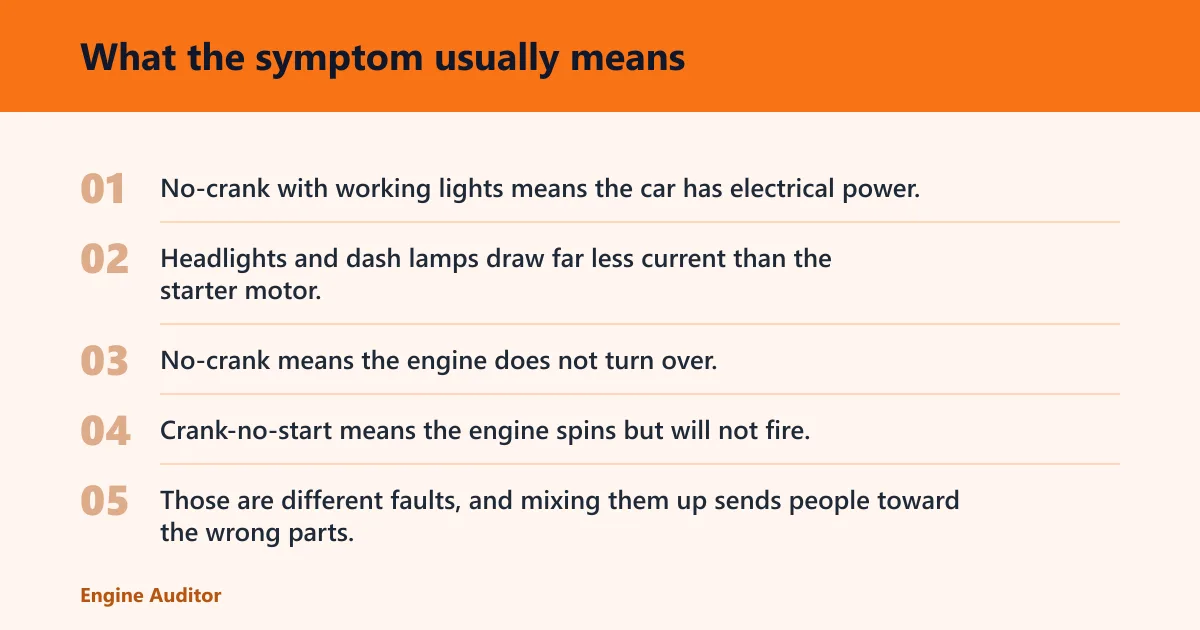
No-crank with working lights means the car has electrical power, but the starter path is failing under load. Headlights and dash lamps draw far less current than the starter motor, so a battery can light the cabin and still collapse when the engine needs to spin.
No-crank versus crank-no-start
No-crank means the engine does not turn over. Crank-no-start means the engine spins but will not fire. Slow crank means it turns, but sluggishly. Those are different faults, and mixing them up sends people toward the wrong parts.
When the fault is probably battery, cable, starter, or switch
A low battery or bad connection may show up as dim lights, rapid clicking, or a jump-start that works. A starter or starter solenoid problem often gives one hard click, or a weak single response with no engine movement. Complete silence pushes the search toward the start signal path: relay, fuse, switch, safety interlock, or security system.
What does the sound tell you?
Sound is the fastest branch point. A no-crank problem that makes no noise is usually not the same problem as one that clicks or grinds. Use the sound clue first, then choose the next test instead of swapping parts.
Complete silence when you turn the key
No sound can mean a bad switch, fuse, relay, or security fault. On automatics, the neutral safety switch or park/neutral switch can also block the start signal. On manuals, the clutch pedal switch can do the same thing if the pedal is not fully engaged.
One loud click with no crank
One hard click may point to the starter. The starter solenoid may be pulling in, but the motor is not spinning. That can happen with a failed starter, bad internal contacts, or even a seized engine that keeps the starter from turning the crankshaft.
Rapid clicking, whirring, or grinding
Rapid clicking often points to low battery power. Grinding may mean the starter gear is not engaging as it should. Repeated relay chatter also fits low voltage or a poor connection that drops out as soon as the load comes on.

Check the 12-volt battery first
A healthy, fully charged 12-volt car battery often reads near 12.6 volts at rest. A reading near or below 12.2 volts means the battery has a low charge. Check it after the vehicle has sat for several hours, because surface charge right after driving can mislead the reading.
How to read 12.6 V, 12.2 V, and lower
| Resting battery reading | What it suggests | Next move |
|---|---|---|
| About 12.6 V | Battery is likely charged enough to continue diagnosis | Check terminals, cable drop, starter, relay, and switch path |
| Around 12.4 V | Borderline state of charge | Charge, then retest after sitting |
| 12.2 V or lower | Low charge is likely | Charge or jump-start as a test before deeper diagnosis |
| Near 12.6 V but no-crank remains | Battery-state may be okay; cable, relay, starter, switch, or security issue becomes more likely | Move to connection and sound checks |
Why a battery can pass the light test and fail starter load
Starting the engine needs far more power than running a few lights. A weak battery can power the dash, radio, and lamps, then fall flat when the starter asks for high current. That is why lights on does not clear the battery.
Inspect battery terminals and cable connections
Battery terminals and cable ends must be clean and tight. White, blue, or green buildup can indicate bad battery terminal connections. Loose clamps are a frequent cause of intermittent no-crank and can make a good battery look bad.
Loose clamps and hidden cable damage
You should not be able to twist a battery clamp by hand. If it moves, fix that first. Also check the cable near the terminal for swelling, broken strands, or a stiff section that hints at hidden corrosion under the insulation.
Simple cleaning and retightening checks
- Turn the key off and remove it.
- Inspect both battery posts and clamps for corrosion or looseness.
- Clean the contact surfaces until bare metal is visible.
- Retighten the clamps so they cannot twist by hand.
- Try the start again only after the connection is corrected.
If the car suddenly cranks after that, the fault was likely a connection issue rather than a failed starter.
Should you jump-start it?
Yes, but treat a jump-start as a test, not a final fix. If the car starts with a jump, the problem often points to battery state, cable condition, charging issues, or a parasitic drain. It does not prove the alternator caused the original no-crank.
What a successful jump points to
A jump that makes the engine crank normally usually means the battery was weak, the connection was poor, or the system has a drain. If the engine starts and then dies later, charging system / alternator output should be tested after the engine is running.
When not to keep trying to start the car
Stop if you smell burning, see smoke, or feel hot cables. Repeated start attempts can overheat the starter, battery cables, cable ends, relays, and damaged wiring. A partially seized engine can also drag the starter hard and make repeated tries worse.
Use the diagnostic matrix to choose the next test
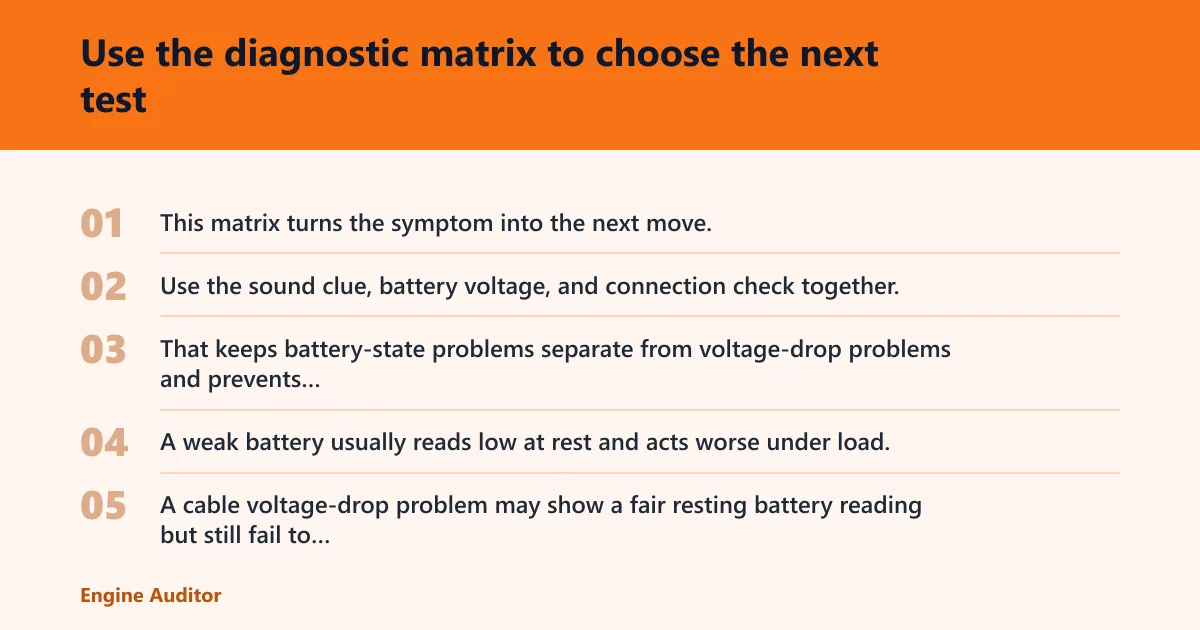
This matrix turns the symptom into the next move. Use the sound clue, battery voltage, and connection check together. That keeps battery-state problems separate from voltage-drop problems and prevents random part replacement.
| Symptom pattern | Likely cause | Next test | Stop-driving warning |
|---|---|---|---|
| Lights work, no sound, battery near 12.6 V | Starter relay, fuse, switch, security fault, park/neutral switch, or clutch switch | Check start signal path and interlocks | Do not keep cycling the key if cables are hot |
| One loud click, no crank | Starter motor, starter solenoid, high resistance in cables, or seized engine | Check battery voltage under load and cable drop | Stop if grinding or burning smell appears |
| Rapid clicking | Low battery power or poor connection | Test resting voltage, then terminals and clamps | Tow if repeated jumps do not change the symptom |
| Grinding | Starter gear not engaging properly | Inspect starter and ring gear area | Do not keep cranking; damage can spread |
| Jump-start works immediately | Battery, connection, charging, or drain issue | Test battery and charging system after startup | Watch for repeat no-start after shutdown |
Battery versus cable voltage-drop clues
A weak battery usually reads low at rest and acts worse under load. A cable voltage-drop problem may show a fair resting battery reading but still fail to carry starter current because corrosion, looseness, or damaged strands limit flow. That is why terminal condition matters as much as battery state.
Could the starter, relay, switch, or safety interlock be the problem?
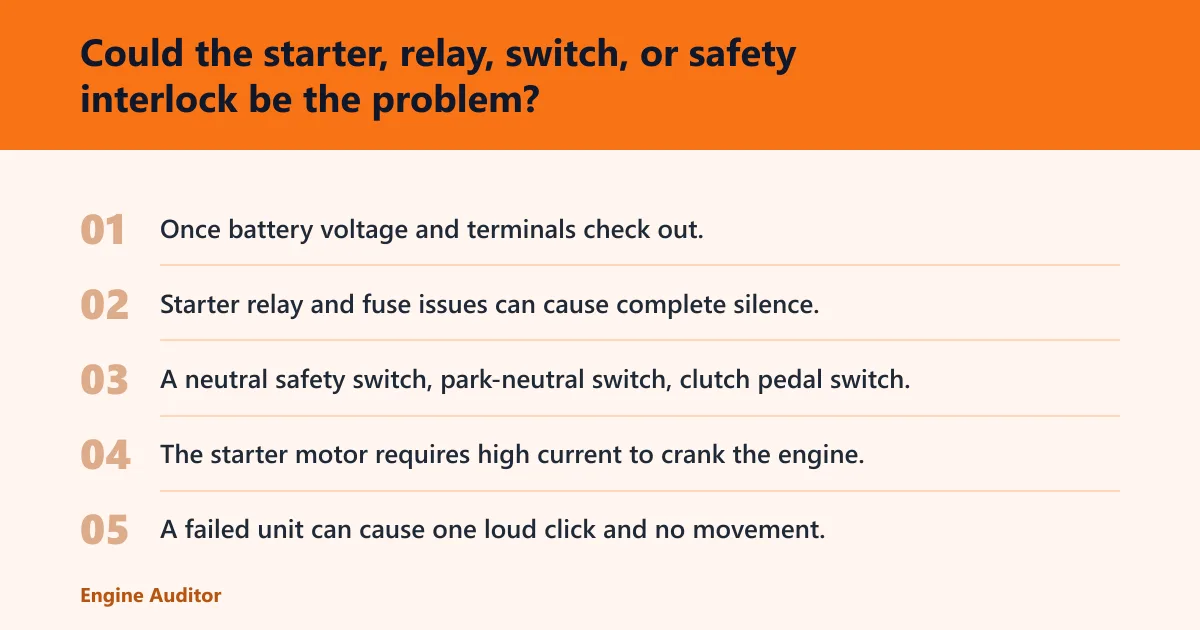
Yes. Once battery voltage and terminals check out, the starter assembly and start-signal path move up the list. Starter relay and fuse issues can cause complete silence. A neutral safety switch, park-neutral switch, clutch pedal switch, or security fault can block the command before the starter ever spins.
Starter motor and solenoid clues
The starter motor requires high current to crank the engine. A failed unit can cause one loud click and no movement. A bad solenoid can click without motor spin. If the engine is seized, the starter may sound failed even when the starter itself is not the main problem.
Starter relay and fuse checks
With complete silence, check the starter relay and fuse before replacing the starter. Those are part of the start-signal path and are easier to inspect than a starter buried low on the engine. A blown fuse or bad relay can mimic a much larger failure.
Neutral safety switch, park-neutral switch, and clutch pedal switch
Automatic transmissions rely on a neutral safety switch or park/neutral switch to confirm the gear selector is in a safe position. Manuals use a clutch pedal switch. If either fails, the key may turn, the dash may light, and the engine still will not crank.
Security system, remote-start, and push-button start edge cases
Aftermarket alarms, remote-start interlocks, and smart key systems can block the start command. Newer push-button cars may also need proper key detection, brake-pedal input, or a known-good jump-point under the hood rather than direct battery access. If the system sees the wrong condition, it can stay silent by design.
Frequently asked questions
why my car won t start but lights work
If the lights work but the engine will not crank, the starter path is failing under load or the start signal is being blocked. Start with battery voltage after the car has sat, then check terminals, relay, fuse, and safety switches. Lights alone do not prove the battery is strong enough to crank.
why won’t my car crank but the lights still work
Because the starter needs far more current than lights or accessories. A battery can run the dash and headlights yet still collapse when asked to spin the engine. If voltage is near or below 12.2 volts, charge or test the battery first, then move to cable and starter checks.
why does my car click but not crank
Clicking means a starter-related event is happening, but the motor is not turning the engine. Rapid clicking often points to low battery power, while one hard click may point to the starter or starter solenoid. If clicking follows a jump-start, the battery or connections are still suspect.
can a bad battery still power the lights but not the starter
Yes. That is one of the most common no-crank patterns. Lighting loads are small compared with starter load, so a weak battery can make the dash look healthy and still fail the crank test. A resting reading near or below 12.2 volts is a strong clue.
how do I tell if it’s the battery, starter, or relay
Use the sound, then the voltage. Low voltage and rapid clicking point toward battery state or connection trouble. One loud click with decent battery voltage points more toward the starter or solenoid. Complete silence shifts attention to the relay, fuse, switch, security system, or interlock.
what battery voltage is considered low for a no-crank diagnosis
A healthy, fully charged battery often reads near 12.6 volts at rest. Near or below 12.2 volts means the battery has a low charge and may not have enough reserve to crank the engine. Check that reading after the vehicle has sat for several hours.
Products related to this article
Sponsored / affiliate links. As an Amazon Associate I earn from qualifying purchases. I may earn additional commission from eligible campaigns.