Why Is My Water Pump Leaking?
A water pump usually leaks from the weep hole, gasket, or shaft seal; if coolant is wet at the pump body or dripping from the pulley area, treat the pump as suspect. Ignoring it can raise engine temperature, damage the pump bearing, and leave you on the shoulder. This guide shows how to tell a pump leak from a hose, cap, or recent installation problem and judge how urgent it is.
Pinpointing the coolant leak source

Start with where the coolant first shows up. A true pump leak usually appears at the pump body, the weep hole, or the pulley area, while a hose or cap problem often leaves coolant elsewhere and runs down onto the pump. The pump moves coolant through the engine, radiator, and hoses, so a leak there can turn into an overheating problem fast.
What a front-of-engine puddle can mean
Green coolant, or sometimes red coolant, pooling at the front of the car often points to the pump or nearby hoses. That does not prove the pump is the source. Coolant can travel along covers, brackets, and belts before it drips, so the highest wet point usually matters more than the lowest puddle point.
A leak near the serpentine belt also deserves attention because the pump is driven by the serpentine belt and crankshaft pulley on many vehicles. If the pulley area is wet, the seal, bearing, or mounting area may be involved.
Water pump leak diagnosis matrix
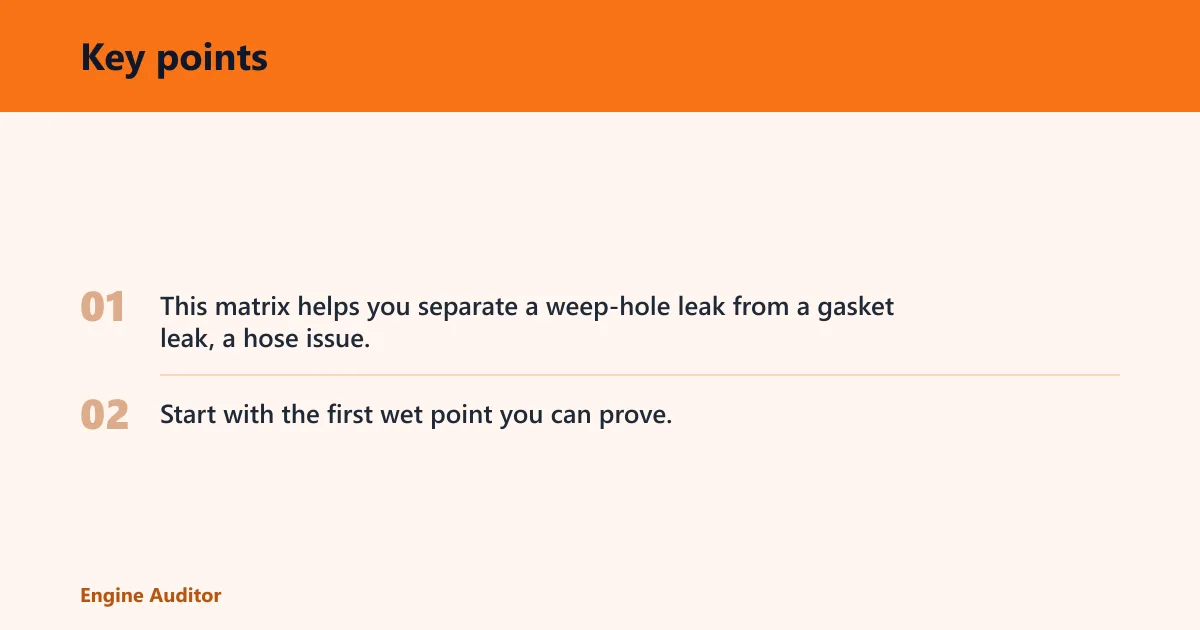
This matrix helps you separate a weep-hole leak from a gasket leak, a hose issue, or a pump that is noisy but not yet leaking. Start with the first wet point you can prove, then match the sound and coolant loss pattern before you decide what to replace.
| Observed drip point | Sound | Coolant loss rate | Likely cause | Recommended action |
|---|---|---|---|---|
| Weep hole | None, squeal, growl, or grind | Slow seep or repeat top-offs | Internal shaft seal failure | Plan pump replacement soon; inspect belt and pulley |
| Pulley area | Growl or grind | Steady drip | Worn bearing letting the shaft move | Replace the pump and inspect the serpentine belt drive |
| Housing seam | None | Slow seep after recent work | Poor gasket surface prep, pinched gasket, wrong sealant, or torque issue | Recheck the install and correct the mounting surface or gasket |
| Hose junction | None or squeal from belt splash | Repeat top-offs | Loose clamp, cracked hose, or fitting leak | Repair the hose or clamp before blaming the pump |
| Under-car front | None | Steady drip or overnight puddle | Coolant traveling from the pump, radiator, cap, or hose | Clean the area and trace the highest wet source, then pressure test |
What the weep hole means
The weep hole is a controlled escape point for coolant, and it is often the first visible sign that the internal seal is failing. A water pump shaft seal keeps coolant inside while the shaft spins. When that seal hardens or wears out, coolant can escape through the weep hole instead of staying inside the pump.
Why a weep-hole trace matters
A damp weep hole usually points to internal seal failure, not a simple external gasket seep. That matters because the repair changes. A gasket leak may be fixed at the mounting surface, but a weep-hole leak usually means replacement is the correct fix. Heat cycling and age are common reasons the seal starts to fail.
Say your 2016 sedan leaves a green stain under the front bumper after a short drive, and the wet spot is centered below the pump pulley. If the weep hole is damp and the pulley itself is dry, that pattern fits an internal seal leak more closely than a hose problem.
What causes a water pump to fail?
Most water pump failures start with seal wear, bearing wear, or coolant problems that shorten seal life. The shaft seal, bearing, and pulley all work together. When one part weakens, the others follow. A pump can leak, make noise, or do both, but those symptoms do not always arrive at the same time.
Shaft seal wear from heat and age
The water pump shaft seal is a common leak point when hardened or worn after heat cycling. The seal must hold back pressurized coolant while the shaft spins at engine speed. Old coolant, mixed coolant, or neglected coolant can become more corrosive and leave deposits that attack the seal over time.
Bearing wear, pulley wobble, and belt drive stress
A worn water pump bearing supports less stable shaft motion, and that movement can let the seal stop holding coolant. A failing bearing can cause a growl or grinding sound near the front of the engine. If the pulley wobbles, the serpentine belt drive may also wear faster or run crooked.
Picture a pickup with a faint front-of-engine growl and no visible puddle yet. If the pulley has side-to-side play but the pump is still mostly dry, the bearing may be failing before the leak becomes obvious. That is still a pump problem, even without a wet floor.
Coolant chemistry and contamination
Old coolant can become more corrosive, and mixed-coolant or neglected coolant shortens seal life. Contamination can create deposits and corrosion at the pump, gasket, and hose necks. That can turn a marginal seal into a visible leak sooner than expected, especially once system pressure rises with normal driving.
Could pressure be the real cause?
Cooling systems run under pressure to raise the boiling point and keep temperature stable. That pressure can expose a weak seal, and pressure spikes can make a marginal leak visible. A bad cap can contribute to abnormal pressure behavior, so a pump leak may appear larger than the pump damage alone would suggest.
How cap issues change the leak pattern
If the cap cannot control pressure correctly, the system may push coolant past a weak shaft seal or seep at a gasket that was already close to failing. That does not mean the cap is the only fault. It means the cap can be part of why a borderline pump starts dripping.
Do not treat every front leak as a bad pump. If the cap is weak and the hose neck is wet, a pressure test may point to the cap first and the pump second. That order matters because replacing the wrong part leaves the problem in place.
Recent replacement leak clues
If the leak started after recent work, suspect the installation before you condemn the pump body. A pinched gasket or poorly cleaned surface can cause seepage. Wrong sealant or overtightening can also create leaks. These problems usually show up at the housing seam instead of the weep hole.
Mounting surface and torque mistakes
The mounting surface must be clean and flat. Old gasket material, coolant residue, or corrosion can keep the new gasket from sealing. If bolts are overtightened, the housing can distort and leak. If they are uneven, the gasket may pinch on one side and seep on the other.
A common first-timer mistake is replacing the pump, then seeing the same drip two days later and assuming the new part failed. If the leak is right at the seam and the weep hole stays dry, the install is a stronger suspect than the pump itself.
How to confirm the source
A cooling system pressure test is used to check where coolant escapes under controlled pressure. It can help separate the pump from hoses, fittings, and the cap. Visual checks matter too, because coolant often runs along parts before it drips. Clean the area first if possible, then watch for the first wet point.
What to inspect first
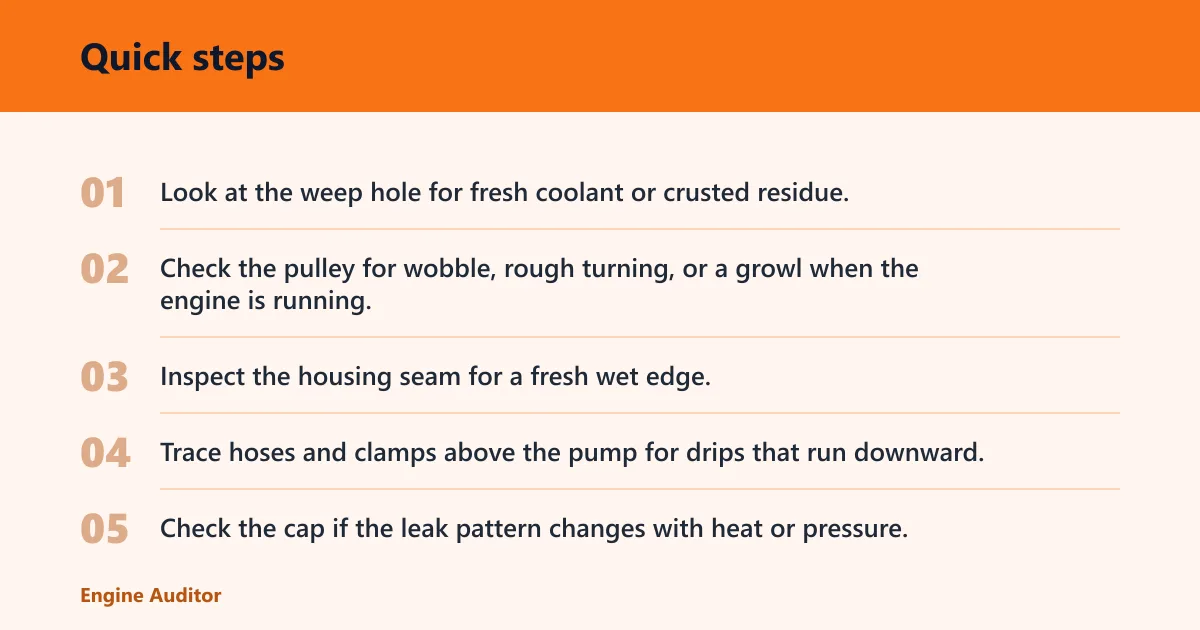
- Look at the weep hole for fresh coolant or crusted residue.
- Check the pulley for wobble, rough turning, or a growl when the engine is running.
- Inspect the housing seam for a fresh wet edge.
- Trace hoses and clamps above the pump for drips that run downward.
- Check the cap if the leak pattern changes with heat or pressure.
What points to the pump versus a nearby part
If the weep hole is wet, the shaft seal is the leading suspect. If the pulley wobbles or the bearing growls, the pump is failing even before the leak gets large. If the seam is wet right after replacement, the gasket or mounting surface is more likely. If the hose junction is damp, the pump may be innocent.
Cooling system pressure testing helps because it can make a hidden seep show up without the engine running. That controlled pressure can reveal a weak seal, a bad cap, or a hose leak that only appears when the system is loaded.
If the leak is from the weep hole or shaft seal, replacement is usually the correct fix. Stop-gap products are not a good answer for a worn seal or bearing. If the leak is from the housing seam after recent work, correct the gasket, surface prep, sealant, or bolt torque instead of replacing more parts blindly.
What to do right away
- Check coolant level and top off only if needed to avoid an immediate overheat.
- Do not ignore a steady drip or a growling pump.
- Inspect the belt for coolant contamination or edge wear.
- Verify the cap and nearby hoses before ordering parts.
- Schedule repair quickly if the weep hole is active or the bearing is noisy.
How to stop a leaking water pump depends on the leak source. A hose clamp may stop a hose leak. A cap may stop a pressure problem. But a leaking shaft seal or failing bearing usually does not stop for long, and continued driving can overheat the engine and make the damage worse.
What causes a water pump to go bad?
Heat, pressure, age, and coolant condition are commonly reported reasons a water pump goes bad. The seal wears from heat cycling, the bearing wears from load, and poor coolant chemistry can corrode the internal parts. If the pump is noisy, leaking, or wobbling, the failure process is already under way.
Why the pump can fail without leaking
Can a water pump fail without leaking? Yes. A bearing can fail first, which may cause noise or shaft play before any coolant appears. In that case, the pump may still move coolant for a short time, but the failure is still real. A noisy pump is not safe to ignore just because the floor stays dry.
Why is my water pump not working? If the pump is no longer moving coolant effectively, the engine may overheat, run unevenly in temperature, or show poor heater output. The fault may be a seized bearing, broken impeller, belt issue, or another cooling-system problem that stops circulation.
Frequently asked questions
Why is my water pump leaking?
A water pump usually leaks from the shaft seal, weep hole, gasket, or mounting surface. If coolant is wet on the pump body, pulley area, or housing seam, the pump is suspect. A hose or cap can also mimic a pump leak, so the exact drip point matters before replacement.
Can a water pump fail without leaking?
Yes. The bearing can fail first, which may create growling, grinding, or pulley wobble before coolant escapes. The pump can also lose pumping ability if internal parts wear enough. A dry pump is not always a healthy pump, especially if front-of-engine noise is present.
Why does my water pump go bad?
Water pumps go bad because the seal, bearing, and coolant conditions all age together. Heat cycling hardens the seal, bearing wear lets the shaft move, and neglected coolant can corrode internal parts. That combination is why some pumps begin to seep before they ever make a loud noise.
Products related to this article
Sponsored / affiliate links. As an Amazon Associate I earn from qualifying purchases. I may earn additional commission from eligible campaigns.