Why Is My Coolant Reservoir Empty but the Radiator Is Full?
With a cold engine, a full radiator and empty reservoir usually mean the recovery path is blocked: a bad cap, split or soft overflow hose, trapped air, or a pressure leak that sends coolant away from the tank. Leave it alone and the system can overheat, lose coolant after heat cycles, or send you down the wrong repair path. This guide separates cap, hose, air, and internal pressure faults, and contrasts that with the reverse pattern.
Why is the reservoir empty?
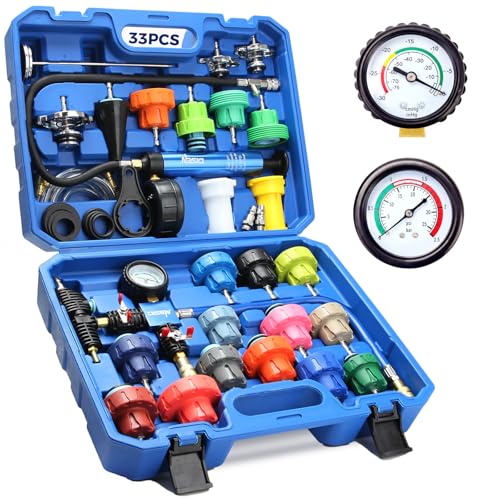
- Pressure tests the cooling system for leaks
- Vacuum refill helps purge air pockets
- Wide adapter set fits many vehicles
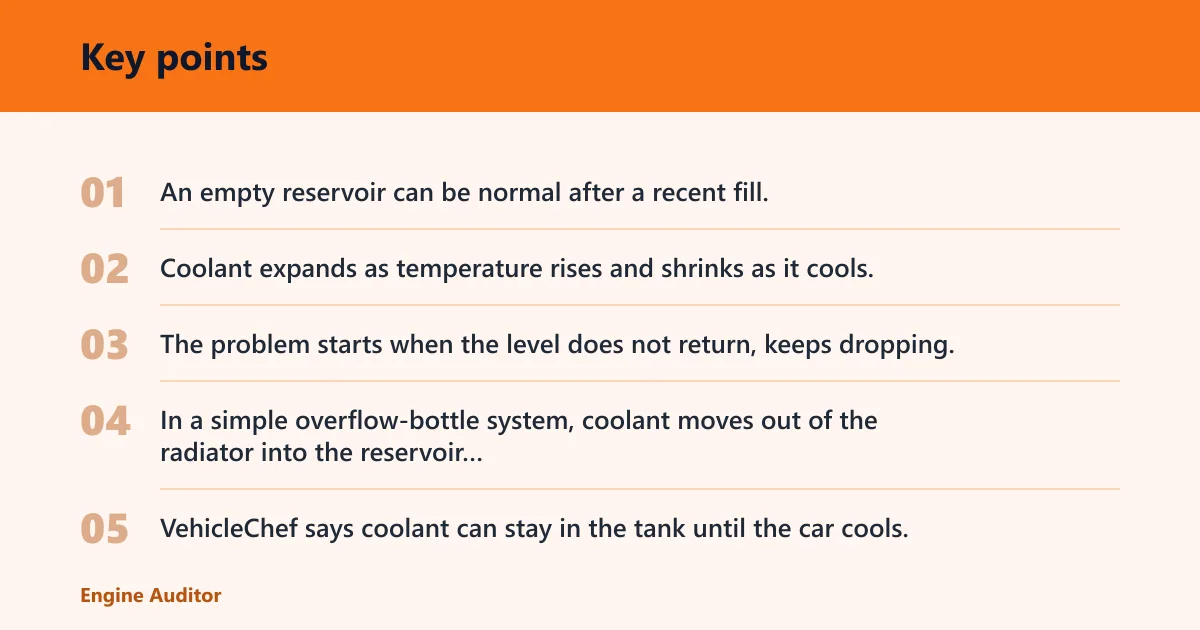
An empty reservoir can be normal after a recent fill, but it should not keep draining under normal operation. Coolant expands as temperature rises and shrinks as it cools, so movement between the radiator and tank is expected. The problem starts when the level does not return, keeps dropping, or the tank is empty every cold check.
What normal hot-and-cold level change looks like
In a simple overflow-bottle system, coolant moves out of the radiator into the reservoir as the engine heats up, then should move back when the engine cools. VehicleChef says coolant can stay in the tank until the car cools, and Vehicle Seeks says the reservoir naturally changes level with engine temperature. That movement should be modest, not a steady loss.
When an empty reservoir is a leak, not a mystery
If the reservoir stays empty after the engine has fully cooled, inspect the outside of the system first. Look at the tank body, hose connections, and cap area for crusty residue, wetness, or dried coolant marks. A cracked tank, loose fitting, or split seam can empty the reservoir while the radiator still looks full at the cap.
Overflow bottle versus pressurized expansion tank
Diagnosis changes with design. A simple overflow bottle is not pressurized and mainly stores expansion and return flow. A pressurized degas or expansion tank is part of the sealed cooling loop, so its level can behave differently. Check the cap style and hose routing before assuming the same symptom means the same fault.
What the radiator-to-reservoir flow should do
The radiator and reservoir work together only if the cap, hose, and tank can move coolant both directions. On cooldown, the system should pull coolant back from the reservoir as pressure falls. If that return path fails, the radiator may end up low and the reservoir may stay high, which is the opposite of a simple empty-tank complaint.
How the cap moves coolant out and back
A radiator cap does two jobs. It holds pressure when the engine is hot, and it must also let coolant return during cooldown on systems that use return flow. A faulty radiator cap can keep sending coolant into the reservoir and can also fail to let it move back when the engine cools.
Why the radiator and reservoir can read differently when cold
A cold radiator should generally be full to the correct point, with the reservoir sitting between its marks. If the radiator is full but the reservoir is empty, the engine may have expelled coolant and may not have recovered it. If the reservoir is full but the radiator is low, return flow or a fill error is more likely.
What happens when the system was filled too low
If the radiator or reservoir was underfilled at the last service, the tank may appear to “disappear” simply because there was not enough coolant in the system to begin with. Recheck the level only when the engine is cold, use the vehicle-specified coolant type and mix ratio, and fill to the marks in the correct component for that design.
Coolant flow diagnostic matrix
| Symptom | Likely failure point | Quick safe check | Next step |
|---|---|---|---|
| Reservoir empty, radiator full | Reservoir leak, cap that will not return coolant, air pocket, or a blocked return hose on an overflow-bottle system | Cold engine only: check the tank, hose, cap seal, and level marks for cracks, wetness, or dried residue | Repair the leak or hose issue, then refill to the correct mark with the specified coolant mix and recheck after a full heat cycle |
| Reservoir full, radiator empty | Failed cap, blocked return flow, or fill error that left the radiator short | Cold engine only: confirm the radiator is truly full at the cap neck before topping the tank | Service the cap and return path first, then refill the radiator and set the reservoir to the correct cold mark |
| No level change after cool-down | Cap not venting or returning coolant, hose blockage, or an air pocket that prevents normal movement | Mark the cold level, warm the engine normally, let it cool fully, then compare levels again | Inspect cap function and hose routing before moving to a pressure test at the cap’s rated pressure |
| Repeated coolant loss with no visible puddle | Internal leak, tiny external seep, or coolant boiling out under pressure | Look for overheating, sweet smell, white exhaust smoke, bubbles in the tank, or residue around joints | Check the radiator, heater core, hoses, and combustion-gas signs before assuming a head gasket |
Can a bad radiator cap cause this?
Yes. A bad radiator cap can cause incorrect pressure control and failed return flow on cooldown. If the cap cannot hold pressure or release it correctly, coolant may be pushed into the reservoir and then never drawn back, or it may vent too early and leave the system short.
Failed pressure control
The cap must hold the system near its designed pressure so coolant does not boil early. If it cannot seal, coolant can migrate to the reservoir or escape elsewhere. A damaged cap gasket, weak spring, or worn neck surface can make the cap lose control even when the rest of the system looks clean.
Failed return flow on cooldown
During cooldown, the system should pull coolant back from the reservoir. If the cap’s vacuum valve sticks or the seal is poor, that return flow stops. On overflow-bottle systems, that often leaves the reservoir full and the radiator low after a heat cycle. It does not usually make the reservoir empty.
Cap gasket damage and neck sealing issues
Do not overlook the cap seat on the radiator or expansion tank neck. A nicked gasket, distorted neck, or corrosion around the sealing surface can mimic a bad cap. If the cap looks suspect, replace it with the correct pressure-rated part for the vehicle, not a generic substitute.
Could the hose be the problem?
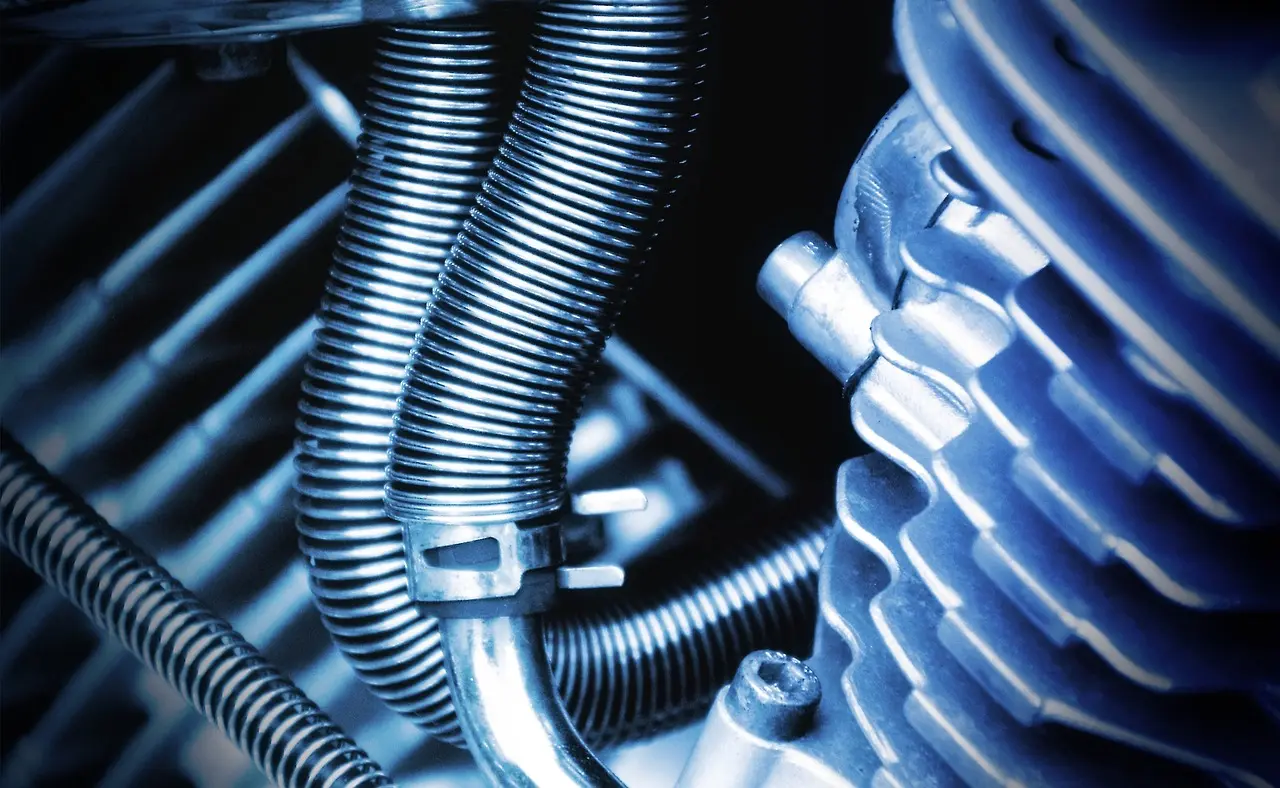
Yes. The hose between the radiator and reservoir can kink, collapse, clog, crack, or leak. The same source says kinked hoses can create blockages that prevent coolant flow. That hose is small, easy to miss, and often the first place where brittle plastic fittings or a loose quick-connect create trouble.
Kinked or collapsed overflow hose
A soft hose can fold over itself or collapse under heat and age. If that happens, coolant may move out of the radiator but not return properly on cooldown. On some vehicles, the hose also bends sharply near the cap neck or reservoir nipple, which makes a hidden kink easy to miss.
Cracked, loose, or clogged hose
Look for splits at the ends, hardened sections, loose spring clips, and crusted deposits inside the line. A clogged hose can sometimes trap coolant residue and block return flow. A disconnected hose can also leave the reservoir dry while the radiator still appears full at the cold check.
How to inspect the hose routing safely
Let the engine cool completely. Then trace the hose from the radiator or cap neck to the reservoir, checking for sharp bends, contact with hot parts, and brittle quick-connects. A common first-timer mistake is squeezing the hose while the engine is hot. Do not do that.
Say your compact sedan has a translucent overflow bottle mounted near the fender, and the hose has a hard bend behind the air box. The bottle keeps reading empty after two drives. That points first to hose routing or a bottle leak, not to a head gasket.
Could the reservoir itself be leaking?
Yes. The reservoir can crack, split at a seam, or leak at a neck or fitting. This matters because a dry tank can coexist with a full radiator for a while, especially if the cap and hose still hold enough function to keep the radiator filled when cold.
Cracks, seam splits, and brittle plastic
Many reservoirs age from heat cycling and vibration. Fine cracks often hide near mounting tabs, molded seams, or the bottom of the tank. A white or pink crust around the seam is a clue. If the tank is brittle or warped, replacement is usually safer than trying to patch it.
Bad fittings and tank neck damage
Check the hose nipple, cap neck, and any sensor ports for damage. A cracked neck can leak only when hot, then look dry later. That pattern can confuse diagnosis because the cold engine may show a normal radiator level while the reservoir appears to have “vanished.”
Why a dry tank can still leave the radiator full
On an overflow-bottle setup, the tank is a storage point, not the main heat exchanger. So a leak at the reservoir does not always drain the radiator right away. That is why the next step is not guessing at a major failure. It is checking the tank, cap, and hose path in order.
When to suspect a deeper cooling fault
If the reservoir problem comes with overheating, bubbling, repeated coolant loss, or poor cabin heat, move beyond the cap and bottle. The same source lists a closed thermostat as a cause of coolant flow failure, and it also notes that a clogged radiator and heater core blockage can be involved. Those faults usually affect temperature control, not just level.
Thermostat stuck closed
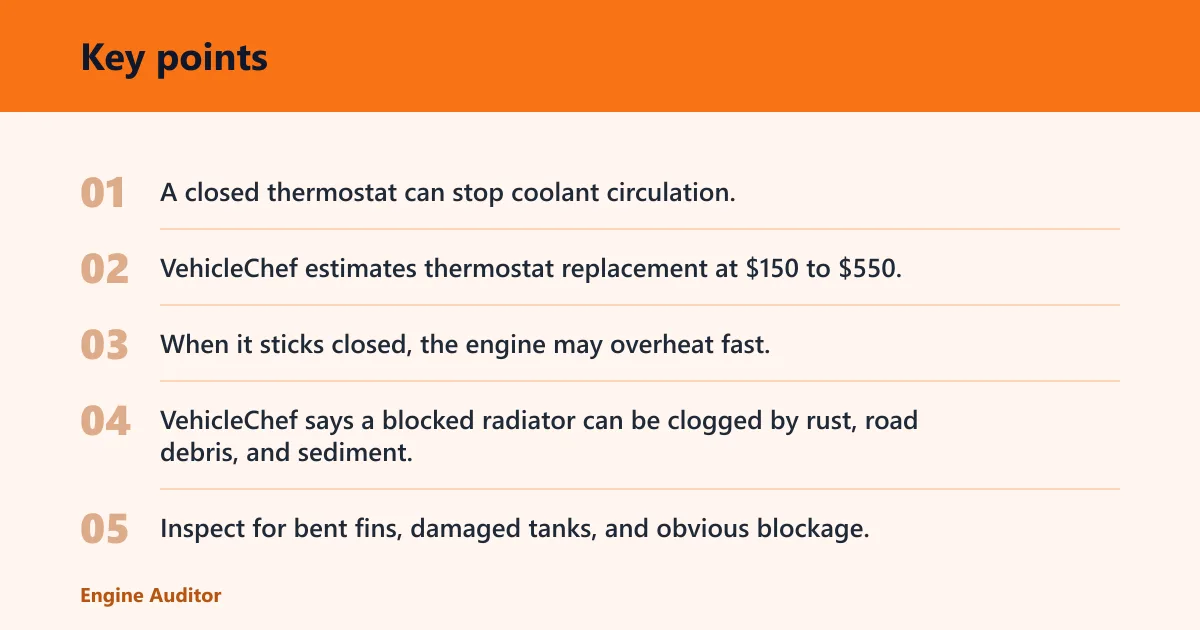
A closed thermostat can stop coolant circulation. VehicleChef estimates thermostat replacement at $150 to $550. When it sticks closed, the engine may overheat fast, the upper hose may stay cooler than expected, and the reservoir behavior becomes secondary to the circulation problem.
Radiator blockage or damage
The same source says a blocked radiator can be clogged by rust, road debris, and sediment. Inspect for bent fins, damaged tanks, and obvious blockage. If the radiator cannot shed heat, coolant can push into the reservoir under load, then the system may behave erratically on cooldown.
Water pump, heater core, or head gasket signs
A weak water pump can reduce coolant movement. A heater core blockage can also affect flow and cabin heat. A head gasket is the serious one: VehicleChef lists a blown gasket as a cause of coolant being forced into the reservoir, and VehicleChef estimates head gasket replacement at $1,400 to $1,600. Look for bubbles, sweet smell, smoke, overheating, or repeated loss with no external leak. Those signs raise concern for combustion-gas intrusion.
Picture a midsize SUV that overheats on the highway, then shows bubbles in the reservoir and no puddle under the vehicle. In that case, the cap and hose still matter, but the repeated loss with heat and no external leak moves head gasket or another internal leak much higher on the list.
What does it mean when your coolant reservoir is empty?
It usually means one of two things: the reservoir has leaked or been misfilled, or the system cannot move coolant back and forth the way it should. The first check is simple and safe. Do it cold, compare the marks, inspect the hose and cap, and confirm the radiator is actually full before deciding the problem is bigger.
- Let the engine cool completely.
- Check the radiator level first, then the reservoir level.
- Inspect the reservoir for cracks, seam splits, and wet residue.
- Check the cap gasket and sealing neck for damage.
- Trace the hose for kinks, collapse, cracks, and loose ends.
- Verify the coolant type and mix ratio match the vehicle specification.
- If the levels are still wrong, test at the cap’s rated pressure, not above it.
Frequently asked questions
Why is my coolant reservoir empty but the radiator is full?
On a cold engine, that pattern usually points to a leak or blockage in the reservoir side of the recovery path: a cracked tank, loose fitting, bad cap return function, trapped air, or a hose problem. Check the tank, cap, and hose first. The radiator being full does not rule out a reservoir fault.
Why is my radiator empty but reservoir full?
That pattern usually means coolant moved into the reservoir but did not return. A bad radiator cap, blocked return path, or improper fill can leave the radiator low even though the tank looks full. Recheck the radiator only when cold, then inspect the cap seal and hose routing before topping anything off.
Can trapped air make coolant disappear from the reservoir?
Yes. Air pockets can keep coolant from moving normally between the radiator and reservoir. They can also make the level change look random after heat cycles. If the system was recently serviced, verify the fill procedure, coolant type, and mix ratio, then watch for repeated loss instead of a one-time drop.
How do I tell if the hose between the radiator and reservoir is blocked?
With the engine cold, trace the hose end to end and look for sharp bends, collapse, cracked sections, residue, or a loose quick-connect. A blocked hose often leaves no obvious puddle. If the tank level does not change after a full cool-down, the hose and cap return path move to the top of the list.
Could a head gasket make the reservoir empty?
Yes, but it is not the first assumption. A head gasket can force combustion gases into the cooling system and push coolant away from the tank. Look for overheating, bubbles, sweet smell, smoke, and repeated coolant loss with no external leak. Those signs justify deeper testing before teardown.
Why does my coolant keep going down with no visible leak?
Repeated loss with no puddle usually means either a small leak that only opens hot, coolant is being pushed into another part of the system, or there is an internal leak. Check the reservoir, hose, cap, radiator, heater core, and signs of combustion-gas intrusion. The cooling system is sealed, so repeated loss is not normal.
Products related to this article
Sponsored / affiliate links. As an Amazon Associate I earn from qualifying purchases. I may earn additional commission from eligible campaigns.