Why Is My Coolant Reservoir Bubbling?
A coolant reservoir can bubble normally during warm-up or right after shutdown, but steady bubbling at idle, rapid overflow, or repeated pressure loss points to trapped air, a weak cap, overheating, or combustion gases. Leave it alone and you can overheat the engine, push coolant out, or damage the head gasket. This guide shows how to read bubble pattern and timing, then walk through a quick at-home check sequence.
Warning: Never remove a radiator cap or reservoir cap when the engine is hot. Pressurized coolant can flash-boil and spray scalding fluid. Let the system cool fully before opening anything.
How the reservoir works and when bubbles are normal

Some movement in the coolant reservoir is normal, especially on a pressurized degas tank or after shutdown. Trouble starts when bubbling is steady, begins cold, or comes with overflow, loss of coolant, white exhaust, or a rising temperature gauge. Timing tells you more than “bubbling” by itself.
For background on related symptoms, see radiator cap symptoms, thermostat stuck closed, cooling fan not working, head gasket symptoms, coolant flush and bleeding, and overheating causes.
Reservoir, overflow tank, and degas tank basics
The coolant reservoir is the plastic overflow or expansion container that holds extra coolant as the engine heats and cools. On many vehicles, the coolant level should sit between the MIN and MAX marks when the engine is cold. Some systems use a pressurized degas tank, so fluid motion there can be part of normal circulation.
That design detail matters. A tank that sees returning coolant flow after shutdown is not the same thing as a tank that keeps bubbling at idle or from a cold start. Do not assume every bubble means failure.
Bubble patterns that are often normal
Normal bubbling usually appears briefly after shutdown as heat soak moves coolant through the system and air dissolves out of the fluid. You may also see a small return stream into the tank from the radiator or engine side. It should calm down as temperatures equalize.
According to major coolant and cooling-system references, pressure raises the coolant’s boiling point, which is why a healthy cap and correctly filled system matter so much; brief post-shutdown movement can be normal, but a loss of pressure changes the picture quickly. See the technical guidance from Gates engine cooling resources and Motorcraft cooling system guidance.
Bubble patterns that point to a fault
Steady bubbling, especially when the engine is still cool, points away from simple heat soak. Common causes include trapped air, a weak pressure cap, overheating, or combustion-gas intrusion from a head gasket or related sealing fault. The temperature gauge and coolant level help separate those causes.
Suppose the tank bubbles lightly for 30 to 60 seconds after shutdown, then stops. That leans normal. Suppose it bubbles from the first minute of cold idle and the upper hose stays cool longer than expected. That leans toward air in the system or a flow problem.
What normal bubbling looks like
Normal bubbling is brief, mild, and tied to temperature change. It often appears right after shutdown, not as a constant stream at idle. Some vehicles with pressurized tanks move more coolant than others, so the same motion can be normal on one car and suspicious on another.
After-shutdown flow and heat soak
After the engine stops, trapped heat can move coolant through the radiator, heater core, and reservoir. That heat soak can cause a short burst of bubbles or a visible return flow into the tank. The action should fade as the system cools.
This is why a bubbling reservoir after a drive is not automatically a head-gasket failure. Timing matters. A brief post-shutdown burble is common; repeated bubbling at idle, or bubbling that starts before the engine is fully warm, is more concerning.
Intermittent movement versus steady bubbles
Intermittent movement usually comes and goes with temperature swings. Steady bubbles, especially in a cold tank, suggest gas is entering the coolant or the system cannot hold pressure. That difference is the key clue many guides miss.
A common first-timer mistake is checking the tank once, seeing bubbles, and jumping to the worst conclusion. Look at when the bubbles appear, how long they last, and whether the gauge rises with them.
Why some pressurized tanks move more than others
Some cars use a pressurized degas tank instead of a simple overflow bottle. On those systems, small changes in level and flow can be expected. The cap type, hose routing, and fill procedure are vehicle-specific, so always match the service information for your exact model.
Why is my coolant reservoir bubbling but not overheating?
When the gauge stays normal, bubbling usually points to low coolant, trapped air, a weak cap, or an incorrect coolant mix before it points to a major overheat. It can still matter. A system that is losing pressure or pulling in air may not overheat yet, but it is already unstable.
Low coolant and trapped air
A low reservoir can pull air into the system through a leak or during recent service. Air pockets often make gurgling or intermittent bubbles, and they can reduce heater output at the dash. Bleeding is usually needed after coolant replacement, hose work, or any repair that opened the system.
Check the level only when the engine is cold. If the coolant sits below MIN, top off with the correct mix and inspect for leaks. If the heater blows cooler than usual at idle, trapped air becomes more likely.
Weak pressure cap or wrong cap rating
A radiator cap or pressure cap with the wrong rating can vent early, lower the boiling point, and let coolant overflow or boil in the reservoir. A weak seal, damaged gasket, or cap that does not match vehicle spec can do the same thing. The pressure rating is not optional.
Cap faults are common because they are small and easy to overlook. Pressure testing is one of the standard ways to confirm cap and system integrity, and cooling-system references consistently note that the cap helps control boiling behavior by maintaining pressure. See Prestone’s cooling system overview and Gates’ radiator cap function guidance.
Wrong coolant mix ratio
A common mix is 50/50 coolant and distilled water, unless the vehicle specifies something different. Too much water reduces boil protection and freeze protection. Too much concentrate can also create problems by reducing heat transfer in some systems.
If the mix is unknown, check the service spec before adding more fluid. A poor mix can make a marginal system bubble sooner, especially in traffic or after a long climb.
How to check the system at home
Start cold, look at the level, then watch how the tank behaves at idle and after shutdown. You are trying to separate harmless thermal movement from pressure loss, air pockets, overheating, or combustion gases. Keep the cap closed until the engine is fully cool.
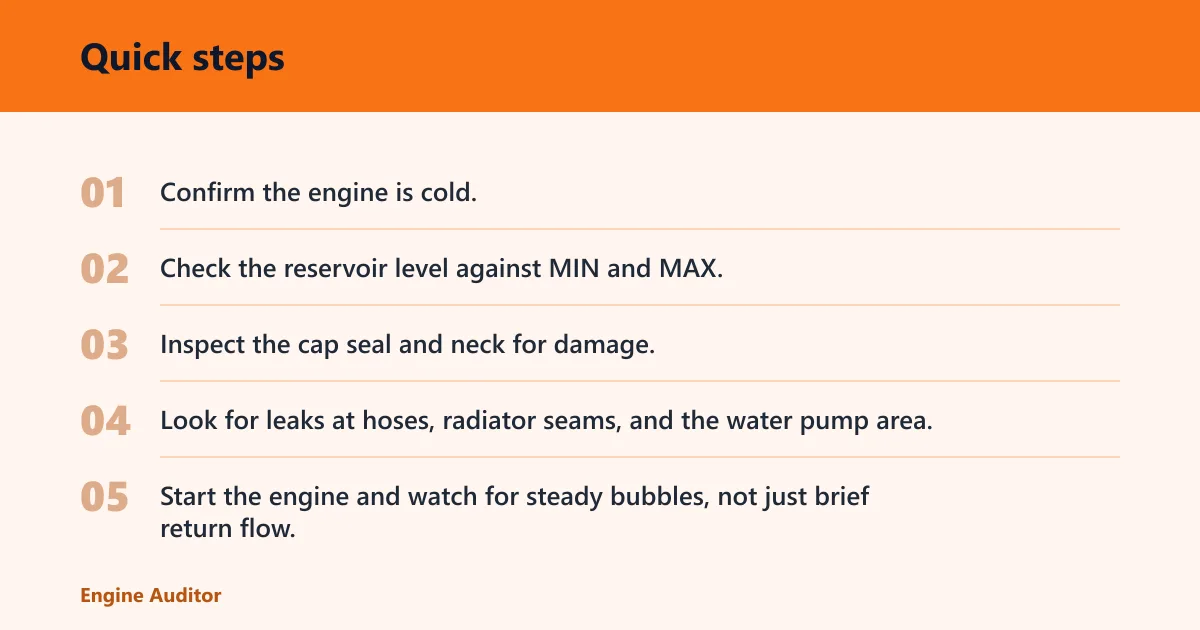
Start cold and inspect the level
With the engine cold, confirm the coolant sits between MIN and MAX. If it is empty or well below MIN, air may already be in the system. Check the hoses, clamps, tank, and cap for wet spots, crusty residue, or dried coolant.
- Confirm the engine is cold.
- Check the reservoir level against MIN and MAX.
- Inspect the cap seal and neck for damage.
- Look for leaks at hoses, radiator seams, and the water pump area.
- Start the engine and watch for steady bubbles, not just brief return flow.
Watch the tank at idle and after shutdown
At idle, steady bubbling is more suspicious than a brief pulse after shutdown. After a drive, a short return flow can be normal. If the tank keeps venting or spills coolant after shutdown, the cap, fan system, or cooling flow may be at fault.
Check hoses, cap condition, and visible leaks
Soft, collapsed, cracked, or swollen hoses can change pressure behavior. A bad cap can vent early. Visible leaks matter because even a small leak can admit air as the engine cools.
Look for dried coolant around hose joints and the reservoir neck. White or colored residue often marks a slow leak better than active dripping does.
Use a funnel, pressure tester, or scan tool if available
A spill-free funnel helps purge air during refill. A vacuum fill tool reduces trapped air on some systems. A pressure tester can reveal a slow leak or a cap that fails below spec. A scan tool can show coolant temperature and fan behavior when the gauge is unclear.
| Bubble timing | Likely cause | Next check | What you’ll usually notice |
|---|---|---|---|
| Cold start, steady bubbling | Combustion-gas intrusion or trapped air | Check coolant loss, cap seal, and cold-tank pressure; consider block test | Pressure in a cold tank, repeated coolant loss, rough warm-up, or white exhaust |
| Idle only, bubbles get worse as heat rises | Overheating, weak cap, or fan problem | Watch gauge, verify fan operation, and inspect cap rating | Heat creep in traffic, rising gauge, fan that stays off, or overflow after idling |
| After shutdown, brief burble then stops | Normal heat soak or return flow | Recheck cold level and watch for repeat loss over several drives | A short bubbling burst, then quiet; level remains stable next morning |
| After shutdown, overflow or steam | Pressure loss, overheating, or fan failure | Check cap, fan relay, fuse, motor, and coolant level | Coolant spit-out, steam, sweet smell, or a hot soak that keeps getting worse |
| Under load or uphill, bubbling starts with rising gauge | Thermostat, fan, or flow problem | Scan coolant temperature and confirm radiator flow and fan command | Gauge climbs on grades or highway pulls, then cools a little at speed or on descent |
| Steady bubbling plus overheating or exhaust-gas symptoms | Head gasket or related sealing fault | Do not drive; perform block test, pressure test, or compression test | Continuous bubbles, coolant loss, white smoke, hard hoses, or a cold tank that builds pressure |
When bubbling points to a bigger fault
Steady bubbling that matches a rising temperature gauge, coolant loss, or exhaust smell needs more than a top-off. That pattern can mean the system is boiling, not just moving air. It can also mean combustion gases are entering the coolant through a head gasket or similar sealing fault.
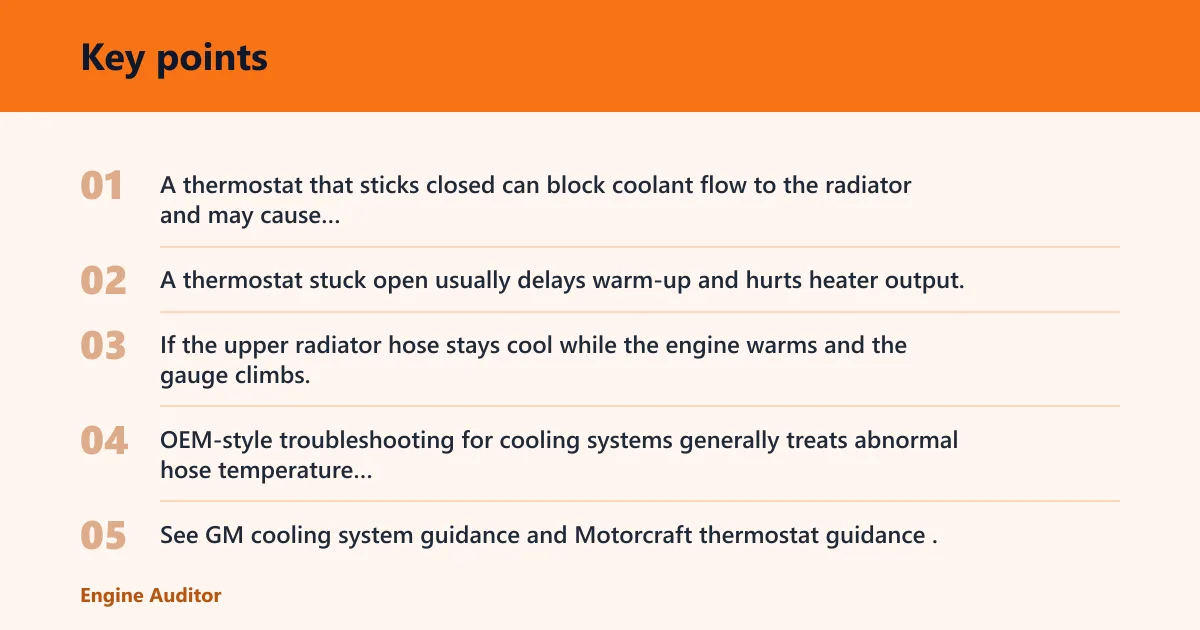
Thermostat stuck closed
A thermostat that sticks closed can block coolant flow to the radiator and may cause rapid overheating and boiling in the reservoir. A thermostat stuck open usually delays warm-up and hurts heater output, but it does not usually cause bubbling by itself.
If the upper radiator hose stays cool while the engine warms and the gauge climbs, the thermostat becomes a stronger suspect. OEM-style troubleshooting for cooling systems generally treats abnormal hose temperature split as a major clue, not a guess. See GM cooling system guidance and Motorcraft thermostat guidance.
Fan system failure
A bad fan relay, fuse, motor, or control module can let the engine boil after driving, especially in traffic or at idle. On some vehicles, the fan should run after shutdown for a short time. If the fan does not come on when hot, overflow may become more likely.
Use a scan tool if available to check fan command and coolant temperature. The gauge alone may not show the full picture.
Head gasket or combustion-gas intrusion
Combustion gases in the coolant can create steady bubbles from cold start or under load. Other signs include pressure in a cold tank, repeated coolant loss, white exhaust, and overheating. Milky oil can happen, but it is not always present, so its absence does not rule the fault out.
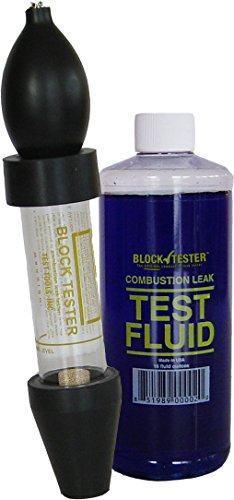
When those signs cluster, a chemical block test or compression test makes sense. Established test references note that combustion-gas detection is one of the standard ways to confirm a head-gasket-related cooling-system fault; see NAPA’s block test overview and Gates’ head gasket failure symptoms guide.
Do not drive warning signs
Do not drive if the reservoir is bubbling steadily and the gauge is climbing, if steam is coming from the engine bay, if coolant is pouring out, or if there is a strong sweet exhaust smell with rapid coolant loss. Those signs point to a fault that can turn into engine damage fast.
Short-distance driving is only reasonable when the bubbling is brief, the level is stable, and the gauge stays normal. If any of those conditions change, park it and diagnose the cause.
Why is my coolant reservoir bubbling and overflowing?
Overflow usually means the system is losing pressure, boiling early, or both. A weak cap can vent coolant before the system should, and overheating can push fluid out even after a drive ends. Overflow after shutdown still counts as a warning sign if it repeats.
Pressure loss and early venting
When a cap cannot hold the correct pressure, the boiling point drops and the reservoir may spit coolant out the vent path. That can happen with the wrong cap, a worn seal, or a damaged tank neck. The result may look like “just overflow,” but the cause is pressure loss.
Overheating after driving or at idle
If the temperature gauge rises in traffic or at idle, the fan system may not be doing its job. If the overflow happens right after a highway run, heat soak plus a weak cap can be enough to push coolant out. Both deserve inspection.
Why overflow after shutdown can still be a warning sign
Some return flow after shutdown is normal. Repeated overflow is not. If the reservoir overflows only after shutdown, check the cap, fan behavior, and coolant level before assuming the engine is safe.
Why is my coolant reservoir bubbling after shutdown?
Brief bubbling after shutdown is often heat soak and return flow, especially on a warm engine. It becomes suspicious when it lasts too long, happens every time, or comes with coolant loss, steam, or a hot gauge. The same motion can mean very different things depending on duration.
Heat soak versus trapped air
Heat soak usually causes a short burst after the key is off. Trapped air can act the same way, but it often returns again on the next cold start and may reduce heater performance. Repeated bubbling after service points toward air bleeding, not normal expansion.
Return flow from the radiator
On some systems, coolant returns to the tank as the engine cools, and that flow can look like bubbling. If the level remains between MIN and MAX when cold, and the action stops after a short time, the system may be behaving normally.
When shutdown bubbling is normal and when it is not
Normal shutdown bubbling is brief and settles. It is not normal when the reservoir continues to bubble hard, overflows, or pushes pressure into a cold tank the next morning. That pattern points to air, cap trouble, overheating, or combustion-gas intrusion.
Frequently asked questions
Is it normal for coolant reservoir to bubble?
Yes, brief bubbling can be normal during warm-up or after shutdown, especially on systems with a pressurized degas tank. It should not be steady at idle, begin from a cold engine, or come with overheating, coolant loss, or steam.
Should my coolant reservoir bubble?
It can bubble briefly, but only in patterns tied to heat soak, return flow, or correct bleeding after service. A steady stream, rapid overflow, or pressure in a cold tank points to a problem that needs diagnosis.
Why is my coolant reservoir bubbling and overheating?
That combination raises the risk level. Overheating can make coolant boil in the reservoir, and a stuck thermostat, failed fan system, or low coolant can trigger it. If the bubbling stays steady and the gauge climbs, stop driving.
Why is my coolant tank bubbling?
The coolant tank may bubble from normal expansion, trapped air after service, a weak pressure cap, overheating, or combustion gases from a head gasket fault. Timing, temperature, and whether the engine is under load help sort those causes.
Products related to this article
Sponsored / affiliate links. As an Amazon Associate I earn from qualifying purchases. I may earn additional commission from eligible campaigns.