What Are the Signs of a Bad Water Pump?
A bad water pump usually shows up as coolant leaks, engine overheating, a whining or grinding front-end noise, or poor heater output; if the temperature needle climbs fast or coolant is pouring out, stop driving. Ignoring it can warp the head, damage the timing belt, or leave you stranded without warning. This guide groups the signs by failure mode so you can judge whether you likely have a leak, bearing problem, impeller issue, or electric pump fault.
Overheating patterns and coolant leaks
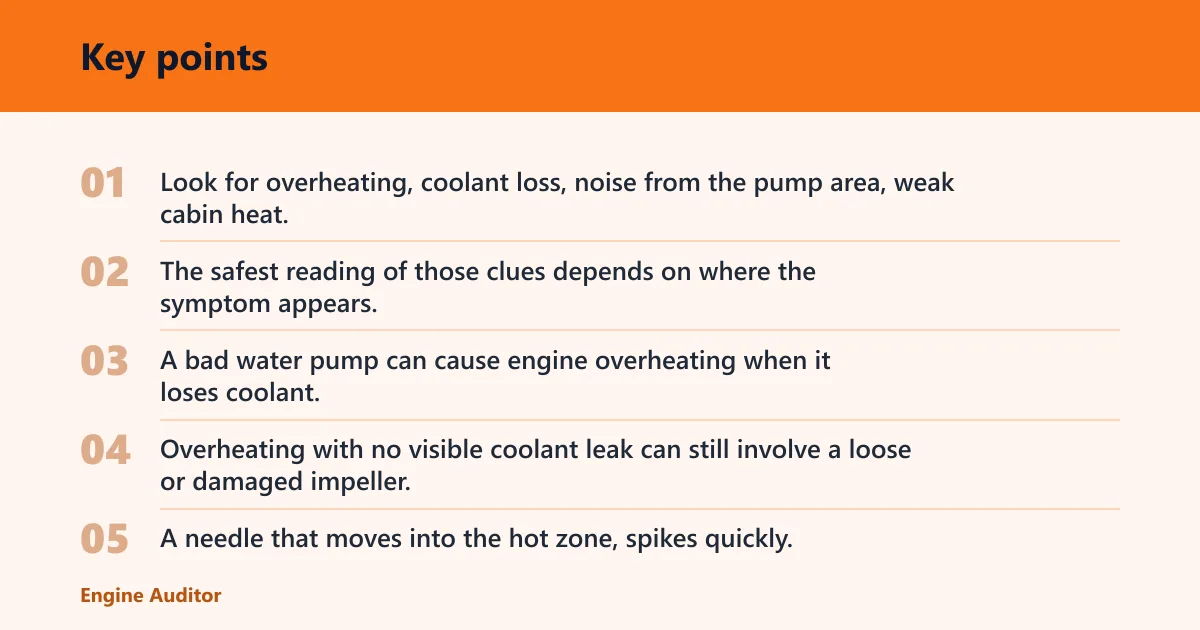

Look for overheating, coolant loss, noise from the pump area, weak cabin heat, and a temperature gauge that rises faster than normal or swings up and down. The safest reading of those clues depends on where the symptom appears, whether the pump is belt-driven or electric, and whether the problem is a leak, a bearing, or circulation loss.
Overheating patterns that point to circulation trouble
A bad water pump can cause engine overheating when it loses coolant, stops turning or cannot circulate enough coolant. Overheating with no visible coolant leak can still involve a loose or damaged impeller, so a dry engine bay does not clear the pump.
Watch the temperature gauge closely. A needle that moves into the hot zone, spikes quickly, or fluctuates during idle or stop-and-go driving needs immediate caution. Overheating at idle but not at road speed also makes radiator airflow an important check.
Say your sedan runs fine on the highway, then the gauge climbs at a long traffic light and drops again once speed returns. That pattern points more toward airflow, circulation, or control issues than a simple steady-state leak.
Coolant leak clues and where to look first
Coolant leak clues can include brightly colored fluid under the front center of the engine. That location fits the pump on many cars, but the same color fluid can also come from a hose, the radiator, the heater core, or the pump housing.
Fresh leakage is stronger evidence than an old stain alone. A leaking pump can still circulate coolant, so a small drip does not rule out overheating, and a dry pump body does not rule it out either because internal damage can remain dry outside.
Do not open a hot radiator or expansion-tank cap. Inspect the area only after the engine cools enough to work safely.
Noise, pulley play, and bearing failure
A worn pump bearing often makes whining, howling, grinding, rumbling, or squealing noises. Shaft wobble and pulley play are the next clues. If the bearing gets worse, the drive belt can slip or the bearing can seize, which may snap the belt.
Does a bad water pump make a whining noise? Yes, it can. That sound often changes with engine speed, because a belt-driven pump turns with the belt and pulley system.
Picture a compact SUV that starts squealing at cold start, then develops a rough rumble at idle. If the pulley can be rocked by hand with the engine off, the pump bearing moves from “suspect” to “strong suspect.”
Weak heater output and temperature gauge clues
A cold heater can go along with poor coolant circulation. Weak, delayed, or lukewarm cabin heat can mean the pump is not moving enough hot coolant through the heater core, though trapped air can create the same symptom.
Can a bad water pump cause a cold heater? Yes. If the heater blows lukewarm air while the engine is hot, circulation is one of the first things to check. That clue matters more when it appears together with overheating or a rising gauge.
What does a leak at the weep hole mean?
A leak at the water pump weep hole often suggests the internal seal may have failed. The weep hole is a small drain point on the pump body, and coolant there points to internal seal failure. That finding is most useful when you inspect the pump cold, before residue dries or spreads.
Why the weep hole matters
The weep hole is designed to show seal trouble before the bearing fails completely. If coolant is present there, the pump has already crossed from normal wear into a failure mode that can worsen quickly.
A leak from that point can coexist with normal circulation for a while. That is why a pump can drip, still move coolant, and still be worth replacing soon rather than waiting for a full breakdown.
Cold-engine inspection steps
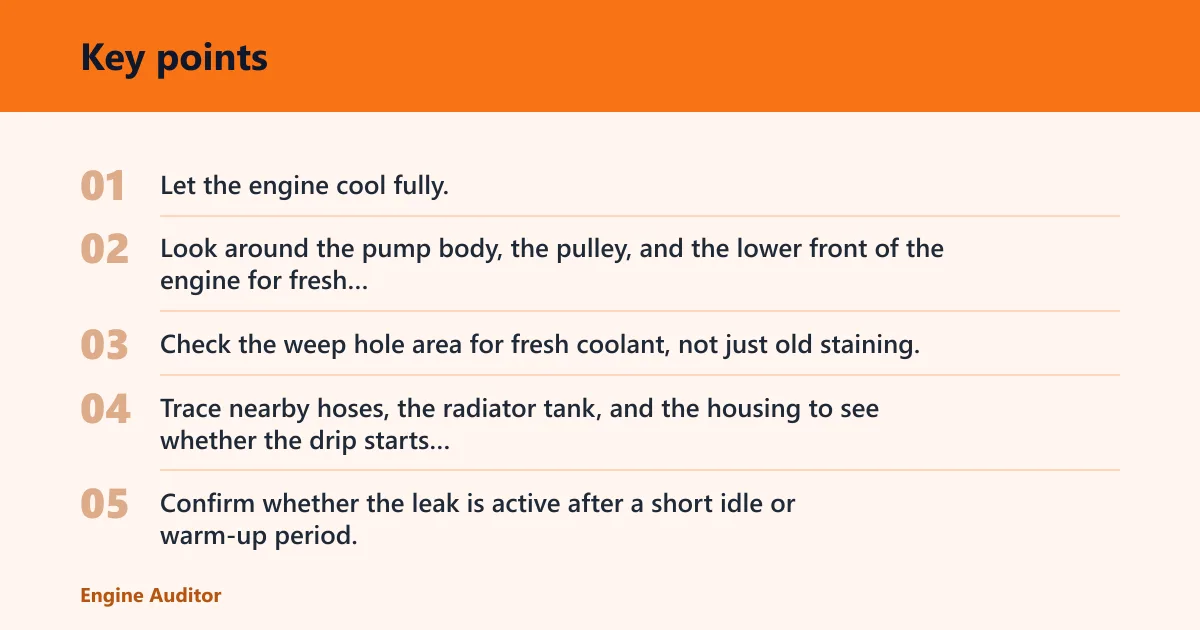
- Let the engine cool fully.
- Look around the pump body, the pulley, and the lower front of the engine for fresh wetness or crusty coolant residue.
- Check the weep hole area for fresh coolant, not just old staining.
- Trace nearby hoses, the radiator tank, and the housing to see whether the drip starts elsewhere.
- Confirm whether the leak is active after a short idle or warm-up period.
When a leak may be coming from somewhere else
Coolant pooling near the pump does not prove the pump is leaking. A hose clamp, thermostat housing, radiator seam, or heater line can drip onto the same area and mimic a pump leak.
A pressure test helps confirm the source when used to manufacturer procedure. Use the correct test procedure and pressure for the vehicle, because an incorrect setup can mislead the result.
Why is my engine overheating but I don’t see a leak?
Overheating without a visible leak can still be a water pump problem. A loose or damaged impeller can reduce flow with no external drip, and a pump with internal damage can remain dry outside. Other causes include air pockets, thermostat trouble, radiator fan problems, or an issue with the radiator cap.
Impeller damage and poor coolant flow
The impeller is the pump’s flow-moving part. If its vanes are broken, loose, or corroded, coolant flow drops even though the pump body may look dry. That can show up as overheating under load, during climbs, or during longer idling periods.
Suppose a car overheats on a steep hill but settles down on flat roads. That pattern can fit reduced flow from an impeller problem, especially if the heater output also weakens when engine load rises.
Air pockets, thermostat issues, and radiator fan clues
Air pockets can block coolant circulation and mimic pump failure. A stuck thermostat can also trap heat, and a weak radiator fan can cause overheating that is worse at idle than at speed.
How do you tell if the water pump is bad or the radiator fan is the problem? If the engine overheats mostly at idle or in traffic but improves at road speed, fan airflow moves higher on the list. If the heater is cold and the gauge rises fast under load, circulation problems move higher on the list.
How the radiator cap fits into the diagnosis
The radiator cap is a pressure-related cooling-system component, not a pump diagnosis by itself. If it cannot hold pressure, boiling protection drops and overheating symptoms can look worse than they should.
The cap can confuse the picture because its failure may mimic a circulation problem or worsen an existing one. Check it as part of the cooling system, not as proof that the pump is bad.
Whining noise or pulley wobble?
Whining, grinding, or pulley wobble points first to bearing wear. The bearing supports the pump shaft, and once it degrades, the pulley can run off-center, make noise, and eventually seize. If that happens, the drive belt can snap.
Bearing wear symptoms
Look for noise that changes with engine speed, a rough feel when the pulley turns by hand with the belt removed, or visible wobble at the pump pulley. A bearing can sound like a howl, a squeal, or a low rumble before it gets worse.
Belt slip and accessory noise lookalikes
Not every front-end noise is a water pump. A slipping belt, worn tensioner, alternator bearing, or idler pulley can sound similar. Belt glazing, dust, or a chirp at start-up can point away from the pump and toward the belt drive.
When the pump may be near seizure
A pump that gets loud, hot, and loose in the pulley area is close to failure. If the pulley feels rough or wobbly, the safest next step is to avoid extended driving and inspect before the bearing locks up.
What is the symptom-to-failure matrix
The matrix below groups common symptoms by the most likely failure mode so you can match the symptom to the safest next check. Use the urgency labels first. If the engine is already in the hot zone, treat it as stop driving now until it cools and you can inspect safely.
| Observed symptom | Likely pump failure mode | What else could mimic it | Safest next check |
|---|---|---|---|
| Coolant dripping from the pump area, especially at the weep hole | Seal failure; inspect soon | Hose, radiator seam, housing, heater line | Inspect cold, then run a pressure test to manufacturer procedure |
| Bright green, orange, red, or yellow fluid pooling under the front center of the engine | Seal leak or housing leak; inspect soon | Radiator, hose, heater core, reservoir overflow | Trace the wettest point upward from the puddle with the engine cold |
| Whining, grinding, rumbling, or squealing from the pump area | Bearing wear; inspect soon | Belt, tensioner, idler, alternator | Check for shaft wobble and pulley play with the engine off |
| Temperature gauge in the hot zone, rapid spikes, or swingy readings | Circulation fault, impeller problem, or electric control fault; stop driving now | Thermostat, radiator fan, air pocket, radiator cap | Let it cool, then check coolant level, fan operation, and stored codes |
| Overheating with no visible leak | Loose or damaged impeller; stop driving now if the gauge rises fast | Air pocket, thermostat, fan, cap, electric pump command issue | Inspect for circulation clues, then test the cooling system and scan for codes |
| Weak, delayed, or lukewarm heater output | Poor coolant circulation; inspect soon unless paired with overheating | Trapped air, low coolant, heater control problem | Bleed air only by the maker’s procedure and recheck heater output |
Belt-driven water pump rows
On a belt-driven pump, look hardest at the pulley, belt, and bearing. A bad bearing can create noise, wobble, and belt slip. A leaking seal may still allow some circulation, while a damaged impeller can create overheating with no external leak.
For belt-driven systems, pulley play and belt condition matter because the pump depends on mechanical drive from the belt. If the belt shows fresh wear or the pulley wanders, the pump area deserves priority.
Electric water pump rows
An electric water pump can fail through electrical or control faults. It may be independent of engine speed, so overheating may not follow the same pattern as a belt-driven pump.
For electric pumps, supply, ground, and command checks matter as much as the pump itself. A pump can still fail to run if the control signal is missing or the power feed is poor.
How do you confirm the diagnosis?
Confirm the diagnosis by checking the cooling system in order: look for leaks cold, test for pressure loss, scan for codes, and separate mechanical failure from airflow or control issues. Do not replace the pump until the fault path is clearer, especially on electric systems.
Pressure test basics
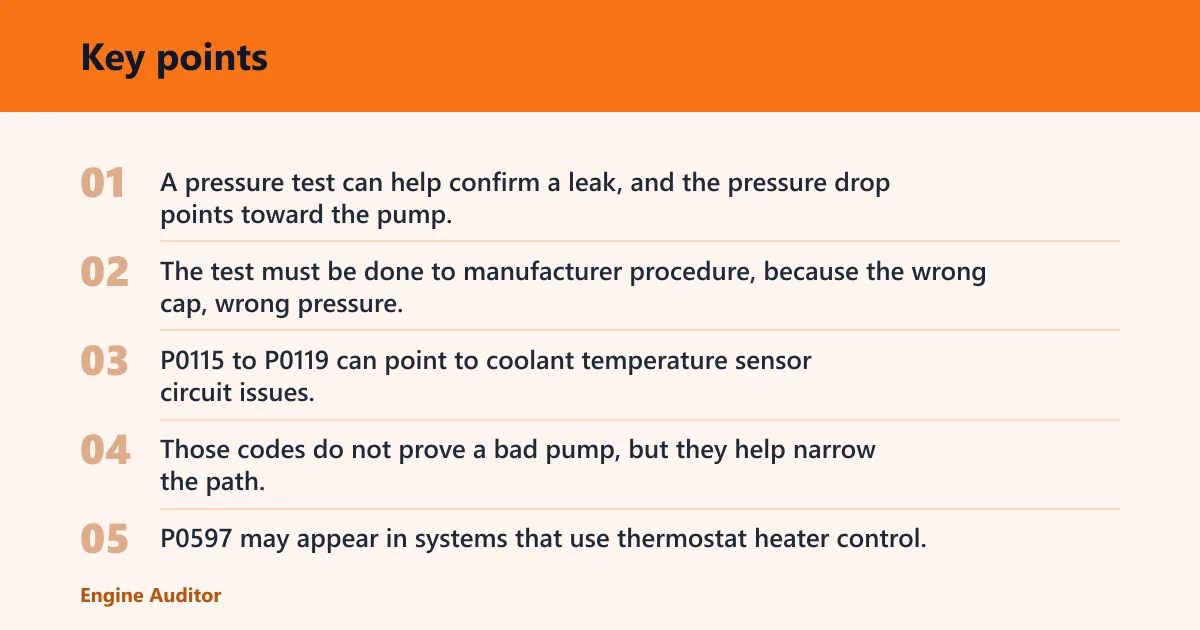
A pressure test can help confirm a leak, and the pressure drop points toward the pump, hoses, or radiator. The test must be done to manufacturer procedure, because the wrong cap, wrong pressure, or sloppy setup can mislead the result.
OBD-II codes that support the diagnosis
P0217 indicates engine overheating. P0115 to P0119 can point to coolant temperature sensor circuit issues, which may distort the gauge or the control strategy. Those codes do not prove a bad pump, but they help narrow the path.
P0597 may appear in systems that use thermostat heater control. That pushes the diagnosis toward supply, ground, command, or control-circuit checks rather than a belt or pulley search.
Supply, ground, and command checks for electric pumps
For an electric pump, verify that it has power, a solid ground, and a command signal from the control system. If those are missing, the pump may not run.
If the system commands the pump on and the pump still does not move coolant, the fault may be inside the pump or in the wiring between the controller and the pump. That distinction matters before replacing parts.
What should you do next?
If the gauge is in the hot zone or coolant is actively leaking, stop driving now. Let the engine cool, inspect cold, and confirm the source before deciding on parts. A water pump can fail by seal, bearing, impeller, or electric control, and each path points to a different next test.
When to stop driving
Stop driving if the temperature needle keeps climbing, if the engine overheats quickly, if coolant is pouring out, or if the pump bearing sounds close to seizing. A belt-driven pump that locks can damage the belt path, and continued driving can turn a repair into a larger engine problem.
When inspection can wait
Inspection can wait briefly if the engine is cool, the leak is small, and the gauge stays normal. Even then, do not ignore fresh coolant residue or a new front-end noise. Those are early signs, not a clean bill of health.
What to replace only after the fault is confirmed
Replace the pump only after the fault source is clear. If the problem is a hose, radiator, cap, air pocket, belt, or electric control fault, replacing the pump alone wastes time and may miss the real cause.
Frequently asked questions
What are the signs of a bad water pump in a car?
The main signs are overheating, coolant leaks, a whining or grinding front-end noise, weak heater output, and a temperature gauge that rises fast or swings around. The most important clue is the pattern: leak, bearing noise, or poor circulation each points to a different failure mode.
What are the first signs of a bad water pump?
The first signs are often a small coolant leak or a faint whine or squeal. A fresh stain near the pump or a new pulley noise is worth checking before the fault becomes a hot-zone event.
Can a bad water pump cause overheating?
Yes. A bad water pump can cause engine overheating when it loses coolant, stops turning, or cannot circulate enough coolant. If the gauge climbs rapidly or the engine overheats with no visible leak, suspect circulation loss, an impeller problem, or an electric control fault.
Does a bad water pump make a whining noise?
Yes. A worn water pump bearing can make whining, howling, grinding, rumbling, or squealing sounds. If you also see shaft wobble or pulley play, the bearing is a strong suspect, and a seized bearing can snap the drive belt.
Can a bad water pump cause a cold heater?
Yes. A cold heater can come from poor coolant circulation, which can happen when the pump is weak or the impeller is damaged. Trapped air can create the same symptom, so heater output should be checked alongside the temperature gauge and coolant level.
Should I keep driving if the temperature gauge goes into the hot zone?
No. Stop driving now if the gauge goes into the hot zone, if the needle climbs fast, or if coolant is leaking heavily. Let the engine cool before opening anything, and do not open a hot radiator or expansion-tank cap.
Products related to this article
Sponsored / affiliate links. As an Amazon Associate I earn from qualifying purchases. I may earn additional commission from eligible campaigns.
 FOXWELL NT301 OBD2 Scanner Live Data Professional Mechanic OBDII Diagnostic Code Reader Tool for Check Engine Light
 Car A/C Repair Kit, 270PCS Rubber O-Ring Seal Kit + 40PCS Car Air Conditioner Valve Core Kit for R12 R134a A/C with Remover & Install Tool+10pcs R134a AC Valve Caps, Fix Refrigeration System