Why Does My Radiator Fan Only Turn on When the AC Is on?
A radiator fan that only turns on with the A/C is often normal, because the A/C request can command fan operation before coolant temperature rises; if the engine also gets hot and the fan never starts, it points to a cooling-system or control fault. Ignoring the difference can lead to overheating, weak A/C, and wasted parts. This guide shows how to trace the fan-control logic step by step with an OBD scanner, a multimeter, and visual checks.
What normal fan operation looks like
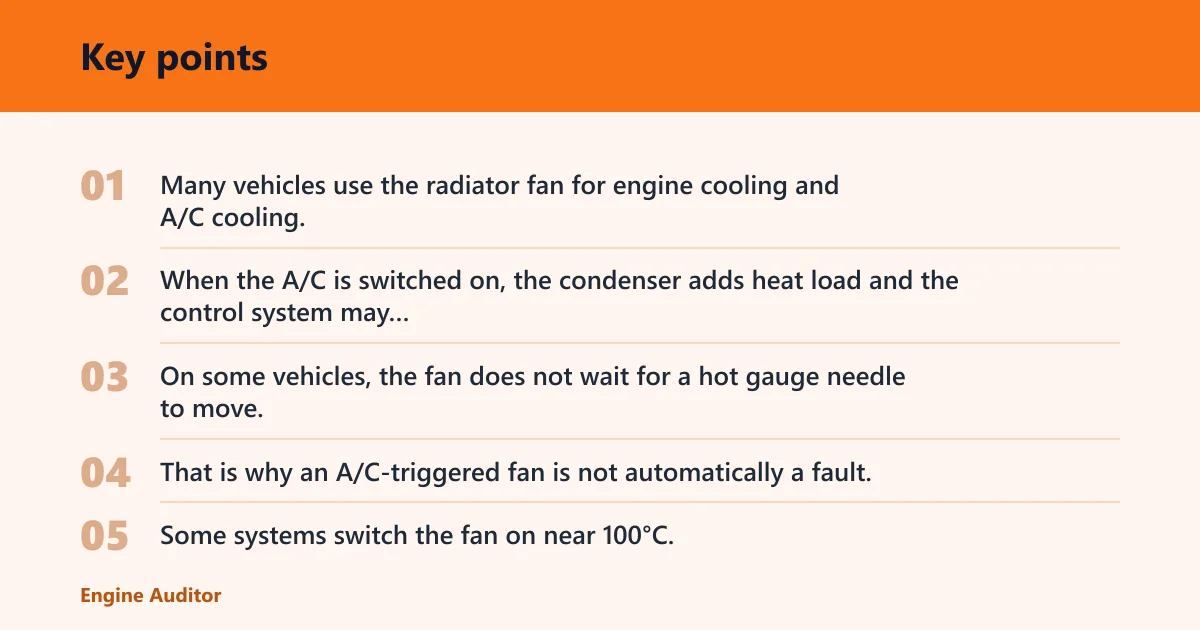


Many vehicles use the radiator fan for engine cooling and A/C cooling. When the A/C is switched on, the condenser adds heat load and the control system may command the fan immediately. On some vehicles, the fan does not wait for a hot gauge needle to move.
That is why an A/C-triggered fan is not automatically a fault. Some systems switch the fan on near 100°C, while others verify fan operation at approximately 105°C. Some manufacturers also allow the fan to continue for 10–15 minutes after shutdown, and some diesel applications permit approximately 16 minutes of post-shutdown fan operation.
Electric fan versus mechanical fan
An electric radiator fan is controlled by relays, a module, or the ECU/PCM. A mechanical fan is driven by the engine, often through a clutch, and reacts to underhood temperature in a different way. If your vehicle has a mechanical fan clutch, the A/C can still affect fan behavior, but the diagnosis path is not the same.
That distinction matters. A mechanical fan problem usually points to clutch slip, belt issues, or airflow obstruction. An electric fan problem can sit anywhere in the command path: sensor input, ECU command, relay, module, wiring, ground, or the fan motor itself.
Single-speed, two-speed, and PWM control
Single-speed fans are simple. The relay closes, the fan gets full voltage, and it runs at one speed. Two-speed systems use different circuits or resistors to switch between low and high speed. PWM systems vary fan speed by pulsing power through a control module, so the fan may run quietly at low load and ramp up under higher load.
That means the same symptom can have different causes. A fan that works only in A/C mode may be missing one command path, one speed circuit, or the module input that tells it to react to engine temperature.
Fan only runs with A/C: 5-minute diagnosis map
| Symptom | Likely control path | Quick test | Next suspect |
|---|---|---|---|
| Fan runs only with A/C on | A/C request is commanding the fan, but engine-temperature command is missing | Turn A/C off, let engine reach normal operating temperature, and watch live coolant temperature on the scanner | Coolant temperature sensor, ECU/PCM input, relay, wiring, or module |
| Fan never runs with A/C off, but engine overheats | Temperature-based command is absent or the fan cannot move air under load | Check coolant level cold, scan for codes, then force the fan command if the scan tool supports it | Sensor signal, relay, fan motor, fuse, wiring, thermostat, or low coolant |
| Fan runs at startup | Fail-safe command, shorted signal, stuck relay, or A/C-related request on some models | Start with A/C off and compare the behavior to key-on engine-off live data | Coolant temperature sensor, wiring fault, relay contacts, or ECU/PCM fail-safe logic |
| Fan stays on after shutdown | Post-shutdown cooling strategy, or relay/module stuck supplying power | Wait the full cool-down period, then pull the relay or check for battery voltage at the fan feed | Stuck relay, fan control module, or ECU command that never ended |
Why does the fan only work with A/C?
The most common reason is that the A/C request is the only command path still working. The condenser adds heat load, so the controller turns the fan on to support refrigerant and condenser cooling. If the fan behaves correctly with A/C but not with engine heat, the problem is often in the temperature-based control path, not the fan motor.
A/C request as the command path
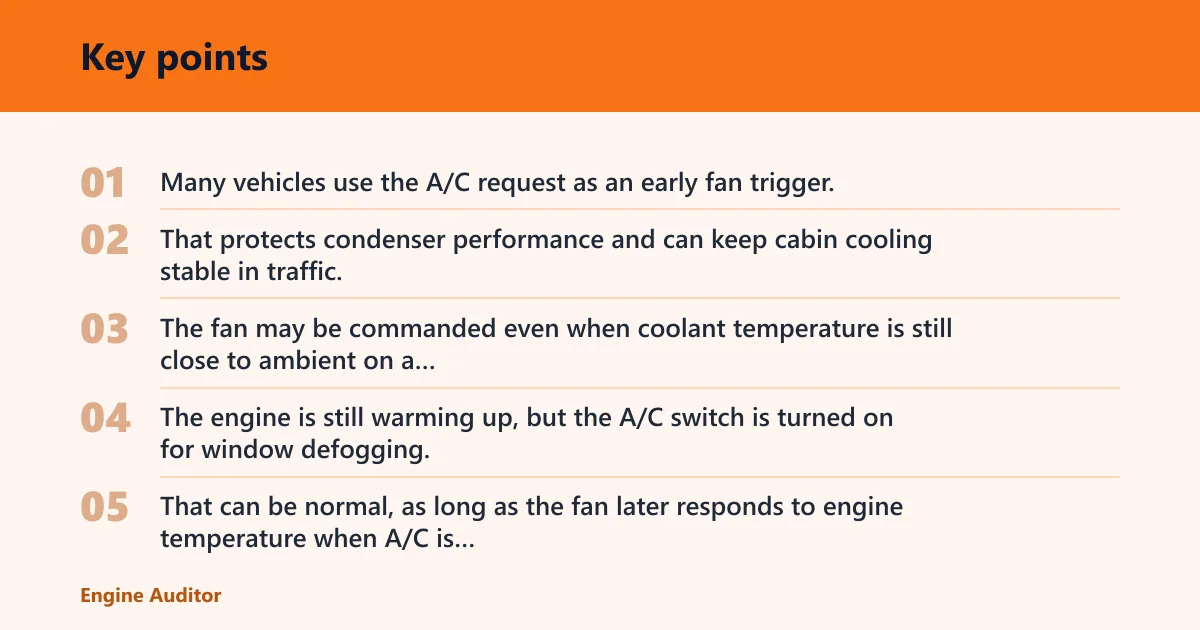
Many vehicles use the A/C request as an early fan trigger. That protects condenser performance and can keep cabin cooling stable in traffic. The fan may be commanded even when coolant temperature is still close to ambient on a cold vehicle, which is why a cold-vehicle coolant reading may be expected to be close to ambient temperature.
Picture a compact car on a cool morning. The engine is still warming up, but the A/C switch is turned on for window defogging. The fan starts right away. That can be normal, as long as the fan later responds to engine temperature when A/C is off.
Condenser heat load and refrigerant pressure input
Some systems also use refrigerant pressure as part of fan control. High A/C pressure can raise fan demand even when coolant temperature is not high. That is why the fan may sound like it is “working with the A/C” instead of with the radiator.
If the fan only runs in that condition, the control logic may be doing exactly what it was designed to do. The key question is whether it also responds to engine temperature, because the cooling fan should not be tied to A/C alone on most vehicles.
When this points to control logic rather than a bad motor
If the fan runs strongly with A/C on, the motor, power feed, and at least one control path are alive. That shifts attention to the engine-temperature command path. A fault in the coolant temperature sensor, ECU/PCM input, or fan control module can leave the A/C request as the only working trigger.
Could a bad sensor or module cause this?
Yes. A bad coolant temperature sensor can make the fan work only with A/C, or make the ECU keep the fan active as a fail-safe response. The control unit relies on sensor voltage and resistance change to estimate temperature. If that signal is implausible, the system may choose a protective fan command.
Coolant temperature sensor signal faults
The coolant temperature sensor reports engine temperature to the ECU or PCM. On a cold engine, a live-data reading that is far from ambient, or one that does not change as the engine warms, is a red flag. One manufacturer diagnostic procedure uses a difference of no more than ±2°C for a cold-check comparison.
That does not mean the sensor is guilty by itself. Wiring damage, corrosion at the connector, or an open or short in the circuit can create the same bad reading. The sensor and its wiring need to be checked together.
ECU or PCM fail-safe fan command
Some systems switch the fan on when the signal is missing or unreasonable. That fail-safe strategy can protect the engine from overheating, but it can also make the fan behavior look random. If the ECU sees a temperature value that makes no sense, it may command the fan on continuously or at odd times.
That is why an OBD scanner matters. Live data can show whether the engine temperature input is believable, while stored codes can point toward a sensor circuit, a control circuit, or a module issue.
Fan control module and reference-voltage checks
Some vehicles use a separate fan control module instead of switching the fan directly through the ECU. In those systems, the module may receive a reference voltage, ground, and command signal. If the reference voltage is missing or unstable, the module may default to the wrong fan state.
Check the connector pins for corrosion, pushed-back terminals, heat damage, and broken locks. A module fault is more plausible when the fan works in one mode but not another, especially if the motor and relay checks pass.
Could a relay or wiring fault be the cause?
Yes. A stuck relay can keep supplying electricity after the ECU stops commanding it, and that can make the fan ignore engine temperature or stay on too long. Wiring faults can do the opposite and block the fan from working when the temperature signal should turn it on.
Stuck relay contacts
A relay with welded or stuck contacts can feed the fan whenever the circuit has power. In some cases, the fan may run with ignition on, with A/C on, or even after the control side is no longer requesting it. That is one of the most common electrical causes to check early.
A simple bench check can help. Compare continuity across the switched contacts with the relay removed. If the contacts stay closed without coil power, the relay is bad. If the relay clicks but the fan still does not run when commanded, the fault may be downstream in the power or ground path.
Power, ground, and connector checks
Start with the basics: fuse, relay socket, power feed, ground point, and fan connector. A fan that works in one operating mode but not another can still have a loose ground or a heat-damaged terminal that fails under higher current. That is common on systems that switch to high speed when coolant temperature climbs.
Use a multimeter to check battery voltage at the fan feed and voltage drop on the ground side while the fan is commanded on. If voltage is present at the connector but the fan does not spin, the fan motor may be bad. If voltage never reaches the connector, the fault is upstream.
Quick continuity and voltage tests
- Inspect the fan fuse and relay first.
- Check the relay socket for battery voltage and a solid ground.
- Command the fan with the scanner if the tool supports output tests.
- Measure voltage at the fan connector while the fan should be on.
- Check continuity through the power and ground circuits if voltage is missing.
Can low coolant or a thermostat fault mimic this?
Yes. Low coolant can reduce heat transfer, and a thermostat fault can make the engine run hotter than expected or take too long to warm up. Either problem can make the fan appear to be the issue when the real cause is poor coolant circulation or a leak.
Cold checks for coolant level in reservoir and radiator
Check the reservoir and radiator level cold. A low reservoir may point to a leak, but the radiator itself also has to be full on systems that allow a radiator cap check. Low coolant can create overheating that seems like a fan-control fault, especially if the fan starts only after the A/C is switched on.
Never judge level from a hot system. A cold check gives the only useful baseline. If the coolant is low, find the leak before replacing the fan or sensor.
Leak clues that change fan behavior
A small leak can create inconsistent fan behavior because the temperature reading may climb quickly when coolant is low, then fall after air moves through the system. Look for dried residue at hose joints, wet spots under the vehicle, and a sweet smell around the engine bay. Those clues point away from the fan motor and toward the cooling system itself.
Stuck-open versus stuck-closed thermostat symptoms
A stuck-closed thermostat can cause overheating and may cause the fan to run more often. A stuck-open thermostat can delay warm-up, which may keep the engine below the temperature where the fan would normally be commanded on. If the fan seems temperature-related, the thermostat deserves attention before more parts are ordered.
Using a scanner to confirm the fault
An OBD scanner is the fastest way to separate a sensor or control problem from a true fan failure. Read codes, check live coolant temperature, and compare that data to the engine’s actual operating state. That helps confirm whether the ECU is seeing a believable signal.
Codes that point to sensor, circuit, or control faults
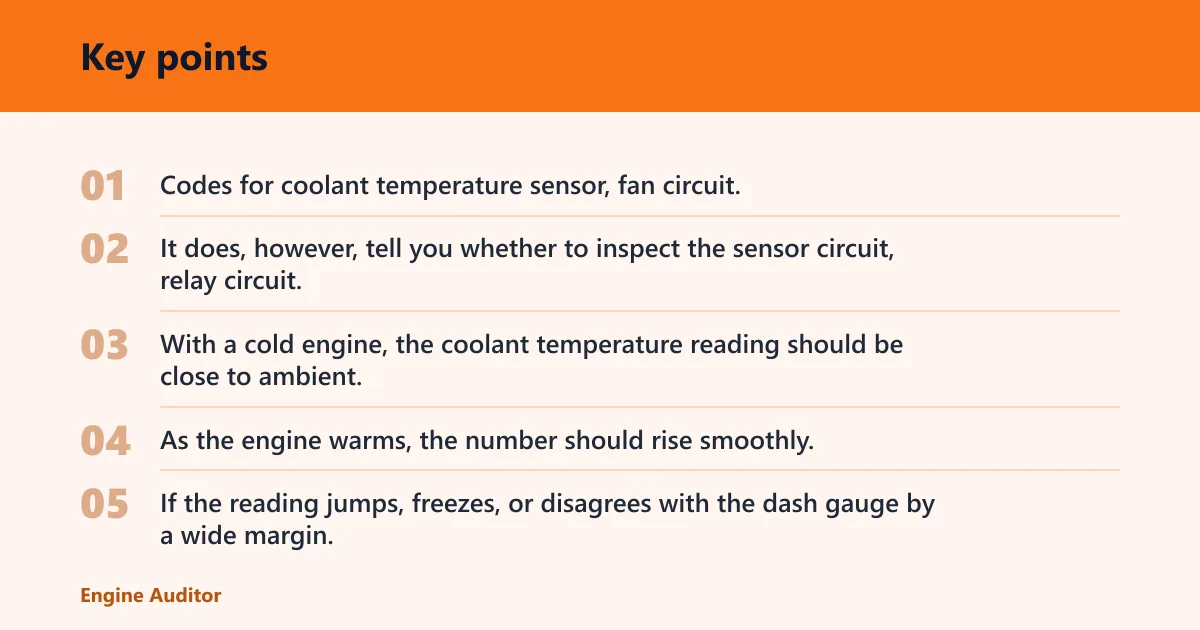
Codes for coolant temperature sensor, fan circuit, or fan control performance point you toward the right branch of the diagnosis. A code alone does not prove the part is bad. It does, however, tell you whether to inspect the sensor circuit, relay circuit, or controller first.
Live data that helps confirm engine temperature input
With a cold engine, the coolant temperature reading should be close to ambient. As the engine warms, the number should rise smoothly. If the reading jumps, freezes, or disagrees with the dash gauge by a wide margin, suspect the sensor, wiring, or module input before replacing the fan.
When to stop at diagnosis and refer out
If the scan tool shows a believable temperature, the relays test good, the wiring checks pass, and the fan still misbehaves, the fault may sit inside the PCM, fan module, or an intermittent harness issue that needs deeper diagnosis. At that point, professional testing is the safer next step than replacing parts blindly.
Suppose the fan runs every time the A/C is on, but the engine reaches normal temperature with the A/C off and the scanner shows steady coolant data. That points away from the motor and toward normal A/C-commanded fan operation. The same car would need deeper work only if the fan fails to come on when temperature rises or codes appear.
Frequently asked questions
Why does my radiator fan only turn on when the AC is on?
Because many vehicles command the fan when the A/C is requested. The condenser adds heat load, so the fan can start before coolant temperature rises. If the fan never responds to engine heat with the A/C off, the likely problem is in the temperature-sensing or control side, not necessarily the fan motor.
Is it normal for the radiator fan to run with the air conditioner on?
Yes, that is often normal. The A/C system can trigger the fan to help cool the condenser and control refrigerant pressure. What matters is whether the fan also responds when the engine gets hot without A/C. If it does not, the fan-control path needs diagnosis.
Could a bad coolant temperature sensor make the fan work only with AC?
Yes. A bad coolant temperature sensor can send an implausible signal and make the ECU use fail-safe fan behavior. The fan may still run with A/C because that command path bypasses the bad engine-temperature input. A scanner and cold live-data check can confirm whether the sensor reading is believable.
Could a stuck relay cause the fan to ignore engine temperature?
Yes. A stuck fan relay can keep supplying power after the ECU stops commanding it, so the fan may run at the wrong time or stay on too long. If the relay contacts are welded or the socket is damaged, the fan can ignore temperature-based control even when the sensor is fine.
How do I tell if the fan motor is bad or the control system is the problem?
If the fan runs strongly when A/C is on, the motor and at least part of the power circuit are likely working. If the fan will not run on command from the scanner, check relay, fuse, wiring, ground, and module inputs before condemning the motor. A direct power test helps separate motor failure from control failure.
What should I check first before replacing the radiator fan?
Check coolant level cold, scan for codes, verify live coolant temperature, inspect the relay and fuse, and look over connectors and grounds. Then confirm whether the fan works in A/C mode and engine-heat mode. That sequence catches the common faults without replacing the fan before the actual cause is known.
Products related to this article
Sponsored / affiliate links. As an Amazon Associate I earn from qualifying purchases. I may earn additional commission from eligible campaigns.