How Do I Know If My Radiator Fan Motor Is Bad?
A radiator fan motor is bad only if it will not spin when battery power and ground are applied directly; if it runs then the fault is elsewhere. Ignoring the wrong part can leave you with overheating, weak A/C, and repeat repairs. This guide shows the symptoms, the fuse-relay-wiring checks, and a simple pass/fail test to isolate the motor.
Radiator fan failure signs


The radiator cooling fan pulls air through the radiator and A/C condenser when road speed is too low for natural airflow. That matters most in traffic, at idle, and after heat soak. A failing fan often shows up first as a slowly rising temperature gauge, not an instant warning light.
Temperature gauge behavior at idle and in traffic
If the gauge climbs toward the hot or red zone at stoplights, then drops again once the car starts moving, fan airflow deserves attention. That pattern points toward a cooling problem that shows up when the vehicle is not moving fast. A bad fan can cause overheating at idle or in slow traffic, where the engine depends on fan pull instead of road speed.
Do not stop at the gauge alone. The same pattern can come from a fuse, relay, wiring fault, or ECM/ECU command issue that keeps the fan off when it should run. The key question is whether the fan is being told to turn on.
Weak A/C at a stop
Weak A/C at idle can point to fan airflow issues because the condenser depends on air moving across it. If the A/C feels warmer while sitting still and improves once you start rolling, the fan circuit moves higher on the list. That symptom often appears before a complete no-fan failure.
Noise, intermittent operation, and visible blade issues
A bad radiator fan motor may make a grinding or whirring noise, and a working fan should create a noticeable whirring or humming sound. A loud noise from the engine compartment can also be a failure symptom. But noise can also come from blades touching the shroud or debris rubbing the fan.
Inspect the fan blades and shroud for cracks, warping, debris, or anything that can obstruct the blades. A fan that starts slowly, stalls, or works only sometimes often points to a weak motor, a corroded connector, or a poor ground. Intermittent problems are easy to miss unless you test at the right time.
When does the fan matter most?
The fan matters most after warm-up, at idle, in stop-and-go traffic, and after heat soak. Those are the moments when there is little natural airflow through the radiator and condenser. If symptoms disappear once road speed increases, the fan circuit becomes more suspect, not less.
Idle and stop-and-go driving
At low speed, the fan has to do more of the airflow work. That is why overheating often shows first at stoplights or in traffic. Lodi Shell warns that overheating at stoplights can become expensive engine damage, so this is not a symptom to ignore.
After warm-up and heat soak
Many systems command the fan on only after coolant temperature rises. A failing fan may first show as a slowly rising temperature gauge after the engine is fully warm. After heat soak, the engine bay stays hot even after shutdown, so a weak motor or bad control path may fail more clearly.
Picture a sedan that idles fine for 20 minutes, then the gauge creeps up while waiting in a drive-thru. The same car cools down as soon as it reaches 35 mph. That pattern fits a fan issue better than a constant mechanical overheat.
Radiator fan decision table
| Symptom | Likely cause | Quick check | Pass result | Fail result | Next step |
|---|---|---|---|---|---|
| Idle overheating | Fan not running, weak airflow, or command fault | Let engine reach operating temperature and watch for fan command | Fan turns on and gauge stabilizes | Fan stays off while gauge rises | Check fuse, relay, wiring, then motor power and ground |
| Weak A/C at a stop | Fan airflow issue or condenser blockage | Run A/C with vehicle stopped and look for fan operation | Fan runs and A/C improves | Fan does not run or airflow is weak | Inspect blades, shroud, and circuit control |
| Silent fan | Blown fuse, bad relay, bad motor, bad command, or open wiring | Check for command and power at the connector | Voltage and ground are present | No voltage, no ground, or no command | Trace upstream before replacing the motor |
| Noisy fan | Worn bearings, rubbing blade, or shroud contact | Inspect fan blades, shroud, and debris | No contact and noise remains with motor movement | Visible rubbing, damage, or rough bearing sound | Replace damaged parts or the motor if bearings are rough |
| Intermittent fan | Corroded connector, loose terminal, weak ground, or failing motor | Wiggle-test connector and check voltage drop or continuity | Stable power and ground under load | Fan cuts in and out | Repair connector or ground before buying a motor |
| Blown fuse | Shorted motor, wiring fault, or seized fan | Inspect fuse and confirm correct amperage rating | Fuse is intact and correct | Fuse is open or wrong rating | Fix the short or binding issue before replacing the fuse again |
| Bad relay | Relay stuck open or stuck closed | Swap with a known good relay or test command | Fan responds normally | Fan does not turn on or keeps running | Replace the relay and retest |
| Damaged connector | Corrosion, heat damage, or loose terminals | Inspect connector closely | Clean terminals and firm fit | Melted plastic or green corrosion | Repair connector and recheck voltage at the motor |
How do you test the fan circuit?
Start with the easiest checks and move toward the motor only after you prove the upstream path. A blown fuse is one of the most common causes of a nonworking radiator fan, and a bad fan relay can keep the fan from turning or keep it running. Do not buy a motor until power, ground, and command are verified. (Wikihow)
Fuse check and correct amperage rating
Check the fan fuse visually and with continuity if needed. The fuse must match the correct amperage rating. If it is blown again after replacement, that usually points to a shorted motor, a wiring fault, or a fan that is binding.
Relay swap or relay command check
The fan relay switches power to the motor. It can fail stuck open or stuck closed. A quick swap with a known good relay, if the relay type matches, can help separate a relay fault from a motor fault. If the fan stays dead with a known good relay, move on.
Power and ground test at the connector
Use a digital multimeter to check for DC voltage at the fan connector and verify ground when the fan should be commanded on. Then check ground and, with the circuit unpowered, use continuity or resistance checks as directed by the service information. Safe ohms testing belongs on unpowered circuits only.
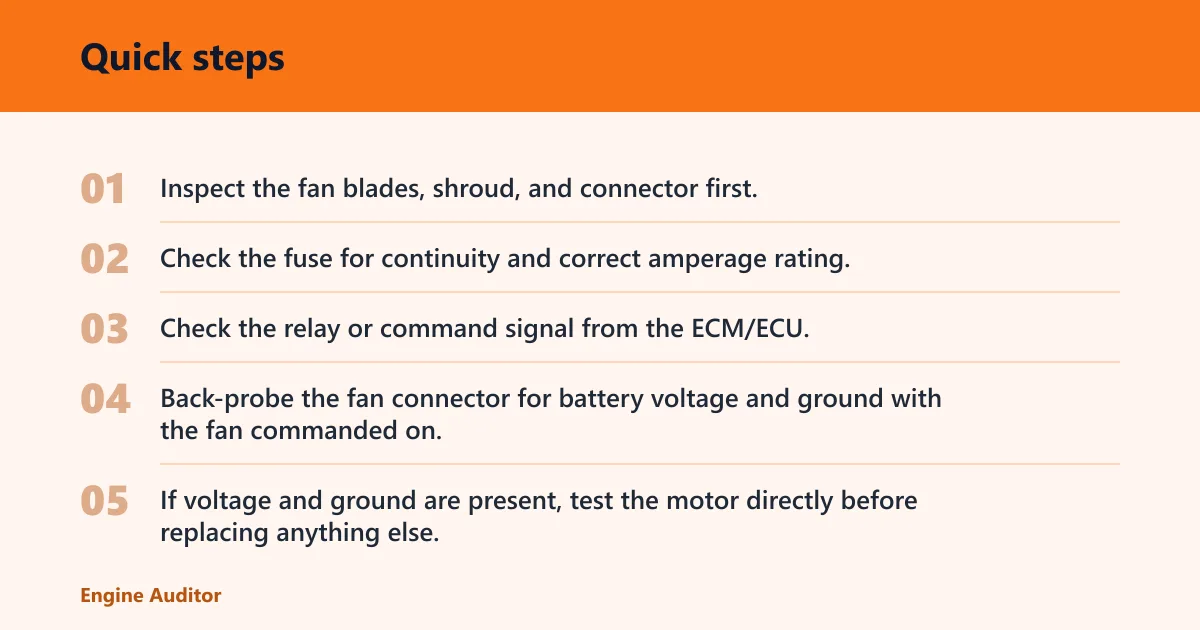
- Inspect the fan blades, shroud, and connector first.
- Check the fuse for continuity and correct amperage rating.
- Check the relay or command signal from the ECM/ECU.
- Back-probe the fan connector for battery voltage and ground with the fan commanded on.
- If voltage and ground are present, test the motor directly before replacing anything else.
A common first-timer mistake is replacing the motor after a silent fan and a clean fuse. That skips the control side. The fan may not have received a command because of a relay fault, a faulty ECM/ECU signal, or a corroded connector.
How do you know the motor is bad?
The motor is the last part to blame after you confirm power, ground, and command. If battery power and ground are applied directly and the fan will not spin, the motor is bad. If it spins under direct power, the fault is upstream, not in the motor.
No spin with confirmed power and ground
This is the cleanest pass/fail point in the diagnosis. If the connector has the right voltage and a solid ground while the fan is commanded on, but the motor does not run, the motor has failed or is mechanically seized. That is the point where replacement makes sense.
Slow start, grinding, or whirring
Grinding noise can indicate worn or dry fan motor bearings. A rough, slow start or a fan that needs a tap to run also points toward motor wear. A rubbing sound can come from blade contact with the shroud, so inspect the plastic parts before you condemn the motor.
Intermittent operation after connector inspection
If the fan works sometimes, then dies, check the connector and harness for corrosion, loose terminals, or melted plastic. Intermittent fan operation often follows heat, vibration, or a weak ground. If those parts pass inspection and the motor still drops out, the motor remains suspect.
Suppose the connector shows battery voltage, the ground tests good, and the fan still only turns after a light tap on the housing. That is a strong clue that the motor bearings or internal commutation are failing, not the fuse or relay.
What else can stop the fan?
Several upstream faults can stop a good fan motor from running. The ECM/ECU may not command the fan because of a sensor issue or control fault. A corroded wire loom, damaged connector, or weak ground can break the circuit even when the motor itself is fine.
ECM/ECU command problems
The ECM/ECU commands fan operation based on sensor inputs. If the scan tool shows coolant-temperature or fan-control faults, that points to the control side. A fan that never receives a command is not a bad motor, even if the symptom looks the same from the driver’s seat.
Corroded wiring harness and damaged connector
Look for corrosion, loose terminals, melted plastic, or broken wires at the connector and harness. Heat can harden the plastic around the fan plug. A poor connection can mimic a dead motor, and it often fails intermittently before it fails completely.
Fan shroud, blade, or debris interference
Physical interference can slow the fan or create noise. Check for cracked blades, warped shrouds, or leaves and debris caught near the fan path. A motor may still be good while airflow is blocked or the blades are touching the housing.
Cooling fan replacement checks
Confirm the motor before buying parts. Lodi Shell advises inspecting the fan, shroud, wiring, fuse, and relay before replacing the motor. That order saves time and avoids replacing a part that was never the problem. A nonworking fan with unverified power and ground is still an unknown, not a motor failure.
Check the A/C condenser airflow path
Because the fan pulls air through the radiator and A/C condenser, blockage in that path can cause weak A/C at idle and higher temperatures in traffic. Make sure the condenser face is not packed with debris and the fan shroud is intact. Air has to move through the whole stack.
Use a multimeter safely on unpowered circuits
A digital multimeter helps with DC voltage, continuity, and resistance checks. Use voltage tests on an energized circuit only when the fan should be on. Use ohms and continuity on unpowered circuits only. That keeps the test meaningful and avoids chasing false readings.
Do not buy a fan motor because a temperature gauge rises once or a relay clicks. Prove the power path first. If the fuse, relay, wiring, connector, command, and ground all check out, then the motor is the right part to replace.
Frequently asked questions
How do I know if my radiator fan motor is bad?
A radiator fan motor is bad if it receives proper battery power and ground at the connector, or direct power on a bench test, and still will not spin. If it runs under direct power, the problem is upstream in the fuse, relay, wiring, control signal, or ground path.
Can a bad fan motor make my car overheat at idle?
Yes. A failing fan can cause overheating at idle or in traffic because the fan is supposed to pull air through the radiator when road speed is low. A rising temperature gauge at stoplights that improves once the car moves is a common clue.
Could a fuse or relay be causing the fan not to turn on?
Yes. A blown fuse is one of the most common causes of a nonworking radiator fan, and a bad fan relay can keep the fan from turning or keep it running. Check those before blaming the motor, especially if the fan never receives power.
Is it safe to drive if the radiator fan is not working?
It is risky. If the engine is overheating, stop driving and get it checked, because damage can happen quickly. If the gauge climbs at idle or in traffic, keep trips short and avoid heavy loads until the fan problem is diagnosed and fixed.
How do I test a radiator fan before replacing it?
Watch for fan operation after warm-up, at idle, with the A/C on, and after heat soak. Then check the fuse, relay, and power and ground at the connector with a digital multimeter. If power and ground are good and the fan still will not run, the motor is the likely failure.
Products related to this article
Sponsored / affiliate links. As an Amazon Associate I earn from qualifying purchases. I may earn additional commission from eligible campaigns.