Why Do I Hear a Whooshing Sound After Turning Off the Car?
Most brief whooshing noises after shutdown are normal if they fade within 30–60 seconds. Common causes include cooling fans, A/C pressure equalization, or turbo after-flow. A loud, lasting, or hot-engine whoosh can signal overheating or a leak. Ignore it, and you can miss a cooling fault that cooks hoses, warps parts, or damages the engine. This guide shows how to tell normal run-on air movement from a problem, starting with the easiest checks.
Sound decision table

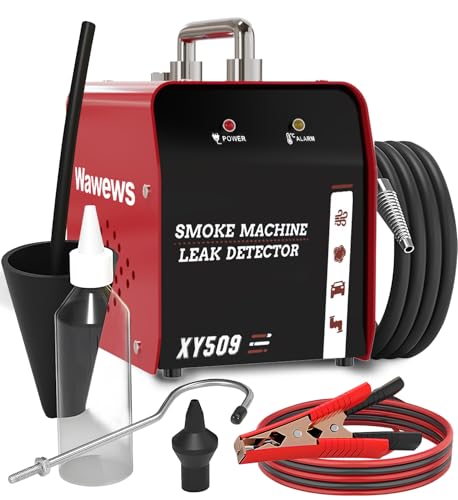
- Helps detect leaks in many vehicle systems
- Includes an adjustable pressure gauge and flow meter
- Offers dual mode with a built-in air pump
| Sound description | When it happens | Likely source | Urgency | First check |
|---|---|---|---|---|
| Brief fan-like whoosh that fades on its own | Right after shutdown, often after idling or slow traffic | Cooling fan run-on from engine heat soak | Low if it stops within a short time | Look and listen for the radiator fan to stop within about 30–60 seconds after shutdown. |
| Soft hiss or whoosh from the dash or vents | After key-off, especially with automatic climate control | A/C pressure equalization or HVAC door movement | Low if brief and not repeated | Check whether the sound comes from the cabin, not the engine bay |
| Whistle or whoosh after boosted driving | After hard acceleration or highway pulls | Turbo spool-down or heat-related air movement | Low if short and only after boost | Confirm the sound is brief and tied to turbocharged operation |
| Hissing whoosh that repeats or lasts with engine running | At idle or while driving, not only after shutdown | Vacuum leak in intake hoses or vacuum lines | Medium | Listen with the engine running and inspect hoses near the intake |
| Whoosh with coolant smell, low level, or damp residue | After shutdown or after a hot drive | Coolant leak at hoses, clamps, radiator, or water pump | High | Check the coolant reservoir level and look for visible leaks |
| Loud pressure-release sound with rising temperature or steam | After overheating or during a hot shutdown | Overheating-related pressure release, possibly thermostat or water pump failure | Urgent | Stop driving, check the temperature warning light, and inspect coolant level only after the engine cools |
Is a brief whoosh after shutdown normal?
A brief whoosh after shutdown is often normal if it lasts only seconds and fades quickly. Usual causes include a cooling fan running on, A/C pressure equalizing, or a turbo cooling down after boost. If the sound is short and the temperature gauge stayed normal, the odds favor a normal run-on noise rather than a fault.
How long the sound should last?
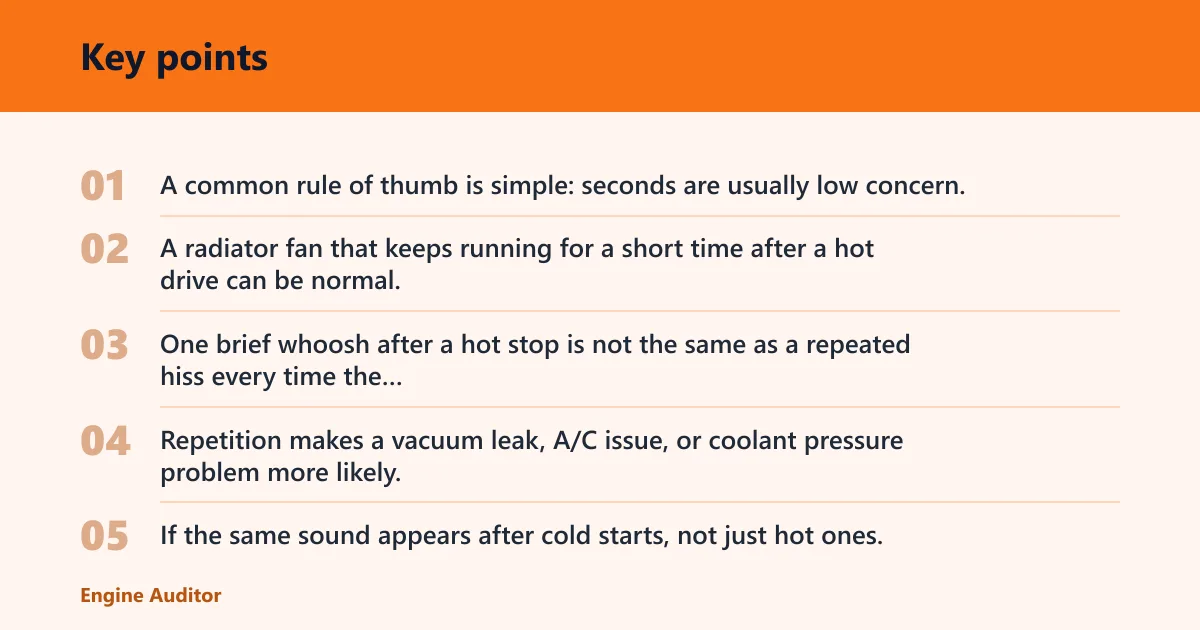
A common rule of thumb is simple: seconds are usually low concern, while repeated or lingering noise deserves attention. A radiator fan that keeps running for a short time after a hot drive can be normal, but a sound that continues well past a minute, grows louder, or returns every shutdown needs inspection.
When repetition changes the diagnosis
One brief whoosh after a hot stop is not the same as a repeated hiss every time the engine shuts off. Repetition makes a vacuum leak, A/C issue, or coolant pressure problem more likely. If the same sound appears after cold starts, not just hot ones, that points away from normal heat soak.
Say your sedan pulls into a parking spot after a 20-minute city drive, and a soft fan-like whoosh lasts about 25 seconds. That fits normal cooling-fan run-on far better than a leak, especially if the gauge stayed centered and no warning light appeared.
Cooling fan and heat soak
The cooling fan can keep running after shutdown because the engine bay still holds heat. That heat soak can drive coolant temperature up for a short time even after the key is off, so the fan may stay on to move air through the radiator. It should stop within a short time.
What to check if it runs too long
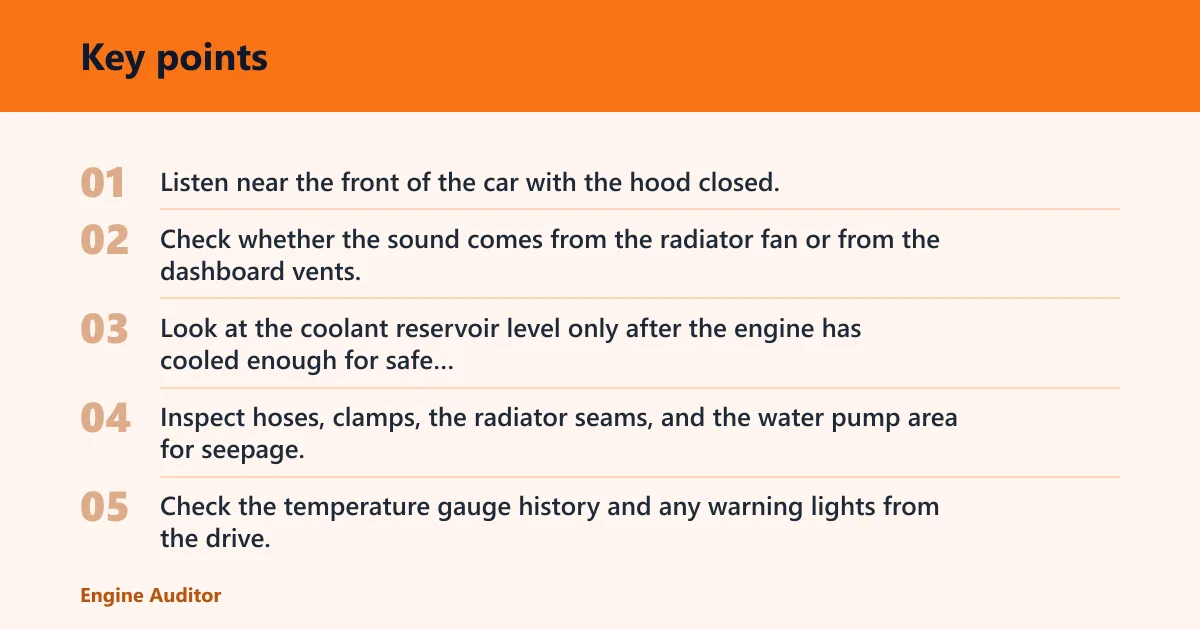
If the fan keeps running for several minutes, starts and stops repeatedly, or sounds unusually loud, inspect the cooling system. Check the coolant reservoir level, the pressure cap, and the area around hoses, clamps, the radiator, and the water pump for wet spots or crusty residue. A sweet smell or a puddle under the front of the car is a clue.
- Listen near the front of the car with the hood closed, then open the hood after shutdown if it is safe to do so.
- Check whether the sound comes from the radiator fan or from the dashboard vents.
- Look at the coolant reservoir level only after the engine has cooled enough for safe handling.
- Inspect hoses, clamps, the radiator seams, and the water pump area for seepage.
- Check the temperature gauge history and any warning lights from the drive.
If a vehicle comes off the freeway and the fan keeps whooshing for several minutes while the temperature gauge stays above normal or there is a sweet odor near the front bumper, that may point to fan run-on that is not typical and should be checked. That pattern is not normal fan run-on. It points to a cooling problem that needs prompt inspection.
Could it be the A/C system?
Yes. A short whoosh after key-off can come from A/C pressure equalization or from HVAC components moving air through the ducts. That sound often seems to come from the cabin rather than the engine bay. If the blower or vent area makes the noise, the A/C or HVAC path deserves a look before the cooling system gets blamed.
Pressure equalization after key-off
When the compressor stops, refrigerant pressure can settle with a brief hiss or whoosh. That is most likely after the A/C has been working hard on a warm day. It should be short, quiet, and not paired with hot-engine warnings or coolant loss.
Vent or blower noise after shutdown
Cars with automatic climate control may move blend doors or other HVAC doors after shutdown. That can sound like air moving behind the dash, even with the engine off. If the sound comes from the vents and not under the hood, the cabin HVAC system is a stronger suspect than the radiator fan.
Turbocharged engines: what a spool-down sounds like
Turbocharged engines can make a brief whoosh or whistle after shutdown, especially after boosted driving. That sound comes from the turbo and nearby plumbing cooling off and settling. A short, post-boost sound is often normal. A long hiss, a change in boost performance, or a sound that appears with the engine running suggests a different fault.
Post-drive whoosh after boost
After a hard pull, the turbo and intercooler plumbing can make a short air-movement sound as pressure drops. The key clue is timing: it follows boosted operation and ends quickly. If the whoosh is tied to acceleration, not to engine shutdown alone, the turbo path is a better fit than a cooling fan.
Heat-related whistling or air movement
Hot turbo parts can also make faint whistling or whooshing as they cool. That should still be brief. If the sound lasts, repeats at idle, or comes with power loss or smoke, the turbocharger or its hoses need inspection.
Could it be a coolant leak or overheating?
Yes. A coolant leak or overheating can cause a whoosh, hiss, or pressure-release sound after shutdown. That becomes much more likely if the coolant level is low, the temperature gauge moved up, the warning light came on, or steam appeared. Coolant loss plus overheating can also point to a head gasket fault.
Reservoir level and visible leaks
Check the coolant reservoir when the engine is cool enough to open safely. Low level is a warning sign, especially if the car has any sweet smell, wet hoses, or dried residue near the radiator, clamps, or water pump. Look under the car for puddles, too.
Thermostat, temperature gauge, and warning light clues
A stuck thermostat or failing water pump can block circulation and drive the engine hot. If the gauge climbed above normal, the warning light came on, or the cabin heat faded just before shutdown, do not treat the whoosh as normal. That sound may be part of a real overheating event.
Head gasket warning signs
Head gasket trouble is more likely when coolant keeps disappearing, the engine overheats again after topping up, or bubbles appear in the reservoir. White exhaust smoke, rough running, and repeated pressure in the cooling system are also clues. That combination needs prompt diagnosis, not more driving.
Cabin HVAC noises after shutdown
Some whooshing noises come from the cabin, not the engine bay. Blend doors can move after key-off, and automatic climate control systems may keep airflow paths changing for a moment. Those sounds are usually lower risk than a cooling-system fault, but you should still separate them from under-hood noise before deciding what to inspect.
Blend door movement
Blend doors and mode doors can shift after shutdown to reset HVAC positions. That can sound like a brief air sweep behind the dash. If the sound is clearly inside the cabin and not tied to engine temperature, it is more likely HVAC behavior than a coolant problem.
Automatic climate control behavior
Automatic systems may run actuators briefly after key-off. That can sound like a soft whoosh or flutter near the center stack or footwell vents. The sound should stop quickly and should not come with a hot gauge, warning light, or coolant smell.
Heater core clues
A heater core problem usually brings a sweet odor, fogged windows, damp carpet, or low coolant more than a simple one-time whoosh. If the cabin smells sweet or the windows mist up after shutdown, the HVAC path and the cooling system both deserve attention.
What should I check first if my car whooshes after I turn it off?
Start with where the sound comes from, how long it lasts, and whether the car showed heat or coolant symptoms. That three-part check sorts most cases quickly. If the sound is brief and clearly from the front of the car, it is often normal. If it is loud, repeated, or paired with overheating signs, treat it as a problem.
- Notice whether the sound comes from the engine bay or the cabin vents.
- Time how long it lasts: seconds, under a minute, or longer.
- Check whether the temperature gauge moved above normal.
- Look for a warning light, steam, or a sweet smell.
- After the engine cools, inspect the coolant reservoir and visible hose, radiator, and water pump areas.
A common mistake is assuming every whooshing sound after shutdown comes from the same part of the car. It is not. A dashboard whoosh with automatic climate control and a front-end whoosh after a hot shutdown point to different systems, so the first check should match the sound’s location.
Can I keep driving if my car whooshes after shutdown?
You can usually keep driving if the whoosh is brief, occurs only after shutdown, and there are no warning lights, steam, coolant loss, or temperature spikes. Stop driving if the sound is loud, persistent, repeated, or tied to overheating symptoms. In that case, the car may need a cooling-system inspection before the next trip.
Frequently asked questions
Why do I hear a whooshing sound after turning off the car?
Most often, a brief whoosh after shutdown comes from cooling-fan run-on, A/C pressure equalization, turbo spool-down, or HVAC door movement. The location and duration matter most. A sound from the front of the car that fades quickly is usually less concerning than one that repeats, gets louder, or comes with heat warnings.
Is a whooshing sound after shutting off the engine normal?
Yes, if it is short and fades within 30–60 seconds. That time window fits normal fan or pressure movement on many vehicles. If the sound lasts much longer, happens every time, or comes with a hot gauge or coolant smell, it needs inspection.
How long should the whooshing sound last after I shut off my car?
A normal post-shutdown whoosh usually lasts only a few seconds to under a minute. Anything persistent, repeated, or growing louder moves the diagnosis away from normal run-on noise. If it keeps going well after the car should have cooled down, check the cooling system and HVAC sources.
Could a whooshing sound after turning off the car be a coolant leak?
Yes. A coolant leak can make a hiss or whoosh, especially if it involves a hose, clamp, radiator seam, or water pump area. Low coolant level, a sweet smell, puddles, steam, or repeated overheating make that far more likely and more urgent.
Could it be the radiator fan, A/C, or turbo making the noise?
Yes. Those are common normal sources. The radiator fan usually sounds like front-end air movement after a hot stop. A/C equalization tends to sound like a brief hiss from the cabin area. Turbo spool-down usually follows boosted driving and ends quickly.
When is a whooshing sound after engine shutdown a problem?
It is a problem when it lasts too long, repeats, or comes with warning lights, steam, a rising temperature gauge, coolant loss, or a sweet smell. Those clues point toward overheating, a leak, or a circulation fault such as a thermostat or water pump issue.
Products related to this article
Sponsored / affiliate links. As an Amazon Associate I earn from qualifying purchases. I may earn additional commission from eligible campaigns.