Why Does My Car Clunk When Shifting Into Drive?
A single clunk as you shift into Drive is often parking-pawl take-up or drivetrain lash, but if it gets louder, repeats, or comes with a delay over 1 second, treat it as a fault and inspect it. Ignoring the timing pattern can hide a mount, linkage, or transmission problem until drivability worsens. This guide separates normal take-up from mount lash and delayed engagement so you can judge what is safe to watch and what needs prompt inspection.
What to check first
- Test on a slope and use the parking brake: If the clunk happens only after the vehicle has been parked on an incline, parking-pawl load may be part of the pattern. Use the parking brake before shifting into Park to reduce load on the pawl, then compare the next start-off on level ground. Owner’s manuals commonly describe this parking-brake-first habit for hill parking, and transmission references note that the pawl is what holds the vehicle in Park.
- Check fluid level and condition: Follow the vehicle-specific transmission fluid procedure in the owner’s manual or service information, because many modern units require a temperature-based check or have no dipstick. Dark, burnt-smelling, or low fluid can change engagement timing and harshness. See your model’s fluid-check procedure and service literature before adding or draining anything.
- Compare Drive versus Reverse: A delay or clunk in only one direction helps narrow whether the problem is forward-side, reverse-side, or more general hydraulic control. That does not confirm the failed part by itself, but it makes the pattern more useful.
- Check for mount movement: Watch the engine and transmission for excess movement as a helper shifts from Park to Drive with the brake held. Excess rock suggests a mount or mounting hardware issue rather than an internal transmission fault.
- Scan for transmission codes: If the symptom is new, worsening, or paired with a delay, scan for powertrain/transmission diagnostic trouble codes and related data before assuming the clunk is only mechanical.
What a clunk into Drive usually means
A clunk into Drive is often a timing clue, not a diagnosis on its own. The key question is whether the noise happens the moment you move the selector, after a pause, or only when the car has been parked on a slope. Those patterns point to different parts of the system.
Normal take-up can sound like a brief thump as slack is removed between the engine, transmission, axle, and tires. A true fault is more likely when the noise is new, getting louder, paired with a delay, or felt as a sharp kick through the floor.
Normal slope take-up versus abnormal lash
When a car sits nose-up or nose-down on a hill, weight can load the parking pawl. Releasing that load can make one clunk as the car comes off the park lock. That is why a brief sound after parking on an incline can be normal, especially if the parking brake was not used before selecting Park.
Abnormal lash is different. If the car jumps, bangs, or hits hard every time you select Drive on level ground, the movement is more likely coming from worn mounts, a drivetrain joint, or an internal transmission issue rather than slope-related park load.
Immediate clunk versus delayed bang
An immediate clunk usually points toward slack, mounts, or park-pawl take-up. A pause before the car catches Drive or Reverse changes the diagnosis and should be checked if it seems excessive. A delay longer than a second or two is not normal and deserves prompt inspection, especially if the delay ends with a clunk.
That delayed bang matters because it often means pressure is building too slowly and then arriving all at once. Low fluid can make the transmission take longer to build pressure, while worn internal parts can let the engagement come in late and harsh. Vehicle service information and transmission references consistently treat delay-plus-bang as more concerning than an isolated thunk.
Can a single clunk on a slope be normal?
Yes. One clunk when you take the car out of Park on a slope can be normal if the parking pawl was carrying the vehicle’s load. If the sound is brief, does not repeat, and the car engages immediately, that pattern is usually far less concerning than a delay or repeated thud.
Parking pawl load and why the noise happens
The parking pawl locks the transmission so the car cannot roll. If the car settles against that lock on a hill, the release can sound like a single clunk when you shift to Drive or Reverse. That is why a one-time noise after parking on an incline is not the same as a fault.
Say your sedan is parked nose-down in a driveway overnight. In the morning, it rolls slightly as you shift out of Park and gives one brief clunk, then Drive engages normally. That pattern fits slope-related take-up far better than a failing transmission.
How the parking brake can reduce it
Use the parking brake before putting the transmission in Park, especially on slopes. That holds the vehicle on the brake system instead of loading the pawl. It can reduce the clunk when you leave Park and may also make the selector feel smoother the next time you start off.
Transmission fluid checks first
Fluid should be one of the first checks because it affects engagement quality. Low transmission fluid can cause harsh engagement, and old fluid or a partly clogged filter can slow engagement. Many modern transmissions have no dipstick, so checking the level may require a specific procedure, correct fluid temperature, and sometimes a scan tool or service-filling process described in the owner’s manual or factory service information.
Low, old, or wrong fluid
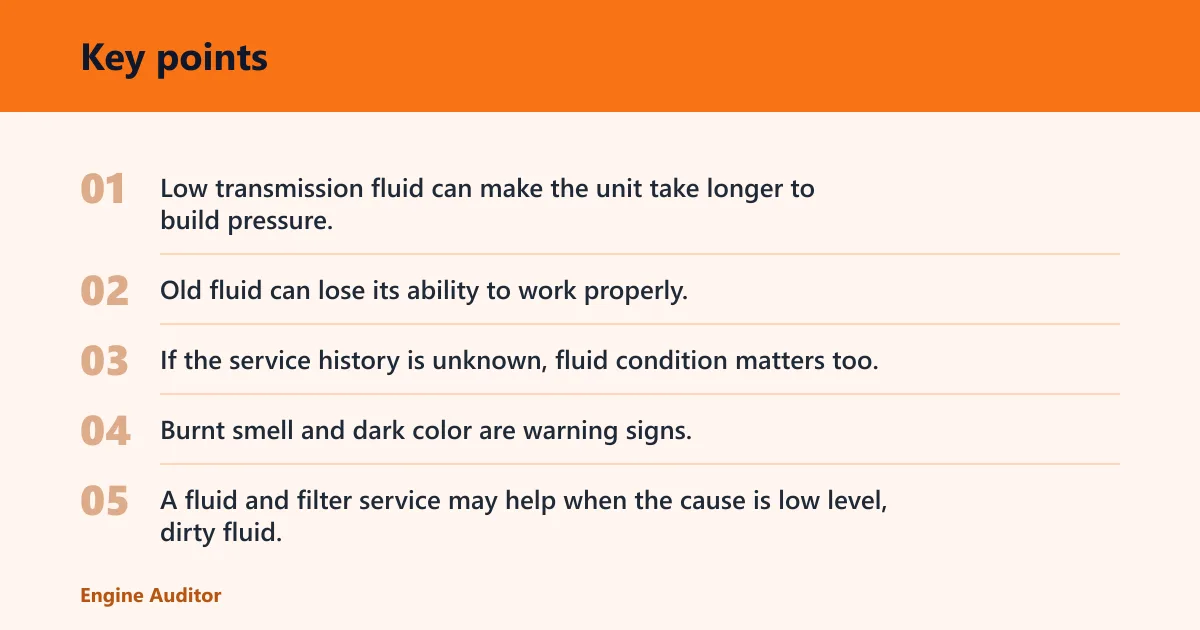
Low transmission fluid can make the unit take longer to build pressure, which can show up as a delay followed by a clunk. Old fluid can lose its ability to work properly, and the wrong fluid can change shift behavior enough to create harsh or erratic engagement.
If the service history is unknown, fluid condition matters too. Burnt smell and dark color are warning signs, especially if the symptom is new or worsening. A fluid and filter service may help when the cause is low level, dirty fluid, or a restricted filter, but it will not fix worn hard parts.
Burnt smell, dark color, and missing dipsticks
Many modern transmissions do not have a dipstick, so a quick under-hood glance may not be possible. In those cases, a proper level check may need the correct fill temperature and fill procedure outlined by the manufacturer. That is why fluid condition and service records matter more than guesswork.
Burnt odor, very dark fluid, or metal debris suggest more than a simple top-off issue. Those signs raise concern for heat, wear, or internal damage, especially if the clunk now comes with delay or slip.
Fluid and filter service limits
A service helps when the problem is caused by level, age, or a partly clogged filter. It does not correct a worn clutch pack, a stuck valve, or a damaged solenoid. If the vehicle starts with a delay that has become worse over time, a service alone may be too late to solve the root cause.
Could mounts be the source?
Yes. Worn mounts are a common non-transmission cause of a clunk into Drive. Engine mounts and transmission mounts both support weight and control movement, so cracked rubber, collapsed rubber, or loose bolts can let the drivetrain shift when load changes.
Engine mount wear and visible rubber damage
Engine mounts with split, cracked, or collapsed rubber can let the engine move when you select a gear. That movement can create a thud or clunk that feels like it comes from the front of the car. The noise may be most obvious as the engine loads against the mount.
Look for visible cracks, oil-soaked rubber, or a mount that sits lower than its pair. A mount that is visibly collapsed can let the engine rock enough to hit a stop or tug on connected parts.
Transmission mount failure and loose bolts
Transmission mounts support the gearbox weight. If a mount is broken, or if bolts are loose, the drivetrain can jump when the transmission takes up load. That can feel like a sharp kick through the floor rather than a soft thunk from the engine bay.
Competitors often stop at “check mounts,” but the mount location matters. A bad engine mount often sends the noise higher in the bay, while a bad transmission mount can feel lower and more direct under the floor.
How mount lash feels through the floor
Mount lash is usually an immediate movement problem. The car may lurch slightly when Drive engages, then settle. If the clunk happens instantly and there is no delay, mounts are more likely than internal transmission wear, especially if the symptom is the same in both Drive and Reverse.
On front-drive cars, do not ignore axle, hub, differential, splines, and joints as lash sources. These are all places where slack can develop and make a shift into gear sound harsher than expected.
Why delayed engagement changes the diagnosis
Delayed engagement is a different symptom from a simple clunk. A pause before Drive or Reverse engages, then a clunk when it finally catches, points toward hydraulic delay or internal wear. A delay that ends with a bang is more concerning than an immediate thump because it suggests the transmission is not applying cleanly and predictably.
Worse cold, worse hot, or after shifting from Reverse
Cold-morning delay can fit hardened or worn internal seals. If the symptom is worse only after the car sits overnight, that pattern is different from a mount thud that happens every time.
Heat can change the pattern too. A delay that gets worse hot can point to fluid breakdown, pressure loss, or wear that shows up after the transmission warms up. If the car is slow to engage only after moving from Reverse to Drive, that can also matter for diagnosis.
When the pattern points inside the transmission
Worn clutches can make it take longer to apply Drive or Reverse. If the delay is only in Reverse, that points toward Reverse-specific parts; if it is only in Drive, the forward side of the transmission becomes the stronger suspect.
Suppose a crossover backs out of a parking space normally, then pauses for two seconds before it catches Drive and gives one hard bang. That pattern is more concerning than a brief mount thump because it combines delay with harsh engagement.
What the valve body and solenoids can do
The valve body routes fluid to the right circuits, and sticking valves can cause harsh engagement. The pressure control solenoid helps regulate line pressure, and a fault there can contribute to delay or a bang on engagement. These parts often need scan-tool diagnosis, because their behavior is not always visible from outside.
Fluid routing and sticking valves
A sticking valve can make the transmission fill the wrong circuit too slowly or too fast. That can produce delayed engagement, a harsh shift into gear, or a repeated flare-and-catch feeling. If the symptom changes with temperature, a valve body problem stays on the list.
Pressure control solenoid checks with a scan tool
The pressure control solenoid is an electronic shift control component. It can contribute to delayed or harsh engagement, and a scan tool can help check codes, commanded pressure, and related data. That said, the scan tool is not the first step by itself; fluid condition, mounts, and symptom timing still matter first.
When service is enough and when repair is deeper
Service can help if the issue is caused by contamination, a sticky valve, or a related code with no hard-part damage. If the delay is growing, the bang is getting worse, or the symptom appears in only one gear range, the repair may need more than service. That is especially true if the transmission is slipping as well.
Car clunk decision matrix
| Symptom pattern | Likely source | Quick driveway check | Why this pattern fits | Drive / book / tow recommendation |
|---|---|---|---|---|
| Single clunk on slope | Parking pawl load or normal lash | Park on level ground and compare; use the parking brake next time | The transmission was likely loaded against the park lock, so release sounds like one brief take-up noise rather than a repeated fault | Drive if it is one brief clunk only |
| Clunk with no delay | Mount lash, axle lash, or park take-up | Check for visible mount cracks or engine movement on engagement | The gear engages immediately, so the noise is more consistent with slack or movement than with a slow hydraulic fill | Book if new or louder; drive cautiously if it is stable |
| Delay then bang | Hydraulic delay, low fluid, valve body, clutches | Note whether the pause is over 1 second or 2 seconds, and whether fluid smells burnt | The pause suggests pressure is building late, and the bang suggests the apply happens all at once instead of smoothly | Book now; tow if engagement is worsening fast |
| Worse cold | Seal wear, thick old fluid, low level | See if it improves after warm-up | Cold fluid and worn seals can slow apply timing until the unit warms up | Book soon |
| Worse hot | Fluid breakdown, pressure loss, internal wear | Check for darker fluid, burnt smell, or slipping | Heat can expose pressure loss or worn friction parts that only show up once the unit is hot | Book now |
| Only Reverse | Reverse-specific transmission parts | Compare Reverse engagement after a full stop | Only one direction misbehaving points toward the circuits and parts used for that direction | Book now |
| Only Drive | Forward-side wear or control issue | Compare Drive after Reverse-to-Drive and Park-to-Drive shifts | Only the forward side is affected, so the issue is less likely to be a general slope or park-pawl event | Book now |
| Clunk plus slipping | Internal clutches, low fluid, or major hydraulic loss | Look for flare, delay, burnt fluid, or a failure to stay engaged | Slip means the transmission is not holding apply pressure or friction capacity, which raises the urgency | Tow now |
What to do if the clunk gets worse
If the clunk is new, louder, or paired with delay, do not keep forcing the car into gear. A worsening delay should push the decision toward a prompt inspection rather than repeated testing.
Drive, book, or tow
- Drive: one brief clunk on a slope, no delay, no slip, and no change in severity.
- Book: repeated clunk on level ground, new mount noise, a delay under a second that is not worsening, or a symptom limited to one gear range.
- Tow: delay longer than a second or two, delay that is getting worse, clunk plus slipping, or a condition that leaves the car hesitant to engage.
Do not keep cycling between Park, Drive, and Reverse to see if it “catches.” That can add stress and hide the pattern you need to describe. If the delay is progressing, stop treating it as a nuisance.
Drive-only and Reverse-only clues
A delay only in Reverse can point to Reverse-specific transmission parts, and a delay only in Drive can point to the forward side of the transmission. That kind of one-sided symptom matters because it narrows the suspect list much faster than a vague clunk complaint.
What to tell a technician
Give the timing first: immediate clunk, delayed engagement, or clunk after a pause. Then say whether it is worse cold, worse hot, only in Drive, only in Reverse, or mainly after parking on a slope. Mention fluid condition if you can confirm it, and note any slipping, burnt smell, or warning lights.
Frequently asked questions
Why does my car clunk when I shift into drive?
A brief clunk can come from parking-pawl take-up or drivetrain lash, but a new or louder clunk can also point to mounts, axle play, or delayed transmission engagement. The timing matters most: immediate engagement points one way, while a pause followed by a bang points more toward a hydraulic or internal transmission fault.
Why does my car make a noise when I shift to drive?
Noise on the shift to Drive can come from worn engine mounts, bad transmission mounts, slack in the driveline, or a transmission that is taking too long to engage. If the noise is only one brief thump on a slope, that can be normal. If it repeats or follows a delay, it needs inspection.
Is a clunk when shifting into drive normal?
Sometimes. A single clunk after parking on a slope can be normal because the parking pawl was carrying load. A clunk on level ground, a clunk that gets louder, or a clunk with delay is not something to ignore. Those patterns point more toward mounts, fluid, or internal wear.
Could this be a transmission problem or just mounts?
It could be either. Immediate harshness with visible engine or gearbox movement often points to mounts, while a pause before engagement points inside the transmission. If the car feels like it hits the floor with a sharp kick, the transmission mount and its bolts deserve attention too.
Can low transmission fluid cause a clunk into drive?
Yes. Low fluid can make the transmission take longer to build pressure, which can create a delay followed by a clunk. Old fluid and a partly clogged filter can do the same. If the fluid smells burnt, looks dark, or the vehicle has no dipstick, a proper level check matters even more.
When is a clunk into drive urgent enough to stop driving?
Stop driving if the clunk comes with a delay longer than 1 second or 2 seconds, if the delay is getting worse, or if the car starts slipping after engagement. Tow it if Drive or Reverse is becoming unreliable. A one-time slope clunk is different from a worsening delay-and-bang pattern.
Products related to this article
Sponsored / affiliate links. As an Amazon Associate I earn from qualifying purchases. I may earn additional commission from eligible campaigns.