How to Thaw a Frozen Car Door Lock Safely
This guide is part of our Car Heater and Defrost Problems in Winter: Causes and Fixes series.
Safety note: This guide covers common frozen-lock and frozen-door causes, but if the key is bent, the cylinder feels jammed, or the trim/seal starts cracking, stop and get help. Controlled heat and approved de-icers are safer than force. Hot water can refreeze quickly in subfreezing weather, which is why AAA and other winter-driving guidance recommend de-icer or gentle heat instead of water.
Use lock de-icer or about 91 percent isopropyl alcohol first, then warm the key gently and use only light pressure; if the key still will not turn after a couple of tries, stop and warm the lock or car door instead. Forcing it can snap the key, damage the cylinder, or tear frozen seals. This guide shows the safest escalation for frozen keyways, handles, seals, and remote-lock failures.
Frozen lock fix selector


| Symptom | Safest first move | What not to do | Estimated time | When to stop and call a locksmith |
|---|---|---|---|---|
| Frozen keyway | Spray lock de-icer into the keyway, then try the key again | Do not force the key or pour hot water into the cylinder | 1-5 minutes | The cylinder will not move after 2 to 3 tries, or the key starts bending |
| Frozen door handle | Warm the handle and surrounding edge with a hair dryer, or use a gentle alcohol mix on the moving edge | Do not yank the handle hard or chip ice with metal tools | 3-10 minutes | The handle flexes but does not release, or the trim begins to crack |
| Stuck door seal | Warm the door edges and weather stripping, then open slowly | Do not pry the door open against the frozen seal | 5-15 minutes | The seal tears, the door still will not release, or the latch remains bound |
| Electronic or remote lock failure | Use the physical key if the vehicle has one, or warm the door area and the key fob battery compartment | Do not keep cranking the remote or force an unresponsive latch | 2-10 minutes | No mechanical backup works, or the lock actuator stays unresponsive |
What you’ll need before you start
- Lock de-icer spray made for locks
- 91 percent isopropyl alcohol for a DIY option
- A small spray bottle for a rubbing alcohol and water mix
- A hair dryer and access to an outlet or extension cord
- A car key that can be warmed gently
- Dry cloths or paper towels
- Salt water solution, only as a last-resort exterior thaw for the handle or latch area; avoid the keyway because salt accelerates corrosion and can worsen corrosion on plated parts, cylinders, and trim
- WD-40 for prevention only, not as the main thawing step
Why car door locks freeze
Moisture in the keyway freezes, and the cylinder cannot turn. That is the most common mechanical failure point. A frozen handle is different. A door can also stay shut because weather stripping and damaged seals trap ice along the edge, even when the key turns normally.
Electronic systems add a separate failure mode. A remote may be dead from battery or cold, and the actuator may not respond even if the keyway is clear. Treat those as separate problems, because the fix order changes. For related prevention, see weather stripping and seal maintenance and dead key fob battery.
Keyway ice
Water in the lock cylinder freezes inside the key slot. That blocks the tumblers and makes the key feel stuck or only partly inserted. A commercial lock de-icer is the first choice because it is made for locks and works quickly on ice when sprayed directly into the keyway. The U.S. Department of Energy and winter-driving guides recommend de-icing products or controlled warming rather than hot water for frozen lock hardware.
Handle and seal ice
Damaged seals are a common cause of frozen door handles. Weather stripping can hold moisture against the door edge, and a frozen seal can keep the latch from moving even if the lock itself is free. If the key turns but the door still will not open, the seal is the next place to check.
Electronic lock issues
If the vehicle uses keyless entry, the problem may be an unresponsive actuator or a weak fob battery rather than ice in the cylinder. Remote key fobs also lose effective range in very cold weather because battery output drops and small internal batteries struggle under load. Do not keep pressing the remote and expecting ice to melt. Use the physical backup key or warm the door area instead.
How to thaw a frozen car door lock without damaging it
Start with the least risky option and move only as far as needed. A de-icer spray or 91 percent isopropyl alcohol is the best first step for the keyway. If the cylinder still resists, warm the key or lock area gently. Stop if the key will not turn after 2 to 3 tries.
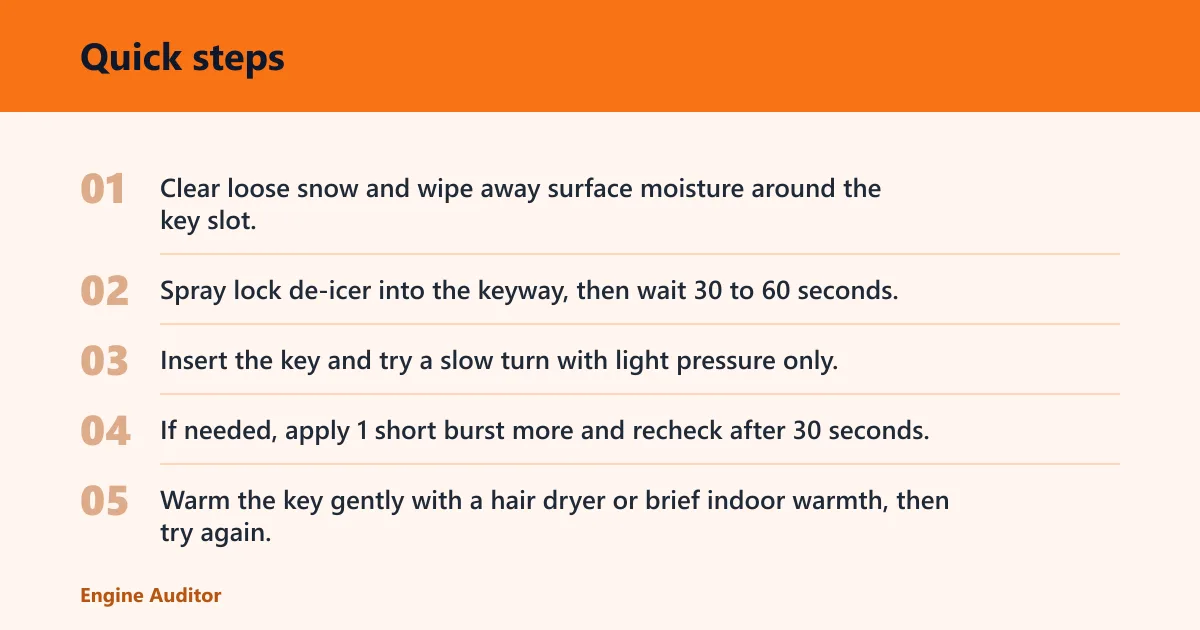
- Clear loose snow and wipe away surface moisture around the key slot.
- Spray lock de-icer into the keyway, then wait 30 to 60 seconds.
- Insert the key and try a slow turn with light pressure only.
- If needed, apply 1 short burst more and recheck after 30 seconds.
- Warm the key gently with a hair dryer or brief indoor warmth, then try again.
- Stop if the key starts flexing, the cylinder binds hard, or the key will not move after 2 to 3 tries.
Suppose the key enters fully but stops at the first twist. That points to ice in the cylinder, not a dead fob. A short application of de-icer usually makes more sense than more force, because the tumblers need to move, not be pushed past the ice.
Use a commercial de-icer first
Keep lock de-icer in the car or at home so it is available before the freeze. Spray it directly into the lock, not onto the door paint, and give it a moment to work. This is the safest first choice because it is made for lock cylinders. For a deeper product-specific walkthrough, see lock de-icer.
Use alcohol only as a backup
Will rubbing alcohol work on a frozen car lock? Yes, it can help dissolve ice faster than plain water. 91 percent isopropyl alcohol is the better DIY choice because higher alcohol content lowers the freezing point more effectively. A backup spray can be mixed with two-thirds alcohol and one-third water, but that is still less ideal than a purpose-made de-icer. Use it sparingly and avoid soaking nearby plastics or electronics.
Warm the key or lock area gently
A hair dryer can warm the lock and door edges, and it is safer than an open flame. It does need an outlet or extension cord. Warm the car key gently as well, because excess heat can damage the key and melt the plastic casing. Industry and roadside guidance consistently advises against open flame or boiling water because both can damage parts and worsen refreezing.
Picture a key that slides in halfway on a 22-degree morning and then refuses to turn. A brief de-icer application plus gentle heat is a better sequence than repeated twisting, which only risks snapping the blade inside the cylinder.
If that didn’t work, try this next
If the keyway is clear but the lock still does not move, shift attention to the door edge and handle. A frozen seal can hold the door shut so firmly that the lock seems broken when it is not. Warm the edge, then test the handle before forcing the latch. If the key is inserted but the cylinder never turns, move to the mechanical freeze steps below; if the key turns but the door stays shut, jump to the seal section.
What if the door handle or seal is frozen?
If the key turns but the door will not open, the problem may be at the handle, latch, or seal instead of the cylinder. Warm the door edge and weather stripping first. If the handle is iced solid, free the moving parts gently rather than pulling harder.
Freeing a stuck handle
Use a hair dryer on the handle and the seam around it for about 1 to 3 minutes, then test the handle again. Salt water is not a preferred thawing method because it can promote corrosion on metal hardware, plated trim, and lock components; if used at all, keep it away from the keyway, rinse/dry the area afterward if conditions allow, and use it only as a last resort on exterior ice. A safer alternative is controlled heat or a small amount of alcohol-based de-icer on the moving edge.
Loosening a frozen weather strip
Open the door only as far as the seal allows, then warm the weather stripping and door edge. Do not pry against the rubber. If the seal is bonded by ice, the door may need more warming than the lock itself. For maintenance tips, see weather stripping and seal maintenance.
When the door will not open even after the lock moves
That usually means the latch area or seal is still frozen. Keep warming the door edge in short passes. If the door begins to flex, stop and wait a few minutes; forcing it can tear damaged seals and bend trim.
Troubleshooting: key inserts but won’t turn vs key turns but door won’t open
If the key inserts but won’t turn: focus on the keyway. The cylinder is likely iced, contaminated, or mechanically stuck. Use lock de-icer, then light heat, then stop if it still binds.
If the key turns but the door won’t open: the lock is probably not the problem. Focus on the handle, latch, and weather stripping, which can freeze the door shut even when the cylinder is working. That distinction saves time and avoids unnecessary force.
What not to do with a frozen lock
Do not pour hot water into the lock. Hot water can refreeze and create a worse ice problem, especially when the metal is below freezing. Do not use a lighter or torch near the cylinder. Open flame is unsafe around paint, rubber, and plastic parts.
Do not force the key if it resists. Do not bend the blade, and do not keep cranking on an electronic lock that is already unresponsive. Greasy lubricants can also make lock problems worse, while dry lubricants are the better choice for general maintenance after the freeze is over. For a maintenance-focused guide, see broken key extraction and when to call a locksmith.
Common mistakes
- Using hot water first, then getting a refrozen cylinder
- Pulling harder on a frozen handle until the trim cracks
- Twisting the key repeatedly until it snaps in the lock
- Assuming a remote failure is the same as a frozen cylinder
- Using grease in the lock and making debris stick
How to keep car locks from freezing again
Prevention is better than thawing. WD-40 is mentioned as a preventative spray before frost because it can reduce water intrusion. Use it before cold weather, not as the main de-icer. Keep lock de-icer in the car, dry the keyway after wet weather, and check seals for cracks. For longer-term care, dry lubricants or graphite-style lock lubricants are generally preferred over heavy oils or grease for lock cylinders.
Preventive spray and drying habits
Apply a preventative spray before frost, then wipe away excess. If the lock or handle gets wet, dry the area before overnight freezing. Dry lubricants are the safer maintenance choice for sticky locks once everything is thawed. Avoid over-oiling, because excess lubricant can attract grit and slow the cylinder over time.
Checking seals and weather stripping
Inspect damaged seals, especially where moisture can get into cracks. A torn weather strip lets water sit against the door edge and increases freezing risk. Replace damaged seals before winter if they are already letting water in.
Where to store de-icer
Keep one spray in the vehicle and one at home. That avoids the common problem of having the product in the garage while the frozen door is outside. Store it where you can reach it without opening the locked car first.
Frequently asked questions
How do you thaw a frozen car door lock without damaging it?
Use lock de-icer sprayed into the keyway first, then try the key with gentle pressure. If that fails, warm the key or lock area with a hair dryer. Stop after 2 to 3 attempts. The safest order is de-icer, mild heat, then professional help. If the issue is a jammed keyway or broken blade, broken-key repair may be safer than continued force.
Is it safe to pour hot water into a frozen car lock?
No. Hot water can refreeze and leave the lock or door edge more iced over than before. If you need heat, use a hair dryer on the lock and surrounding panel, or switch to lock de-icer. The goal is controlled warming, not a fast shock of water.
Will rubbing alcohol work on a frozen car lock?
Yes. Rubbing alcohol is a quick ice-dissolving option, and 91 percent isopropyl alcohol is commonly recommended by locksmith and roadside guidance. It can also be mixed with water, including a two-thirds alcohol and one-third water spray, though straight higher-percentage alcohol is usually the stronger DIY option. Use it on the keyway, not as a soak for trim or electronics.
Can I use a hair dryer to unfreeze a car door lock?
Yes, and it is safer than an open flame. Use it on the lock and door edges, especially near weather stripping and the handle. You need an outlet or extension cord, so plan the power source before you start. Keep the heat moving and avoid overheating one spot.
Does WD-40 help prevent car locks from freezing?
Yes, as prevention before frost, not as the main thawing step. A light application can reduce water intrusion in the lock. After the freeze season, a dry lubricant is a better general maintenance choice, and greasy lubricants can make sticking worse.
What should I do if my car key won’t turn in the cold?
Stop forcing it and assume ice in the cylinder first. Spray a lock de-icer into the keyway, wait a short moment, then try again. If the key still will not turn after 2 to 3 tries, warm the key gently or call a locksmith before the blade snaps.
Products related to this article
Sponsored / affiliate links. As an Amazon Associate I earn from qualifying purchases. I may earn additional commission from eligible campaigns.