Why Is There a Buzzing Noise From My Dashboard?
A buzzing noise from the dashboard usually points to HVAC blend doors, a blower motor, or an electrical relay. The key clue is whether it changes with key position, fan speed, A/C use, or engine state. Ignoring it can leave you with no heat, weak cooling, a dead battery, or a growing electrical fault. This guide helps you match the sound to the right system and narrow the cause fast.
Dashboard buzz decision table
Start with the power state first. A buzz that happens with the key on, engine running, or the car switched off can lead you to very different parts of the dash. Fan speed, temperature changes, and A/C commands separate blower problems from actuator faults and electrical chatter faster than a broad noise hunt.
| Symptom pattern | Most likely cause | When the noise happens | Fan speed effect | Temperature effect | State | First test |
|---|---|---|---|---|---|---|
| Buzz rises and falls with fan speed | Blower motor or debris in the fan | HVAC on | Yes | No | Key on or engine running | Change fan speed from low to high and listen for a direct change |
| Whistle-like buzz with weak airflow | Cabin air filter restriction | HVAC on | Often stronger on higher settings | No | Key on or engine running | Inspect the cabin air filter first |
| Rapid clicking or buzzing after temperature change | Blend door actuator | When you change temp or mode | Usually little change | Yes | Key on, sometimes after shutdown | Move temperature from hot to cold and listen for repeated cycling |
| Buzz continues after key off for a short time | Actuator cycling or retained-accessory power | After shutdown | No | Maybe | Off | Wait for the car to sleep and note whether the sound stops on its own |
| Buzz from the dash with no HVAC input | Instrument cluster or relay | Ignition changes or accessory load | No | No | Off or key on | Switch accessories on and off, then check if the noise tracks the load |
| Fast clicking with dim lights or weak crank | Relay chatter from low voltage | Key on or cranking | No | No | Engine off or idle | Check battery voltage and charging output |
| Buzz only when A/C is selected | A/C compressor clutch or pulley issue | A/C on | No | No | Engine running | Turn A/C off and compare the sound immediately |
| Buzz grows at idle and fades with throttle | Alternator or charging system | Idle | No | No | Engine running | Observe whether the noise changes as engine speed rises slightly |
| Buzz changes when the car hits bumps | Loose dash-mounted accessory or connector | While driving | No | No | Driving | Press gently on nearby trim and listen for a change |
| Buzz with mode changes, not fan changes | HVAC control module or actuator command issue | When switching vent positions | No | Sometimes | Key on | Switch between floor, dash, and defrost and listen for repeated movement |
| Buzz plus air movement sound near the dash on acceleration | Vacuum leak | Under load or changing engine vacuum | No | Sometimes | Engine running | Listen for the sound to change with engine load |
| Buzz from behind the cluster with warning chimes or odd gauge behavior | Instrument cluster fault | Ignition or accessory load | No | No | Off or key on | Check whether the sound appears with the cluster awake and disappears when the car sleeps |
Use the pattern before the part
That table is the fastest way to narrow the source. A buzz that tracks fan speed points to the blower circuit. A buzz that reacts to temperature or vent mode points more toward a blend door actuator or HVAC control issue. A buzz that appears with the key on but no airflow request often points to relays, modules, or low voltage.
Say your dashboard buzz starts the moment you switch the fan from 1 to 4, and it gets louder in direct step with blower speed. That pattern points to the blower motor, debris in the squirrel-cage fan, or a restriction that is making the motor work harder. It is a different problem from a click that happens only when you move the temperature dial.
Suppose the sound is a repeated buzz for a few seconds after shutoff, then it stops. That pattern fits retained-accessory power, an actuator finishing its sweep, or a control module staying awake briefly. It is less consistent with a belt, tire, or other moving part outside the cabin.
Why does the buzz change with fan speed?
If the noise changes with blower speed, the blower motor is the first place to look. A worn blower bearing can hum or buzz, and debris striking the fan can do the same. A clogged cabin air filter can also restrict airflow and create a whistle-like buzz, but it usually affects airflow more than it creates a mechanical sound on its own.
Blower motor and cabin filter checks
Check whether the noise grows at higher fan settings or appears only when the blower runs. That behavior points toward the blower motor, the fan wheel, or a filter that is loading the circuit with extra resistance. Replacement access is often under the glovebox or behind the dash, depending on the vehicle.
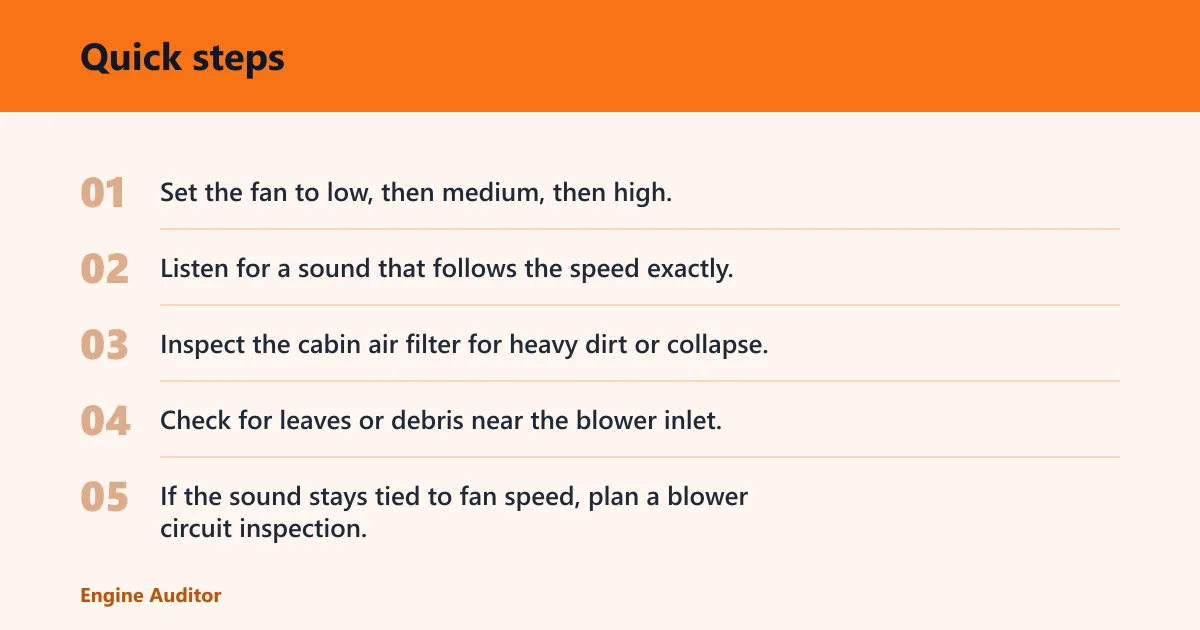
- Set the fan to low, then medium, then high.
- Listen for a sound that follows the speed exactly.
- Inspect the cabin air filter for heavy dirt or collapse.
- Check for leaves or debris near the blower inlet.
- If the sound stays tied to fan speed, plan a blower circuit inspection.
Cabin air filter service interval depends on the vehicle and the environment. Dust, pollen, and debris shorten it. A filter check is a low-cost first step because it can reduce strain and make blower noise easier to separate from a worn motor.
Is the blend door actuator making the noise?
A blend door actuator is a small electric motor that controls temperature or air direction. When its gears strip or the unit loses position, it can click or buzz repeatedly. The clue is that the sound often appears when the key is on or when you change temperature or vent mode, not when you simply change blower speed.
Temperature and mode commands matter
Move the temperature from full cold to full hot, then switch between floor, dash, and defrost. If the buzz starts, stops, or repeats during those changes, the actuator is high on the list. Some units also cycle after the car is shut off as they park themselves.
Low system voltage can make an actuator hunt for position instead of settling cleanly. That can sound like repeated buzzing or light clicking behind the dash. A weak battery or a charging problem can turn a borderline actuator into a noisy one.
Why low voltage can mislead you
Do not assume a buzzing actuator is always mechanically broken. If voltage drops while the HVAC system is trying to move a door, the actuator may keep retrying. That looks like a bad part, but the first test should include battery and charging checks when the noise appears at idle or with the engine off.
Could the dashboard noise be electrical?
Relays and fuses can buzz or click rapidly when voltage is low or when a circuit is failing. The instrument cluster can also make noise from internal relays or warning chimes. If the sound does not change with blower speed, temperature, or airflow commands, the next step is electrical diagnosis rather than HVAC parts swapping.
Relays, fuses, and cluster behavior
Check the fuse box or junction block with the key on and accessories operating. A relay that chatters or a fuse circuit that drops voltage can produce a fast buzz that sounds like it is inside the dash. The same logic applies if the cluster noise changes with ignition state or accessory load.
When available, scan for HVAC codes and body codes. That matters when the control module may be commanding an actuator repeatedly or when the cluster is reporting a fault that does not show up as a simple blown fuse. A scan tool is most useful after the basic power and ground checks have failed to isolate the source.
What if the sound appears only with A/C on?
If the buzz happens only when the A/C is switched on, the compressor clutch or its pulley path moves to the top of the list. That noise can travel through the firewall and be heard near the dash. If the sound disappears as soon as you turn A/C off, the compressor side deserves a closer look.
Separate clutch noise from blower noise
Blower noise usually changes with fan speed. A/C clutch noise usually changes with the A/C button, not the fan control. That difference helps you avoid blaming the cabin fan for a noise that starts and stops with the compressor circuit.
Picture a car where the fan can run quietly on heat, but the moment A/C is selected, a buzz appears even if the fan stays on the same setting. That pattern fits the clutch or pulley path better than the blower motor. If the noise becomes harsher at idle, the charging system and compressor load both deserve attention.
Why does it happen with the engine off?
Buzzing with the engine off usually points away from airflow parts and toward retained-accessory power, modules, or relays that stay awake briefly. Some vehicles cycle HVAC actuators after shutdown. Others let a control module or cluster stay live for a short time before it sleeps.
Off-only buzzing needs a different branch
If the sound appears only after shutdown, wait and see whether it stops on its own. Repeated cycling that continues or returns after a short pause can mean a control fault, a sticking relay, or low voltage that keeps a module from settling. That is a useful clue because it separates off-only electrical chatter from a mechanical dash rattle.
Can low fluid cause a buzzing noise from the dashboard? Sometimes, but only indirectly and less often than electrical or HVAC faults. Low power steering fluid is one possible cause of humming while driving, but it usually comes from the steering system, not the dash. A true dashboard buzz still deserves a direct check of HVAC and electrical sources first.

Start with the least costly checks, then move toward electrical diagnosis if the pattern does not point to a simple part. A basic first pass can rule out a restricted filter, a loose fuse, or a relay that is buzzing under load. If the sound is persistent, do not keep guessing by part name alone.
Basic first pass
- Note whether the sound happens off, key on, idle, or while driving.
- Change fan speed and see whether the noise follows it.
- Change temperature and vent mode and listen for repeat buzzing.
- Inspect the cabin air filter.
- Check fuses and relays with the key on.
- Test battery and charging output if the sound shows up at idle or after shutdown.
- Use a scan tool if HVAC or body codes are available.
A buzzing noise is a symptom, not a diagnosis. The fastest fix comes from matching the sound to the control input that changes it. That is how you separate HVAC faults from electrical chatter and from a dash-mounted accessory that is vibrating loose.
A persistent or worsening buzz can precede a larger failure. A blower motor can stop moving air, a relay can fail, or a weak charging system can leave you with multiple electrical symptoms. If the source is hard to trace, professional electrical diagnosis is the next step.
Frequently asked questions
Why is there a buzzing noise coming from my dashboard?
A dashboard buzz often comes from the HVAC system, a relay, or a control module. The best clue is what changes the sound: fan speed, temperature setting, A/C use, key position, or engine state. That pattern tells you where to start instead of treating every buzz as the same fault.
Why is my car making a buzzing noise from the dashboard?
If the sound is truly from the dash, the likely causes are blower motor wear, a blend door actuator, relays, or the instrument cluster. A buzz that follows fan speed points to the blower circuit. A buzz that appears with temperature changes points more toward an actuator or HVAC control issue.
Why is my car buzzing when it’s off?
Buzzing after shutdown often points to retained-accessory power, an HVAC actuator finishing its cycle, or a relay that is chattering as voltage drops. If it lasts only a short time, it may be normal behavior. If it repeats, scan the HVAC and body systems and check battery condition.
Is dashboard buzzing caused by the blower motor or AC?
It can be either, but the control pattern separates them. A blower motor buzz usually changes with fan speed. An A/C clutch noise usually changes when you turn A/C on or off, even if the fan stays steady. That split is the fastest way to avoid guessing.
Is a dashboard buzz dangerous to keep driving with?
Sometimes yes. A relay buzz can point to low voltage, a failing charging system, or a circuit that may stop working. A blend door problem can leave you with no heat or defrost. If the buzz is persistent, gets louder, or comes with warning lights, diagnose it soon.
Products related to this article
Sponsored / affiliate links. As an Amazon Associate I earn from qualifying purchases. I may earn additional commission from eligible campaigns.