Why Does My Car Rattle After Turning It Off?
A rattle right after shutdown is often normal if it lasts 1–10 seconds and comes from exhaust cooling, heat shields, or engine rock-back. Repeated metallic clunks, shaking, or noise after about 10 seconds deserves inspection. Ignoring a new shutdown rattle can let a loose shield, failing mount, or exhaust leak get worse and turn a small repair into a larger one. This guide shows the timing clues that separate normal after-run noise from faults that need a closer look.
This guide is part of our Car Noise Diagnosis by Symptom: Where the Sound Comes From and How Serious It Is series.
When the noise happens points to the real problem

The short answer is that shutdown changes load, heat, and vibration all at once. Some parts shift as engine torque drops, some parts keep changing shape while they cool, and some noises become obvious once the engine stops masking them.
Timing matters more than volume. A brief tick or light clatter during the first seconds after key-off can come from normal exhaust cooling, while a heavy clunk, repeated metal-on-metal noise, or a sound that keeps going usually points to loose hardware, a sagging exhaust, or mount wear.
Car rattle decision table
| When it happens | Likely source | Quick check | Urgency |
|---|---|---|---|
| Right at key-off | Engine mount or transmission mount movement, or exhaust rock-back | Look for a single clunk or shake as the engine stops | Inspect soon if the clunk is new or strong |
| 5 to 30 seconds after shutdown | Heat soak in exhaust metal, heat shield, clamps, or muffler | Listen for ticking, pinging, or sharp metallic noise as parts cool | Usually lower urgency unless it is loud or worsening |
| Only after hot driving | Exhaust parts expanding and shifting, or a shield touching nearby metal | See whether the noise follows a highway run or steep climb | Inspect soon if it is repeatable and getting louder |
| Returns on the next cold start | Muffler internals, catalytic converter damage, mount wear, or brake rust | Note whether the sound repeats at idle, startup, or first move-off | Prompt inspection if it sounds metallic or affects drivability |
Why does the sound happen after shutdown?
Shutdown noise often appears because the car is changing state, not because it is “still running.” The engine stops making steady torque, the exhaust starts to cool, and parts that were held in place by heat or pressure begin moving again on their own.
Engine rock-back and mount movement
When the engine stops making power, it can rock slightly in its mounts. Worn engine mounts can send a clunk or shake through the body at that moment, and a worn transmission mount can add another thump or vibration as the drivetrain settles.
That movement can make the car feel like it is still running for a second or two. It is not the same as an idle rattle. It is a shutdown motion problem.
Heat soak and cooling metal
Exhaust metal changes shape slightly as it heats up, then changes again as it cools. Metal expands with heat, and rubber hangers flex with movement, so a part that sat quietly while driving can click or rattle after the engine stops.
That is why a noise may begin only after you park. Heat soak keeps hot parts changing after shutdown, so the sound can arrive late rather than immediately.
Why low-speed and idle noises are easier to hear after the engine stops
Once the engine is off, there is less background noise. A light tick from the exhaust tunnel or a sharp shield rattle near the floor can seem louder because the engine is no longer covering it up.
Picture a compact car that only makes a 10-second metallic tick after a long climb. If the sound appears only after heat builds, the timing points more toward cooling exhaust parts than a fuel or ignition problem.
Heat shields and loose exhaust parts
Loose exhaust hardware is a common reason for a post-shutdown rattle. Heat shields are thin metal panels designed to protect the underbody from heat, and loose heat shields can make a sharp metallic sound. A rattle that is worse at certain RPM ranges can point to a heat shield.
How a rusted heat shield rattles
Heat shields sit close to hot exhaust parts, so rusted fasteners or broken tabs can let them vibrate. The sound is often sharp and metallic, and it may change with engine RPM because vibration patterns shift as load changes.
That is not the same as a deep exhaust boom. It is usually lighter, more tinny, and easier to trigger by tapping or flexing the panel with a tool during inspection.
Hangers, rubber mounts, clamps, flanges, and welds
Exhaust hangers keep the system supported and centered. Rubber mounts help control movement. If they wear out, the exhaust can sag and contact the frame or crossmember. Loose clamps or flanges can let exhaust parts shift and vibrate, and broken welds can rattle.
A failed gasket at a joint can also create an exhaust leak. That matters because a leak can add a ticking or chuffing sound that is easy to mistake for a loose shield.
When exhaust contact with the body matters
If the pipe, muffler, or resonator touches the body, crossmember, or heat shield, the car may rattle only during shutdown as the metal settles. That contact can also become louder over bumps or when shifting between drive and reverse.
Say your hatchback rattles only after a warm freeway drive, and the sound comes from under the rear seat area. That pattern points toward exhaust movement under the floor, not a brake problem at the wheels.
Could the muffler or catalytic converter be failing?
Yes. Internal exhaust damage can mimic a loose shield, especially if the noise sounds like metal pieces in a can. Internal muffler or catalytic converter damage can sound like a can of loose metal pieces, and a failing catalytic converter may also cause power loss.
Loose muffler internals
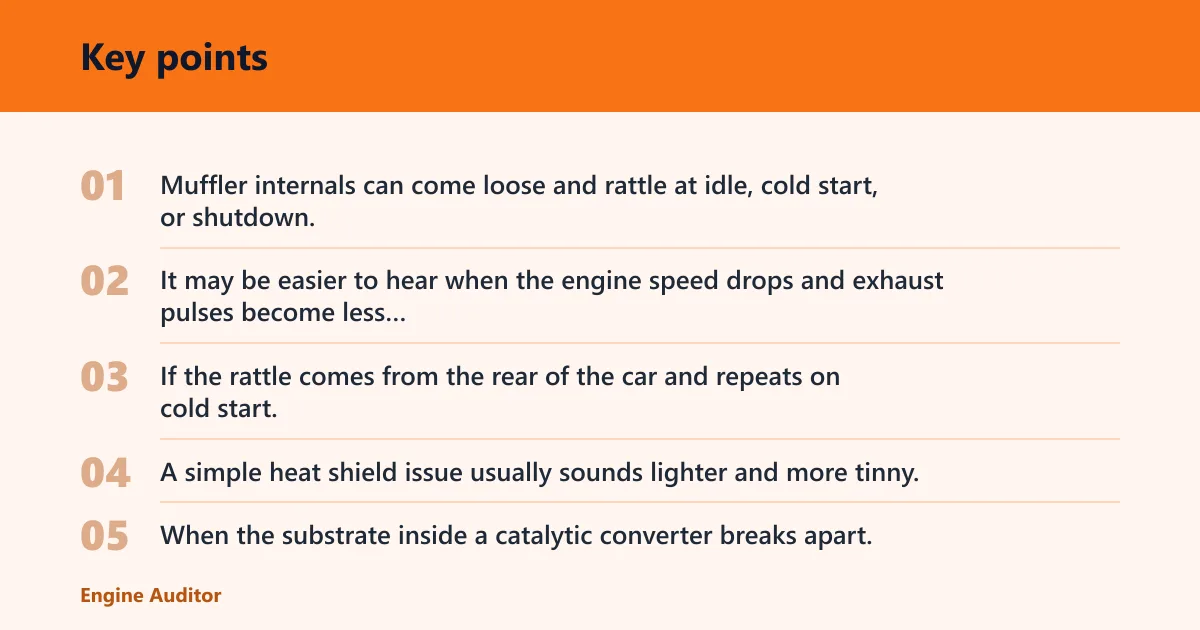
Muffler internals can come loose and rattle at idle, cold start, or shutdown. The noise is often metallic and hollow. It may be easier to hear when the engine speed drops and exhaust pulses become less steady.
If the rattle comes from the rear of the car and repeats on cold start, the muffler itself deserves attention. A simple heat shield issue usually sounds lighter and more tinny.
Internal catalytic converter damage
When the substrate inside a catalytic converter breaks apart, it can sound like loose pieces moving around inside a shell. That can happen during shutdown, on startup, or while driving. A check engine light may appear, and power loss is another clue.
This is a safety issue if the converter is overheating or the noise is accompanied by a sudden change in engine sound. Do not ignore a new metallic rattle from that area.
Clues that point to an exhaust leak
A leak at a clamp, flange, or gasket often adds a sharper ticking or puffing sound than a broken internal part. If the sound is strongest near a joint and changes as the engine cools, that joint deserves a close look.
Noise that starts after hot driving and then fades as the exhaust cools can still be a loose joint, even if the car sounds normal at idle later.
Could brakes or mounts be the source?
Yes. Not every post-parking noise comes from the exhaust. Brake rotor surface rust, engine mounts, and transmission mount wear can all create sounds that appear right after shutdown or during the first move.
Brake rotor surface rust after rain or parking
Brake noise after startup can come from overnight surface rust on rotors. The first movement can scrape rust off the rotors and create temporary noise. That can sound like a light grind or squeak for a few seconds after parking brake release or the first roll forward.
Some reverse noises disappear after a few brake applications and are usually harmless. If the sound is brief, wheel-related, and disappears quickly, it is less likely to be an exhaust fault.
Engine mount clunks on shutoff
Worn engine mounts can let the engine shift more than it should when torque drops to zero. That can create a clunk, a short shake, or the feeling that the car is still running for a moment after key-off.
If the noise happens right at shutdown and not five minutes later, mount movement climbs higher on the list. A worn mount is also more likely to show itself during gear changes or hard acceleration.
Transmission mount vibration at key-off
The transmission mount supports drivetrain movement, so wear there can create a clunk or vibration when the engine stops. It can also add to a shutdown shake that feels like one side of the car shifts slightly as the engine settles.
A combined engine mount and transmission mount problem can make the whole car rumble after shutdown. That is different from a pure exhaust tick.
When should you stop driving and inspect it?
Stop treating the sound as normal if it turns into grinding, repeated metal-on-metal noise, or a hard clunk that gets worse. A sudden change in engine sound, visible exhaust sag, or contact with wiring or fluid lines means the car needs inspection soon.
Car rattle checklist
- Listen for heavy grinding or scraping rather than a light tick.
- Look under the car for a hanging exhaust section or broken hanger.
- Check whether the noise touches wiring, brake lines, or fluid lines.
- Note whether the sound started after a hard drive, a pothole, or a repair.
- Watch for power loss, a check engine light, or a sudden change in exhaust tone.
- Arrange inspection quickly if the noise is loud, repeatable, or getting worse.
Older high-mileage cars are more prone to these noises because mounts, shields, and hangers have had more heat cycles. Turbo engines can also be noisier after shutdown because hot parts keep changing shape. Vehicles with aftermarket exhaust often develop more rattles from fitment and clearance issues.
A common first-timer mistake is blaming every noise on the same loose part. A car that ticks for 15 seconds after a hot drive, then rattles again on the next cold start, may have more than one issue: cooling exhaust metal plus a worn hanger or damaged muffler internals.
If the sound is new, note exactly when it happens, what changes with temperature, and whether it returns on the next cold start. Those three details do more for diagnosis than guessing from the noise alone.
Frequently asked questions
Why does my car rattle after I turn it off: a brief rattle after shutdown?
A brief rattle after shutdown often comes from exhaust cooling, heat shield vibration, or engine rock-back as torque drops. If it lasts 1–10 seconds and fades, it may be normal. Repeated clunks, long-lasting noise, or metal-on-metal sounds point to a fault that should be inspected.
Why does my car make noise after turning it off?
Parts keep moving for a short time after shutdown. Metal expands and contracts with heat, rubber hangers flex, and mounts settle as engine load disappears. That mix can create ticking, clunking, or rattling. The timing and location of the noise are the best clues.
Why is my car still making noise after turning it off?
If the noise continues after shutdown, listen for the first few seconds versus the 5 to 30 second cooling period. A short tick can be normal. A sound that keeps going, gets louder, or sounds metallic near the exhaust tunnel or rear floor deserves an inspection.
Why does it sound like my car is still running after I turn it off?
That feeling usually comes from engine mount or transmission mount movement as the drivetrain settles. The engine is off, but the body can still react to the shutdown motion for a moment. If the car shakes hard or clunks sharply, mount wear becomes more likely.
Why does my car shake after turning it off?
A shake at key-off often points to worn engine mounts or a worn transmission mount. The engine can rock back when power drops, and the movement can be passed into the cabin if the mounts are weak. A strong shake is not something to ignore.
Why did my car rattle when I turned it off?
A single rattle at shutdown can come from a heat shield, exhaust hanger, loose clamp, or engine movement. If it happened after hot driving, heat soak is a likely trigger. If it happens again on cold start or idle, the source may be inside the muffler or catalytic converter.
Why does my car rattle on start up?
A startup rattle can point to muffler internals, a catalytic converter issue, or briefly noisy brake rotors after overnight surface rust. Some reverse noises disappear after a few brake applications and are usually harmless. If the sound persists, the source needs a closer look.
Why does my car rattle in idle?
Idle rattles often become clearer when engine speed drops and vibration patterns change. Loose heat shields, broken exhaust welds, or internal muffler damage can all sound worse at idle. If the rattle changes with RPM ranges, a heat shield is worth checking first.
Why does my car rumble after I turn it off?
A rumble after shutdown often comes from exhaust movement, sagging hangers, or a mount issue that lets the drivetrain settle heavily. If the sound is low and deep rather than sharp and metallic, look at the exhaust system, mounts, and any part that may touch the body.
Why is my car making noise after turning it off?
Some post-shutdown noise is normal, especially for a short cooling tick. The timing tells you more than the volume. A sound that starts immediately, lasts longer than a short cooling period, or comes with grinding, power loss, or visible sag should be checked promptly.
Products related to this article
Sponsored / affiliate links. As an Amazon Associate I earn from qualifying purchases. I may earn additional commission from eligible campaigns.