Can You Mix Orange and Green Coolant?
No, do not mix orange and green coolant unless the vehicle maker explicitly allows both. If they are already mixed, a small top-off is usually less risky than a full blend, but a cooling-system flush is the safer fix. Mixed coolant can gel, lose corrosion protection, clog the radiator or heater core, and lead to overheating and repair bills. This guide explains what the color mix usually means, how much risk you have, and what to do next if the car is already running hot.
Color does not equal compatibility: IAT vs. OAT chemistry
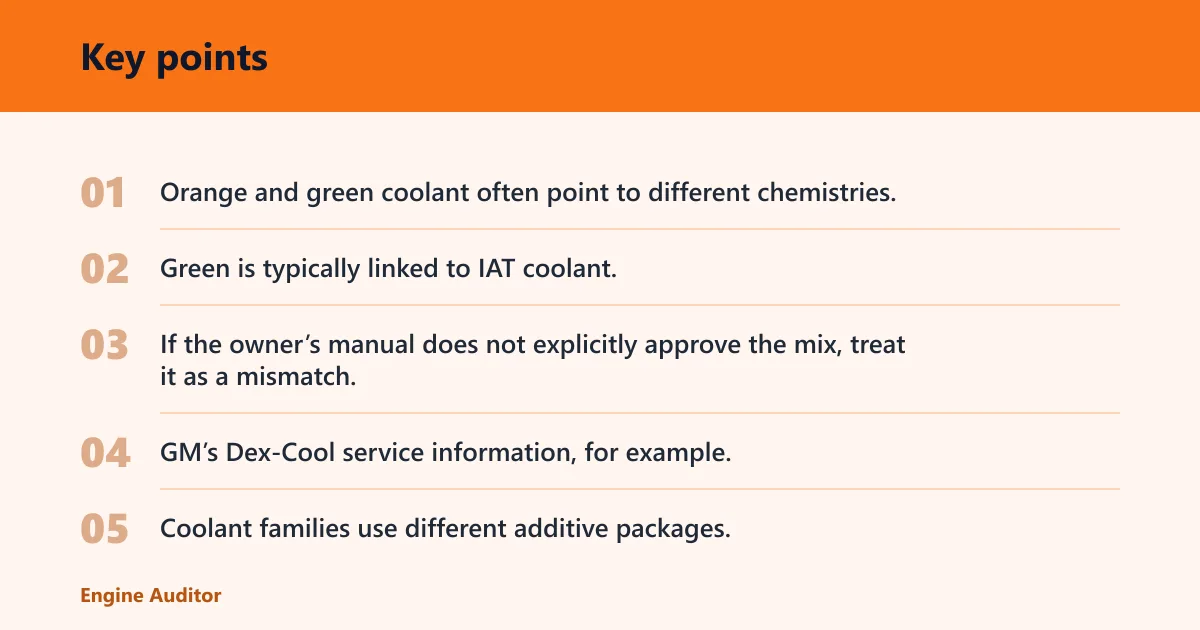


Usually no. Orange and green coolant often point to different chemistries, and color alone does not prove compatibility. Green is typically linked to IAT coolant, while orange is commonly associated with OAT coolant such as Dex-Cool. If the owner’s manual does not explicitly approve the mix, treat it as a mismatch. GM’s Dex-Cool service information, for example, ties compatibility to the approved specification, not the dye color.
Why the answer changes by formula, not just color
Coolant families use different additive packages. IAT coolant, short for inorganic additive technology, is common in older vehicles and is often serviced on a schedule set by the vehicle maker. OAT coolant, short for organic acid technology, is used in many modern vehicles and may have longer service intervals, but those intervals are spec-dependent rather than universal.
HOAT coolant, or hybrid organic acid technology, sits between those ideas, but it is not universally compatible across brands or vehicle specs. Some products also label themselves “universal,” yet that does not make them safe for every system. Prestone says some IAT and OAT coolants can create a gelatinous substance, and it warns not to choose by color alone. OEM service literature should always outrank the bottle color or marketing label.
What happens if you mix orange and green coolant?
Incompatible coolant can form sludge or clouding, weaken corrosion protection, and restrict flow through the radiator or heater core. The result can include hotter running, reduced heater output, and long-term damage to seals and metal passages. If the blend turns gelatinous, the system may run hotter, and the heater may stop delivering warm air.
Sludge, clouding, and blocked passages
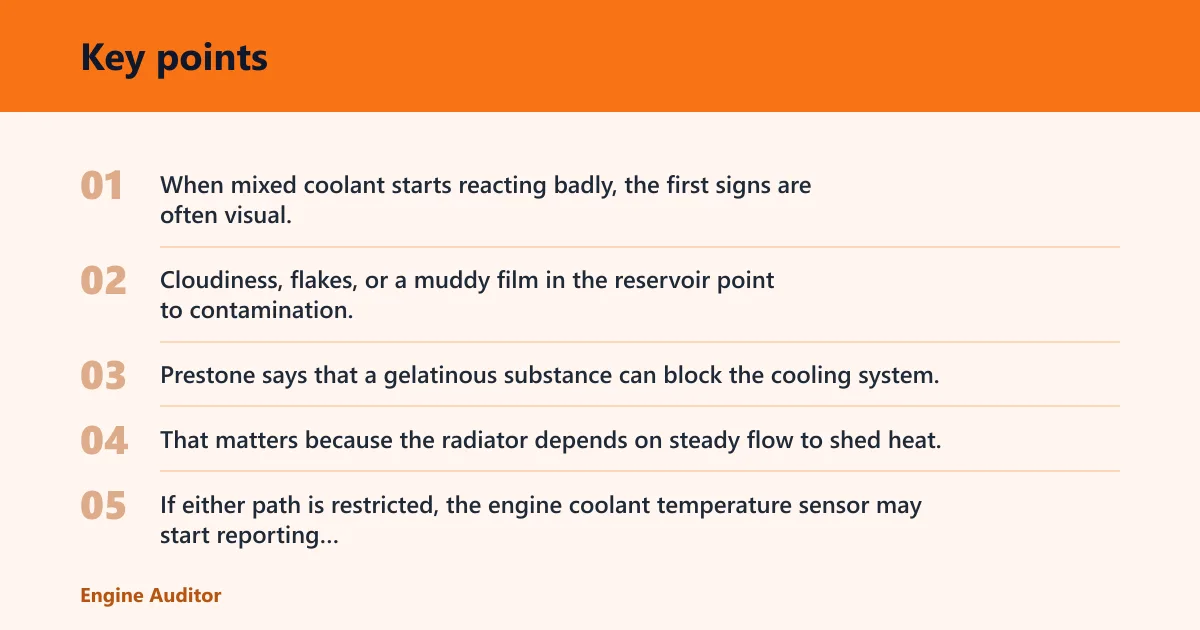
When mixed coolant starts reacting badly, the first signs are often visual. Cloudiness, flakes, or a muddy film in the reservoir point to contamination. The same source says that a gelatinous substance can block the cooling system, which can leave radiator passages partially plugged and reduce heater-core flow.
That matters because the radiator depends on steady flow to shed heat, and the heater core depends on that same circulation to warm the cabin. If either path is restricted, the engine coolant temperature sensor may start reporting rising temperature as the system loses control of heat transfer. OEM service guidance and radiator manufacturers treat restricted flow as a repair issue, not a harmless cosmetic change.
Corrosion and component risk
Mixed coolant does more than look bad. Wrong additives can lose their protective effect, which raises the chance of corrosion inside the engine block and around metal passages. The water pump can also suffer if deposits or sludge change the way coolant moves through the pump and seals.
Picture a car that got a few quarts of the wrong orange coolant after a level check showed low. If the reservoir stays clear and the temperature needle behaves normally, the risk is lower than a full-system contamination case. If the fluid turns cloudy within days, the risk jumps.
What should you do if you already mixed the wrong coolant?
Start by deciding how much was added and whether the system already shows symptoms. A tiny top-off with no sludge is a different problem from several quarts mixed into the whole system. If the car is overheating, losing cabin heat, or showing cloudy coolant, stop driving and get help. For a broader breakdown of costs and next steps, see coolant flush cost and overheating symptoms.
If you already mixed orange and green coolant, what to do next
| Scenario | Likely risk level | Immediate next step | Is a drain-and-refill enough? | When to stop driving | Safe to drive to shop? |
|---|---|---|---|---|---|
| Tiny top-off | Lower, but not zero | Check the owner’s manual and confirm the OEM coolant spec before the next service | Sometimes, if the fluids are confirmed compatible and the system stays clear | Stop if the temperature rises, the heater output drops, or the reservoir clouds up | Yes, if the engine temperature stays normal and the mix was only a small emergency top-off with approved or distilled water; no if the wrong coolant was added |
| Several quarts mixed | Moderate to high | Schedule a drain-and-refill or full flush as soon as possible | Often not enough by itself; a full flush is smarter if compatibility is unknown | Stop driving if the gauge climbs, the fan runs hard, or the cabin heat disappears | No, unless it is a very short, carefully monitored move and the engine stays cool; otherwise tow it |
| Visible sludge or clouding | High | Do not keep topping off; arrange a coolant flush and inspection | No, a simple drain-and-refill may leave residue behind | Stop driving if sludge is visible or flow seems restricted | No |
| Overheating or no-heat symptoms | Highest | Pull over, let the engine cool, and get professional help | No; the system needs diagnosis before refilling | Stop immediately | No |
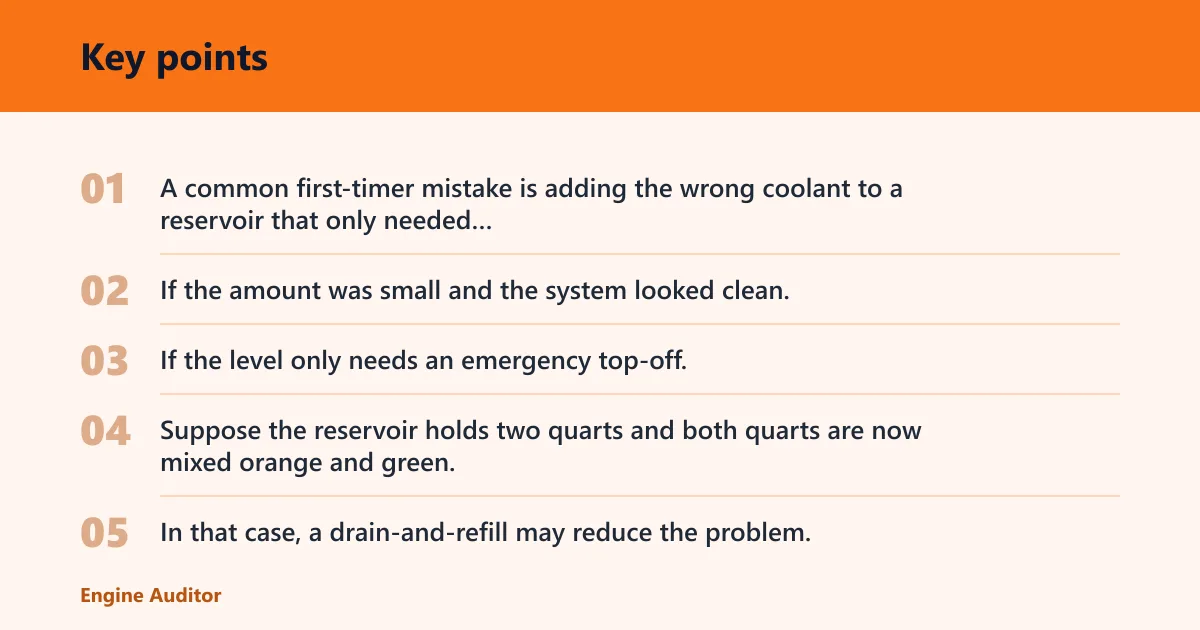
A common first-timer mistake is adding the wrong coolant to a reservoir that only needed a small top-off. If the amount was small and the system looked clean, verify the exact specification in the owner’s manual and schedule the proper service at the next interval instead of guessing again. If the level only needs an emergency top-off, many OEMs allow distilled water temporarily, but only until the correct coolant can be added.
Suppose the reservoir holds two quarts and both quarts are now mixed orange and green. That is no longer a simple top-off. In that case, a drain-and-refill may reduce the problem, but a full coolant flush is the safer call because mixed fluid may still remain in the radiator, engine block, and heater core. If you are trying to tell whether the issue is the radiator or the heater side, see radiator vs heater core problems.
How do you know which coolant your car takes?
The owner’s manual is the primary source. It should list the exact coolant specification, not just a color. That matters because some vehicles want IAT, some want OAT, and some require a specific HOAT formula or manufacturer approval. Prestone specifically says to refer to the owner’s manual before topping up.
Check the label and OEM spec, not the color alone
Read the bottle label for the coolant family and the vehicle approvals it claims. If the label does not match the manual, do not assume it is fine. Color can be misleading because dye is not the same thing as chemistry, and different brands may use similar colors for different formulas.
If the manual is missing, use the vehicle make, model, engine, and model year to look up the OEM coolant spec through the manufacturer. GM’s Dex-Cool documentation and similar OEM service pages make the spec the deciding factor. If that still leaves doubt, do not gamble with a random bottle from the shelf. A dealership parts counter or a mechanic can verify the right product before more coolant goes in. For a quick refresher on reading the reservoir safely, see how to check coolant level and spec.
What to do if the coolant type is still unknown
- Stop topping off with whatever is nearby.
- Check the owner’s manual or OEM service information for the exact coolant spec.
- Inspect the reservoir for clouding, sludge, or flakes.
- If the fluid is mixed or contaminated, plan a coolant flush.
- If the engine is hot or the heater stops working, stop driving and get help.
Should you flush the system or just top off?
A simple top-off may be acceptable only when you know the coolant spec, the amount added was tiny, and the system shows no sign of contamination. If the wrong coolant was used, or if compatibility is unknown, a drain-and-refill is the minimum response and a full flush is often the better one.
When a drain-and-refill may be enough
If you caught the mistake early and the system received only a small amount, a drain-and-refill can be enough when the approved coolant family is confirmed and the fluid still looks clean. That is the lower-risk path because it reduces the mixed ratio without assuming the blend is harmless.
When a full coolant flush is the safer call
A full coolant flush is smarter when the system has several quarts of mixed fluid, when sludge or clouding is visible, or when the vehicle has overheating or no-heat symptoms. A flush removes mixed or degraded fluid before refilling, which helps protect the radiator, heater core, water pump, and engine block from ongoing contamination. If you need to budget the service, start with coolant flush cost.
Do not keep driving if the temperature gauge climbs fast, the heater blows cold, or the reservoir looks muddy. Those are signs that the system may already be restricted. If the engine is overheating, shut it down and have the cooling system inspected.
Frequently asked questions
Can you mix orange and green coolant?
Usually no. Orange and green coolant often belong to different chemical families, so color alone is not enough to prove compatibility. If the owner’s manual does not approve both products, treat the mix as a risk and plan a drain-and-refill or flush rather than adding more coolant.
Can you mix orange and green antifreeze in a car?
Only if the manufacturer specifically allows that exact combination. Many orange products are OAT-based and many green products are IAT-based, and those families are not automatically compatible. The safest check is the owner’s manual, not the bottle color or a guess based on the reservoir.
Can you mix Ford orange and green coolant?
Do not assume Ford orange and green coolant are interchangeable. Ford specifications vary by model year and engine, and some vehicles require a particular coolant chemistry rather than a color match. Check the manual or OEM spec first, especially before topping off a low system.
Products related to this article
Sponsored / affiliate links. As an Amazon Associate I earn from qualifying purchases. I may earn additional commission from eligible campaigns.