How Much Does a Coolant Flush Cost?
A coolant flush typically costs about $100 to $250 at an independent shop and about $150 to $400 at a dealership. Higher quotes can be normal when the vehicle needs extra coolant, a drain-and-fill is specified, or the shop bundles cooling-system repairs. Skip it or do it wrong, and you can end up paying for overheating, corrosion, or a failed water pump. This guide breaks down a quote line by line so you can judge labor, fluid, additives, and fees fast.
Typical cost range

The national average coolant flush cost is $131 to $209, and Kelley Blue Book says a radiator flush can average between $131 and $209. That is a useful benchmark, not a promise. The final bill moves with coolant type, cooling-system capacity, labor time, shop rate, disposal fees, and any add-ons. Regional labor rates, urban versus rural pricing, and whether the shop calls the service a “flush,” “exchange,” or “drain-and-fill” can also shift the total.
A coolant flush may also appear as a radiator flush, coolant exchange, or cooling system flush. The service method changes the price. A drain-and-fill usually costs less than a machine flush because it uses less time and fewer shop steps. If you are comparing quotes, also check related maintenance pages like coolant types, overheating symptoms, thermostat replacement, radiator repair, and dealer vs independent service cost comparisons.
Coolant flush quote table
| Line item | Sample low | Sample mid | Sample high |
|---|---|---|---|
| Coolant needed | 1.0 gallon | 1.4 gallons | 2.0 gallons |
| Coolant type | Standard OAT | OEM-spec HOAT | OEM-spec PHOAT |
| Labor time | 0.6 hour | 0.8 hour | 1.2 hours |
| Labor rate | $110 per hour | $145 per hour | $175 per hour |
| Disposal fee | $0 | $8 | $15 |
| Leak test | $0 | $18 | $25 |
| Thermostat inspection | $0 | $12 | $20 |
| Cleaner or conditioner | $0 | $12 | $22 |
| Tax | $6.60 | $3.19 | $11.74 |
| Total | $116.60 | $169.80 | $277.74 |
The mid quote above matches the calculator example closely: 1.4 gallons of coolant, 0.8 labor hours, $38.61 for coolant, $116.00 for labor, $12.00 for cooling system add-ons, and $3.19 in tax, for a total of $169.80. The calculator also uses coolant type, system capacity, service method, labor, disposal fees, add-ons, and tax.
Same vehicle, two quote styles
| Quote detail | Drain-and-fill | Machine flush |
|---|---|---|
| Vehicle example | Midsize sedan | Midsize sedan |
| Capacity used in quote | 1.4 gallons | 1.4 gallons |
| Coolant spec | OEM-spec HOAT | OEM-spec HOAT |
| Service method | Drain-and-fill | Machine flush and refill |
| Labor time | 0.6 hour | 0.8 hour |
| Labor rate | $145 per hour | $145 per hour |
| Coolant cost | $38.61 | $38.61 |
| Fees and add-ons | $8 disposal + $0 extras | $8 disposal + $12 cleaner + $12 inspection |
| Tax | $2.28 | $3.19 |
| Total | $133.89 | $169.80 |
That side-by-side shows why totals differ even for the same vehicle: the machine flush costs more because it takes longer and includes more shop steps. The quote also changes when a shop adds a cleaner, inspection, or other cooling-system line item. If the estimate does not explain the service method, capacity, coolant spec, labor, fees, and tax, ask for a revised breakdown before approving it.
What a flush quote should include
A clean quote names the service method, the coolant specification, and any extra items before you approve the work. The formula is coolant plus labor plus add-ons plus tax. If the estimate does not show how those pieces add up, ask for a line-item breakdown.
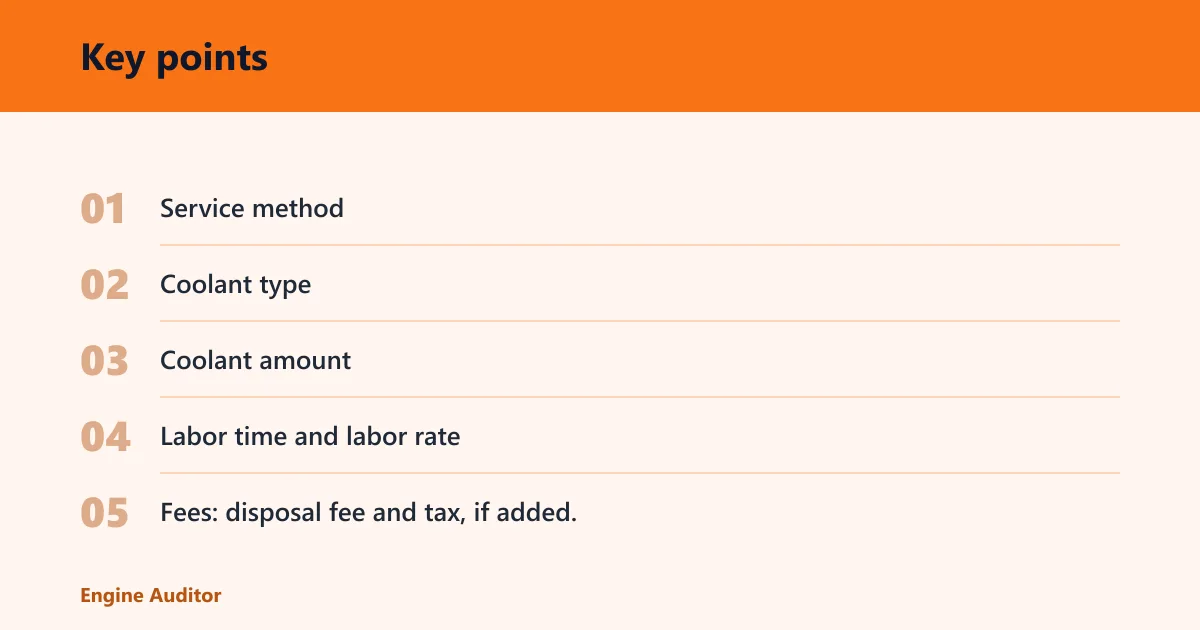
- Service method: drain-and-fill or machine flush.
- Coolant type: OAT, HOAT, IAT, or PHOAT, plus whether it is OEM-spec.
- Coolant amount: the number of quarts or gallons the vehicle needs.
- Labor time and labor rate: both should be visible.
- Fees: disposal fee and tax, if added.
- Optional items: leak test, thermostat inspection, cleaner, or conditioner.
That list also helps you separate required work from optional upsells. A leak test can make sense on a vehicle with low coolant, wet hose ends, or a recent overheat. Cleaner or conditioner is not automatic. Ask why it is there.
Say your compact sedan takes only about 1 gallon of coolant and the shop recommends a simple drain-and-fill. A quote near the national average can be normal if labor stays short and no extra parts are added. If the same car is quoted much higher, the line items should explain the jump.
Why do shop prices differ?
Shop type matters. Quick-lube shops often price lower, independent shops can land near the national average, and dealer service centers usually charge more. The difference is usually labor rate and booked time, not only the coolant itself. Canada and the UK can price differently because labor, taxes, and coolant availability vary by market, so local quotes matter more than a single headline number.
Quick-lube pricing
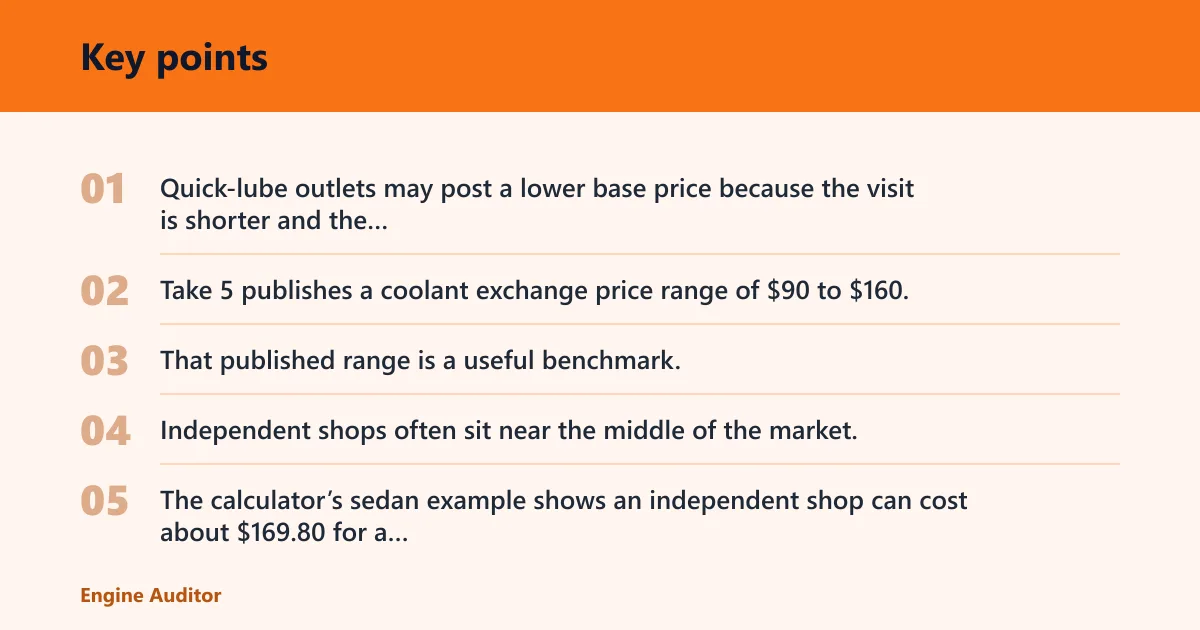
Quick-lube outlets may post a lower base price because the visit is shorter and the labor rate is often lower than a dealer’s. Take 5 publishes a coolant exchange price range of $90 to $160, and the total depends on coolant amount and type. That published range is a useful benchmark, but the chain notes that pricing can vary by location and vehicle, and service naming can differ from one store to the next.
Independent shop pricing
Independent shops often sit near the middle of the market. The calculator’s sedan example shows an independent shop can cost about $169.80 for a sedan drain and fill. That kind of quote is usually normal when the vehicle needs standard labor, OEM-spec fluid, and a modest fee line.
Dealer pricing
Dealer service centers are usually higher because their labor rate is higher and they may quote OEM fluid by default. A dealer quote is not automatically inflated. It may be the correct price if the vehicle requires a specific coolant chemistry or if the cooling system is more complex.
Does coolant type change the price?
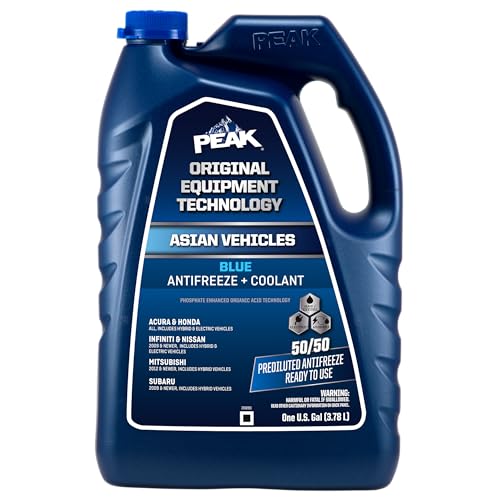
Yes. Coolant chemistry affects cost, and OAT, HOAT, IAT, and PHOAT coolants can price differently, especially when OEM-spec fluid is required. A quote that names the exact spec is easier to judge than one that says only “coolant.”
Coolant chemistry and OEM specs
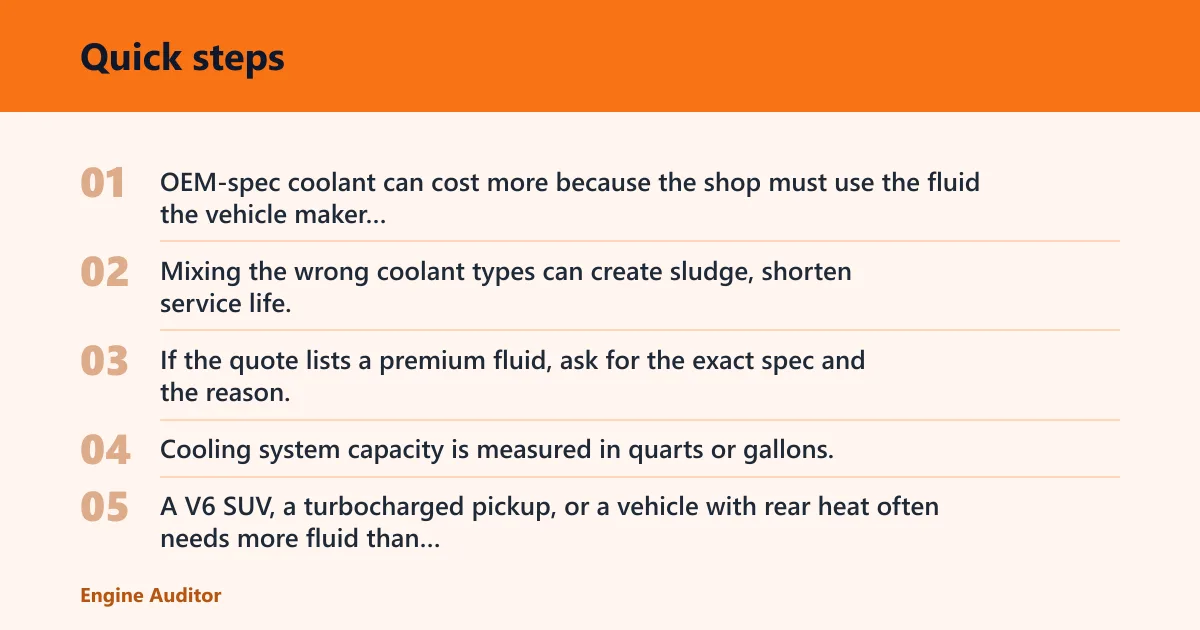
OEM-spec coolant can cost more because the shop must use the fluid the vehicle maker calls for. Mixing the wrong coolant types can create sludge, shorten service life, or leave you paying for another flush later. If the quote lists a premium fluid, ask for the exact spec and the reason.
Capacity and added fluid
Cooling system capacity is measured in quarts or gallons, and larger systems need more coolant. That is a direct pricing input. A V6 SUV, a turbocharged pickup, or a vehicle with rear heat often needs more fluid than a small sedan, so the quote should reflect that.
Picture a midsize SUV that needs a larger fill than a compact car. If the shop uses the same labor time but more gallons, the fluid line should rise while the labor line stays similar. If both fluid and labor jump without an explanation, ask for the reason.
Is a drain-and-fill cheaper than a flush?
Usually, yes. A drain-and-fill is cheaper than a machine flush because it is simpler and often uses less labor. A flush can be the better call when the coolant is old, contaminated, or mixed, but it should not be sold as mandatory for every visit.
When a full flush may cost more
A machine flush can cost more when the system is hard to access, the coolant is badly degraded, or the shop adds a cleaner step before refilling. If the quote includes a flush plus cleaner plus inspection, the higher total may still be reasonable. The key is whether each item has a purpose.
When the simpler service is enough
If the owner’s manual calls for a drain-and-fill at that service interval, do not pay for a more complex procedure without a reason. The manual matters because some vehicles specify a particular coolant type and service interval. Start there, then compare at least two quotes.
What should you check before approving the quote?
First, check whether the quote names the service method and coolant spec. Then look for disposal, tax, and any add-ons. The best quotes are clear about what is required and what is optional, which makes it easier to compare shops without guessing.
- Match the quote to the owner’s manual.
- Check the coolant type and amount.
- Confirm the labor time and labor rate.
- Look for disposal fee and tax.
- Ask whether leak test, thermostat inspection, or cleaner are required.
- Get another quote if the total jumps without clear reasons.
Frequently asked questions
How much does a coolant flush cost at a dealership?
A dealership quote is usually higher than a quick-lube or independent shop quote because labor rates are often higher and OEM fluid is commonly specified. In many markets, a dealership coolant service lands around $150 to $400, but the exact number depends on the vehicle, coolant type, and labor time. A dealership total can still be fair if the vehicle needs a branded coolant, more fluid, or a longer booked labor time.
How much does a coolant flush cost at Jiffy Lube?
Jiffy Lube pricing varies by location, vehicle, and coolant spec, and there is no single chain-wide figure to treat as universal. In practice, the quote can sit below dealership pricing and near independent-shop pricing, but the exact total is location-based and may be listed as coolant exchange, cooling system service, or radiator service depending on the store. Use the written estimate to check coolant amount, labor, and add-ons, then compare it with another local quote before you approve the work.
How much does a coolant flush cost at Valvoline?
Valvoline pricing also depends on location, vehicle, and coolant type, so a posted number for one store should not be read as chain-wide pricing. Expect the written estimate to vary by region and by whether the store is quoting a coolant exchange, flush, or drain-and-fill. Ask whether the quote covers the correct coolant chemistry, labor time, disposal, and tax before you compare it to other shops.
How much does a coolant flush cost at Firestone?
Firestone pricing is generally quote-based and can vary by store, vehicle, and service naming, so the most useful number is the local estimate rather than a national posted price. Independent and national chain pricing often lands somewhere between a quick-lube quote and a dealership quote, with the total driven by coolant capacity, labor time, and any extra cooling-system checks. If Firestone quotes a higher total, confirm whether the shop included OEM-spec coolant, inspection time, and disposal fees.
How much does a coolant flush cost in Canada?
In Canada, coolant service pricing is often higher in major cities and can vary with labor rates, taxes, and coolant availability. A quote that looks normal locally may be above a U.S. average after exchange rate, provincial tax, and shop labor are factored in. Ask for the same line items you would want anywhere else: service method, coolant spec, capacity, labor, fees, and tax.
How much does a coolant flush cost in the UK?
In the UK, coolant exchange pricing varies by region, vehicle make, and whether the garage uses manufacturer-approved coolant. Because labor rates, VAT, and parts sourcing differ from U.S. pricing, a direct comparison to U.S. averages can be misleading. The best way to judge a UK quote is to compare the coolant specification, labor time, and whether the garage is quoting a full flush or a simple drain-and-refill.
How much does a coolant flush cost at Take 5?
Take 5 publishes a coolant exchange price range of $90 to $160, and the total depends on coolant amount and type. That published range is a useful benchmark, but your vehicle’s capacity and coolant spec can move the final bill higher or lower. Because pricing is location-based, the store’s written estimate is the number that matters most.
What is the difference between a coolant flush and a drain and fill?
A drain-and-fill replaces only the coolant that drains out, while a flush is a more involved exchange that may use extra steps or equipment. A drain-and-fill is usually cheaper. The right choice depends on the manual, the coolant condition, and whether contamination is present. If the estimate uses different names for the service, ask whether the price includes a machine flush, a simple drain-and-fill, or both.
What should be included in a coolant flush quote?
A solid quote should list the service method, coolant specification, coolant amount, labor time, labor rate, disposal fee, tax, and any add-ons. If the shop leaves those pieces out, ask for a line-item version so you can tell whether the total is normal or padded. A quote is usually normal when it explains why the shop needs more fluid, more time, or a specific coolant spec; it is usually overpriced when the total rises without a matching line item.
Products related to this article
Sponsored / affiliate links. As an Amazon Associate I earn from qualifying purchases. I may earn additional commission from eligible campaigns.