Why Is My Temperature Gauge Reading Hot but Not Overheating?
A temperature gauge that reads hot without boil-over, steam, or power loss is often a bad signal path, not a hot engine. Confirm coolant temperature with an OBD2 live data scan or infrared thermometer, and treat about 220°F/104°C or higher as a real overheat. Ignoring the difference can lead to needless parts replacement or, worse, a missed overheating fault. This guide shows how to verify true engine temperature first, then isolate the sensor, wiring, cluster, coolant level, or airflow fault.
Temperature gauge comparison chart
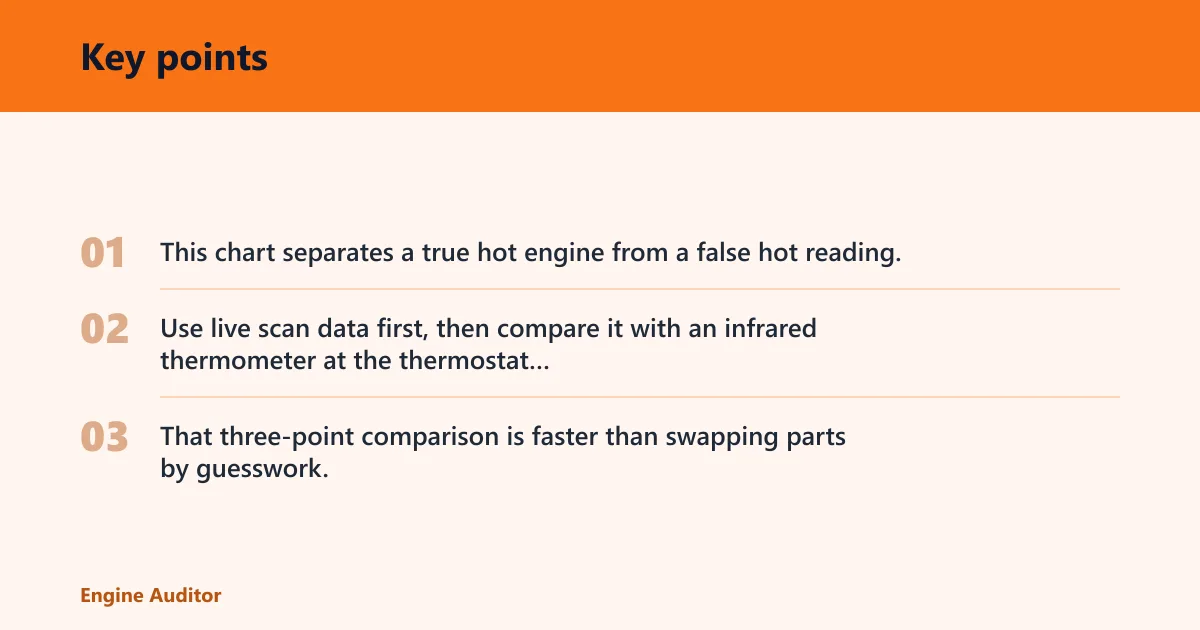


This chart separates a true hot engine from a false hot reading. Use live scan data first, then compare it with an infrared thermometer at the thermostat housing or upper hose. That three-point comparison is faster than swapping parts by guesswork.
| Scan-tool coolant temp | IR thermometer at thermostat housing or upper hose | Dashboard gauge behavior | Next check |
|---|---|---|---|
| 185 to 205°F | Within about 10 to 15°F of scan data | Gauge near normal or slightly above normal | Likely normal operation. If the gauge still reads hot, suspect cluster, wiring, or gauge calibration. |
| 195 to 220 degrees | Near scan data, with steady rise and fall | Gauge rises normally, no red zone | Cooling system is probably behaving as designed. If the needle is erratic, check the sensor circuit and cluster. |
| Below 180°F while gauge is hot | Also cool or only mildly warm | Gauge reads hot or jumps high | False signal path. Inspect the coolant temperature sensor, wiring, connectors, and cluster input. |
| 220°F/104°C plus | Upper hose and thermostat housing are clearly hot | Gauge is high and may enter the red zone | Assume real overheating. Check coolant level, airflow, thermostat action, radiator condition, and fan operation after the engine cools. |
| Fluctuating wildly | Also fluctuates or shows sudden drops | Needle swings or spikes intermittently | Look for air in the cooling system, poor connector contact, broken wires, or a drifting sensor signal. |
Why is the gauge hot?
A hot gauge can mean a false signal or real heat. Some vehicles use one coolant temperature sensor for the ECU and cluster; others split the signal path, so a fault in one branch can mislead the dash while the engine stays near normal. Verify the data before replacing parts.
Start with the signal path
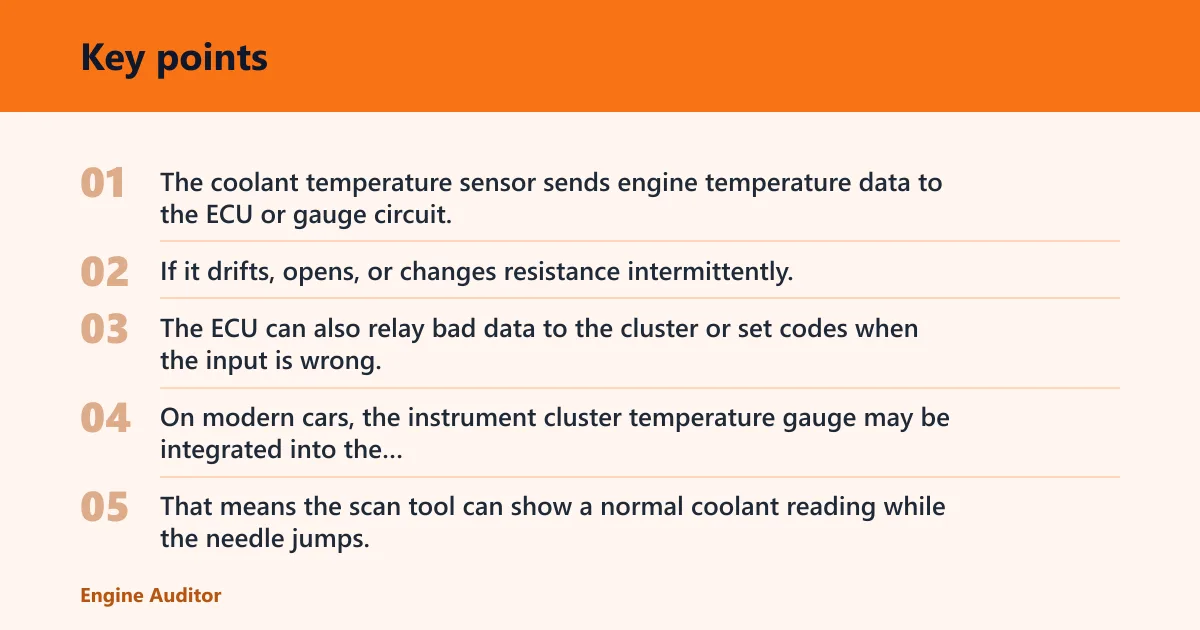
The coolant temperature sensor sends engine temperature data to the ECU or gauge circuit. If it drifts, opens, or changes resistance intermittently, the gauge can read hot even when the engine is not overheating. The ECU can also relay bad data to the cluster or set codes when the input is wrong.
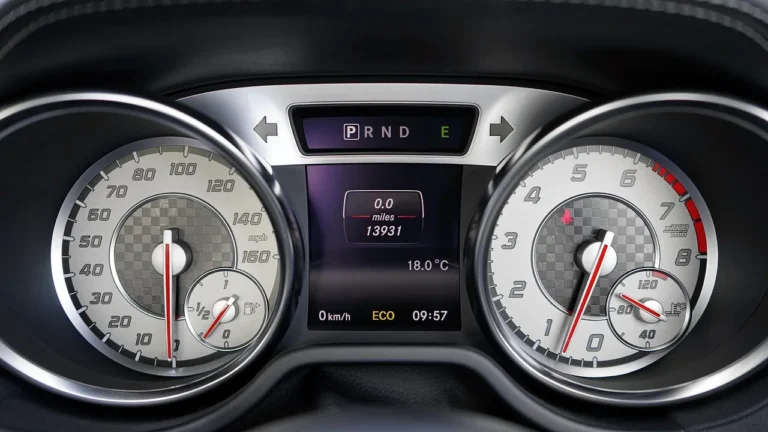
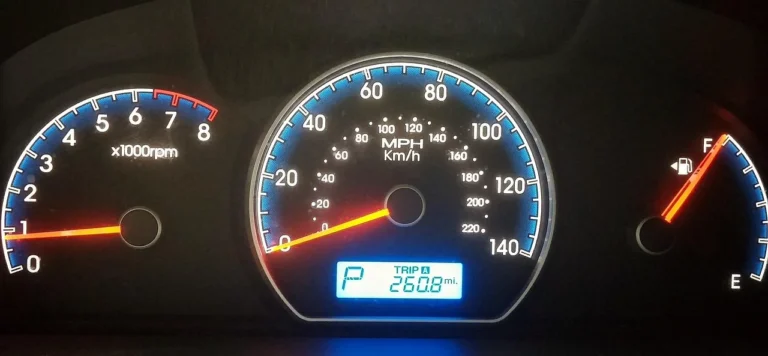
On modern cars, the instrument cluster temperature gauge may be integrated into the cluster and can fail on its own. That means the scan tool can show a normal coolant reading while the needle jumps, hangs high, or reads erratically.
Use live data before touching parts
An OBD2 scanner gives the most useful first check. Compare reported coolant temperature with the dashboard gauge and, if possible, with an infrared thermometer aimed at the thermostat housing or upper hose. MechanicBase recommends verifying temperature with scan data, and it lists 195 to 220 degrees as the ideal operating band.
Check coolant level first
Check the coolant level with the engine cold, not after a drive. Low coolant can mimic a temperature problem, expose the sensor, and let the gauge swing as trapped pockets move through the system. The reservoir markings should show the proper cold level before any deeper diagnosis starts.
What low coolant can hide
Low level is not just a refill issue. It can leave air near the coolant temperature sensor, cause unstable readings, and make the gauge jump before the engine is truly hot. The same source lists low coolant as a cause of a hot-running engine, so a low reservoir deserves attention even if there is no steam.
A common first-timer mistake is checking the reservoir after a short drive and assuming the level is “fine” because coolant is still visible. Compare the level to the cold-engine marks, because expansion after warm-up can mask a low fill.
Roadside checks that are safe
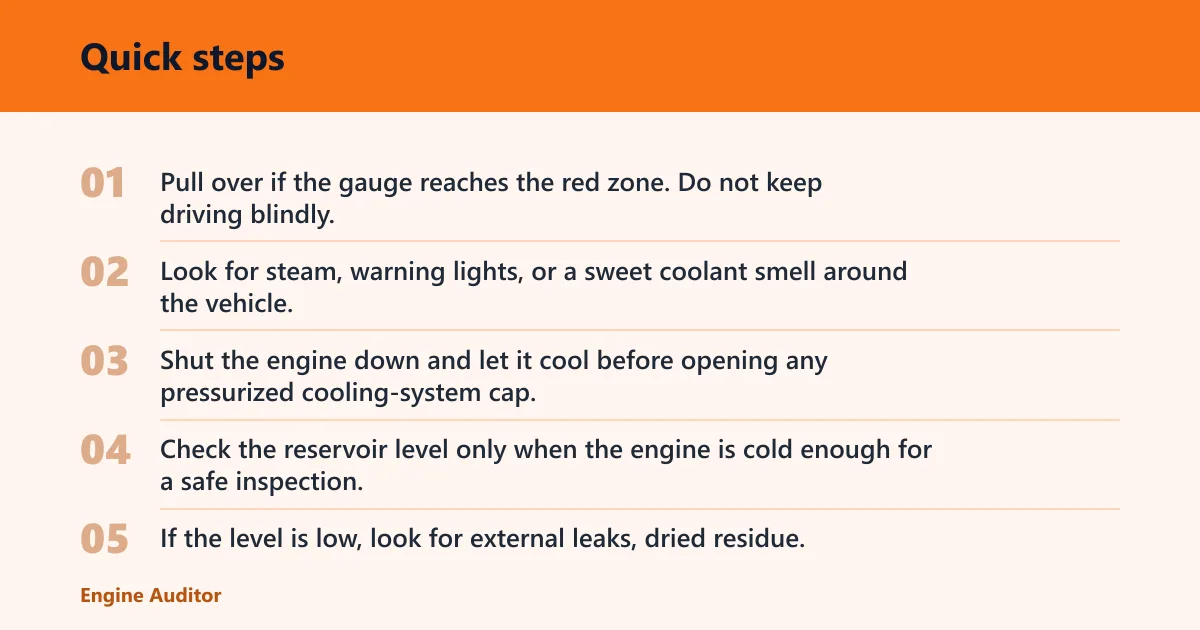
- Pull over if the gauge reaches the red zone. Do not keep driving blindly.
- Look for steam, warning lights, or a sweet coolant smell around the vehicle.
- Shut the engine down and let it cool before opening any pressurized cooling-system cap.
- Check the reservoir level only when the engine is cold enough for a safe inspection.
- If the level is low, look for external leaks, dried residue, or wet hose ends before topping off.
Can a bad coolant temperature sensor make the gauge read hot?
Yes. A faulty coolant temperature sensor can make the gauge read hot, drift upward, or spike intermittently even when the engine is not overheated. It is one of the most common suspects, but you should prove it with live scan data or a multimeter before replacement.
How the sensor fails
The sensor can fail electrically, change resistance as it warms, or send a biased reading that looks hotter than reality. Some faults are intermittent and appear only after heat soak. MechanicBase also notes that a faulty sensor can affect auxiliary fan operation, which can complicate the symptom pattern.
Suppose the scan tool shows 188°F while the dash needle sits near hot. That mismatch points away from true overheating and toward the sensor circuit, the cluster, or the wiring between them.
How to test it
Use scan data first, then test resistance with a multimeter if the service information gives a chart. Compare readings cold and as the engine warms. If the sensor output jumps without a matching change in actual temperature, the sensor is suspect.
- Check for trouble codes tied to coolant temperature input.
- Compare cold resistance to the expected range in the service manual.
- Watch for unstable readings as the wiring is gently moved.
- If the sensor shares a circuit with the ECU and cluster, confirm both paths.
Wiring and connector faults
Broken wires, corrosion, poor contact, and high resistance can all distort coolant temperature readings. These faults often show up as spikes, sudden drops, or a gauge that changes after the car warms and the connector heat-soaks.
Where to inspect
Use wiring diagrams to trace the sensor, ECU, and cluster path. Inspect the connector at the sensor first, then follow the wiring for rubbed insulation, oil contamination, bent pins, or looseness. High resistance in a terminal can make a good sensor look bad.
A broken conductor does not always create a dead gauge. It can also create an erratic gauge, especially when vibration or engine movement opens and closes the circuit.
What to measure
Check continuity and resistance across suspect sections with the battery disconnected where the service procedure requires it. If the scan-tool reading flickers while the wiring is moved, that is a strong clue. A temperature gauge that spikes only after a bump or a hard turn often points to a wiring fault rather than a cooling problem.
Can the cluster lie?
Yes. The instrument cluster temperature gauge can fail, read high, or move erratically even when the ECU data is normal. On many modern vehicles, the gauge is part of the cluster electronics, so the fault may be inside the panel rather than in the engine bay.
When the ECU data looks normal
If scan data stays stable and the infrared reading matches it, but the dash still reads hot, the cluster becomes a prime suspect. Some clusters need repair; others need replacement and coding or programming, depending on the vehicle design.
Picture a sedan that reports 198°F on the scanner and shows a normal upper hose temperature with the IR thermometer, yet the gauge rests near the hot mark. That pattern fits a cluster fault far better than a cooling-system fault.
ECU input faults
The ECU can also be the relay point for bad coolant temperature data. In rare cases, the control unit itself is the fault source. More often, the ECU is simply passing along a bad sensor signal or a wiring fault, and it may set codes that help narrow the circuit.
Thermostat and airflow checks
A thermostat problem can still matter even when there is no steam. The same source notes that a thermostat closes when the engine is cold and opens once the engine gets hot. If it sticks closed, real overheating can develop; if it sticks open, warm-up behavior changes and the gauge may behave oddly.
Thermostat behavior
A stuck-open thermostat usually causes long warm-up times and cooler-than-normal readings. A stuck-closed thermostat can trap heat and push the coolant toward a real overheat. That is why the gauge should not be blamed on electronics until scan data and hose temperatures are compared.
Radiator and airflow
Radiator blockage, fan failure, and poor airflow can raise actual temperature even before steam appears. Do not ignore these because the engine still runs smoothly. A faulty fan relay, clogged radiator fins, or debris between the radiator and condenser can create real heat with no dramatic symptom yet.
The same source lists air in the cooling system as a cause, low coolant as a cause, a bad temperature gauge as a cause, and an overworked engine as a cause. Those may overlap. A car towing uphill in hot weather may run closer to the upper end of normal, while a clogged radiator or weak fan can push it beyond that range.
Frequently asked questions
Why is my temperature gauge reading hot but the engine is not overheating?
That pattern usually means the measurement chain is lying somewhere between the sensor and the dash. Start with scan-tool coolant temperature and an IR reading at the thermostat housing or upper hose. If those readings are normal, focus on the sensor, connector, wiring, ECU input, or instrument cluster.
Could a broken wire or connector cause the temperature gauge to read hot?
Yes. Broken conductors, corrosion, loose terminals, and high resistance can all distort the signal. These faults often cause spikes, erratic movement, or readings that change when the wiring is moved. Use wiring diagrams, continuity checks, and connector inspection before replacing expensive parts.
How do I tell if the gauge is wrong or the engine is actually hot?
Compare three readings: scan-tool coolant temperature, infrared temperature at the thermostat housing or upper hose, and the dashboard gauge. If scan data and IR temperature agree but the gauge reads hot, the fault is likely in the cluster or signal path. If all three are high, treat it as real overheating.
Is air in the cooling system enough to make the gauge act hot?
Yes. Air pockets can sit at the sensor, create bubbles, and produce unstable or misleading readings. Air is especially likely after coolant loss or poor bleeding. If the scan data swings oddly while the engine temperature seems steady, trapped air should be part of the diagnosis.
Can a faulty instrument cluster make the temperature gauge read high?
Yes. Many modern cars use an integrated cluster gauge that can fail on its own. If scan data is normal and the infrared reading matches it, the cluster becomes a likely fault source. In that case, cluster repair or replacement may be needed after the wiring has been checked.
Products related to this article
Sponsored / affiliate links. As an Amazon Associate I earn from qualifying purchases. I may earn additional commission from eligible campaigns.