Why Is My Temperature Gauge Reading Cold?
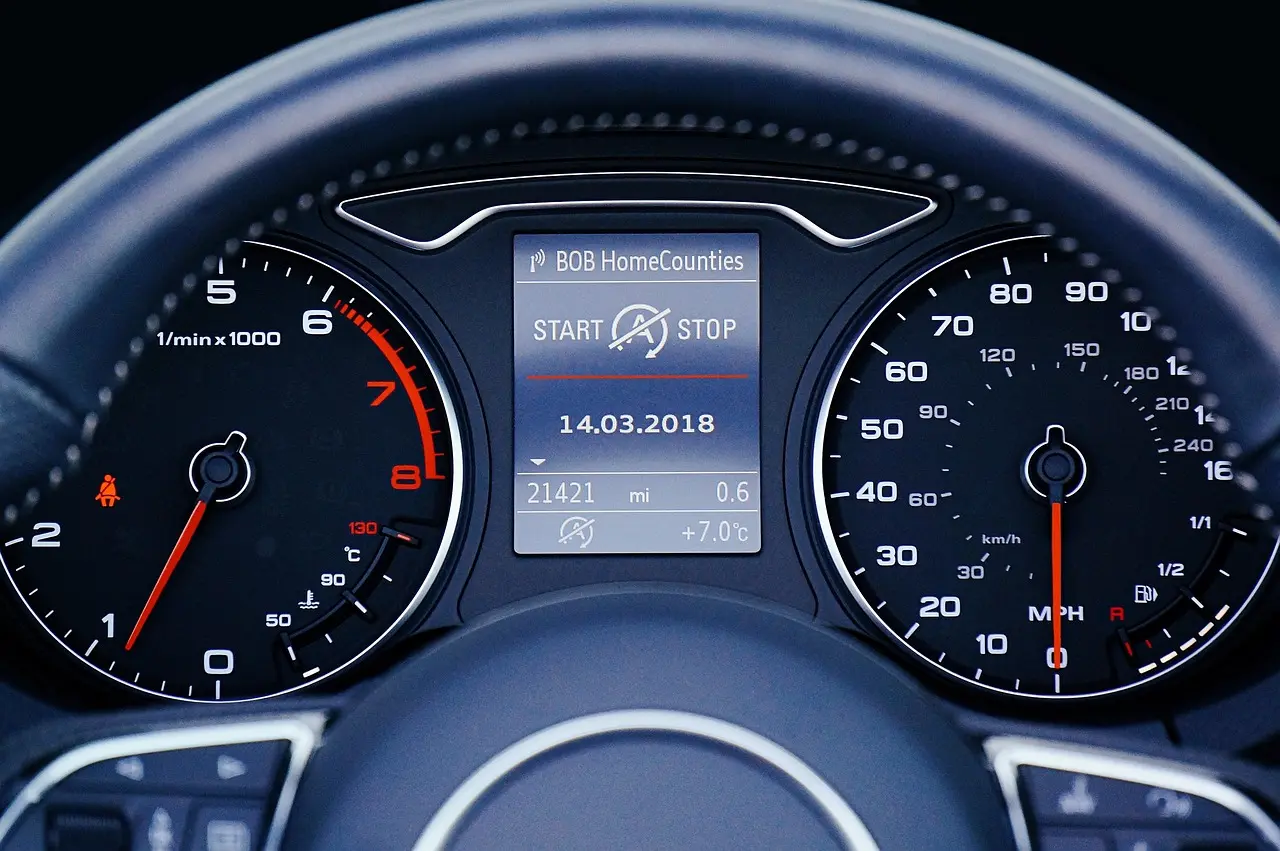
A temperature gauge that stays on cold usually means the engine may be running too cool because the thermostat is stuck open, or there may be a fault in the gauge circuit or related parts such as the coolant temperature sensor, wiring, an air pocket, or the instrument cluster. Ignoring it can hide a real overcooling or warm-up problem, and a bad reading can also mask overheating later. This guide shows how to tell real low temperature from a false cold reading, then narrow the fault to the thermostat, sensor, wiring, air, or instrument cluster.
Cold gauge diagnosis


First, decide if the engine is actually cold or if the gauge is wrong. The quickest split comes from heater output, hose temperature, and scan data. If the cabin heat stays weak, the upper radiator hose warms very slowly, and the scan tool shows low coolant temperature, the engine may be underheating. If the heater is hot and scan data looks normal while the dash stays cold, the problem is likely in the gauge path.
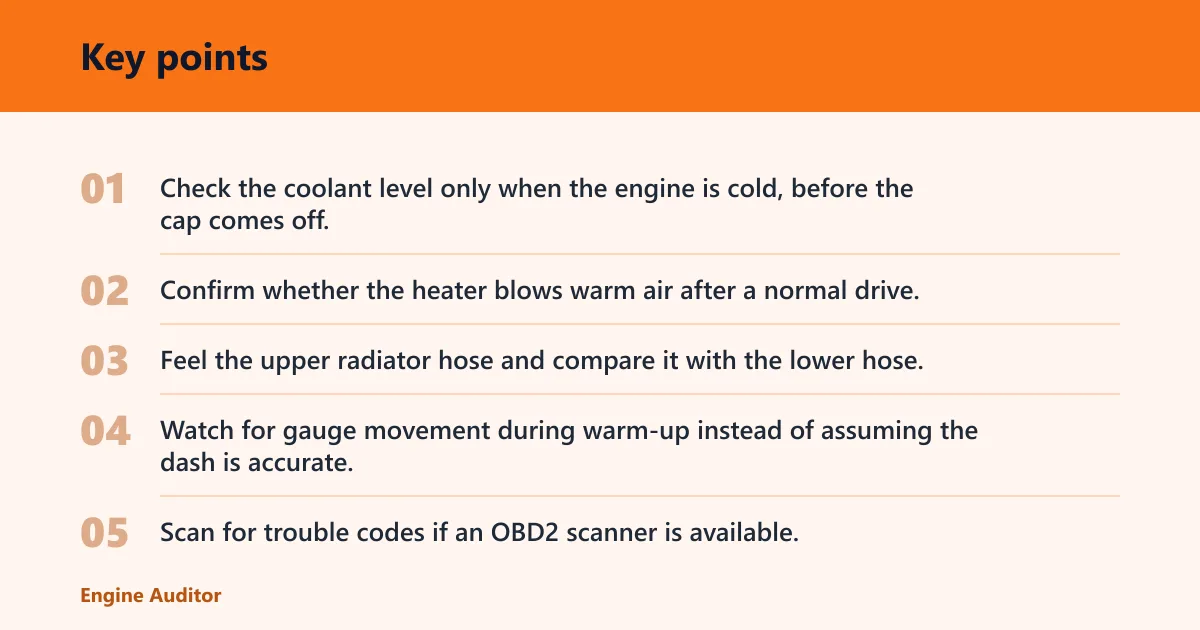
Start with the cheapest test
- Check the coolant level only when the engine is cold, before the cap comes off.
- Confirm whether the heater blows warm air after a normal drive.
- Feel the upper radiator hose and compare it with the lower hose.
- Watch for gauge movement during warm-up instead of assuming the dash is accurate.
- Scan for trouble codes if an OBD2 scanner is available.
If the car has just had coolant service, air may move higher on the list. A small pocket at the sensor can make a healthy engine look cold on the dash. Suppose the coolant was changed yesterday and the gauge now bounces between cold and normal on hills. That pattern points first to trapped air, not a failed thermostat.
What does it mean when your temperature gauge stays on cold?
A gauge that never leaves cold means one of two things: the engine is not reaching normal operating temperature, or the temperature signal is not getting to the cluster correctly. Modern temperature gauges are often integrated into the instrument cluster, so the fault may sit in the sensor, wiring, cluster, or ECU data path rather than the gauge face itself.
Which symptom pattern points where?
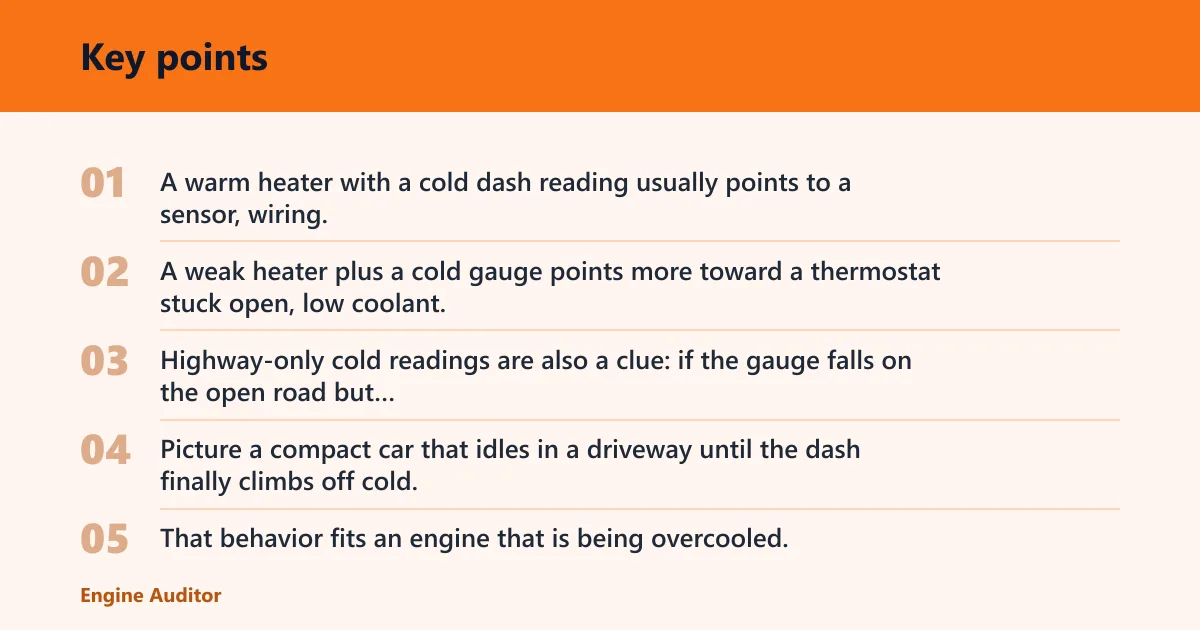
Use the pattern, not the needle alone. A warm heater with a cold dash reading usually points to a sensor, wiring, or cluster issue. A weak heater plus a cold gauge points more toward a thermostat stuck open, low coolant, or air in the system. Highway-only cold readings are also a clue: if the gauge falls on the open road but climbs in traffic, the thermostat may be stuck open enough to overcool at speed.
Picture a compact car that idles in a driveway until the dash finally climbs off cold, then drops again on the highway. That behavior fits an engine that is being overcooled, often by a thermostat that is not closing fully. The gauge is warning about a real temperature problem in that case, even if the needle itself is not perfectly accurate.
Compare heater output and hose temperature
Warm air from the heater is a useful reality check. If the heater output turns hot while the gauge stays cold, the engine is likely warm and the gauge signal path is suspect. If the heater stays lukewarm and both radiator hoses warm slowly, the engine may never be reaching normal temperature because coolant flow through the radiator is too early.
Hose temperature matters because it separates flow problems from display problems. A warm upper hose with a cool lower hose often means the thermostat is doing its job and the radiator is rejecting heat. Two hoses that warm together too soon can point to a thermostat stuck open.
Use idle versus highway behavior to separate causes
An engine that warms slowly at idle but seems normal once driven may have a thermostat problem, because airflow across the radiator changes at road speed. A gauge that behaves strangely only at idle, especially with fluctuating readings, can also point to air near the sensor or a connector problem. If the reading changes little between city and highway driving, suspect the sensor or cluster before the thermostat.
Check recent coolant service for trapped air
Recent coolant replacement is a major clue. Air in the cooling system can cause the gauge to stay cold if the bubble sits at the sensor, and it can also make the reading jump around. Bleeding the system correctly is the fix, but the cause should still be verified before parts are replaced.
Temperature sensor and wiring
The coolant temperature sensor, often called the ECT sensor, is the most common cause of a gauge that stays on cold. Some vehicles use two temperature sensors. Others use one sensor for both ECU temperature and the gauge. That layout matters because one failed circuit can affect only the dash, while another can affect both the ECU and the cluster.
ECT sensor layouts on different vehicles
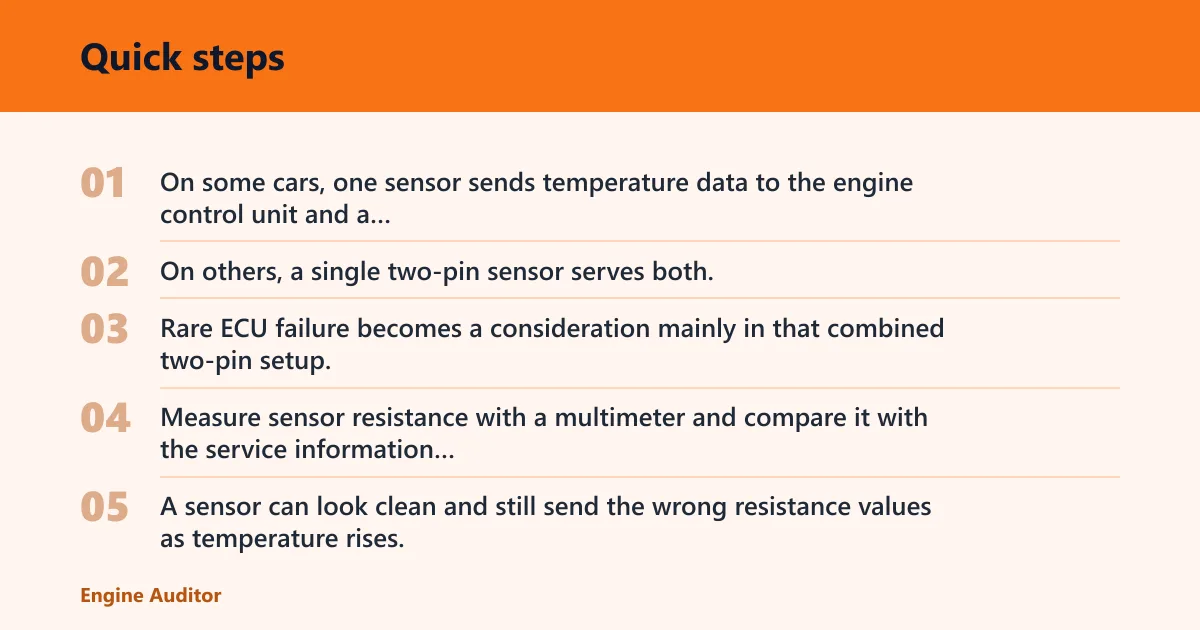
On some cars, one sensor sends temperature data to the engine control unit and a separate sender feeds the gauge. On others, a single two-pin sensor serves both. Rare ECU failure becomes a consideration mainly in that combined two-pin setup, because the module may receive bad or missing data before the cluster ever sees it.
How to test the sensor with a multimeter
Measure sensor resistance with a multimeter and compare it with the service information for that vehicle. The point is not to guess from appearance. A sensor can look clean and still send the wrong resistance values as temperature rises. A sensor that never changes in a sensible direction as it warms is suspect.
Use the meter at the sensor connector first, then at the wiring side if the reading is strange. That split helps tell whether the sensor itself is wrong or the signal is being lost in the circuit.
Check harness continuity and connector corrosion
Bad wiring between the cluster and the sensor can cause the issue. Broken wires can interrupt the temperature signal, and corrosion in plug connectors is a common problem. Clean the electrical connector, inspect the seal, and look for coolant wicking or green corrosion inside the pins. If the seal has failed once, the corrosion may return unless the connector is repaired correctly.
Resistance testing is the practical next step when the circuit seems open or intermittent. Do not skip the wiring just because the sensor looks new. A fresh sensor cannot fix a broken signal path.
Thermostat and coolant flow
The thermostat controls coolant flow through the radiator. If it sticks wide open, coolant circulates too early and the engine may never reach optimal operating temperature. That can leave the gauge near cold, especially in cool weather or on the highway where airflow through the radiator is strongest.
A thermostat stuck open and slow warm-up
A stuck-open thermostat usually creates a slow warm-up pattern, weak cabin heat, and a gauge that struggles to climb. The engine may still run, but it runs too cool. That is not harmless. Fuel control and cabin comfort both suffer when the engine never settles near its designed temperature.
What hose temperatures tell you
Watch the radiator hoses during warm-up. A healthy thermostat keeps the upper radiator hose cooler at first, then opens once the engine warms. If both hoses warm almost together from a cold start, the thermostat may be open too soon. If the heater stays weak while the hose temperatures look wrong, low coolant or air may be part of the problem too.
When low coolant or air can mimic thermostat trouble
Low coolant can make the temperature gauge read cold if the sensor is exposed to steam, air, or a moving pocket of coolant rather than a steady flow. Air in the system can copy thermostat symptoms closely. Bleeding the cooling system is the corrective step, but only after you confirm that the level is correct and there is no active leak.
Gauge and cluster faults
When the cluster lies, the engine may be fine. A fault in the instrument cluster or temperature gauge can leave the needle on cold even while the ECU sees normal temperature. Modern gauges are often integrated into the instrument cluster, so the fault can sit inside the module, not in the face of the gauge itself.
When the cluster lies
If scan data shows normal coolant temperature, the heater is hot, and the wiring tests pass, the cluster becomes a stronger suspect. Some clusters fail because of internal faults or bad solder joints. In that case the gauge may stay cold, move erratically, or fail only after vibration or heat soak.
Bad solder joints and internal failure
Internal cluster faults often behave like intermittent electrical problems. The reading may flicker, lag, or recover after a bump. That pattern is not typical of a thermostat failure, which usually changes the warm-up curve more than the needle movement itself.
When programming or replacement may be needed
Some cluster repairs require replacement or programming, especially when the gauge is part of a module-based dash. If the cluster stores the vehicle’s mileage or other coded data, replacement may involve setup steps beyond simple bolt-in installation. That makes diagnosis worth doing carefully before ordering parts.
Cold-reading symptom matrix
This table maps common symptom patterns to the most likely fault, the first test to run, and the tool required. Use it to separate a real cold engine from a false cold reading before replacing parts.
| Symptom pattern | Most likely fault | First test | Tool required |
|---|---|---|---|
| Warm heater, dash stays cold | ECT sensor, wiring, or cluster fault | Compare scan-tool coolant temp with dash reading | OBD2 scanner |
| Weak heater, both radiator hoses warm early | Stuck-open thermostat | Watch hose warm-up from a cold start | Hand check and thermometer if available |
| Gauge fluctuates after coolant service | Air in the cooling system | Bleed the system and recheck level | Cooling-system bleed tools |
| Gauge reads cold only on the highway | Thermostat stuck open | Compare idle versus highway behavior | Road test and OBD2 scanner |
| Scan tool shows normal temperature, dash stays cold | Instrument cluster or gauge fault | Test cluster input and gauge response | Ohm tester |
| Cold reading with corrosion at connector | Connector corrosion or broken wiring | Inspect and clean the connector, then test continuity | Multimeter |
ECU and OBD2 checks
An OBD2 scanner can check trouble codes in the engine control unit and show live coolant temperature data. That live number is the key comparison point. If the ECU sees normal temperature but the dash still reads cold, the fault is downstream of the ECU. If the ECU also sees a low or erratic reading, the sensor or its circuit is still in play.
Read codes and live coolant data
Look for temperature-related codes first, then view live data as the engine warms. A steady rise in scan data with a dead-cold dash points toward cluster or gauge trouble. A scan reading that stays implausibly low supports a sensor, wiring, or air problem instead.
Confirm whether the ECU sees temperature correctly
This step matters on vehicles with one sensor for both ECU and gauge, and on vehicles with separate sensors. If the ECU gets correct data but the gauge does not, the cluster or the wire to the gauge side is the likely fault. If both are wrong, stay focused on the sensor, connector, air pocket, or thermostat.
When a module fault is still on the table
The rare ECU-failure scenario applies mainly when a combined two-pin temperature sensor is used. That does not make the ECU the first suspect. It becomes a later check after the sensor, wiring, connectors, and thermostat have been ruled out with data, not guesses.
Frequently asked questions
Why is my temperature gauge reading cold?
The most common reasons are a faulty coolant temperature sensor, a stuck-open thermostat, wiring trouble, air in the cooling system, or a cluster fault. Use heater output, hose temperature, and scan data to decide whether the engine is truly cold or the gauge circuit is lying.
Can a bad coolant temperature sensor make the gauge stay cold?
Yes. The coolant temperature sensor is the most common likely fault in this diagnosis. Some vehicles use one sensor for both ECU and gauge data, while others use two. Test the sensor with a multimeter and compare live OBD2 data to the dash reading.
Could low coolant make the temperature gauge read cold?
Yes. Low coolant can uncover the sensor or let it read steam, air, or unstable coolant flow. That can make the gauge stay cold or swing around. Check the level only when the engine is cold, then look for leaks before assuming the sensor is bad.
Can air in the cooling system cause a cold temperature reading?
Yes. Air in the cooling system can trap a bubble at the sensor and distort the reading. The gauge may stay cold or fluctuate after coolant service. The fix is to bleed the cooling system correctly and verify that the level stays stable afterward.
Is a stuck-open thermostat why the gauge never warms up?
It often is. A thermostat stuck wide open can keep coolant flowing through the radiator too soon, so the engine never reaches optimal temperature. That usually shows up as slow warm-up, weak cabin heat, and a gauge that sits near cold, especially at highway speed.
Could wiring or corrosion cause the temperature gauge to read cold?
Yes. Broken wires, corroded connectors, and poor seals can interrupt the signal between the sensor, ECU, and cluster. Cleaning the connector and checking continuity with a multimeter are practical first tests. If the signal drops out only when the wiring is moved, the wiring is suspect.
How do I test the coolant temperature sensor and gauge circuit?
Start with an OBD2 scan, then compare live coolant temperature with the dash. Measure sensor resistance with a multimeter, inspect connector corrosion, and test wiring continuity. If the ECU data is normal but the gauge stays cold, the cluster or its internal circuitry becomes the stronger suspect.
Products related to this article
Sponsored / affiliate links. As an Amazon Associate I earn from qualifying purchases. I may earn additional commission from eligible campaigns.