Why Is My Engine Taking Too Long to Reach Operating Temperature?
If the temperature gauge stays below normal after about 10–15 minutes of driving, or the cabin heat never gets hot, suspect a cooling-system fault rather than normal cold-weather warm-up. Ignoring it can mean poor fuel economy, excess wear, and hidden overheating later. This guide shows the symptom patterns that point to a stuck-open thermostat, bad coolant sensor, low coolant, or fan-control problem.
What normal warm-up looks like
The engine is built to run in a set temperature range. A thermostat limits coolant flow when the engine is cold, then opens as temperature rises so the engine can settle into that range. When everything works, the gauge should rise steadily, not sit near the bottom for a long stretch.
A slow rise is not the same as a gauge that stays low. Short trips, winter air, and strong airflow across the radiator can all delay warm-up, but the engine should still reach normal once load and time add up. If it never gets there, the pattern matters more than the calendar.
Why running cold matters
Low temperature can hurt fuel economy and increase engine wear. Cold-reading sensors can also push the ECU into richer fueling, which raises emissions and can increase carbon buildup. The problem is not only comfort or dashboard behavior. It changes how the engine runs.
Hot coolant also flows through the heater core to warm the cabin. That is why weak cabin heat often points to a real low-temperature condition, not just a flaky gauge. If the heater stays lukewarm after the engine has been running long enough, treat that as a clue, not a coincidence.
Is it normal for my car to take longer to warm up in cold weather?
Cold weather can lengthen warm-up time. Cold air makes it harder for the engine to hold heat, so winter driving can slow the gauge rise and keep cabin heat weak for longer. That delay is usually most obvious on short trips and in freezing temperatures.
The key is whether the pattern stays within reason. A cold morning can explain a slower climb. It does not explain a gauge that never reaches normal, a heater that stays weak after a longer drive, or a temperature drop that appears only when highway airflow increases.
When normal winter delay stops looking normal
Use the whole symptom set. If the gauge warms slowly but reaches its usual mark, the thermostat and fan control may still be fine. If the gauge hovers low, the heater stays lukewarm, and fuel economy drops, the problem looks more like a cooling-system fault than ambient temperature alone.
A block heater is suggested for freezing temperatures. That can help with cold starts, but it should not be used to explain a persistent low-temperature reading after the engine has been driven long enough to warm up on its own.
Can a stuck-open thermostat make my engine run too cold?
Yes. A thermostat can fail stuck closed or stuck open, and a stuck open thermostat prevents the engine from reaching its ideal operating temperature. When cold, the thermostat stays closed to help the engine warm up quickly. If it sticks open, coolant flows too soon and too freely, so warm-up drags out.
A common clue is a gauge that climbs slowly, then never settles where it used to. Another is weak cabin heat, especially at idle and during highway cruising. The thermostat is one of the first parts to suspect when the engine seems permanently behind on temperature.
What highway temperature drop can mean
If the gauge looks acceptable in town but drops on the highway, look at airflow and thermostat control together. A faulty radiator fan can cause overcooling, and a fan can keep the engine too cool in cold weather if it runs when it should not. A thermostat that is stuck open can make that drop more noticeable.
Suppose a 4-cylinder sedan warms up in stop-and-go traffic, then the gauge falls once steady highway airflow begins. That pattern fits overcooling better than a fuel issue. A thermostat that opens too early is a common cause, but a fan that keeps running is another.
Can low coolant cause slow warm-up?
Low coolant may delay warm-up and weaken cabin heat because the heater core depends on hot coolant flow. A closed system should not keep losing coolant, so a top-up should always lead to a leak check, not a shrug. Low level can come from hoses, radiator, water pump, reservoir, thermostat housing, heater core, gaskets, or seals.
Low coolant can also make temperatures act inconsistent from one drive to the next. Air pockets move through the system, heat transfer suffers, and the gauge may swing or climb erratically. That is different from a thermostat problem, which usually follows a more repeatable pattern.
What to inspect before adding more coolant
- Check the reservoir level only when the engine is cold.
- Look for damp hoses, dried residue, or crust near clamps and fittings.
- Inspect the radiator cap area, thermostat housing, and water pump for signs of seepage.
- Check the passenger footwell or windshield for a sweet smell or fogging that can point to a heater-core leak.
- Track whether the level drops again after one or two drives.
If you need to keep topping off a closed system, that is a leak pattern until proven otherwise. Do not treat low coolant as normal maintenance loss.
Can a bad coolant temperature sensor make the gauge read wrong?
Yes. The coolant temperature sensor measures engine coolant temperature and usually feeds the ECU or ECM, and sometimes the dashboard gauge as well. A faulty sensor can make the ECU think the engine is colder than it is, and a bad temperature sensor can cause the engine to run richer than necessary.
That means the dash can mislead you in two different ways. Sometimes the engine is actually cold. Sometimes the gauge is wrong while the engine has already warmed up. The distinction matters because the repair path is not the same.
Gauge problem or real cold-running engine?
If the heater blows hot, the upper radiator hose gets warm, and the gauge still reads low or jumps around, suspect the sensor, wiring, or cluster side of the problem. If the heater stays weak and the hose remains cooler than expected after a normal drive, the engine itself may truly be running cold.
Picture a driver who sees a low gauge on a 20-minute commute, but the cabin heat is strong and steady. That points more toward a sensor or gauge fault than a stuck-open thermostat. If both the gauge and the heater agree that the engine is cold, the fault is more likely real.
Engine temperature matrix
This matrix helps separate cold-weather delay from a fault. Use the symptom pattern first, then the quick test, then decide whether to monitor or book service.
| Symptom | Most likely cause | Quick confirmation test | Urgency | Shop now vs. monitor |
|---|---|---|---|---|
| Longer warm-up in freezing weather, but the gauge eventually reaches normal | Cold weather ambient temperature | Compare a cold morning drive to a mild day on the same route | Low | Monitor if the gauge reaches normal and cabin heat becomes strong |
| Gauge climbs slowly and stays low on most drives | Stuck-open thermostat | Watch whether highway airflow makes the gauge drop farther | Medium to high | Shop now if it repeats after several drives |
| Weak cabin heat, low coolant level, or a level that keeps falling | Low coolant or leak | Check the reservoir cold, then inspect for seepage or residue after parking | High | Shop now; a closed system should not keep losing coolant |
| Dash reads cold, but heat output seems normal | Bad CTS or gauge fault | Compare dash reading to heater output and hose warmth after a normal drive | Medium | Monitor briefly if drivability is normal; shop now if fueling or shifting seems off |
| Temperature falls at speed, fan runs when the engine is already cold | Overcooling fan fault | Confirm whether the fan keeps running after a cold start with little load | High | Shop now if the fan runs continuously when it should not |
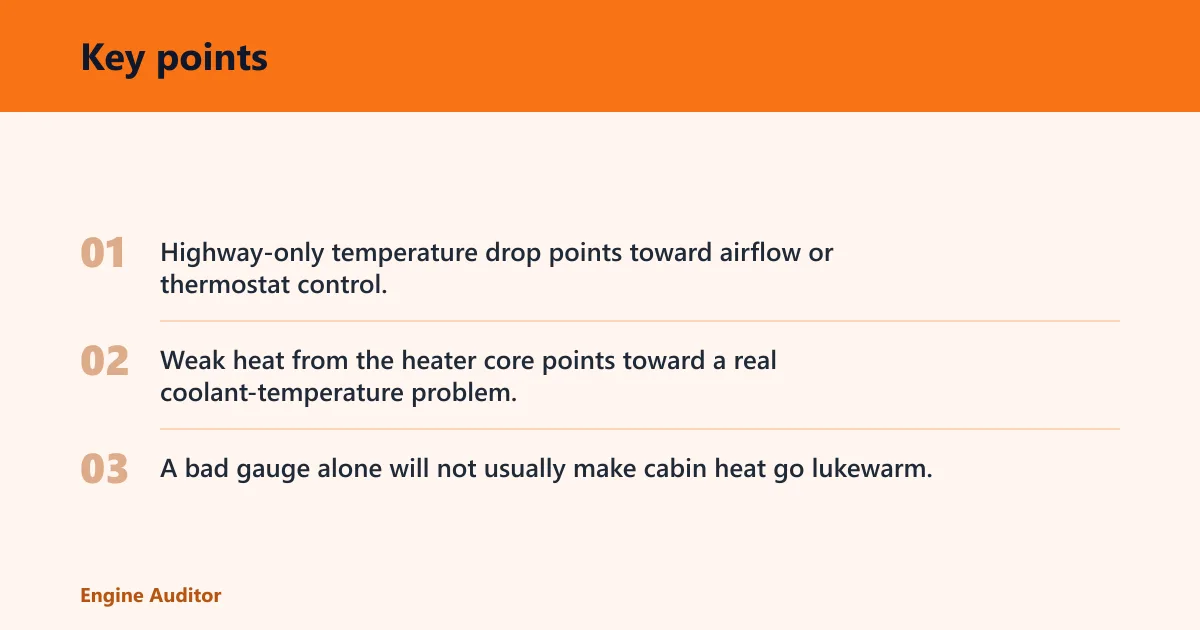
Two clues are especially useful here. Highway-only temperature drop points toward airflow or thermostat control. Weak heat from the heater core points toward a real coolant-temperature problem, or low coolant that is keeping hot coolant away from the core. A bad gauge alone will not usually make cabin heat go lukewarm.
When a radiator fan keeps the engine too cool
Yes, a radiator fan can keep the engine too cool. A faulty radiator fan can cause overcooling, and a fan can keep the engine too cool in cold weather if it runs when it should not. Relay, switch, or sensor faults can command the fan on when there is no need for extra cooling.
A cold engine should not have a continuously running fan. If the fan starts early, stays on after a cold start, or runs hard during easy driving in cold weather, the system may be overcooling the engine instead of protecting it.
What fan-control faults look like
Fan-related problems often show up as a gauge that refuses to settle, especially at highway speeds or right after startup. The heater may still be weaker than expected because the coolant never stays hot long enough. Unlike a simple cold-day delay, this pattern tends to repeat in a similar way each drive.
A common first-timer mistake is to blame the thermostat immediately when the fan is actually the part holding the engine cold. If the fan runs when the engine is stone cold, that is not normal behavior.
Why is my heater blowing lukewarm air when the engine is cold?
Weak cabin heat usually means the engine is not sending enough hot coolant to the heater core, or the heater core is not getting steady hot flow. Hot coolant flows through the heater core to warm the cabin, so lukewarm air often tracks with low operating temperature, low coolant, or a thermostat that is not closing properly.
If the heater gets warm only at idle and fades on the highway, think airflow or thermostat control. If the heater stays weak all the time, and the gauge also reads low, the engine may be running cold for real. That is a stronger fault signal than the dash alone.
Why does my engine temperature drop while driving on the highway?
A temperature drop at highway speed can point to overcooling. Fast airflow through the radiator can expose a thermostat that is stuck open, or a fan that is running when it should not. Cold air makes it harder for the engine to hold heat, so a weak system can show the problem most clearly at speed.
If the drop happens only after several minutes on the highway, and the heat output also drops, that pattern is more consistent with a real cooling-system fault than with a bad gauge. A sensor issue can misread temperature, but it usually does not explain the heater’s behavior by itself.
What symptoms mean I should get the cooling system inspected?
Get the cooling system inspected if the gauge stays below normal after about 10–15 minutes of driving, the heater never gets properly hot, or the temperature drops on the highway. These are pattern-based warnings. They point to thermostat, coolant level, sensor, or fan-control faults more than to ordinary winter delay.
Do not wait if coolant keeps disappearing, the fan runs continuously on a cold engine, or the car is running rich and getting worse fuel economy. Those signs suggest the problem is affecting operation, not just comfort.
Simple decision path before booking a shop visit
- Check whether the issue happens only in very cold weather or on every drive.
- Note whether cabin heat is weak, normal, or strong.
- Watch for highway temperature drop versus idle-only behavior.
- Inspect coolant level cold, then recheck after a day or two.
- Decide whether the dash reading matches the heater and hose temperature.
If the answers point in different directions, that is useful. A gauge fault looks different from a real cold-running engine, and a leak pattern looks different from a thermostat problem. The symptom set is the diagnosis tool.
Frequently asked questions
Why is my engine taking too long to warm up?
The most common pattern is a thermostat that is stuck open, cold weather that slows heat retention, or low coolant that prevents steady heat transfer. If the gauge stays low after 10–15 minutes, or the heater never gets hot, the problem is more likely a fault than normal winter delay.
Could a bad coolant temperature sensor make the gauge read wrong?
Yes. A faulty temperature sensor can make the ECU think the engine is colder than it is, and that can also cause the engine to run richer than necessary. If the heater is strong but the gauge reads low, suspect the sensor, wiring, or gauge side of the system.
Can a radiator fan cause the engine to stay too cool?
Yes. A faulty radiator fan can cause overcooling, and a fan can keep the engine too cool in cold weather if it runs when it should not. Relay, switch, or sensor faults can command the fan on too early or too often, which is not normal on a cold engine.
Products related to this article
Sponsored / affiliate links. As an Amazon Associate I earn from qualifying purchases. I may earn additional commission from eligible campaigns.
 Car A/C Repair Kit, 270PCS Rubber O-Ring Seal Kit + 40PCS Car Air Conditioner Valve Core Kit for R12 R134a A/C with Remover & Install Tool+10pcs R134a AC Valve Caps, Fix Refrigeration System
 Auto Car Dent Repair Puller Head Paintless-Dent Repair Removal Kit for Slide Hammer Pulling Tab Adapter Pulling Tabs Car Aluminum-alloy Puller Head Adapter Screw Glue-tabs for Slide Hammer and