Which Vehicle Type Is Best for Road Trips?
Many road trips suit a minivan for families and gear-heavy travel, or a wagon for smaller groups that want car-like handling; an SUV is best reserved for cases where ground clearance or all-wheel drive is needed. Pick the wrong body style and you give up fuel economy, cargo room, or long-distance comfort. This guide matches road-trip needs to vehicle types and shows when a wagon or minivan beats the usual SUV choice.
Road trip vehicle matrix

The best road-trip vehicle balances comfort, cargo space, seating room, and fuel economy. SUVs feel roomy and versatile, but that size can raise fuel use and parking stress. Minivans are often best for families. Sedans and hatchbacks usually cost less to run than larger vehicles.
| Vehicle type | Highway comfort | Fuel economy | Cargo flexibility | Passenger access | Camping readiness | City parking ease |
|---|---|---|---|---|---|---|
| Sedan | High | High | Medium | Medium | Low | High |
| Hatchback | Medium | High | Medium-high | Medium | Low-medium | High |
| Wagon | High | Medium-high | High | High | Medium | Medium |
| SUV | Medium-high | Medium | High | Medium-high | High | Low-medium |
| Minivan | High | Medium | High | High | Medium | Low-medium |
| Pickup truck | Medium | Low-medium | High for gear, low for enclosed cargo | Medium | High for gear hauling | Low |
Solo: sedan or hatchback. Couple: wagon or sedan, with a hatchback as the compact choice. Family: minivan first, then SUV if you need ground clearance or AWD. Camping: SUV or pickup if the route includes rough access or towing; wagon if the campsite is paved and the gear stays inside.
Highway comfort scores
Comfort on long drives depends on seat support, cabin noise, ride control, and enough room to change position. A wagon often feels like a long-distance car with extra luggage space. A minivan usually wins for people-hauling comfort. Large SUVs can feel roomy, but their size can add fatigue on narrow roads and in traffic.
Fuel economy scores
Highway mpg matters most on long-distance travel. Sedans and hatchbacks usually return better fuel economy than larger vehicles because they are lighter and smaller. Wagons often sit between sedans and SUVs. Larger SUVs and pickup trucks usually consume more fuel, and that difference becomes more visible on multi-day trips.
Cargo and passenger access scores
Cargo volume matters in cubic feet or liters, but interior flexibility matters more than a number on a spec sheet. Rear seat folding expands usable space. Hatchbacks and wagons are useful because the liftback opening makes loading easy. Minivans win when passenger access matters, especially with a full second row or third row.
Camping and parking scores
Ground clearance matters for rough roads, campsite access, and mixed-surface routes. It is not required for most paved highway trips. Higher clearance can help over ruts, but it also raises entry height and can make loading harder. City parking is simpler with smaller vehicles, especially sedans and hatchbacks.
📊 ISO 3833-1977 is an international standard for road vehicle types, terms, and definitions. Source: Vehicle.
What should you prioritize?
Start with trip length, passenger count, luggage, and route type. If the trip is mostly paved highway, comfort and fuel economy matter more than ground clearance. If the route includes campsite tracks, dirt access roads, or towing, clearance and drivetrain matter more. Match the body style to the actual trip, not the biggest-looking shape.
Trip length and highway time
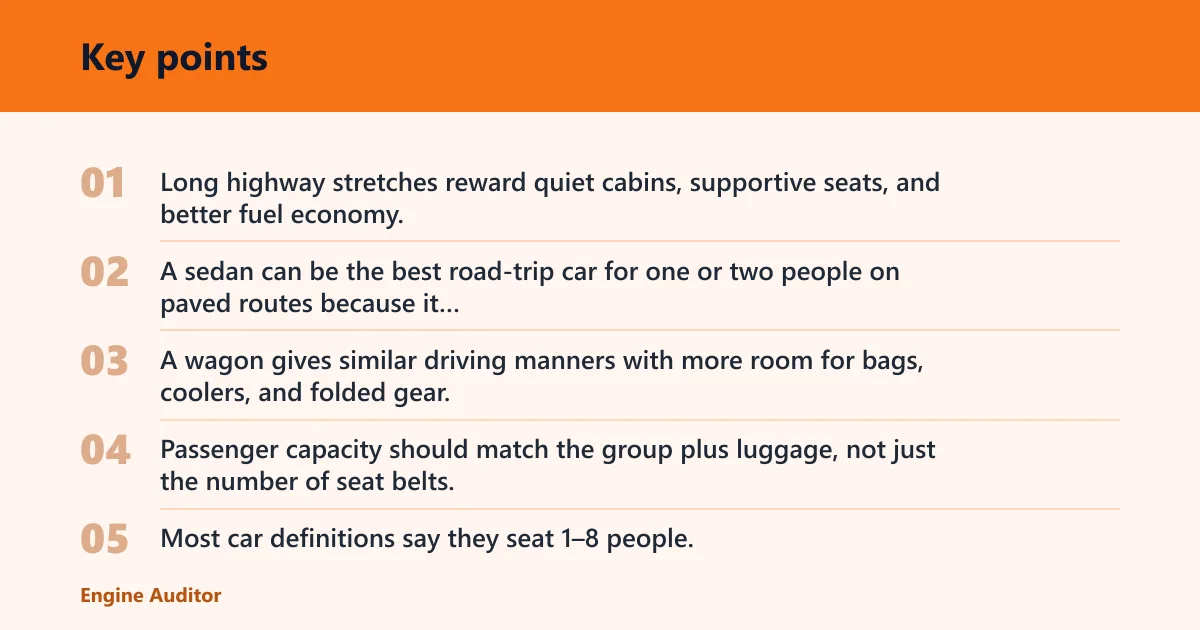
Long highway stretches reward quiet cabins, supportive seats, and better fuel economy. A sedan can be the best road-trip car for one or two people on paved routes because it is efficient and stable at speed. A wagon gives similar driving manners with more room for bags, coolers, and folded gear.
Passenger count and luggage
Passenger capacity should match the group plus luggage, not just the number of seat belts. Most car definitions say they seat 1–8 people, but a usable road-trip layout depends on whether adults can sit comfortably in the second row and whether the third row still leaves cargo space. (Wikipedia)
City parking and daily use
If the trip starts and ends in dense parking, a compact body style is easier to live with. Hatchbacks are often the easiest to place in tight spaces because they combine a small footprint with a liftback rear opening. Sedans are also simple to park and usually cheaper to run.
Rough roads and campsite access
Choose clearance when the route demands it. An SUV can make sense for gravel driveways, forest-road campsites, snow-covered detours, and all-wheel-drive traction needs. For paved interstates and well-kept highways, extra ride height does not add much. It can even hurt ease of entry and fuel economy.
Say your trip is a four-day highway run for two adults with two carry-ons, two duffel bags, and no camping gear. A wagon often fits better than a tall SUV because the loading floor is lower, the cabin drives more like a car, and the luggage area is easier to use.
Which vehicle type is best for road trips?

The best vehicle type depends on who is riding, how much luggage you carry, and whether the route stays on pavement. For many paved road trips, a wagon or minivan is often a better fit than the default SUV. Sedans and hatchbacks are the efficient choice for smaller groups.
Sedan for efficient highway travel
A sedan is often enough for solo travelers or couples who pack light. It typically has four doors, comfortable front and rear seating, and trunk-based cargo storage. The trunk is less flexible than a hatch, but the body shape usually helps highway fuel economy and keeps parking simple.
Hatchback for compact flexibility
A hatchback gives you a liftback rear opening and a compact footprint. That combination makes it easy to load awkward bags, groceries, or soft luggage. It is a strong choice when you want better cargo flexibility than a sedan without stepping up to the size, cost, and fuel use of a larger vehicle.
Wagon for low-load cargo space
A wagon is often a strong road-trip body style because it pairs a long roof and larger cargo area with car-like handling. The lower step-in height helps with luggage and passengers, and the cargo area is usually easier to load than a taller SUV. For paved trips, that trade often wins.
SUV for mixed-use versatility
An SUV fits well when you need higher seating position, available AWD or 4WD, or extra room for gear. The tradeoff is size and fuel use. For a long paved trip, the added height is not automatically better, and a wagon or minivan may deliver more comfort for the same route.
Minivan for family comfort
A minivan is often the best answer for family road trips. It is commonly reported to offer generous passenger room, sliding doors, and easy third-row access. Those features matter when you are loading child seats, backpacks, snacks, and bags many times a day. On long trips, access and space reduce friction.
Pickup truck for gear and towing
A pickup truck makes sense when the trip is really about hauling cargo, towing a trailer, or carrying dirty gear in an open bed. That utility comes with ride comfort tradeoffs, more wind exposure, and poorer fuel use than smaller passenger vehicles. It is a tool, not the default answer.
Sedan, hatchback, or wagon?
Choose a sedan when you want efficient highway travel and simple parking. Choose a hatchback when you need a compact car with better cargo access. Choose a wagon when you want more luggage space without moving up to an SUV. For many paved road trips, the wagon is the sweet spot.
When a sedan is enough
A sedan works well if you have two or fewer adults, modest luggage, and mostly highway miles. The trunk keeps bags out of sight, the cabin is usually quiet enough for long days, and fuel economy is often stronger than in larger vehicles. It is a straightforward road-trip answer.
Why hatchbacks are easier to pack
The rear opening on a hatchback makes tall or odd-shaped cargo easier to load than through a sedan trunk. Folding the rear seats expands usable space for bags or small gear. That helps when the trip includes flexible packing needs, but you still want a compact car for city driving.
When a wagon beats an SUV
A wagon beats an SUV when the trip is paved, the group is small to medium, and you want easier loading without a tall step-in height. The lower center of gravity helps the vehicle feel more car-like on highways and winding roads. You get useful cargo space without paying the SUV penalty.
SUV or minivan for long trips?
For long family trips, a minivan usually beats an SUV on passenger room, access, and third-row usability. An SUV makes more sense when you need higher ground clearance, AWD or 4WD, or a tougher route. If the trip is mostly paved, the minivan is often the better long-haul choice.
Where SUVs fit well
SUVs fit well when your route includes bad weather, dirt access, rougher parking lots, or mixed-surface driving. Their higher seating position can help visibility, and available AWD or 4WD variants can improve traction. The downside is that the extra size can hurt fuel economy and make loading more awkward.
Why minivans help families more
Minivans are built around people, not cargo-first styling. Sliding doors help in tight parking spots. The cabin usually gives more second-row and third-row comfort than an SUV of similar price or size. For child seats, strollers, snack bags, and rest-stop churn, that design works better.
Seating access and third-row comfort
Easy access matters because a third row that is hard to reach gets used less. In many SUVs, the rearmost seats are cramped and the aisle is tight. Minivans usually make that row easier to enter and exit, which matters on all-day drives with repeated stops.
Fuel use and size tradeoffs
Larger vehicles usually consume more fuel, and the difference becomes obvious over long distances. A bigger cabin can help comfort, but extra mass and frontal area can raise highway fuel burn. If the route is all pavement, size only helps if you actually need the space or seating.
When does a pickup truck make sense?
A pickup truck makes sense when you need an open bed, towing capability, or space for bulky outdoor equipment. For most road trips, though, the ride comfort tradeoff and open cargo exposure make it less appealing than a wagon, minivan, or SUV with enclosed storage.
Open-bed cargo and towing
If the trip includes a trailer, a boat, a utility load, or muddy gear that should stay out of the cabin, the truck bed is useful. It is not the best answer for luggage, though, because weather protection and locking storage are better inside the vehicle.
Ride comfort tradeoffs
Pickup trucks usually sit higher and ride with a different suspension focus than passenger cars. That can mean more bounce, more noise, and less comfort on long paved drives. If the cargo does not require an open bed, a wagon or SUV often makes the trip easier.
Camping and trailer use
For camping, a pickup works best when you are hauling a trailer, a rooftop setup, or dirty gear that should stay separate from the cabin. If you want all luggage enclosed and easy to reach, an SUV or wagon often works better. Ground clearance helps, but cargo plan matters more.
Suppose a family of five is heading to a lake campground with tents, a cooler, and camp chairs, but the access road is paved and the site has no trailer. A minivan usually fits the load better than a pickup because the gear stays inside, passengers can enter easily, and fuel use stays lower.
Road-trip use cases by vehicle type
Match the vehicle to the trip pattern, then choose the body style. Solo and couple trips usually favor smaller cars. Family trips favor minivans. Camping and rough-access trips can justify SUVs or pickups. The best choice is the one that fits passengers, luggage, and the road surface without extra bulk.
Solo driver recommendation
For a solo driver, start with a sedan or hatchback. You get strong highway efficiency, easier parking, and enough room for one person plus luggage. If the route includes rough roads or winter surfaces, an SUV may be worth it, but only if the added size is actually needed.
Couple recommendation
For two people, a wagon is often the strongest road-trip choice. It offers more luggage room than a sedan, easier loading than an SUV, and car-like handling on long drives. A hatchback is the compact option, while a sedan stays the efficiency pick for very light packing.
Family recommendation
For families, a minivan is usually the best first choice. Sliding doors, roomy seating, and easy access to the third row reduce daily hassle on the road. If the trip involves rough roads or snow, move up to an SUV only if the extra clearance or traction is truly needed.
Camping recommendation
For camping, choose based on access and cargo shape. A wagon works for paved campsite access and enclosed luggage. An SUV suits mixed-surface roads and higher clearance needs. A pickup makes sense when you are towing or carrying large gear that does not belong inside the cabin.
Frequently asked questions
What is the best road trip vehicle?
For most paved road trips, the best vehicle is the one that fits your passengers, luggage, and fuel needs without extra size. Minivans are often best for families, wagons are strong for smaller groups, and SUVs only pull ahead when ground clearance or AWD truly matters.
What is a good road trip car?
A good road-trip car is comfortable for hours, has enough cargo space for real luggage, and does not waste fuel on the highway. Sedans and hatchbacks are strong choices for solo travelers and couples. Wagons add useful space without giving up car-like handling.
What vehicle type is best for long road trips?
For long road trips, a vehicle with strong highway comfort and efficient fuel use is usually best. That often points to a sedan, wagon, or minivan, depending on passenger count. If you need rough-road capability, an SUV may fit better, but it is not the automatic winner.
Should I buy an SUV or sedan for road trips?
Choose a sedan if your trips are mostly paved, your group is small, and you want better fuel economy and easier parking. Choose an SUV if you need ground clearance, AWD or 4WD, or more mixed-use flexibility. For pure highway travel, the sedan often makes more sense.
Is a minivan good for road trips?
Yes. A minivan is one of the best road-trip choices for families because it offers more passenger room, sliding doors, and easier access to the third row. It also handles luggage well. If you prioritize comfort and access over image or ride height, a minivan is hard to beat.
What makes a car comfortable for long drives?
Comfort comes from seat support, quiet cruising, stable highway manners, and enough room to avoid feeling cramped. A vehicle that matches your luggage and passenger count also helps, because clutter and tight seating make fatigue worse. Long trips reward the right fit more than extra size.
What vehicle is best for road trips and camping?
If camping includes rough access roads or heavy gear, an SUV or pickup can make sense. If the campsite is paved and the gear stays inside, a wagon or minivan may be better. Ground clearance matters only when the route needs it. Cargo shape and access still matter more.
Products related to this article
Sponsored / affiliate links. As an Amazon Associate I earn from qualifying purchases. I may earn additional commission from eligible campaigns.