Which Vehicle Type Is Best for City Parking?
For city parking, a subcompact hatchback or small sedan under about 170 inches long and 70 inches wide is often a good choice; a compact hatchback is another common option, while large SUVs and full-size pickups are often the hardest to place curbside or in tight garages. Poor parking fit means more blocked aisles, more scrapes, and more time circling for a legal space. This guide ranks vehicle types for curbside, garage, and apartment-lot parking, with size thresholds and parking-fit rules you can use before you buy.
Choosing a city car by parking style and living space
Quick ranking by parking problem
For curbside parallel parking, compact sedan and hatchback models usually rank near the top because shorter length matters most. For narrow garages, width and turning circle can matter as much as length. For apartment lots, visibility and door-swing room often decide whether a vehicle feels easy or awkward to live with.
A compact sedan is the best city car when the main problem is finding legal curbside space. A hatchback is often the better pick if you need more cargo flexibility without giving up a compact footprint. A compact SUV helps with seating height, but it usually gives back some parkability to get that benefit.
City parking size thresholds
Under 170 inches long is the practical sweet spot for dense city parking. Over about 180 inches long, parking often gets noticeably harder in tight curbside blocks and crowded garages. Width matters just as much in narrow garages and between pillars; under about 72 inches can be a useful guide, especially when mirrors, door clearance, and adjacent cars all compete for space.
Length, width, and turning circle
Length affects whether the vehicle fits into a curbside gap without repeated pull-ups. Width affects whether the doors can open and whether the driver can thread through garage pillars or painted lines. Turning circle, or turning diameter, matters when you need to swing into a tight stall, make a U-turn, or correct a bad angle in one move.
A shorter turning circle can make dense streets easier to manage. It also helps in apartment lots where lanes are narrow and spaces are set at awkward angles.
| Measure | Practical city-parking guidance | What it affects most |
|---|---|---|
| Overall length | Under 170 inches is the sweet spot | Curbside parallel parking and tight lot maneuvering |
| Overall length | Over 180 inches is harder in dense cities | Legal curbside gaps and garage clearance |
| Overall width | Under 72 inches is a useful guide | Narrow garages, pillars, and door clearance |
| Turning circle | Smaller is easier | U-turns, garage entries, and tight lots |

Parking-fit matrix
This matrix ranks major vehicle types by parking difficulty, not by price or power. A type can score well in one parking setting and poorly in another. That is why a compact SUV may feel fine in an open apartment lot yet be worse than a hatchback in a narrow garage.
| Vehicle type | Curbside parallel parking | Narrow garage ease | Visibility | Cargo compromise | City running costs |
|---|---|---|---|---|---|
| Compact sedan | Excellent | Very good | Good | Moderate | Usually low |
| Hatchback | Excellent | Very good | Good | Very good | Usually low |
| Compact SUV | Good to fair | Fair | Very good | Very good | Moderate |
| Hybrid vehicle | Depends on body style | Depends on body style | Depends on body style | Depends on body style | Very good in stop-and-go traffic |
| Electric vehicle | Depends on body style | Depends on body style | Depends on body style | Depends on body style | Low if charging access is easy |
Compact sedans are easy to park and usually have great mpg. Hatchbacks bring the same compact footprint with more cargo flexibility. Compact SUVs offer higher seating and an AWD option on some trims, but that does not erase the parking penalty from extra height and width.
Hybrids and EVs matter most after parkability is solved. Hybrids are strongest in stop-and-go traffic, where regenerative braking helps efficiency without charging. EVs can cut operating cost and stay quiet in traffic, but they depend on home or work charging access.
Are hatchbacks easier to park than SUVs?

Yes, usually. Hatchbacks are often easier to park than compact SUVs because they keep a compact footprint while staying lower and simpler to fit into garages and curbside gaps. A compact SUV can still be manageable, but its extra height and width often make it feel bulkier even when the length difference is modest.
Why compact footprint wins curbside
For parallel parking, overall length is the first limit, then wheelbase and rear overhang. A hatchback often fits more easily because the rear hatch gives useful cargo room without stretching the body. That makes it a strong answer when you need small outside dimensions but still want usable interior space.
Why a small SUV can still be awkward
A compact SUV may seem easier because the driver sits higher and sees farther over traffic. Yet it can still be worse in a garage if the mirrors, roofline, and turning circle make the approach feel tight. This is the failure case many buyers miss: short does not always mean easy if the vehicle is wide or boxy.
Suppose a hatchback and a compact SUV are both close to 172 inches long. The hatchback may still slot into a narrow garage more cleanly because its lower roof and slimmer body leave more side clearance and reduce the number of corrections needed on entry.
When hatchback cargo flexibility matters
If you carry groceries, luggage, or a folded stroller, a hatchback often gives you more usable cargo space than a sedan trunk. That matters in city life because it lets you keep a compact parking footprint without giving up daily flexibility. For many drivers, that is a better trade than moving up to a small SUV.
What do hybrids and EVs change?
Hybrids and EVs do not change the parking rules, but they change the ownership tradeoff. A hybrid is a smart choice for mostly city driving because stop-and-go traffic is where it is most efficient. An EV is attractive when charging is easy and low operating cost matters more than range convenience.
Hybrid advantages in stop-and-go traffic
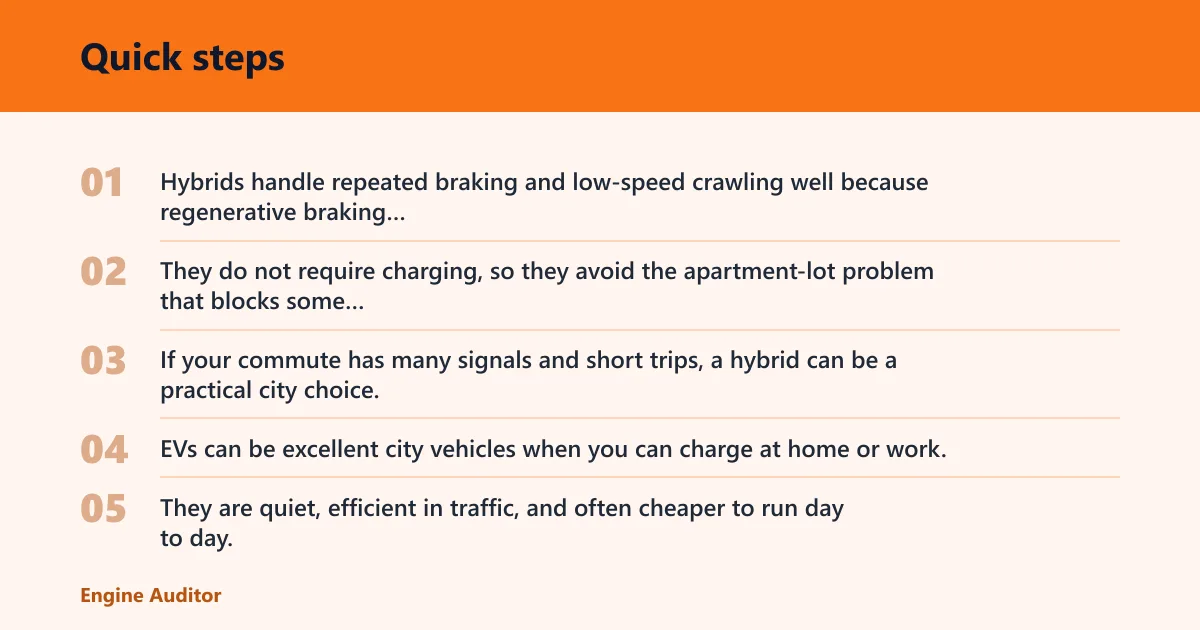
Hybrids handle repeated braking and low-speed crawling well because regenerative braking recovers energy that would otherwise be lost. They do not require charging, so they avoid the apartment-lot problem that blocks some EV owners. If your commute has many signals and short trips, a hybrid can be a practical city choice.
EVs, charging access, and low operating cost
EVs can be excellent city vehicles when you can charge at home or work. They are quiet, efficient in traffic, and often cheaper to run day to day. But parking fit still comes first. A long EV with poor garage manners is still a poor fit, even if its fuel cost is low.
A common first-timer mistake is choosing an EV for urban efficiency and then discovering the only nearby garage has tight pillars and a narrow entry lane. In that case, charging savings do not make up for a vehicle that is hard to place every night.
When city efficiency should not outweigh parking fit
If your parking is curbside on a crowded block, or your garage has a low turning margin, choose the body size that fits first. Then compare hybrid or EV options within that size. Fuel savings matter, but only after you know the vehicle can be parked without constant stress.
Parking assist and visibility
Backup cameras, parking sensors, and 360-degree camera systems help with tight spaces. They reduce blind spots and make it easier to judge distance to curbs, poles, and other cars. They help most when the body shape is hard to see from the driver’s seat, but they do not shrink the vehicle.
Visibility tradeoffs for tall and short drivers
Taller drivers often notice roofline and mirror placement less than shorter drivers, but both groups can struggle if the hood or rear corners disappear from view. A high seating position can help you see over traffic, yet it can also create a false sense of ease in parking. You still need enough external clearance.
Shorter drivers may prefer a lower vehicle if they want easier reach to pedals and better judgment of corner placement. Taller drivers may prefer a vehicle with a more upright cabin. Either way, parking-fit should be checked against the seating position you actually need.
What features make parking easier in tight spaces?
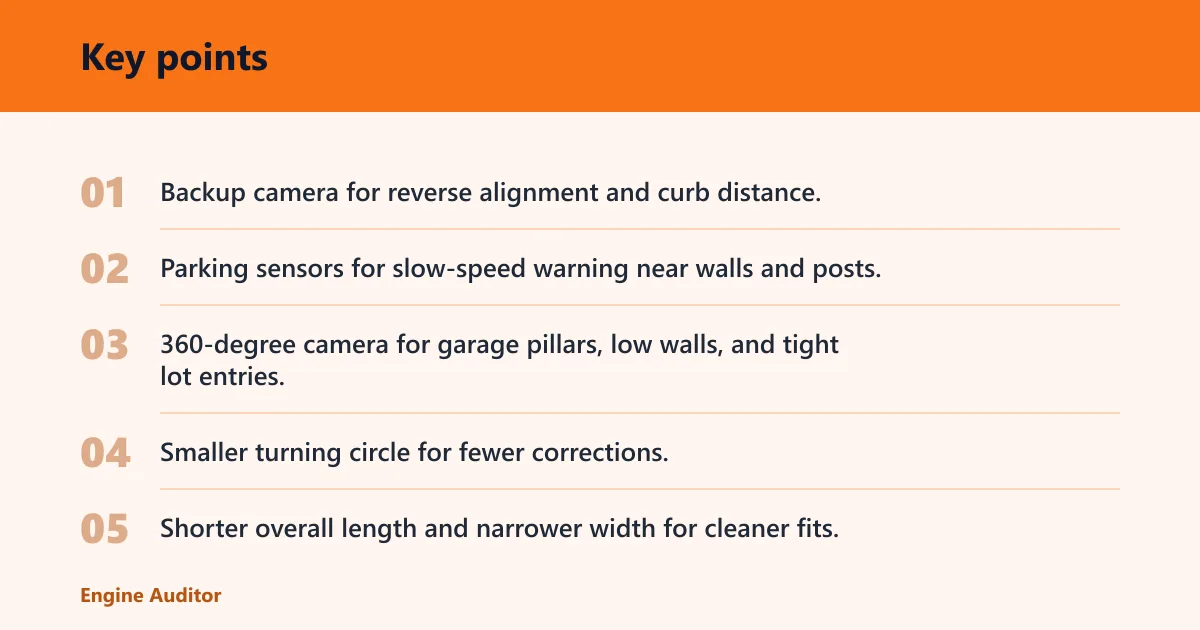
- Backup camera for reverse alignment and curb distance.
- Parking sensors for slow-speed warning near walls and posts.
- 360-degree camera for garage pillars, low walls, and tight lot entries.
- Smaller turning circle for fewer corrections.
- Shorter overall length and narrower width for cleaner fits.
These features help, but they do not erase a poor size choice. A vehicle that is over 180 inches long will still be harder to place in dense cities, even with driver aids. That is why the size thresholds belong ahead of tech on your shopping list.
How to choose by parking pattern, cargo, and access needs
Start with where you park most often: curbside, a narrow garage, or an apartment lot. Then decide how much cargo room, child-seat access, or mobility access you need. The best city vehicle is the one that fits your parking space first and your daily use second.
Best match by common use case
- Curbside parking most days: compact sedan or hatchback under 170 inches long.
- Narrow garage with pillars: hatchback or small sedan under 72 inches wide.
- Need more cargo without going big: hatchback first, compact SUV second.
- Mostly city miles and no charging access: hybrid vehicle.
- Home or work charging available: EV can make sense if the body size still fits.
- Child seats or mobility needs: check rear door opening, seat height, and door swing before judging by length alone.
For child seats, rear access can matter more than trunk size. For ADA or mobility access, seat height, door opening, and transfer space can outweigh a few extra inches of length. That is one reason a compact SUV can be the right answer for one driver and the wrong answer for another.
Frequently asked questions
What cars are good for city driving?
Compact sedans, hatchbacks, and some compact SUVs are good for city driving, but the parking fit should lead the decision. Under 170 inches long is the sweet spot, and under 72 inches wide helps in narrow garages. Hybrids and EVs fit well when you also want lower operating cost.
What is the best city car?
The best city car is usually a compact sedan, especially if curbside parking is the main challenge. It is easy to park and typically has great mpg. A hatchback can be just as good if you want more cargo flexibility without moving into a larger body.
Which vehicle type is easiest to park in the city?
A compact sedan or hatchback is usually easiest to park in the city. The deciding factors are short overall length, modest width, and a small turning circle. If a vehicle is over 180 inches long or wide enough to crowd a narrow garage, parking gets harder fast.
Is a compact SUV too big for city parking?
Not always, but a compact SUV is often less convenient than a hatchback or compact sedan. It can work in open apartment lots and some garages, especially if you value higher seating and AWD availability on some trims. In narrow garages and tight curbside blocks, it usually feels bulkier.
Should I choose a hybrid for stop-and-go city driving?
Yes, a hybrid is often a smart choice for stop-and-go city driving. Regenerative braking helps in traffic, and you do not need charging access. It is a strong pick if you want urban efficiency but do not want to plan around plugs, cords, or public charging.
How long is too long for city parking?
Over 180 inches long is too long for easy parking in many dense cities. Under 170 inches is the practical sweet spot. If your regular parking is a narrow garage or crowded curb, length alone can decide whether the vehicle fits cleanly or turns every stop into a correction exercise.
Which cars have auto parking?
Auto-parking is not universal, and availability varies by trim and model year. Some compact sedans, hatchbacks, compact SUVs, and EVs offer it on higher trims or option packages. Treat it as a bonus feature, not a substitute for the right length, width, and turning circle.
Products related to this article
Sponsored / affiliate links. As an Amazon Associate I earn from qualifying purchases. I may earn additional commission from eligible campaigns.