Why Is My Temperature Gauge Not Moving?
By a diagnostic technician focused on cooling-system and cluster faults
This guide is part of our Car Cooling System Problems: Overheating, Coolant Leaks, Fan and Gauge Faults Explained series.
A temperature gauge that stays on cold usually points to a bad coolant temperature sensor or its wiring, a stuck-open thermostat, trapped air, or a cluster fault. If the engine reaches normal temperature but the gauge never moves, the shortest path is to compare live coolant data with the dash, then isolate the sensor circuit, cluster input, thermostat, and air pockets.
Diagnostic note: Factory service information and owner manuals consistently treat the coolant temperature signal as a scan-data first diagnosis. Normal operating temperature is commonly in the 190°F to 220°F range once the engine is warmed, though exact thresholds vary by make and calibration. Refer to OEM service manuals, NHTSA owner manuals, and SAE-style diagnostic procedures for vehicle-specific specs.
What the gauge is telling you

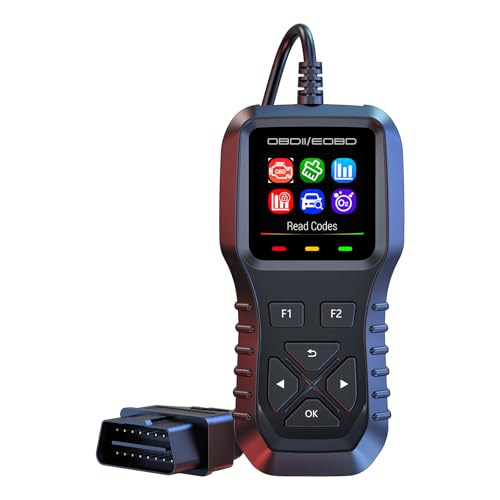
- Reads and clears engine codes fast
- Shows live sensor data in graphs
- Includes readiness and EVAP checks
On a normal gauge, C means cold and H means hot. The needle should move from C toward the middle as the engine warms up, and a midpoint reading is generally treated as normal operating temperature. Near H is overheating and unsafe, and on H is severe overheating.
That pattern matters because a stuck needle can come from more than one fault. A gauge that never leaves cold can be an input problem, a display problem, or a cooling-system problem that keeps the engine from warming up.
Some vehicles use a digital display instead of a needle, but the logic is the same: the reading should change as the coolant temperature changes. If it does not, separate sensor data from dash display behavior before replacing parts.
Temperature gauge diagnosis matrix
Use the symptom pattern first. That cuts the search down faster than swapping parts at random.
| Symptom pattern | Likely fault | Quickest test | Tool needed | Usually safe to drive? |
|---|---|---|---|---|
| Stays on C | Coolant temperature sensor, wiring, or cluster input | Compare OBD2 live coolant data with dash reading | OBD2 scanner | Only if engine temp on scan data is normal |
| Rises slowly | Thermostat stuck open | Check whether coolant temperature climbs slowly and never settles at normal operating temperature | OBD2 scanner | Usually yes, but heat output may be weak and fuel use may rise |
| Fluctuates | Air in the cooling system, corroded connector, intermittent wiring fault | Watch live data while tapping harnesses and checking for bubbles during bleeding | Scanner, flashlight, cooling-system bleed tools | Use caution; unstable temperature data can hide real overheating |
| Works only after restart | Intermittent wiring, connector contact issue, ECU data mismatch | Check for temporary loss of signal and pending codes after key cycle | OBD2 scanner, wiring diagram | Not ideal until the fault is found |
| Fan runs while gauge is cold | Fail-safe logic, sensor mismatch, ECU data issue, wiring fault | Compare ECU coolant temperature with dash reading | OBD2 scanner | Depends on actual coolant temperature, not the gauge alone |
Why is my temperature gauge not moving?
Start with live data before you touch the dash or thermostat. If the OBD2 scanner shows coolant temperature climbing normally but the gauge stays on C, the problem is usually in the gauge circuit, cluster, or the path between sensor and dash. If live data also stays cold, focus on the sensor, wiring, or a thermostat stuck open.
Confirm the engine is warming first, then compare what the ECU sees with what the dash shows. That split tells you which side of the system to test next.
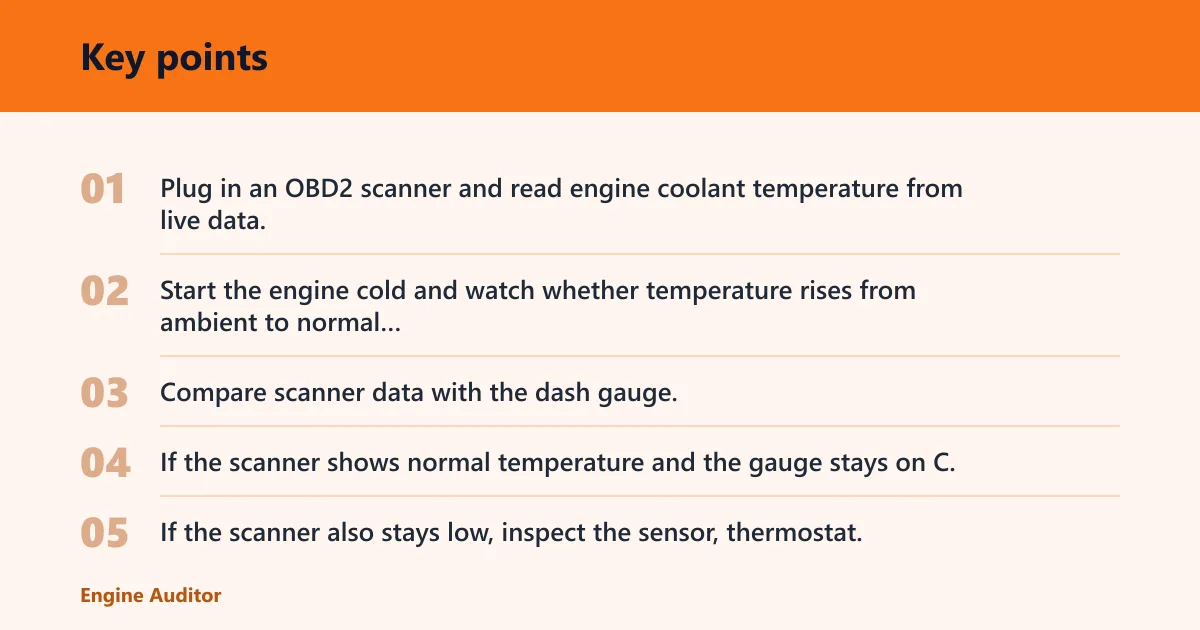
- Plug in an OBD2 scanner and read engine coolant temperature from live data.
- Start the engine cold and watch whether temperature rises from ambient to normal operating temperature.
- Compare scanner data with the dash gauge.
- If the scanner shows normal temperature and the gauge stays on C, test the sensor circuit, wiring, and cluster.
- If the scanner also stays low, inspect the sensor, thermostat, and air in the cooling system.
If a scanner shows coolant temperature climbing to about 190°F while the gauge stays on C, that points away from the thermostat and toward the sensor circuit, the dash input, or the cluster itself. If the scanner still reads near ambient after about 10 to 15 minutes of normal idling and road load, the engine may not be warming properly, which puts the thermostat and trapped air higher on the list. Factory procedures typically use live-data confirmation before condemning the gauge or cluster.
Coolant temperature sensor tests
The coolant temperature sensor measures engine coolant temperature. It may be the most common cause of a gauge staying on cold. Some cars use one sensor for both the ECU and the gauge. Other cars use separate sensors for the ECU and the dash gauge, so you need to know which layout your vehicle uses before you test.
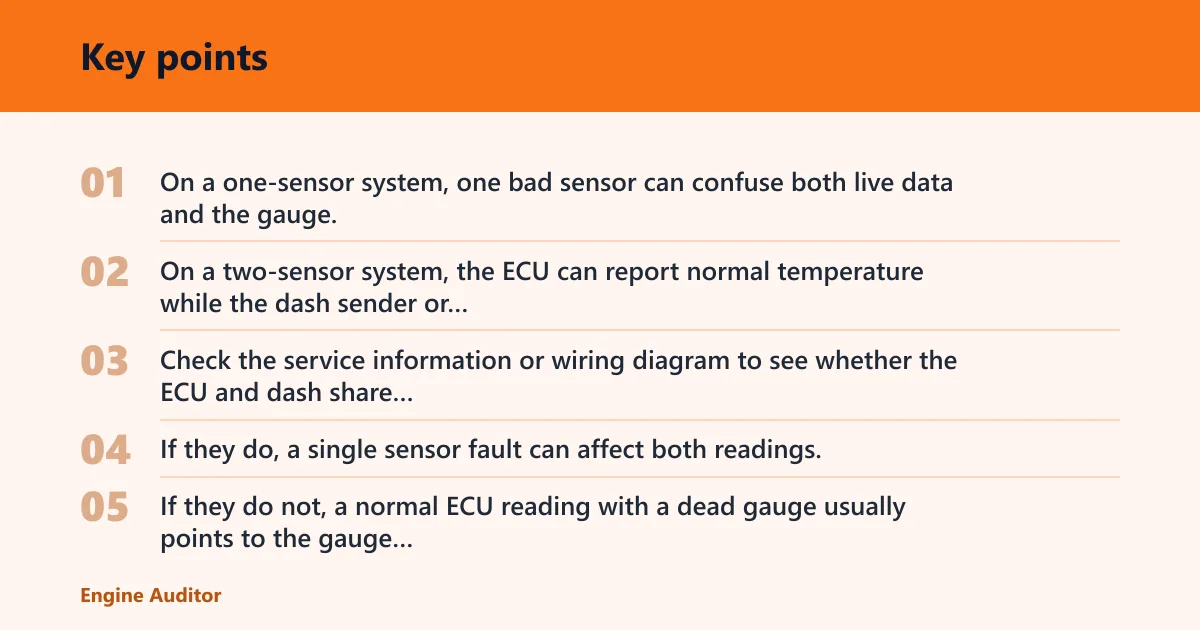
That layout changes the diagnosis. On a one-sensor system, one bad sensor can confuse both live data and the gauge. On a two-sensor system, the ECU can report normal temperature while the dash sender or its circuit fails separately.
Single-sensor versus dual-sensor systems
Check the service information or wiring diagram to see whether the ECU and dash share one sensor. If they do, a single sensor fault can affect both readings. If they do not, a normal ECU reading with a dead gauge usually points to the gauge sender, cluster input, wiring, or connector path. This is common on vehicles that use a dedicated sender for the cluster and a separate ECT sensor for the PCM.
Resistance testing with a multimeter
A sensor can be tested with a multimeter using correct resistance values for the vehicle and temperature condition. The exact values depend on the model, so you need the factory chart or service data. A reading that is far outside spec, open, or unstable while the connector is steady is a strong fault clue.
Resistance testing works best when you match the sensor temperature to the chart. If the engine is fully cold, the reading should reflect that cold state. If the engine is warm, the resistance should drop as coolant temperature rises. OEM manuals typically specify both the expected resistance curve and the temperature-to-resistance checkpoints for diagnosis.
When the sensor is likely the fault
If live OBD2 data is wrong, the sensor itself or its wiring becomes the first suspect. If live data is correct but the gauge is dead, the fault shifts toward the dash side. A sensor that is out of range, open, or shorted can keep the gauge on cold even when the engine is hot. Common DTCs include P0115, P0116, P0117, and P0118, depending on whether the circuit is implausible, low, or high.
Could wiring or connectors be the problem?
Yes. Broken wires can stop temperature data from reaching the gauge, and corroded connectors are a common problem. Corrosion can affect sensor, ECU, and cluster connectors. Cleaning with electrical contact cleaner may restore a poor connection, but a damaged seal can let corrosion return.
This is where a wiring diagram matters. Resistance testing from connector to connector is recommended because it helps separate a bad sensor from a damaged wire or a bad terminal. Intermittent faults are often harder to catch than an outright open circuit, so a wiggle test during live data monitoring can help.
Connector corrosion and poor contact
Look for green or white corrosion, loose pins, oil intrusion, and moisture inside the plug. A connector can pass continuity one moment and fail the next if the contact pressure is weak. That can create a gauge that wakes up only after a restart or only after vibration changes the contact.
Continuity checks with a wiring diagram
Use the diagram to trace the circuit from sensor to ECU or cluster. Then check continuity end to end. If the wire passes resistance testing but the gauge still fails, inspect the terminal fit, splice points, and connector pins for damage that a simple continuity test may miss.
One common pattern is a gauge that jumps once, then drops back to cold after a bump or restart. That points to an intermittent connection more than a bad thermostat.
Could the instrument cluster be causing a temperature gauge that stays on cold?
Yes. The instrument cluster can fail internally, especially on modern cars where the temperature gauge is integrated into the cluster. Bad soldering or internal faults can stop the needle or display from moving even when the sensor and ECU data are normal. In some cases, cluster repair or replacement is needed.
If the vehicle uses a separate gauge sender and the sender tests correctly, cluster fault moves up the list. Some clusters can be checked with an ohm tester in certain cases, but the exact method depends on the design. Do not put the cluster first unless sensor and wiring checks point away from the engine side.
Basic gauge and cluster checks
With the ignition on, some clusters perform a sweep or self-check. If the temperature gauge never moves during that self-check, the fault may be inside the cluster. If the gauge responds during a test but not during driving, look harder at the sensor input path.
A cluster fault is often the last step after the more common sensor, wiring, and connector checks. That order saves time and avoids replacing an expensive part too early.
Why is my temperature gauge not working and fan running?
When the fan runs but the gauge stays cold, the ECU may be reacting to fail-safe logic, a sensor mismatch, or bad coolant temperature data. That combination means the control unit may see a value that does not agree with the dash, or it may be substituting a protective default. Live data is the fastest way to sort that out.
If the fan is on because the ECU thinks the engine is hot, but the gauge is cold, do not assume the gauge is right. Compare live coolant temperature on the scanner with the dash reading and check for fault codes. A mismatch points to the sensor circuit or data path, not just the fan relay. Many OEM strategies command the fan on high if the ECT signal is implausible or missing.
Thermostat and air pockets
A thermostat stuck open prevents the engine from reaching normal operating temperature. That can make the gauge rise slowly rather than normally, especially on highway or cool-weather driving. It should be checked after sensor and wiring issues because a bad thermostat does not usually explain a dead gauge if live data and dash data disagree.
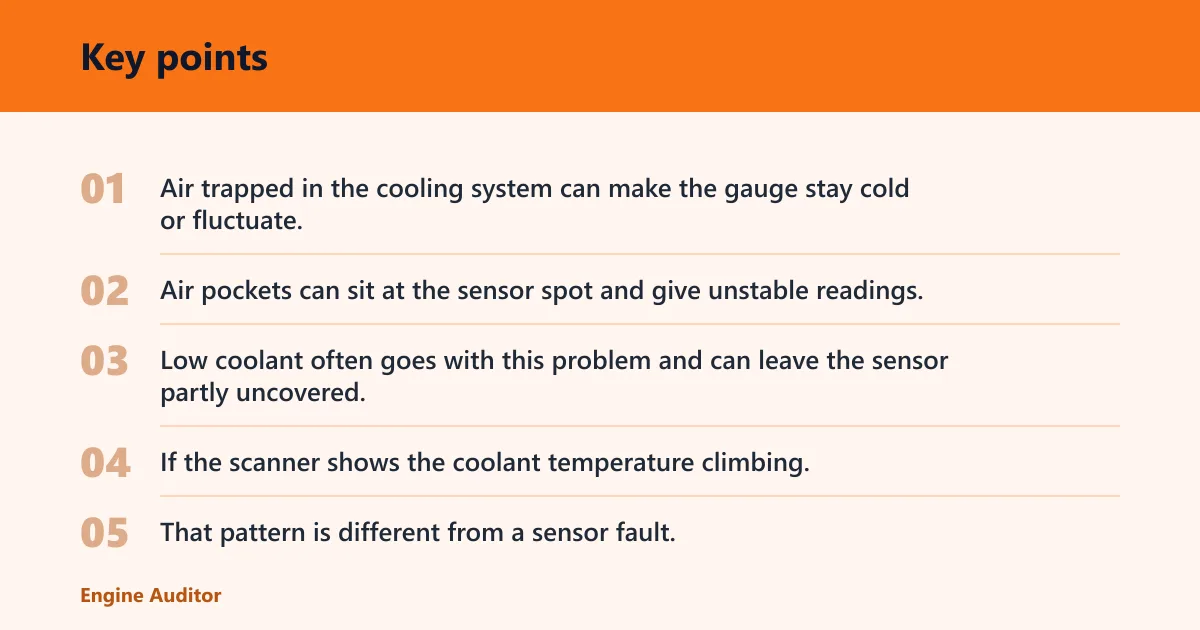
Air trapped in the cooling system can make the gauge stay cold or fluctuate. Air pockets can sit at the sensor spot and give unstable readings, so bleeding the cooling system is required after repairs or coolant loss. Low coolant often goes with this problem and can leave the sensor partly uncovered.
A thermostat stuck open
If the scanner shows the coolant temperature climbing, but it climbs too slowly and settles below normal operating temperature, the thermostat is a strong suspect. That pattern is different from a sensor fault. A thermostat issue affects actual engine warm-up, not just the gauge reading. Some OEM service data treats a thermostat that never lets coolant reach the calibrated target as a no-heat or low-heat complaint first, not a cluster issue.
Air in the cooling system
Air pockets can make the gauge read cold one minute and warm the next. They can also trigger fan behavior that seems random. If coolant has recently been changed, lost, or repaired, bleed the system before assuming the gauge or sensor has failed.
Bleeding matters because trapped air can move with engine speed and thermostat opening, changing the sensor’s surroundings. That can produce readings that look electrical even when the cause is hydraulic. Recheck coolant level after the engine cools, because some systems purge air only after a heat cycle.
What counts as abnormal behavior
Normal behavior is simple: cold at startup, then a move toward the middle after warm-up. A gauge that never leaves C is abnormal if the scanner shows normal coolant temperature. A gauge near H is overheating and unsafe. Continued driving near H or on H can damage the engine.
Do not wait for the needle to hit H before acting. If the gauge climbs toward H, pull over and shut down if needed to prevent damage, then diagnose the cause once the engine is safe to inspect.
Frequently asked questions
Is a stuck-on-cold gauge a sensor problem or a thermostat problem?
It can be either, but the pattern is different. A bad coolant temperature sensor can leave the gauge on cold even when the engine is warm. A thermostat stuck open usually makes the engine warm slowly, so the gauge rises slowly instead of moving normally. Live data separates the two quickly.
Can air in the cooling system keep the gauge on cold?
Yes. Air pockets can sit at the sensor location and make the gauge stay cold or fluctuate. That is why bleeding the cooling system matters after coolant loss or repairs. If the reading changes with engine speed or after a bleed, trapped air is a strong suspect.
What does it mean when your temperature gauge doesn’t move?
It means the dash is not showing a temperature change, but that does not tell you why. The cause may be a bad sensor, wiring problem, cluster fault, thermostat issue, or trapped air. The quickest path is to compare live OBD2 data with the gauge, then test the circuit that disagrees.
Sources
- OEM service information and factory diagnostic charts for engine coolant temperature sensor resistance, circuit tests, and thermostat specifications.
- NHTSA owner manuals for cooling-system warnings, normal gauge interpretation, and overheating cautions.
- SAE-style diagnostic practice for using live data, circuit comparison, and fail-safe fan strategy in modern engine controls.
Products related to this article
Sponsored / affiliate links. As an Amazon Associate I earn from qualifying purchases. I may earn additional commission from eligible campaigns.