What Is the Purpose of the Coolant Overflow Tank?
The coolant overflow tank stores expanding coolant from a hot, pressurized cooling system and returns it as the engine cools. A steady drop, boiling, or constant overfill often points to a leak, a bad cap, trapped air, or combustion-gas intrusion. Ignore it, and you can chase repeated low-coolant warnings, overheat the engine, or miss a failing head gasket. This guide explains how the tank works, what normal level changes look like, and how its behavior points to specific faults.
Coolant overflow tank basics
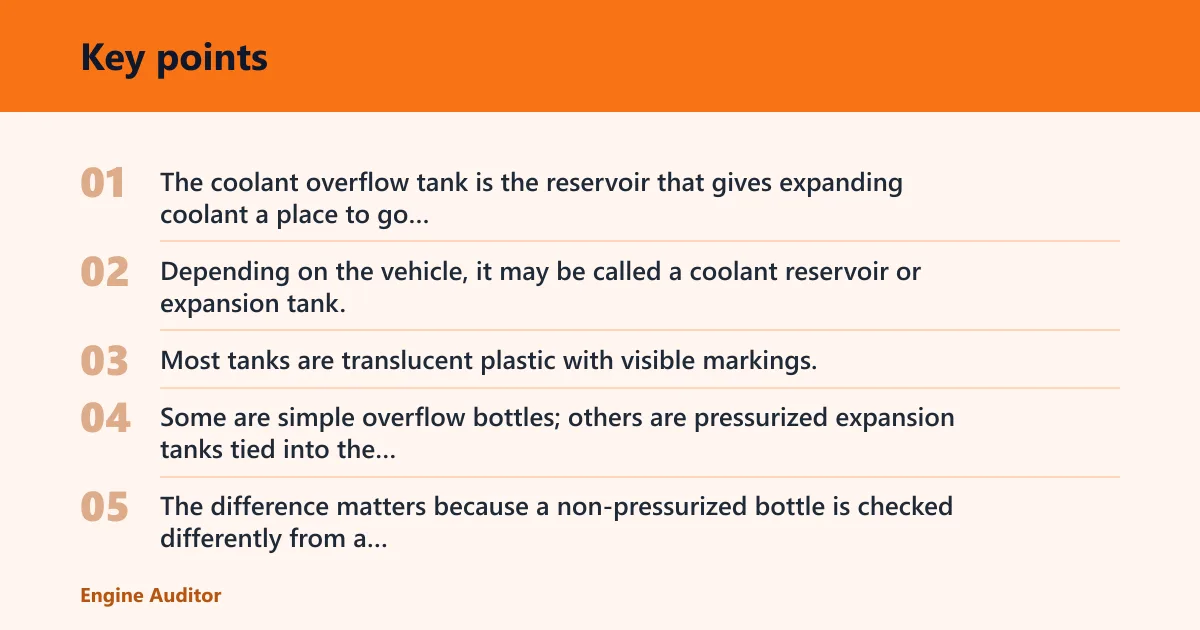
The coolant overflow tank is the reservoir that gives expanding coolant a place to go when the system heats up. Depending on the vehicle, it may be called a coolant reservoir or expansion tank, and the label can matter because the fill rule changes with the design.
Most tanks are translucent plastic with visible markings. Some are simple overflow bottles; others are pressurized expansion tanks tied into the cooling loop. The difference matters because a non-pressurized bottle is checked differently from a tank that shares system pressure.
Overflow bottle vs expansion tank
A non-pressurized overflow bottle mainly catches coolant that the radiator cap pushes out when pressure rises. A pressurized expansion tank is part of the sealed cooling system and holds coolant under pressure. If you treat one like the other, you can overfill it or misread a normal level swing as a fault.
Look for the vehicle’s markings, cap arrangement, and hose layout before adding coolant. The tank may be marked MIN and MAX, and the minimum line may be marked with an L for low while the maximum line may be marked with an F for full.
How the system moves coolant
Coolant expands as it heats and contracts as it cools. That movement is normal. The tank stores coolant while the engine is running and hot, then excess coolant flows back into the motor when the engine cools.
Pressure control is part of the design, not an accident. The cooling system is built to handle thermal expansion, and the radiator cap helps keep that pressure in range. If pressure control is wrong, coolant can be pushed into the tank too early or too often, and overheating can follow.
Why pressure control matters
The radiator cap maintains a closed system. Its pressure rating must match the vehicle. A bad radiator cap can change pressure in the cooling system, which changes when coolant moves to the reservoir and when it returns. That can create overflow symptoms even when the rest of the system looks normal at a glance.
Too much pressure can push coolant into the tank. Too little pressure can let coolant boil sooner than it should. Either fault can create uneven heat, local boiling, and level changes that confuse a quick check.
How to check the level cold
Check the reservoir with the engine cold. The level should sit between its MIN and MAX marks when checked cold. If the tank is low, add coolant only to the proper mark for that reservoir design. If it is already above MAX when cold, do not add more.
A common rule of thumb is to leave room for expansion. MechanicBase says the overflow tank should be filled by at least 30%. That does not replace the vehicle manual, but it does support the basic idea: the tank needs space so heated coolant has somewhere to go.
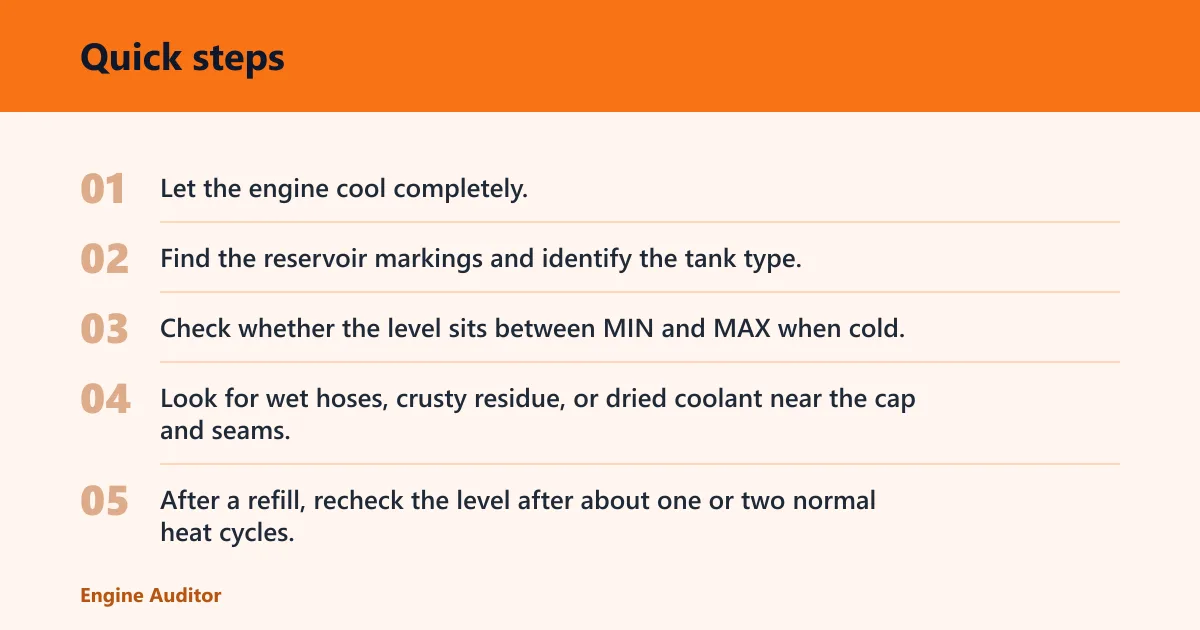
- Let the engine cool completely.
- Find the reservoir markings and identify the tank type.
- Check whether the level sits between MIN and MAX when cold.
- Look for wet hoses, crusty residue, or dried coolant near the cap and seams.
- After a refill, recheck the level after about one or two normal heat cycles.
What you do next depends on where the level sits. If the radiator is low but the reservoir is full, that is a different clue from a tank that is simply between marks. The reservoir alone does not tell the whole story.
Say your sedan leaves the shop after a thermostat change and the reservoir drops from halfway to just above MIN after two cold cycles. That can be normal purge if the system had air trapped in it. If the level keeps falling while the radiator is still low, the next checks should move to leaks, the cap, and trapped air.
Why is the reservoir overflowing?
Overflow often means the system is moving coolant or gas somewhere it should not. The common causes are a bad radiator cap, the wrong pressure rating, an air pocket after service, or a circulation fault that changes how heat and pressure build inside the engine.
Bad radiator cap or wrong pressure rating
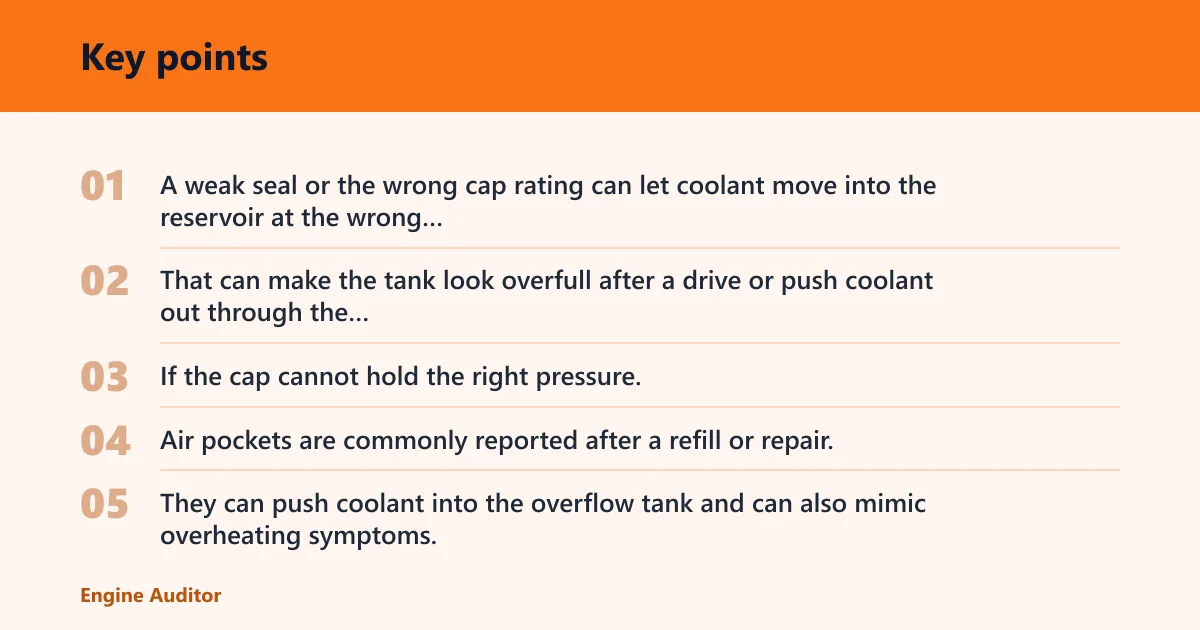
A weak seal or the wrong cap rating can let coolant move into the reservoir at the wrong time. That can make the tank look overfull after a drive or push coolant out through the overflow path. If the cap cannot hold the right pressure, the rest of the cooling system will behave badly.
Air pocket after service
Air pockets are commonly reported after a refill or repair. They can push coolant into the overflow tank and can also mimic overheating symptoms. A freshly serviced system that burps coolant once or twice is not the same thing as a system that keeps expelling coolant every drive.
Thermostat or circulation fault
A faulty thermostat can prevent the engine from regulating coolant properly. A defective water pump can slow or stop coolant flow. Either fault can create uneven heat, local boiling, and pressure spikes that send coolant into the reservoir even if the tank itself is fine.
Picture a truck that gets a new thermostat, then starts pushing coolant into the reservoir after the first highway run. If the radiator is low, the tank is full, and the upper hose stays hotter than expected, the issue may be trapped air or a circulation problem rather than a bad bottle.
Overflow tank diagnostic table
This table links common reservoir behavior to the most likely causes and the next checks. Use it as a map, not a final diagnosis. The same symptom can come from pressure control, circulation, or combustion gas.
| Reservoir behavior | Likely cause | Next check |
|---|---|---|
| Overfull when cold | Overfill, wrong cap, or a tank that was filled past its normal mark | Verify the cold level against MIN and MAX; confirm whether the reservoir is pressurized or non-pressurized |
| Level rises after a drive | Normal thermal expansion, weak cap, or restricted pressure control | Check the cap rating, look for coolant near the cap, and compare the hot rise to the cold level |
| Radiator low but reservoir full | Cap fault, trapped air, or coolant not returning from the tank | Inspect the cap seal, bleed air if the design calls for it, and recheck after a full cool-down |
| Bubbling at idle | Air pocket, boiling from circulation trouble, or combustion gas intrusion | Watch for repeated bubbles, smell exhaust in the tank, and inspect for overheating or compression leak signs |
| Coolant pushed out after refill | Air pocket, overfill, or purge after service | Recheck the level cold, confirm the fill point, and see whether the purge stops after a few heat cycles |
Can a bad engine part fill the tank?
Yes. A reservoir that keeps filling can reflect a problem elsewhere in the cooling system, not a fault in the tank itself. Water pump problems, thermostat issues, and combustion leaks can all change flow, pressure, and level behavior.
Water pump problems
A defective water pump can slow or stop coolant flow. That can create hot spots and pressure swings that push coolant into the overflow tank. If the pump is weak, the system may overflow on one drive and run low on the next because circulation is unstable.
Head gasket, cracked head, or cracked block
Bubbling coolant may indicate a blown head gasket, cracked block, or cracked head. This is the major failure case. Combustion gas in the reservoir can pressurize the system, force coolant into the tank, and make the level behave erratically even when there is no external leak.
A common first-timer mistake is to blame the reservoir first because it is the visible part. If the tank bubbles at idle, smells like exhaust, or keeps pushing coolant out after the system has been bled correctly, the next check should be for combustion gas intrusion, not another bottle refill.
Normal purge versus major failure
Normal purge usually happens after a refill, hose change, thermostat swap, or similar service. The level can drop as air leaves the system and coolant returns to the engine. Persistent bubbling, constant loss, or repeated overflow after warm-up is a different pattern and needs deeper diagnosis.
Do you need a coolant overflow tank?
Most closed cooling systems need some form of overflow or expansion tank. It gives the system room for thermal expansion and a way to recover coolant as the engine cools. Without it, pressure control is harder and small losses are more likely to become larger problems.
What is the coolant reservoir for? It is for storage during hot running and return flow during cool-down. What is the radiator overflow tank for? Same basic job, but the exact plumbing depends on whether the vehicle uses a simple catch bottle or a pressurized expansion tank.
What happens if the overflow tank is overfilled? There may be no room for expansion, so hot coolant can be forced out of the vent or hose path. That can leave a mess, lower the cold level later, and hide the real cause of a pressure problem.
What is the coolant expansion tank for? It is the place where coolant can move as pressure changes, especially on systems designed around a pressurized reservoir. If the vehicle uses that design, fill rules should follow the mark and cap arrangement, not a generic “top it off” habit.
Frequently asked questions
What is the purpose of the coolant overflow tank?
The coolant overflow tank gives expanding coolant a place to go when the engine is hot and returns that coolant as the engine cools. It also helps reveal pressure problems, because odd level changes can point to a weak cap, trapped air, or a circulation fault.
How does a coolant overflow tank work?
As coolant heats up, pressure rises and excess fluid moves into the tank. When the engine cools, the system draws coolant back. In a healthy system, the level swings between the marks rather than staying full or empty all the time.
How much coolant should be in the overflow tank?
Check it cold, and the level should sit between MIN and MAX. Some tanks use L and F instead of those letters. Do not fill past the mark that matches the cold level, because the tank needs space for expansion when the engine warms up.
What happens if the overflow tank is overfilled?
An overfilled tank can push coolant out when the engine heats up, even if the rest of the system is working. That can make the reservoir seem faulty when the real issue is simple excess fluid, a weak cap, or trapped air that was not fully purged.
Why would coolant overflow from the tank?
Common reasons include a bad radiator cap, the wrong cap rating, air pockets after service, a thermostat fault, a weak water pump, or combustion gas from a head gasket, cracked head, or cracked block. The pattern of overflow tells you where to look next.
What is the coolant reservoir for?
The coolant reservoir stores extra coolant while the engine runs hot and gives it back as the system cools. It is also a quick visual clue: if the tank is repeatedly low, full, or bubbling, the cooling system likely has a pressure or circulation problem.
Products related to this article
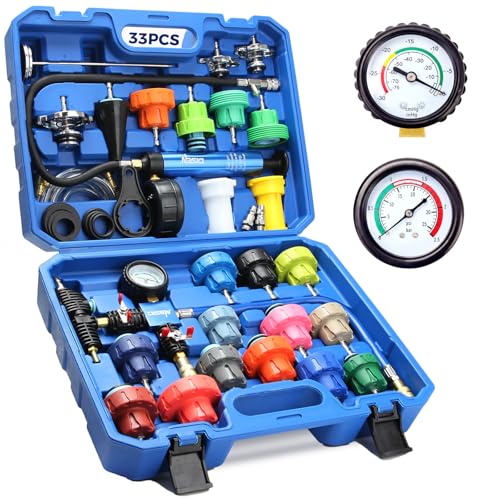
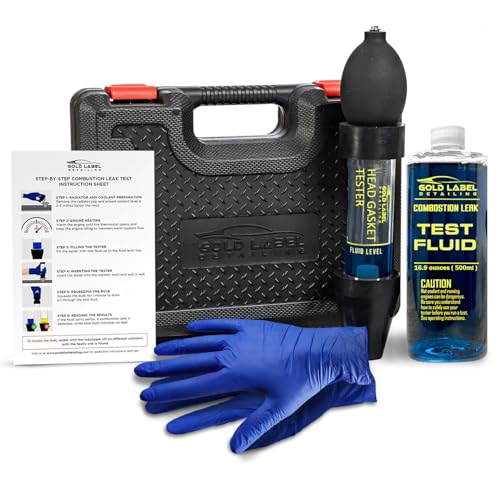
Sponsored / affiliate links. As an Amazon Associate I earn from qualifying purchases. I may earn additional commission from eligible campaigns.