Why Is My Car Overheating and Then Going Back to Normal?
If the temperature drops back to normal after a restart, during light load, or once airflow improves, suspect a sensor, wiring, or gauge fault; if it rises again under load, treat it as likely real overheating and stop driving. According to OEM service-manual guidance and common cooling-system diagnostics, repeated overheating can damage the head gasket, warp the cylinder head, and crack components fast enough to turn a small fault into a major repair. This guide shows how to tell a false reading from a cooling-system failure, and what each timing pattern points to.
Why the temperature rises and falls


A brief spike can come from a cooling part that works only part of the time. A thermostat may stick, a fan may cut out, coolant may be low, or air may move around inside the system and change what the sensor sees. When the fault eases, the needle can fall even though the cause is still there.
That is why a falling gauge is not proof that the problem is gone. A temperature gauge that rises and then falls can be caused by low coolant, trapped air, a sticking thermostat, or a fan or sensor fault. Treat the first spike as real until you have evidence that the reading, not the cooling system, is at fault.
How to sort a real overheat from a bad reading
Use a simple sequence: first verify signs of real overheating, then match the timing pattern, then decide whether the car is safe to keep driving. That order keeps you from dismissing a real cooling failure because the gauge later calmed down. It also helps separate sensor or gauge problems from actual coolant loss, airflow problems, or circulation failure.
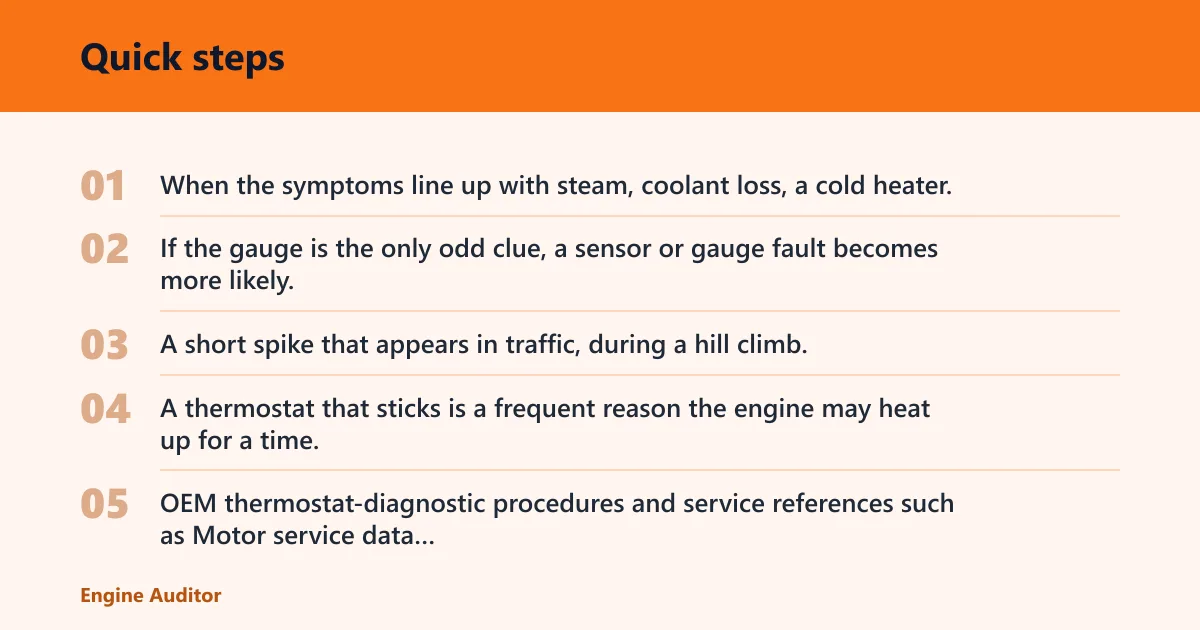
When the symptoms line up with steam, coolant loss, a cold heater, or a fan that never starts, assume the problem is real until proven otherwise. If the gauge is the only odd clue, a sensor or gauge fault becomes more likely, but the cooling system still needs a cold check before you trust the reading.
What a brief spike usually means
A short spike that appears in traffic, during a hill climb, or after a long idle can point to a part that is not keeping up under one condition. A thermostat that sticks is a frequent reason the engine may heat up for a time, then settle again once coolant flow changes. OEM thermostat-diagnostic procedures and service references such as Motor service data commonly call for checking whether the engine stabilizes only after flow changes or speed improves.
Why normal cooling can return after a fault moment
Cooling can look normal again when vehicle speed improves airflow, engine load drops, or the thermostat opens after a delay. That does not clear the fault. A bad water pump may cause overheating at first and then cooling down again, and a failed radiator fan can stop the engine from cooling properly at idle. Reputable service references such as ALLDATA/Motor-style flowcharts treat these as intermittent cooling-system patterns, not as proof the system is healthy.
When a drop in temperature still means stop driving
If the gauge reaches the red zone, steam appears, coolant is being pushed out, or the warning returns after another few minutes, stop driving. A brief recovery does not mean the engine is safe. Continuing to drive can turn a cooling fault into engine damage, even if the needle later falls. That is the same basic warning found in OEM owner and service manuals: once an overheat is confirmed, the safest move is to shut down and inspect before further operation.
Is it really overheating or just a bad reading?
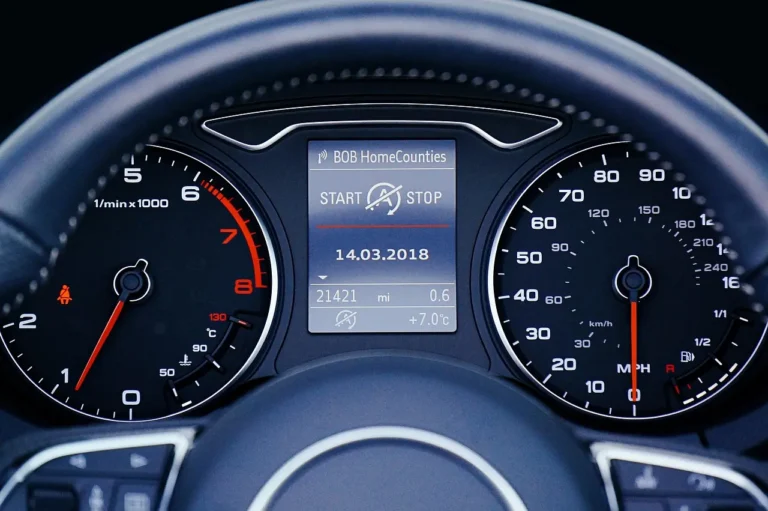
Sometimes the engine is truly too hot. Sometimes the display is lying. A faulty coolant temperature sensor can send the wrong signal, and a bad temperature gauge can misreport true engine temperature. Even so, an erratic reading should be treated as real until you check the cooling system and confirm otherwise.
Signs the engine is truly hot
Look for steam, a sweet coolant smell, bubbling in the reservoir, coolant loss, or a heater that suddenly blows cold while the gauge climbs. Those signs point to a real cooling problem, not only a display issue. If the temperature keeps rising under load, assume the engine is overheating. OEM cooling-system diagnostics and factory service references also treat heater output loss plus rising temperature as a strong sign of low coolant or poor circulation.
Signs the gauge or sensor may be wrong
A sudden spike with no change in how the engine feels, followed by an immediate return to normal, can point to a sensor or gauge problem. If the cooling fan behaves oddly, the reading jumps without warning, or the needle moves in a way that does not match the engine’s behavior, the sensor or gauge deserves attention. A mismatch between dash reading and actual driveability is a classic clue in service-manual diagnostics and scan-tool-based troubleshooting.
Why you should treat an erratic gauge as real until checked
The safe approach is simple: act first, diagnose second. A false reading can waste time, but a real overheat can damage the engine quickly. Check the coolant when the engine is cold unless the manual says otherwise, then confirm whether the fault is in the cooling system or in the reading itself. Many OEM procedures specify a cold-engine coolant check to avoid false low-level readings and to prevent burns from a pressurized hot system.
Normal car overheating and matrix
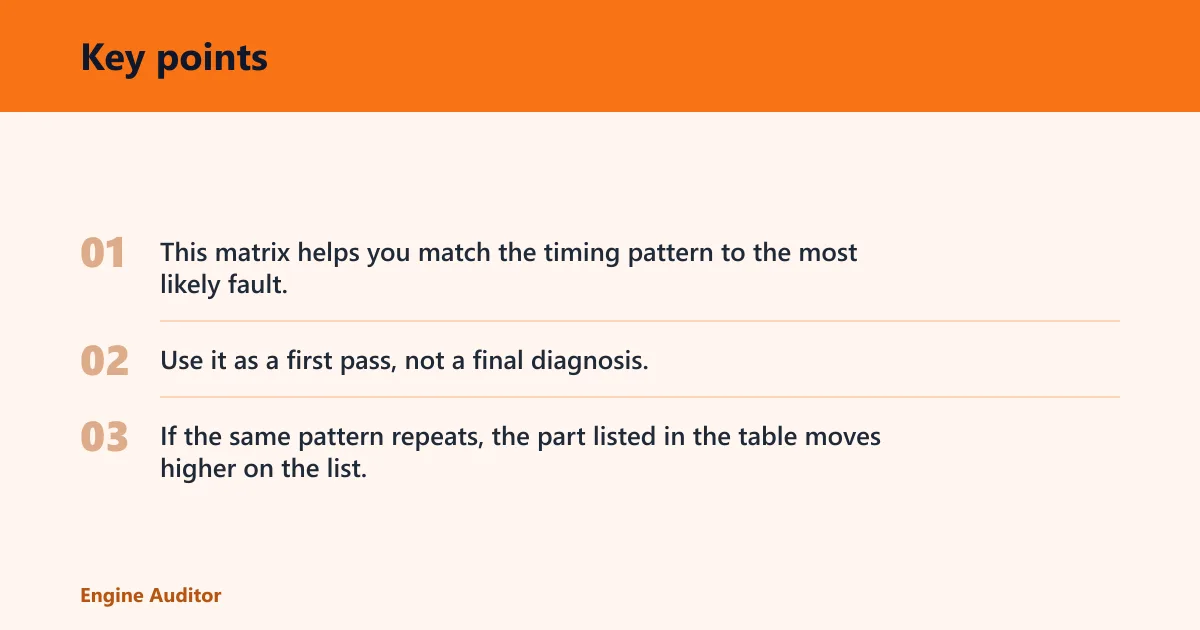
This matrix helps you match the timing pattern to the most likely fault. Use it as a first pass, not a final diagnosis. If the same pattern repeats, the part listed in the table moves higher on the list.
| Symptom pattern | Likely cause | What confirms it | What rules it out | Quick check | Stop-driving level |
|---|---|---|---|---|---|
| Overheats at idle but stays normal at speed | Radiator fan failure, airflow issue, or low coolant | Fan does not come on when hot, A/C does not trigger fan, or temperature rises mainly in traffic | Normal idle with strong fan operation and no temperature rise in traffic | Check whether the fan comes on with the engine hot and the A/C on | High if the gauge climbs toward red; stop if steam appears |
| Overheats after 20 to 30 minutes | Thermostat sticking, radiator restriction, or partial water pump failure | Heat builds only after warm-up, then repeats on the same schedule | Immediate overheating from startup or no timing pattern at all | Watch for heat spikes that come and go as the thermostat opens and closes | Moderate to high; stop if the spike keeps returning |
| Gauge spikes then drops | Coolant temperature sensor fault, temperature gauge fault, trapped air, or thermostat | Gauge movement does not match engine behavior, heater output, or fan operation | Steam, coolant loss, or repeated overheating that proves the engine is actually hot | Compare the gauge with heater output and fan behavior | High until the reading is verified |
| Heater blows cold | Low coolant, air in the system, or water pump trouble | Heater output drops at the same time the gauge climbs or the upper hose stays oddly cool | Strong cabin heat with a stable gauge and normal coolant level | Check coolant level on a cold engine and look for leaks | High if the gauge is rising at the same time |
| Fan never turns on | Fan motor, relay, wiring, or sensor command fault | Fan stays off when hot or when A/C is switched on, depending on the vehicle strategy | Fan runs normally at temperature or when the A/C is commanded on | Turn the A/C on and watch whether the fan starts | High in traffic or at idle |
| Coolant level keeps falling | Leak, head-gasket-type loss, or internal coolant loss | Reservoir keeps dropping after refills or there are dried coolant traces, drips, or white residue | Level stays stable after a proper cold fill and no external loss is found | Check hoses, radiator, water pump area, and the ground under the car | Very high; do not keep driving if the level drops again |
Can low coolant or trapped air do this?
Yes. Low coolant can trigger temporary overheating, and air in the system can create bubbles that interrupt circulation. The cooling system is closed and should never have air bubbles. When coolant is low or air is trapped, temperature swings often show up first at idle, in traffic, or right after a heat cycle.
Why low coolant causes temperature swings
Low coolant leaves less fluid to carry heat away from the engine. That can let the gauge rise, then fall when the remaining coolant shifts or the engine load changes. Low coolant often points to a leak or internal loss, so the level problem should not be treated as a one-time refill issue. Factory service manuals commonly instruct a cold check first because a hot pressurized system can mask the real level.
How trapped air affects heater output and temperature stability
Air pockets can block coolant flow through the heater core and parts of the engine. That is why the heater may blow cold while the gauge climbs. Air often follows low coolant, and it can make the engine temperature behave as if the fault is coming and going.
What to check on a cold engine
Check the coolant only when the engine is cold unless the manual says otherwise. Look at the reservoir level, radiator cap area if the system design allows it, and any visible hose or pump leaks. If the level is low, refill only with the correct coolant type and find the loss path. Cold checks are the standard recommendation in OEM-style service procedures because hot systems can vent, expand, and give misleading results.
What a traffic-only spike usually points
Say your compact sedan idles in a drive-through for 15 minutes, then the gauge jumps near red and falls once you start moving again. That pattern points more toward fan or airflow trouble than a random gauge issue, especially if the A/C also gets weaker at the same time.
Can a thermostat, fan, or radiator cause the spike?
Yes. Those three parts sit at the center of many intermittent overheating complaints. A thermostat controls coolant flow to and from the engine, a radiator fan moves air through the radiator, and the radiator removes heat from coolant. If any one of them misbehaves, the engine can heat up for a while and then seem normal again.
Thermostat sticking open or closed
A thermostat that sticks can cause heat spikes before the temperature stabilizes. Sticking closed can trap heat in the engine. Sticking open can slow warm-up and may create odd swings if the system is already low on coolant or has air in it. Modern cars may use sensor-controlled thermostats, which can change the failure pattern. OEM and technical-service references typically compare warm-up behavior, hose temperatures, and repeat timing to separate thermostat faults from other causes.
Radiator fan failure at idle or under load
A failed radiator fan can stop the engine from cooling properly, especially at idle or in slow traffic where natural airflow is weak. On many vehicles, the same fan also affects air conditioning performance. If the A/C weakens or the fan never starts, the fan circuit or control command should be checked quickly. Factory diagnostics commonly expect the fan to come on based on temperature, A/C request, or both, depending on the vehicle strategy.
Radiator restriction or clogging
A clogged radiator can prevent coolant from circulating as it should. That restriction may show up after 20 to 30 minutes, under load, or when airflow drops at low speed. A restricted radiator often behaves like an intermittent problem because it cannot shed heat well when demand increases.
Could the water pump or sensor be the problem?
Yes. A water pump and a sensor fault can create very different symptoms, and both can fool a driver into thinking the issue fixed itself. A bad water pump may cause overheating at first and then cooling down again. A coolant temperature sensor can fail intermittently and send wrong data.
Partial water pump failure
A partially failing pump may still move some coolant, which is why the temperature can rise, fall, and then rise again later. A complete failure can prevent cooling entirely. Watch for leaks around the pump, wobble from the pulley area, or heat that gets worse with engine speed changes. Service-manual diagnostics often look for reduced flow, noise, or leakage as signs that the pump is losing efficiency before total failure.
Coolant temperature sensor faults
The coolant temperature sensor measures coolant temperature, and when it fails intermittently it can make the gauge appear erratic. That does not mean the engine is safe. If the heater output, fan behavior, and gauge reading do not agree, the sensor and its wiring should be checked before you assume the engine is fine. Scan-tool data compared against actual symptoms is the standard way to confirm whether the sensor is lying.
Faulty temperature gauge warnings
A faulty temperature gauge can misreport true engine temperature, especially if the needle jumps sharply or drops without a matching change in engine behavior. Still, do not dismiss it. A false gauge is possible, but until confirmed, the reading must be treated as a real overheat warning because the damage risk is the same. If the dash reading does not agree with the engine’s behavior, the cluster, sender, wiring, or PCM input should be considered in the diagnosis.
What a highway-then-idle pattern can mean
Suppose a minivan starts overheating after about 25 minutes on the highway, then settles when the driver exits and idles at a light with the heater on full hot. That pattern can point to a thermostat, radiator restriction, or partial water pump issue rather than a single bad gauge reading.
When the pattern points to a bigger engine fault
Some patterns deserve extra caution because they suggest the engine is losing coolant or cannot keep temperature stable at all. If coolant keeps dropping with no obvious leak, the heater blows cold while the gauge climbs, or overheating returns after each cool-down, the problem may be more serious than a one-part failure.
Coolant keeps dropping with no obvious leak
Repeated coolant loss can mean an external leak that is hard to see or an internal loss path. Check under the car after parking, inspect hoses, the radiator, the water pump area, and the reservoir. If the level keeps falling, do not keep topping off and ignoring it.
Heater blows cold while the gauge climbs
That combination often means coolant is not circulating properly. Low coolant, trapped air, pump trouble, or a blocked heater circuit can all create it. If the heater stays cold and the temperature rises at the same time, the car should be treated as unsafe to keep driving until the cause is found.
Overheating returns after each cool-down
Repeated return spikes are a warning sign. A car that cools briefly and then overheats again may have a thermostat that sticks intermittently, a fan that cuts out, a pump that is losing flow, or a radiator that cannot pass enough heat. Repeated cycling means the fault is active, not solved.
Diagnostic checklist
- Check the coolant level only when the engine is cold unless the manual says otherwise.
- Look for leaks, steam, or signs of dried coolant around hoses, the radiator, and the water pump.
- Note when the problem happens: idle, highway speed, after 20 to 30 minutes, or after shutdown.
- Watch the heater, fan, and gauge together. Mismatched behavior points toward sensor or circulation faults.
- Stop driving if the gauge reaches the red zone, steam appears, or the level drops again.
Frequently asked questions
Why does my car overheat and then go back to normal?
That pattern usually points to a fault that appears only under certain conditions, such as low coolant, trapped air, a sticking thermostat, a fan problem, or a sensor fault. A drop back to normal does not prove the fault is gone. If the temperature rises again under load, treat it as real overheating.
Why is my engine overheating then going back to normal?
The engine may be overheating because circulation or airflow is weak, then recovering when speed, load, or thermostat position changes. That can happen with a bad water pump, radiator restriction, fan failure, or low coolant. The key clue is when it happens, not just the gauge reading itself.
Why is my car overheating all of a sudden?
A sudden overheat can come from a rapid coolant loss, a failed fan, a thermostat that sticks, or a pump that stops moving coolant well. If it happens without warning, check for steam, leaks, and a red-zone gauge. Sudden overheating deserves immediate attention because engine damage can start fast.
Why does my car overheat after 30 minutes?
Overheating after 20 to 30 minutes often points to a part that fails once the engine is fully warm, such as a thermostat, radiator restriction, or partial pump failure. Heat soak can also expose low coolant or trapped air. The timing matters because it tells you which part is under stress.
Can low coolant cause temporary overheating?
Yes. Low coolant can cause temporary overheating because there may still be enough fluid to cool the engine for a while, then not enough when demand rises. Low coolant often means there is a leak or internal loss. Check the level only when the engine is cold.
Could the temperature gauge be wrong?
Yes. A faulty coolant temperature sensor can send wrong data, and the temperature gauge itself can misreport the true engine temperature. But an erratic reading should still be treated as real until checked, because the engine may be overheating even if the needle is the part that is lying.
Is it safe to keep driving if the temperature drops again?
Not if it dropped after a red-zone event, steam, or repeated overheating. A temporary recovery can happen with a bad thermostat, fan, pump, sensor, or low coolant, but the fault may still be active. If the engine overheats again under load, stop driving and inspect the system.
Products related to this article
Sponsored / affiliate links. As an Amazon Associate I earn from qualifying purchases. I may earn additional commission from eligible campaigns.