Vehicle types for tall drivers: Best cabins and seats
For tall drivers, the best fit usually comes from full-size SUVs, pickups, and some sedans with long seat tracks and high rooflines. Judge them by key fit-and-comfort measures like headroom, legroom, and seat height, rather than badge or class. Bad cabin geometry leads to bent knees, a low roofline, neck strain, and short drives that feel long. This guide compares vehicle types, seat positions, and cabin dimensions so you can match torso, legs, and daily use to the right layout.
This guide is part of our Vehicle types guide series.
Matching Cabin Fit to Body Shape and Driving Routine
The best vehicle type depends on your body shape and driving routine. Tall drivers usually need enough headroom for a natural neck angle, enough legroom for knee clearance, and a seat height that keeps the hips and thighs supported. Full-size SUVs and half-ton pickups often lead, but the best answer changes if you need easy parking, a lower step-in, or a long highway commute.
Start with body shape, not badge
Long-torso drivers usually run into roof contact first, while long-leg drivers often run out of legroom before they run out of headroom. Two people of the same height can fit very differently in the same motor vehicle. A high roof does little if the seat sits too low, and a long cabin helps less if steering reach feels cramped.
How daily commuting fit differs from road-trip fit
Daily commuting fit is about quick entry, clear sightlines, and a seat that feels natural in short trips. Road-trip fit adds thigh support, shoulder comfort, and lower noise levels over time. A vehicle can feel fine for a short drive and become annoying after a longer stretch, so check both use cases before you decide.
Which cabin dimensions matter most?
Front headroom, front legroom, seat height, and steering adjustment are the core measurements for tall drivers. Headroom tells you whether your helmet, hair, or posture touches the roof. Legroom and seat-track range determine knee angle and pedal comfort. Seat height and reach then decide whether your hips, shoulders, and arms can settle without strain.
Front headroom and roof packaging
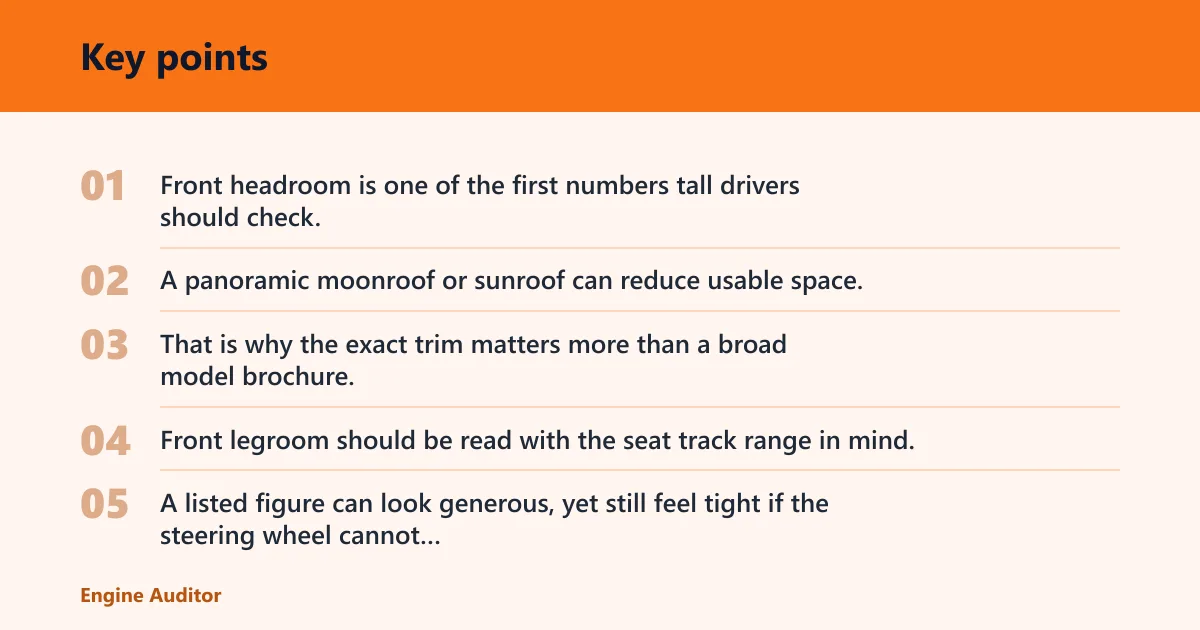
Front headroom is one of the first numbers tall drivers should check, but it only tells part of the story. A panoramic moonroof or sunroof can reduce usable space, especially if the glass package lowers the headliner. That is why the exact trim matters more than a broad model brochure.
Front legroom and seat track range
Front legroom should be read with the seat track range in mind. A listed figure can look generous, yet still feel tight if the steering wheel cannot move far enough away or if the pedals sit too close to the floor. Knee clearance and ankle comfort depend on the whole driving triangle, not one dimension.
Seat height, hip angle, and thigh support
A higher seat position often helps tall drivers because it raises the H-point relative to the floor. That can reduce knee bend and make entry easier. It also changes thigh support, which matters on long drives. Too low a seat can leave thighs unsupported; too high can make the knees feel boxed in.
Steering wheel reach and adjustment range
Steering wheel telescoping and tilt adjustment are not optional details for tall drivers. They help align arms and shoulders so the wheel does not crowd the chest or force the shoulders forward. Check the adjustment range on the exact trim, because trim-level differences can change whether the wheel clears your preferred seat position.

How do SUVs and trucks compare for tall drivers?

SUVs and trucks often give tall drivers a better starting point than small cars because they tend to have higher seating positions and more upright cabin geometry. The comparison is not automatic, though. Midsize SUVs can be a good compromise, full-size SUVs usually offer the most space, and half-ton pickups vary widely by cab size and trim.
Midsize SUV: where it fits and where it falls short
A midsize SUV usually offers upright seating and enough room for many tall drivers, especially those who want daily usability and an available 3-row layout. It can work well if you need easy parking, decent cargo space, and a seat that is not too low. Its limit is that front space can feel narrower than full-size options.
Full-size SUV: why it often leads on front-seat space
A full-size SUV generally gives the strongest front-seat comfort for tall drivers who also carry passengers. The cabin is usually broader, the seat base can be more supportive, and the driving position often feels less cramped. If your priority is front comfort over footprint and fuel cost, this is often the benchmark.
Half-ton pickup truck: cab layout, trim spread, and seat position
A half-ton pickup truck can be excellent for tall drivers because the seating position is high and the front cabin is often wide. But cab size matters. Regular, extended, and crew cab layouts can change legroom and recline range a lot, and trim differences can affect both seat comfort and wheel adjustment.
For reference, the 2026 Nissan Pathfinder is described as a midsize three-row SUV, the 2026 GMC Sierra 1500 is described as a half-ton model, and the 2026 GMC Yukon starts at $69,600. The Pathfinder starts at $39,990, which is a useful reminder that size, space, and price do not move together in a straight line.
Which seat position is best for tall drivers?
The best seat position depends on whether your torso or legs are the longer part of your frame. Long-torso drivers usually need more headroom and a wheel that adjusts far enough, while long-leg drivers often need a longer seat track and a higher H-point. The goal is relaxed knees, supported thighs, and arms that are not reaching.
Long-torso drivers
Long-torso drivers should prioritize roofline clearance first, then steering reach. A seat that sits slightly lower can help, but only if it does not create a cramped hip angle or leave the thighs floating. If the roof is close in the brochure, a moonroof-equipped trim may be a poor fit even before the test drive starts.
Long-leg drivers
Long-leg drivers should focus on front legroom, pedal spacing, and seat track range. A generous legroom number means little if the seat cannot slide far enough back without making the wheel unreachable. Look for a layout that lets the knee relax rather than point upward, because that angle gets tiring quickly.
High-H-point vs lower seating
A high-H-point seat usually helps with entry and exit, and it often improves thigh support. That is why many tall drivers prefer SUVs and pickups over low sedans. A lower seating position can still work, but it needs excellent telescoping reach and enough roof clearance to avoid a hunched posture.
Do panoramic moonroofs reduce headroom?
Yes. Panoramic moonroofs and sunroofs can reduce usable headroom, and that reduction matters most for long-torso drivers or anyone sitting close to the roof already. The issue is not the glass itself but the packaging around it, which can lower the headliner and take away the last inch that matters.
Why roof glass can change the fit
Roof glass often changes the cabin shape in a way that spec sheets do not make obvious at a glance. A trim with a moonroof can be listed as the same model and still feel tighter above the crown of the head. That is why tall drivers should never assume the base trim fit carries over to every other trim.
How to compare trim sheets before you test drive
Check the exact trim, then see whether the roof option package changes front headroom. If the brochure lists front headroom without the panoramic moonroof, treat that as the baseline, not the guarantee. For tall drivers, this is one of the most common reasons a promising vehicle disappoints in the seat.
Tall-driver fit scorecard by vehicle type
Use this scorecard as a quick screen before you spend time on trim sheets or test drives. It is a fit framework, not a model ranking. A pass means the vehicle type usually gives tall drivers a workable starting point; a fail means it often needs careful trim-by-trim checking to avoid cramped space.
| Vehicle type | Headroom | Legroom | Seat height | Steering reach | Roof option penalty | Ingress/egress | Quick verdict |
|---|---|---|---|---|---|---|---|
| Small car | Low to mixed | Low to mixed | Low | Mixed | Often high | Poor for many tall drivers | Fail for most; only specific trims pass |
| Midsize SUV | Usually good | Usually good | Medium to high | Usually good | Moderate | Usually easy | Pass for many; check roof package carefully |
| Full-size SUV | Strong | Strong | High | Strong | Moderate | Easy | Pass; often the safest bet for tall drivers |
| Half-ton pickup | Strong | Strong to very strong | High | Strong | Low to moderate | Easy to moderate | Pass; cab size and trim decide final fit |
Concrete examples show the spread. The Pathfinder has 42.3 inches of front headroom without the panoramic moonroof and 44.3 inches of front legroom. The Sierra 1500 has 43.11 inches of front headroom and 44.53 inches of front legroom. The Yukon has 42.3 inches of front headroom without the sunroof and 44.5 inches of front legroom.
Those numbers do not end the discussion, but they do show why vehicle type matters. A half-ton truck or full-size SUV can give a taller driver enough room to sit upright without sliding the seat all the way back. In a smaller cabin, the same driver may need to trade comfort for steering reach or roof clearance.
What should you check on a test drive?

A test drive matters before buying because fit can change once you sit, steer, brake, and enter or exit the cabin. Plan on a decent amount of time, rather than a very short parking-lot loop. You are checking knee clearance, thigh support, pedal comfort, and whether ingress and egress happen without twisting or ducking. If the cabin feels awkward before the route starts, it usually gets worse on longer drives.
20 to 30 minute fit check
Spend enough time in the seat to notice pressure points and posture drift. Short sits hide problems in the lower back, shoulders, and right knee. A longer loop also helps you judge noise, seat cushion shape, bolstering, and how fatigue builds when the road surface changes.
Knee clearance, thigh support, and pedal comfort
Check that your knees do not press into the dash and that your thighs rest on the cushion without lifting your hips. Pedal comfort matters because a cramped right leg can make the ankle work too hard. If the seat is wide but flat, or firm but oddly shaped, long drives can still feel tiring.
Ingress and egress without twisting or ducking
Easy entry and exit matter more than many buyers expect. A good seat height lets you sit down and stand up with less bending, which matters on daily errands as much as on road trips. If you have to duck hard under the roof or twist out of the seat, the layout is fighting your body.
Say your torso is long and your driving route is mostly highway. A full-size SUV with a high seat and wide wheel adjustment may feel far better than a lower car with similar headroom, because the hip angle and shoulder reach stay relaxed for longer.
Suppose your legs are the longer half of your frame and you commute across town. A midsize SUV with solid seat track range may be enough, but only if the steering wheel still reaches comfortably after the seat moves back. If not, the extra legroom is mostly theoretical.
Frequently asked questions
What vehicle type is best for tall drivers?
Full-size SUVs and half-ton pickups usually give tall drivers the best starting point because they combine higher seat positions, broader cabins, and stronger front legroom. Some sedans can still work if they have long seat tracks and a low dash, but the cabin has to fit your torso and legs together.
Which cars have the most headroom for tall drivers?
Vehicles with taller rooflines and upright seating usually offer the most usable headroom. That often includes full-size SUVs, some midsize SUVs, and pickups. The exact trim matters because panoramic moonroofs and sunroofs can reduce headroom enough to change a pass into a fail for long-torso drivers.
Are SUVs or trucks better for tall drivers?
Both can work well, but trucks often win on seat height and front cabin width, while SUVs often win on enclosed comfort and passenger flexibility. A full-size SUV may feel better if you want a quieter cabin and easier family use. A half-ton pickup may feel better if you want more open space around the driver.
Do panoramic moonroofs reduce headroom for tall drivers?
Yes, they can. The glass itself is not the only issue; the frame and headliner packaging can lower the usable space above your head. That is why you should check the exact trim sheet and not assume the base model headroom carries over to a moonroof-equipped version.
Can a midsize SUV be comfortable for a tall driver?
Yes, a midsize SUV can be comfortable if it has enough front headroom, usable legroom, and a seat that sits high enough to support your thighs. It often gives a good balance of room and daily usability. The catch is that roof options and trim changes can shift the fit quickly.
What front legroom should tall drivers prioritize?
Tall drivers should prioritize enough front legroom to keep the knee angle open and the ankle relaxed, with extra attention to seat track range. A listed number helps, but the real question is whether the wheel still reaches once the seat is moved back. Legroom without adjustment range can still feel tight.
What should tall drivers look for in a test drive?
Check headroom, legroom, seat height, and steering reach in one sitting position, then drive long enough to notice knee clearance and thigh support. If entry and exit require ducking or twisting, the cabin is probably a poor long-term match. A 20 to 30 minute route is the minimum useful check.
Products related to this article
Sponsored / affiliate links. As an Amazon Associate I earn from qualifying purchases. I may earn additional commission from eligible campaigns.