Best Vehicle Types for Reliability: Categories That Last Longer
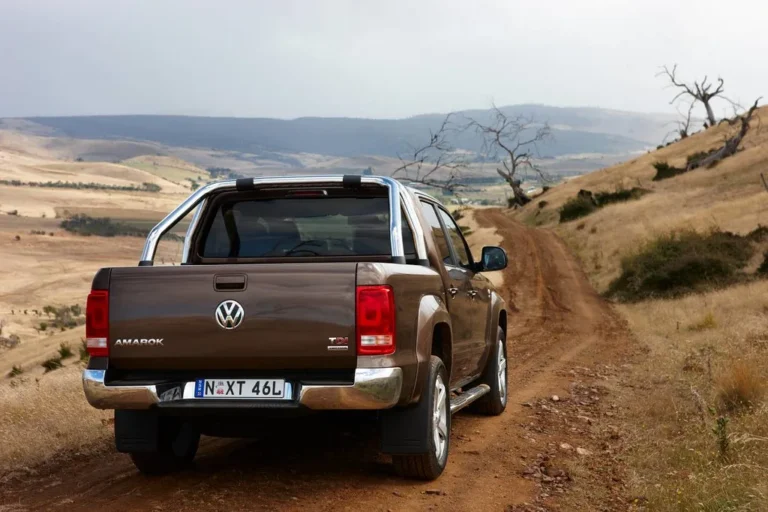
Body-on-frame pickups and full-size SUVs often last longest when maintenance is kept up and most miles are highway miles. Compact sedans and wagons can outlast many crossovers too, because they carry less weight and put less strain on brakes, tires, and suspension parts. Without regard to body style, vehicles can face rust, suspension wear, and drivetrain repairs before 150,000 miles. This guide ranks body styles by typical wear, then matches each one to the driving patterns and climates where it holds up best.
Which vehicle types last the longest?
Category matters because each body style takes a different mix of load, heat, vibration, corrosion, and repair complexity. A vehicle that spends its life on smooth roads with light cargo ages very differently from one that tows, idles, or lives in road salt. The longest-lived category is often the one that avoids stress, not the one with the highest ground clearance.
What high mileage usually means by body style
For shoppers, “high mileage” is less about one universal number than about how hard the vehicle has worked. A 180,000-mile sedan with regular fluid service and limited stop-and-go use may have less wear than a 120,000-mile truck that towed often and sat outside in winter salt. Condition and service history still matter most.
Vehicle longevity matrix
| Category | Failure exposure | Repair complexity | Rust risk | Tire/brake wear | Towing stress | Family-use wear | Best for |
|---|---|---|---|---|---|---|---|
| Sedan | Low to moderate | Low | Moderate | Low | Low | Low | Long highway commutes, low ownership cost |
| Compact SUV | Moderate | Moderate | Moderate | Moderate to high | Low to moderate | Moderate | All-weather daily use with modest cargo needs |
| Midsize SUV | Moderate to high | Moderate to high | Moderate | Moderate to high | Moderate | High | Families that need space and can accept higher upkeep |
| Pickup truck | Moderate to high | Moderate | High | High | High | Moderate | Frequent towing, payload work, fleet duty |
| Minivan | Moderate | Moderate | Moderate to high | Moderate | Low | High | Family hauling with low-stress driving patterns |
Why simpler designs usually age better
Reliability tracks failure points, repair access, and the amount of work each part must absorb. Simple powertrains use fewer parts that can fail. That does not make every simple vehicle durable, but it does cut the number of repairs that can interrupt long-term ownership.
Typical drivetrain layouts and service access
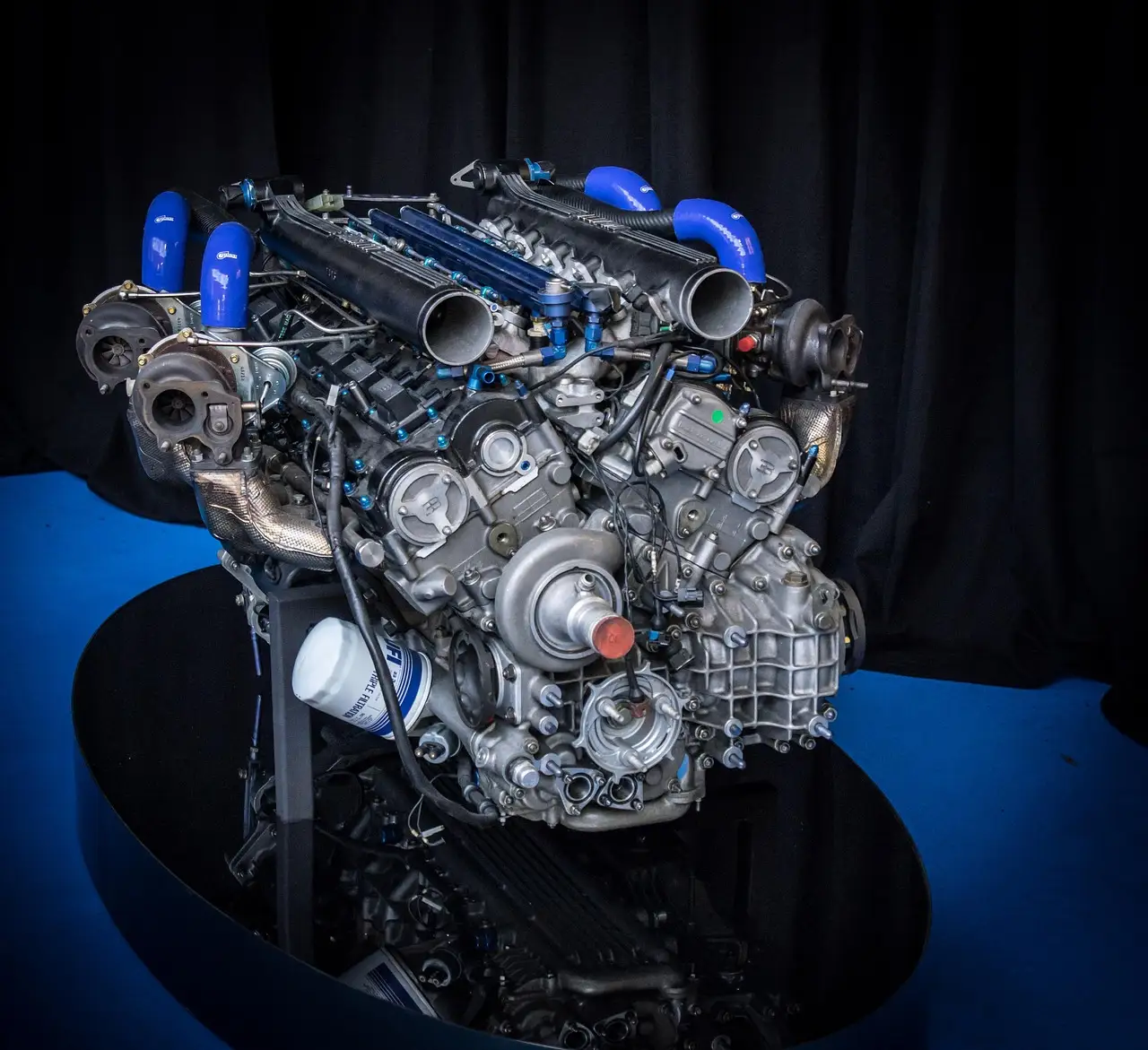
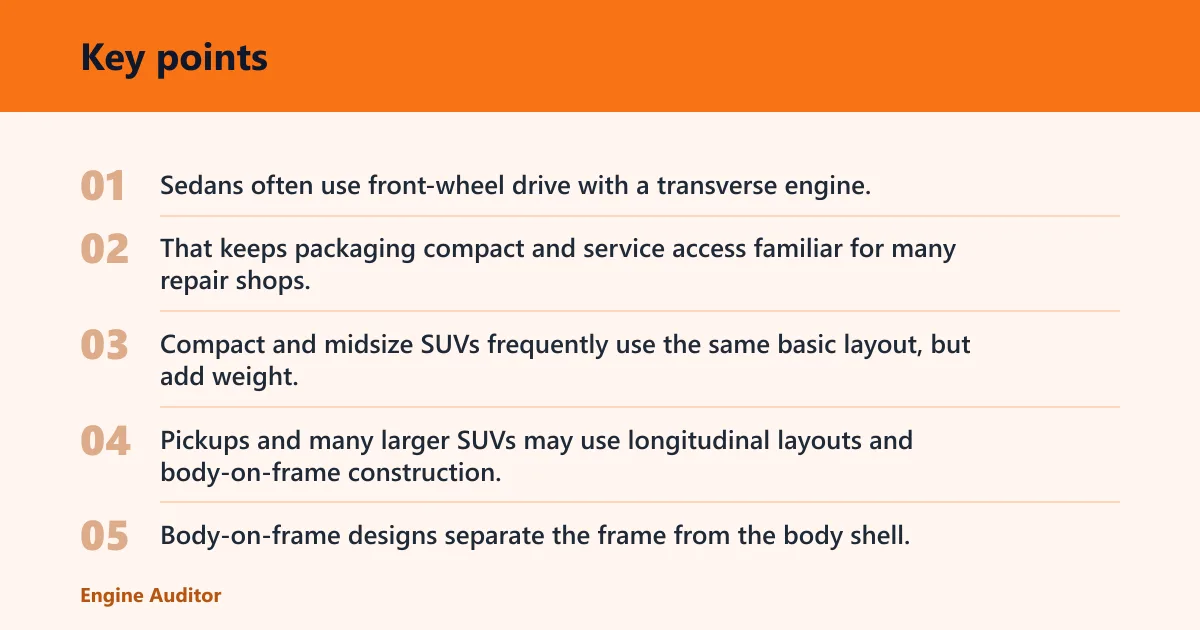
Sedans often use front-wheel drive with a transverse engine. That keeps packaging compact and service access familiar for many repair shops. Compact and midsize SUVs frequently use the same basic layout, but add weight, taller suspensions, and often AWD hardware. Pickups and many larger SUVs may use longitudinal layouts and body-on-frame construction, which can help with towing but may add complexity.
Body-on-frame designs separate the frame from the body shell. That helps with payload and towing loads, and it can make frame and suspension parts easier to replace after hard use. The tradeoff is weight and ride comfort. Unibody construction saves weight and usually drives better on pavement, but collision repairs and corrosion control can be more demanding when rust reaches structural sheet metal.
Transmission choice and common failure modes
Automatic transmissions dominate this segment comparison. Conventional automatics often handle heat and load well when fluid service stays on schedule. Manuals can last a long time because they avoid some automatic wear items, but clutch life depends heavily on traffic and driver use. CVTs can deliver good fuel economy, yet they often face stricter fluid intervals and less tolerance for neglected service.
A common rule of thumb is that transmission fluid changes around every 30,000 to 60,000 miles help many automatics, though some manufacturers recommend longer intervals. That difference matters. Heat, dirty fluid, and towing can shorten life faster than body style alone.
Example situations
Say your commute is 42 miles of highway each way, with little idling and no towing. A simple sedan with a conventional automatic may age slowly because it carries less mass, uses less fuel, and puts less strain on brakes and suspension.
Suppose a compact SUV spends winters on salted roads and summer weekends with a rooftop box. The extra weight, roof load, and AWD hardware can raise tire wear and maintenance needs, even if the vehicle feels more capable in bad weather.
Are sedans still the safest long-term bet?
Often yes, if your goal is low-cost longevity rather than maximum cargo room. Sedans usually put fewer demands on the drivetrain and suspension than taller vehicles, and they are often lighter, which helps tires, brakes, and fuel use. That does not make every sedan the winner, but it keeps them near the front for ownership cost.
Maintenance complexity and repair costs
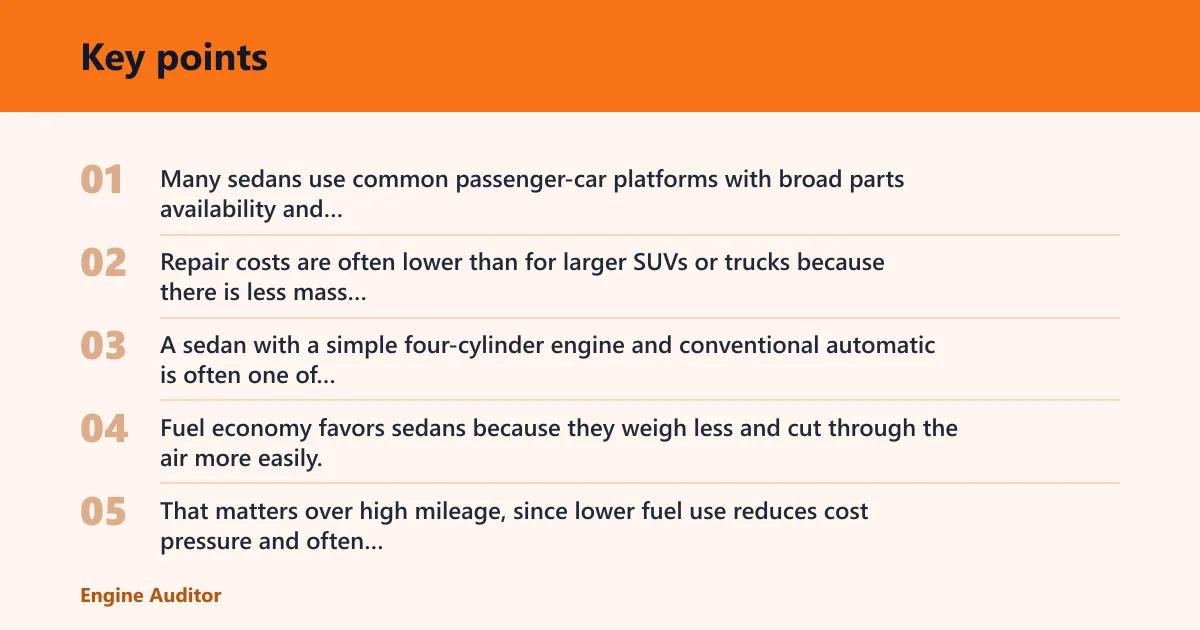
Many sedans use common passenger-car platforms with broad parts availability and straightforward service layouts. Repair costs are often lower than for larger SUVs or trucks because there is less mass to stop, less tire to replace, and less drivetrain hardware to maintain. A sedan with a simple four-cylinder engine and conventional automatic is often one of the easiest long-term ownership choices.
Fuel economy tradeoffs and high-mileage durability
Fuel economy favors sedans because they weigh less and cut through the air more easily. That matters over high mileage, since lower fuel use reduces cost pressure and often points to lower mechanical stress. High-mileage durability is strongest when the car avoids short trips, overheating, and neglected fluid service. A sedan that lives on the highway can last a long time.
When sedans are the cheapest to own
Sedans often cost less to own when you value tires, brakes, fuel, and repair access more than cabin height or cargo volume. They are a strong fit for commuters, empty nesters, and drivers who do not need to tow. If salt corrosion is heavy in your area, a sedan still needs rust care, but it usually has less exposed underbody hardware than many trucks.
Do SUVs last longer than sedans?
Not as a category. Some SUVs last longer than many sedans, but that depends on platform, drivetrain, and use pattern rather than body style alone. Compact and midsize SUVs add weight and often AWD hardware, which can raise tire wear and service needs. They gain utility, not automatic longevity.
Compact SUV wear patterns
Compact SUVs trade a higher seating position and more cargo space for added mass and more moving parts. Ground clearance can help in snow, deep ruts, and rough driveways, but it does not reduce wear by itself. AWD is available on many models, and that helps traction, yet it adds drivetrain parts, fluid service, and a fuel-economy penalty.
Midsize SUV family use, platform sharing, and resale
Midsize SUVs often use family-focused packaging, more powerful engine choices, and third-row or near-third-row layouts. Those features increase wear from passengers, cargo, and stop-and-go use. Platform sharing can help parts availability and service familiarity, but more features usually mean more failure points. Resale can stay strong because buyers want space, not because the vehicle is inherently simpler.
AWD availability and its long-term cost
AWD helps in snow and rain, especially where traction starts weak. It also adds maintenance points: extra fluids, more driveline components, and more weight. That weight contributes to tire wear and brake wear. In a dry climate with no real traction need, a front-wheel-drive version often costs less to keep for the long run.
Are trucks or vans more reliable over high mileage?
It depends on use. Trucks usually take harder mechanical loads because of towing and payload, while minivans often rack up highway and school-run miles with less strain. For pure work duty, trucks can survive very high mileage if maintained. For family use, minivans often age with fewer shocks to the drivetrain.
Pickup frame strength, towing, and suspension wear
Pickup trucks use frame construction that suits towing and payload, and that is a real durability advantage under work conditions. The downside is that heavy loads punish springs, shocks, brakes, wheel bearings, and tires. Fleet mileage patterns often include idling, short deliveries, and repeated loading, which can age a truck faster than the odometer alone suggests.
Minivan sliding doors, transmission life, and rust exposure
Minivans often last well because they are used for steady daily driving rather than hard hauling. Their transmissions can live a long time if fluid service stays on schedule and towing stays light. Sliding-door mechanisms add complexity, and rust can collect around door tracks, rocker panels, and rear arches where road salt stays trapped.
Which category fits fleet mileage better?
For commercial or mixed-use fleet mileage, pickups usually fit work tasks better because they can handle payload and towing. For passenger-heavy routes, shuttle duty, or school-family use, minivans often hold up better because they do not need to fight cargo weight the way trucks do. The best fit is the one with the least forced stress.
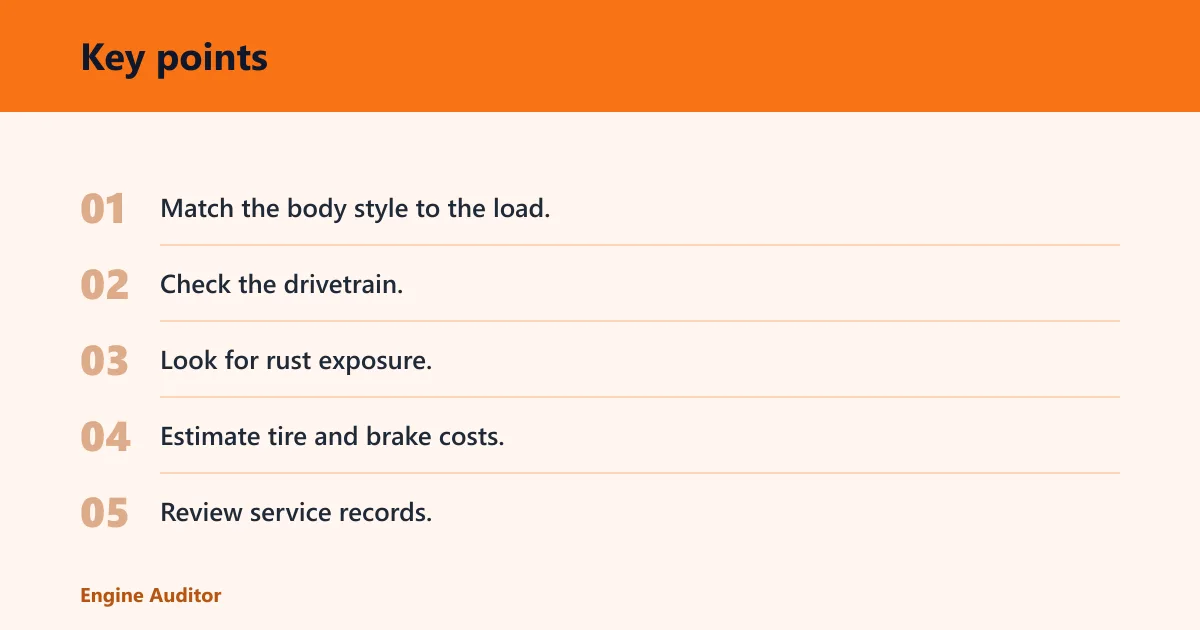
- Match the body style to the load. Choose a sedan for light-duty commuting, a minivan for family hauling, a truck for towing and payload, and an SUV only when the space or traction benefit is real.
- Check the drivetrain. A simple conventional automatic or manual often has fewer costly failure modes than a neglected CVT, turbo-heavy setup, or overworked AWD system.
- Look for rust exposure. Salt climates punish brake lines, subframes, door sills, and suspension mounts, so underbody condition matters as much as mileage.
- Estimate tire and brake costs. Heavier vehicles and AWD systems usually consume tires and brakes faster, which changes long-term ownership cost.
- Review service records. Regular oil changes, transmission service, coolant service, and differential service tell you more about longevity than body style alone.
A common first-timer mistake is buying a tall SUV for winter confidence, then discovering that the extra weight, larger tires, and AWD service needs cost more than a simpler front-drive car with good winter tires. Traction helps. It does not erase wear.
Frequently asked questions
Which vehicle type is the most reliable long term?
For many buyers, a simple sedan or minivan with a conventional automatic can be the easiest long-term bet because it has fewer heavy-duty stresses than a truck or AWD SUV. That said, a maintained body-on-frame pickup used mostly on highways can also last a very long time.
What vehicle categories are cheapest to maintain long term?
Sedans are usually the cheapest because they are lighter, simpler, and often use more common parts. Front-wheel-drive versions without turbochargers or CVTs often keep costs down. Minivans can also be reasonable if sliding-door repairs are rare and the transmission service schedule is followed.
Which vehicle types hold up best in harsh weather?
AWD compact and midsize SUVs, plus body-on-frame trucks and SUVs with proper winter tires, handle snow and rain well. But harsh weather also means salt, and salt drives corrosion. A well-rusted AWD vehicle can age worse than a clean front-drive sedan kept on good roads.
Does body style affect repair frequency and lifespan?
Yes, because body style changes what wears first. Trucks and SUVs usually face more tire, brake, suspension, and drivetrain load. Sedans often face fewer of those stresses. The effect is real, but it is still secondary to maintenance, climate, and how the vehicle is used day to day.
Products related to this article
Sponsored / affiliate links. As an Amazon Associate I earn from qualifying purchases. I may earn additional commission from eligible campaigns.