Best Vehicle Types for Gas Mileage: Top Efficient Categories
Hybrid cars usually return the best gas mileage, with hybrids at the top; SUVs, minivans, trucks, and sports cars generally burn more fuel as weight, engine size, and aerodynamic drag rise. Pick the wrong body style and fuel costs stay high for years. This guide ranks vehicle types by fuel efficiency, then compares them with passenger space, cargo room, towing, and daily use.
Vehicle type decision table
| Vehicle type | Efficiency tier | Typical MPG or MPGe range | Passenger and cargo tradeoff | Best-fit use case | Do not choose if |
|---|---|---|---|---|---|
| Hybrid cars | Top | About 55 MPGe average for the hybrid-car list; Prius Plug-in Hybrid at 127 MPGe; Prius hatchback hybrid at 57 MPGe | Best fuel economy, moderate space, light-duty hauling | City commuting, long daily mileage, low fuel spend | You want a simple gas-only fuel gauge, frequent long trips with no charging plan, or maximum towing capacity |
| Compact hatchbacks | Top tier for gas-only and hybrid options | Usually strong city, highway, and combined MPG; exact rating depends on engine and trim | Small footprint, flexible cargo area, limited rear seat room | City commuting, parking-tight neighborhoods, light cargo | You need a large back seat, quiet long-haul comfort, or heavy cargo volume every day |
| Compact SUVs | Upper middle | Usually better than midsize and three-row SUVs, but lower than efficient hatchbacks and hybrids | More ride height and cargo flexibility than a hatchback, more weight than a car | Mixed-use commuting, small families, light weekend gear | You want the lowest possible MPG, or you pick a larger engine and all-wheel drive without needing them |
| Minivans | Middle to upper middle | Hybrid versions can outperform many three-row SUVs | Excellent seating and cargo access, heavier than compact cars | Family hauling, car seats, road trips, sliding-door convenience | You insist on truck-like ground clearance or off-road styling over space efficiency |
| Three-row SUVs | Middle | 22 MPG average; 28 MPG for the Mitsubishi Outlander; 29 MPG for the Volkswagen Tiguan | More seating, more mass, less cargo room behind the third row than many shoppers expect | Large families that need extra seats and SUV packaging | You are choosing one mainly for fuel savings, or you rarely use the third row |
| Full-size trucks | Lower middle | 23 MPG average; 25 MPG ceiling for the GMC Sierra 1500 and Chevrolet Silverado 1500 | Strong towing and payload, poor efficiency once configured for work | Towing, hauling, job-site use, long-range refueling stops | You want the best gas mileage, especially with 4×4, heavy-duty tires, or max tow hardware |
| Sports cars | Lower middle | 25 MPG average; Mazda MX-5 Miata at 29 MPG; Ford Mustang coupe at 26 MPG | Best performance focus, limited passenger and cargo practicality | Weekend driving, light commuting, lower fuel burn than many expect | You need family space, cargo room, or high-efficiency everyday transport |
Which vehicle types get the best gas mileage?
Hybrid cars usually sit at the top, followed by efficient compact hatchbacks and smaller compact SUVs. That ranking comes from EPA combined ratings, which combine city and highway driving into one number, and from basic physics, because lighter bodies, smaller engines, and lower drag use less fuel.
How the ranking is judged
Use the EPA combined number first, then check the city and highway split. The combined figure matters because it reflects mixed driving more honestly than a single highway number. Plug-in hybrids are listed in MPGe because they can run on electricity as well as gasoline, so MPGe is not a straight gas-mileage number.
That difference matters. A plug-in hybrid may post a very high MPGe, but the gasoline engine may still matter on long trips after the battery is depleted. For gas-only shopping, compare MPG. For a plug-in, compare both MPGe and electric range in miles.
Why smaller and lighter vehicles usually use less fuel
Smaller vehicles usually need less energy to move their mass and less power to overcome rolling resistance. A lighter hatchback with a small engine and front-wheel drive often beats a larger crossover with the same engine because the bigger body weighs more and pushes more air.
Engine size and cylinder count matter too. A smaller-displacement four-cylinder with an automatic tuned for efficiency usually returns better MPG than a larger V6 or a turbocharged setup geared for acceleration. All-wheel drive often trims MPG as well, especially in city driving.
Where hybrids fit ahead of gas-only body styles
Hybrid cars lead because they recover energy in slow traffic and use the electric motor to help at low speeds. Those figures put hybrid cars above most gas-only body styles.
Standard hybrids and plug-in hybrids are not the same choice. A standard hybrid does its best work on fuel economy without needing charging. A plug-in hybrid can post higher MPGe and give electric-only commuting range, but it asks more planning from the driver.
Hybrid cars: usually the efficiency leaders
Hybrid cars usually lead because they pair a smaller gasoline engine with electric assist, and the EPA combined rating rewards that setup in stop-and-go driving. A standard hybrid is the easier gas-savings choice for most shoppers, while a plug-in hybrid can post even higher MPGe if you charge it and drive within its electric range.
Standard hybrid versus plug-in hybrid
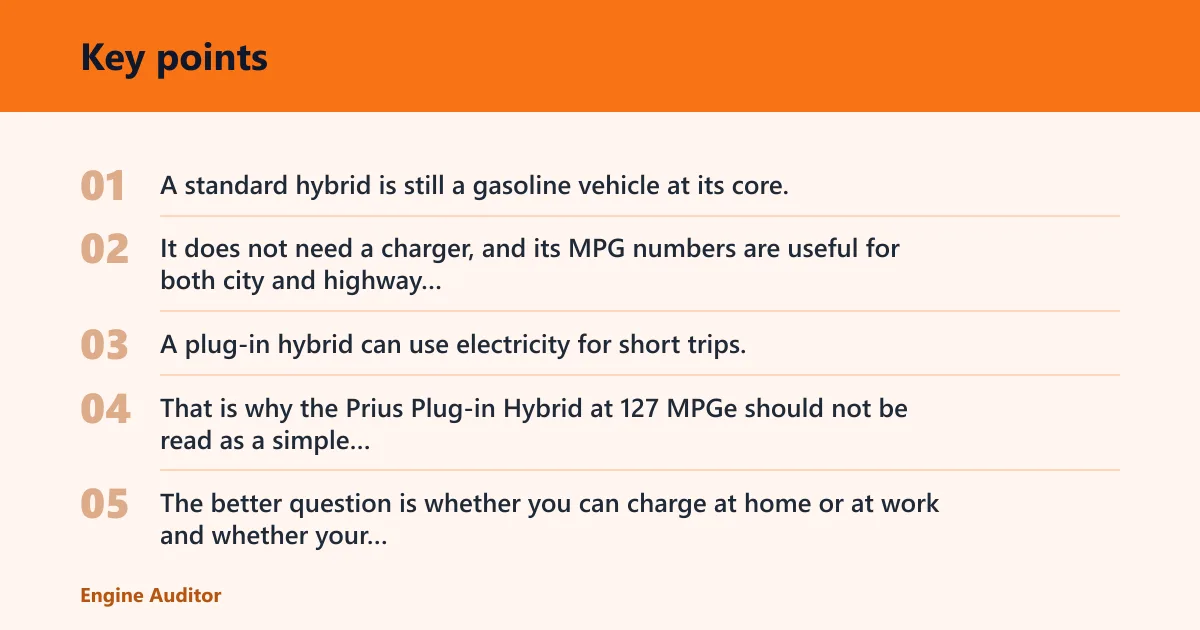
A standard hybrid is still a gasoline vehicle at its core. It does not need a charger, and its MPG numbers are useful for both city and highway comparison. A plug-in hybrid can use electricity for short trips, so its MPGe can look far better than a gas-only vehicle even when gasoline use is similar on longer drives.
That is why the Prius Plug-in Hybrid at 127 MPGe should not be read as a simple gas-mileage figure. The better question is whether you can charge at home or at work and whether your routine fits the electric range. If not, a standard hybrid can be the cleaner buy decision.
City and highway rating patterns
Hybrid cars usually shine in city ratings because braking energy is recovered and the engine can shut off more often. Highway ratings still matter, but the gap between city and highway is often smaller on a hybrid than on a conventional gas car. That helps explain why hybrids can beat larger gas vehicles even when size is similar.
Say your commute is 14 miles each way with stoplights and one grocery stop on the way home. A standard hybrid usually gives the better ownership answer than a small gas SUV, because the city portion of the trip is where the hybrid system earns back fuel.
Electric range and when MPGe matters
MPGe matters when the vehicle can plug in. It measures energy use, not gasoline alone. For a plug-in hybrid, electric range in miles is part of the buying decision because that range tells you how often you can avoid gasoline entirely on short trips.
If your daily drive is shorter than the plug-in’s electric range, the cost gap can be large. If your driving is mostly highway and you rarely charge, a standard hybrid often makes more sense because the MPG rating stays the main number that matters.
What SUV body style gets the best mpg?
Compact SUVs usually get the best mpg among SUV body styles, especially when they use a small four-cylinder engine, front-wheel drive, and an efficient automatic. Midsize SUVs sit lower, and three-row SUVs sit lower still because extra seating, extra weight, and larger bodies all cut efficiency.
Compact SUVs versus midsize SUVs versus three-row SUVs
Compact SUVs usually win the SUV category because they keep mass down while still giving a higher seating position and useful cargo space. Midsize SUVs add room and comfort, but the MPG penalty grows with size. Three-row SUVs are the least efficient of the three because they carry the most weight and usually use larger engines.
The Volkswagen Tiguan is listed at 29 MPG in the three-row SUV group, and the Mitsubishi Outlander at 28 MPG. Those are strong numbers for the class, but they still trail efficient compact cars and many hybrids. The average fuel efficiency for a three-row SUV is 22 MPG.
Hybrid availability across SUV sizes
Hybrid powertrains improve SUV MPG, but they do not erase the weight penalty. A compact hybrid SUV can be a smart compromise for shoppers who need higher seating and cargo space. A three-row hybrid SUV can still be efficient relative to the class, but it remains heavier than a hatchback or sedan hybrid.
A common first-timer mistake is choosing a compact SUV only because it feels efficient, then adding all-wheel drive, a larger engine, and heavy wheels. That can push it behind a simpler hybrid minivan or hatchback in real-world fuel use.
Why two-row SUVs usually beat three-row models
Two-row SUVs usually beat three-row models because they shed seats, structure, and weight. They also tend to have less cargo volume behind the rear seat, which is a fair trade for lower fuel burn. Three-row SUVs are for people capacity first; mpg is usually a compromise.
Weight-to-power balance matters here. A heavier SUV needs more engine output to feel responsive, and once the engine size rises, fuel economy tends to fall. That is why body style matters before trim level: the same badge can hide very different fuel costs.
Compact hatchbacks and small cars
Compact hatchbacks are often the best gas-only answer because they keep curb weight low while using modest engines and efficient transmissions. They can rival sedans on fuel use, and the hatch layout often adds cargo flexibility without forcing the bigger footprint that hurts MPG.
Low curb weight and small-engine output
A compact hatchback usually uses a small engine, often a four-cylinder with modest power output. That is enough for commuting and light errands, not for towing or strong passing power. The fuel advantage comes from low weight, small displacement, and a transmission tuned for economy.
Hybrid hatchbacks push this even further.
City, highway, and combined MPG
Look for a hatchback that stays efficient in all three EPA numbers, not only on the highway. City MPG matters for errands and traffic. Highway MPG matters for road trips. Combined MPG tells you whether the vehicle stays efficient across both. The best hatchbacks usually keep the spread fairly tight.
For shoppers who want fuel economy without charging, a hatchback is often the cleanest answer. It gives you smaller exterior dimensions, easier parking, and enough cargo space for luggage, groceries, or a folded stroller without stepping into SUV weight.
Why hatchbacks can rival sedans on fuel use
Hatchbacks can match sedans because their short rear body section can reduce weight and improve utility. The shape is not always the enemy of aerodynamics; the main fuel penalty usually comes from added mass, wider tires, and a larger engine. Keep those in check and a hatchback stays efficient.
Are minivans better on gas than big SUVs?
Often yes, especially when the minivan is a hybrid and the SUV is a large gas-only model. Minivans are built to move people efficiently, while big SUVs often carry more weight, larger engines, and optional four-wheel drive that cut mpg. The result can be surprising: more seats, less fuel use.
How minivans compare with three-row SUVs
Minivans usually beat big three-row SUVs because they are built around passenger packaging instead of off-road stance. The Chrysler Pacifica Plug-In Hybrid earns 82 MPGe and is a minivan hybrid, which puts it well ahead of most large SUVs on efficiency. That matters if you move kids, cargo, and car seats every day.
Three-row SUVs can still make sense if you need higher ground clearance or towing. But if the third row is mainly for school runs and airport trips, a minivan usually gives better space per gallon. It also tends to have a flatter cargo floor and easier third-row access.
When a minivan is the smarter family choice
Choose a minivan when you need doors that open in tight parking spots, room for child seats, and luggage space that does not vanish when the third row is up. The fuel savings can be meaningful over a year of school runs and road trips. Efficiency and family convenience often point in the same direction here.
Where a hybrid minivan can beat a gas SUV
A hybrid minivan can beat a gas SUV because it avoids the large-engine penalty while carrying similar passenger loads. That is one reason the Pacifica Plug-In Hybrid matters in this ranking: it shows that family utility does not automatically require poor fuel economy. If charging is possible, the gap can widen further.
Full-size trucks and sports cars
Full-size trucks and sports cars sit lower in fuel economy, but for different reasons. Trucks trade mpg for towing and payload. Sports cars trade it for acceleration, handling, and lower mass than many people expect. In both categories, drivetrain choice changes the result a lot.
Which truck setup is the most efficient?
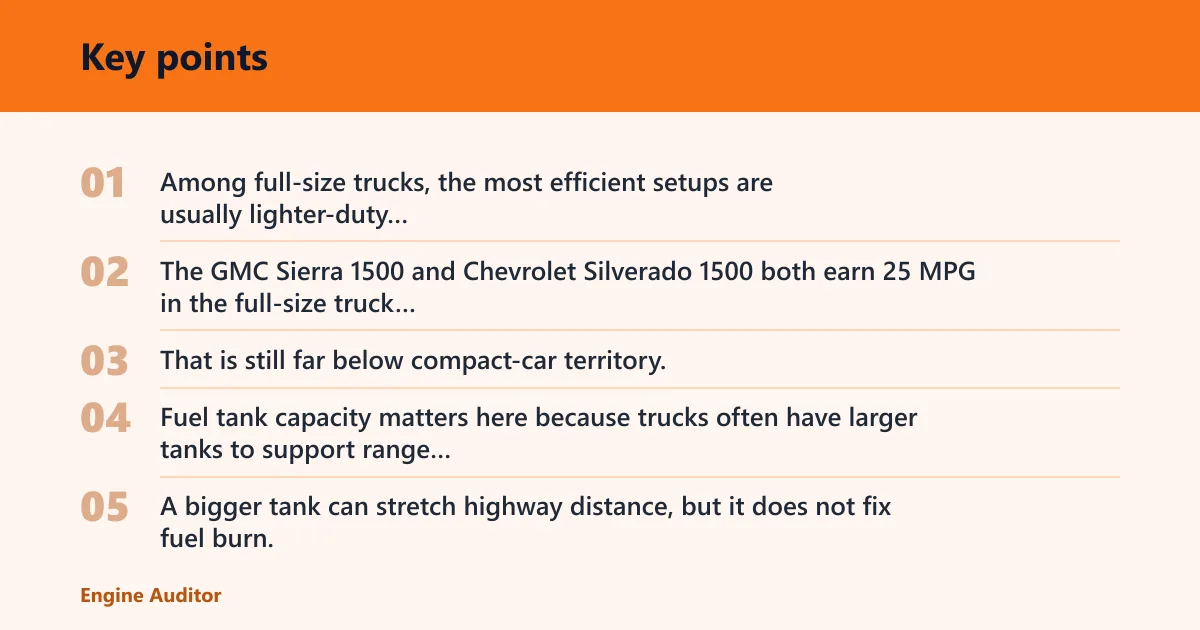
Among full-size trucks, the most efficient setups are usually lighter-duty configurations with fewer off-road extras, smaller wheels, and a more efficient powertrain. The GMC Sierra 1500 and Chevrolet Silverado 1500 both earn 25 MPG in the full-size truck list, against a 23 MPG average for the class. That is still far below compact-car territory.
Fuel tank capacity matters here because trucks often have larger tanks to support range under load. A bigger tank can stretch highway distance, but it does not fix fuel burn. If towing is the priority, mpg usually falls further as gearing and cooling hardware shift toward work use.
Diesel versus gas engine efficiency
Diesel engines can be more efficient in some truck use cases because they make strong low-end torque, which helps when towing at lower engine speeds. Gas engines often cost less up front and can be smoother for light use. The better choice depends on whether the truck spends more time empty or under load.
For shoppers who tow often, a diesel can improve range and reduce fuel stops, but the total ownership picture still depends on purchase price, maintenance, and how much weight the truck actually pulls. A tow package can also lower efficiency by adding cooling, gearing, and structural changes.
Fuel-efficient sports car trims and transmission effects
Sports cars can get decent mpg, but only compared with other performance vehicles. The Mazda MX-5 Miata is the most fuel-efficient sports car at 29 MPG, and the Ford Mustang coupe reaches 26 MPG. The average fuel efficiency for a sports car is 25 MPG.
Transmission choice matters. Manual and automatic versions of the same sports car can post different MPG numbers, and the more efficient trim is often the one with the lighter engine or the more economy-minded gear ratios. Still, the performance tradeoff remains: better mpg usually means less power or softer acceleration.
Fuel-efficient drivetrain choices
- Start with body style. A smaller vehicle usually beats a larger one before any trim change.
- Choose the smallest engine that meets your load needs. A 2.0-liter four-cylinder often uses less fuel than a larger engine in the same class.
- Prefer efficient transmissions. Modern automatics tuned for economy often beat older gearboxes; manual vs automatic results can go either way depending on the model.
- Choose front-wheel drive if you do not need all-wheel drive. AWD usually adds weight and drag.
- Check the EPA city, highway, and combined numbers together. The best choice for commuting is not always the best choice for road trips.
- For plug-in hybrids, compare MPGe and electric range. For gas-only vehicles, compare MPG only.
That rule set helps explain why the Volkswagen Tiguan’s most efficient drivetrain uses a 2.0-liter four-cylinder engine and automatic transmission. The drivetrain choice matters as much as the badge on the hood. Same body style, different fuel bill.
Picture a shopper comparing a compact SUV with a hybrid minivan. The SUV has the styling they want, but the minivan cuts fuel use and carries more people with less compromise. If the goal is family duty first, the boxier shape can still be the smarter economic choice.
Frequently asked questions
Which vehicle type gets the best gas mileage?
Hybrid cars usually get the best gas mileage among common body styles, especially compact hybrid hatchbacks and hybrid sedans. In this list, the Toyota Prius Plug-in Hybrid posts 127 MPGe, while the Toyota Prius hatchback hybrid is rated at 57 MPGe. For gas-only choices, compact hatchbacks usually come next.
Are hybrid cars always more fuel efficient than gas cars?
No. Hybrids are usually more efficient, but a poorly chosen hybrid trim can be less efficient than a lighter gas-only vehicle with a smaller engine and better gearing. A big SUV hybrid can still lose to a compact gas hatchback. Compare body style, drivetrain, and EPA combined ratings together.
Which truck type is most fuel efficient?
The most fuel-efficient full-size trucks are usually lighter-duty half-ton models with efficient gas or diesel powertrains, smaller wheels, and non-max-tow configurations. In the full-size truck list here, the GMC Sierra 1500 and Chevrolet Silverado 1500 both reach 25 MPG, against a 23 MPG average for the segment.
Do sports cars ever get decent gas mileage?
Yes, some do. Sports cars are not efficiency leaders, but lighter models with modest engines can post respectable numbers. The Mazda MX-5 Miata reaches 29 MPG and the Ford Mustang coupe reaches 26 MPG, which is better than many buyers expect, though still below the best hybrid or hatchback results.
What’s the best vehicle type for fuel economy without going electric?
A standard hybrid car is usually the best answer if you want fuel economy without going fully electric. It avoids charging and still delivers strong EPA combined MPG. If you want more cargo flexibility, an efficient compact hatchback or a hybrid minivan can be the next-best practical choice depending on passenger needs.
How much mpg do three-row SUVs get on average?
The average fuel efficiency for a three-row SUV is 22 MPG. Some efficient entries do a little better, such as the Volkswagen Tiguan at 29 MPG and the Mitsubishi Outlander at 28 MPG, but the class still trails compact SUVs, hatchbacks, and hybrids because of weight, seating, and packaging demands.
Products related to this article
Sponsored / affiliate links. As an Amazon Associate I earn from qualifying purchases. I may earn additional commission from eligible campaigns.