Transmission Control System Stuck in One Gear: What It Means
A transmission control system stuck in one gear usually means the unit has entered fail-safe mode, is getting bad speed, range, or sensor inputs, or has a hydraulic or mechanical fault that blocks shifts. Ignore it, and the transmission can overheat, clutches can wear fast, and a minor sensor fault can turn into a rebuild. This guide shows how to tell which branch you have, which checks to run first, and when the fault points to wiring, fluid, solenoids, or internal wear.
What one-gear operation means

One-gear operation usually means the transmission control module has limited shift strategy to protect the drivetrain, or the transmission can no longer respond to shift commands. The difference matters. A fail-safe unit often still moves the car, while a hard mechanical fault may leave you with slipping, delayed engagement, or no usable reverse.
Limp mode versus a hard fault
In limp mode or fail-safe mode, the TCM may lock the transmission into a default gear and limit available shifts. Warning lights and stored codes are common. A hard fault is different: gear changes may be blocked because hydraulic pressure, clutch apply, or internal gear control has failed.
What warning lights and DTCs usually mean
Transmission-related DTCs are often in the P07xx range and related communication codes, and they can point to sensor, solenoid, range switch, or module faults. They do not prove the failed part. Use the codes as a map, then confirm with live data and simple electrical checks before replacing expensive components.
Why the symptom can come from electronics or mechanics
Shift logic depends on speed signals, range information, voltage supply, and hydraulic response. If the TCM sees implausible input, it may command a safe gear strategy. If hydraulic pressure is low or clutches are worn, the transmission may also stay in one gear even when the electronics are fine.
Must-have diagnostic checks
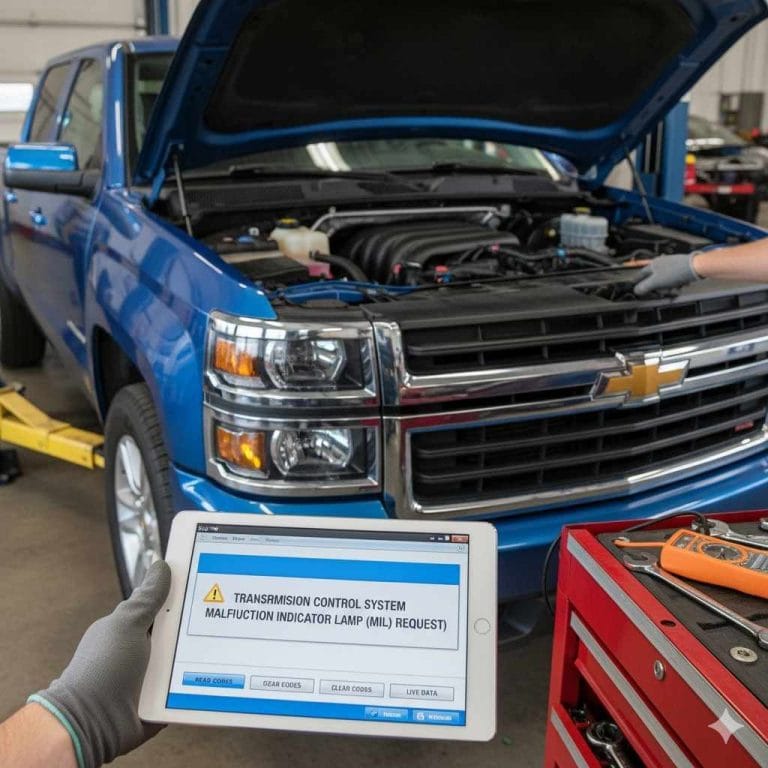
Start by reading transmission codes and freeze-frame data from a scan tool that can access the TCM, then check battery voltage, charging output at the alternator, and chassis and engine grounds, and finally inspect fluid level and condition with the factory procedure. Those three checks tell you whether the problem looks electrical, hydraulic, or internal. They also keep you from swapping parts when the transmission is reacting to a power, fluid, or sensor issue.
Scan transmission codes and freeze-frame data
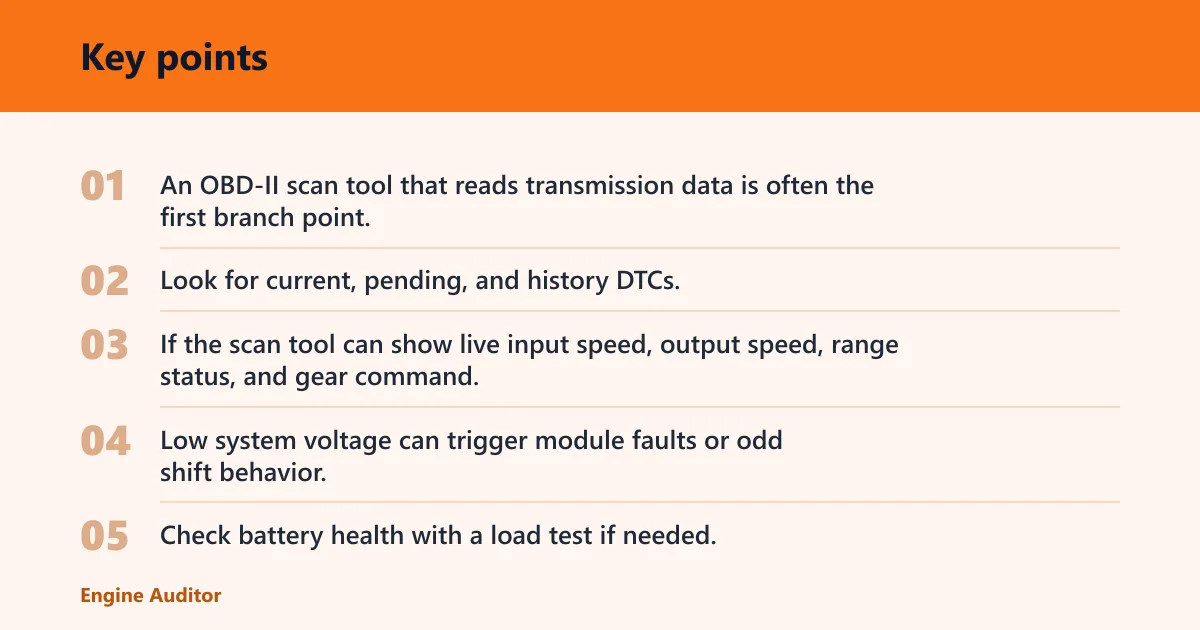
An OBD-II scan tool that reads transmission data is often the first branch point. Look for current, pending, and history DTCs, plus freeze-frame data from the moment the fault set. If the scan tool can show live input speed, output speed, range status, and gear command, you can compare what the TCM wants with what the transmission reports.
Check battery voltage, charging output, and grounds
Low system voltage can trigger module faults or odd shift behavior. Check battery health with a load test if needed, verify charging output at idle and under load, and inspect ground connections before chasing solenoids or a TCM. A weak battery or bad charging system can create false communication errors, lower voltage during cranking, and confuse the transmission control system.
Inspect transmission fluid level and condition
Low fluid, degraded fluid, or the wrong fluid type can cause abnormal shifting and gear lockout. Check the level using the correct procedure for the vehicle, not a guess. Burnt smell, dark color, or debris on the dipstick or pan magnet suggests more than an electronic issue. Fluid problems can also make line pressure unstable.
Transmission scan data matrix
This matrix separates the most common stuck-in-one-gear patterns into branches. Use it to decide whether to keep diagnosing electronics, move to pressure testing, or stop and inspect for internal damage.
| Symptom pattern | Likely fault category | Best next test | Do not drive? |
|---|---|---|---|
| Starts in one gear, warning light on, stored transmission codes | Limp mode / fail-safe | Read DTCs, freeze-frame, and live gear-range data | Yes, if it slips, bangs, or overheats |
| Gear display does not match shifter position, reverse or overdrive missing | Range/inhibitor switch or wiring | Check range switch inputs, wiring continuity, and misreporting on scan data | Yes, if reverse is unpredictable or vehicle lurches |
| Input speed looks normal but output speed is erratic or zero | Vehicle speed sensor, output speed sensor, or tone wheel issue | Compare live speed signals and inspect sensor wiring | Usually yes, if shifts stop and speedometer behavior changes |
| Electrical code for shift solenoid, harsh or fixed gear behavior | Solenoid or hydraulic routing fault | Check solenoid resistance, power supply, and hydraulic line pressure | Yes, if it is stuck, slipping, or making noise |
| Gear ratio error, slip, flare, or no commanded shift under load | Internal mechanical failure | Pressure test, pan inspection, and deeper teardown diagnosis | Yes |
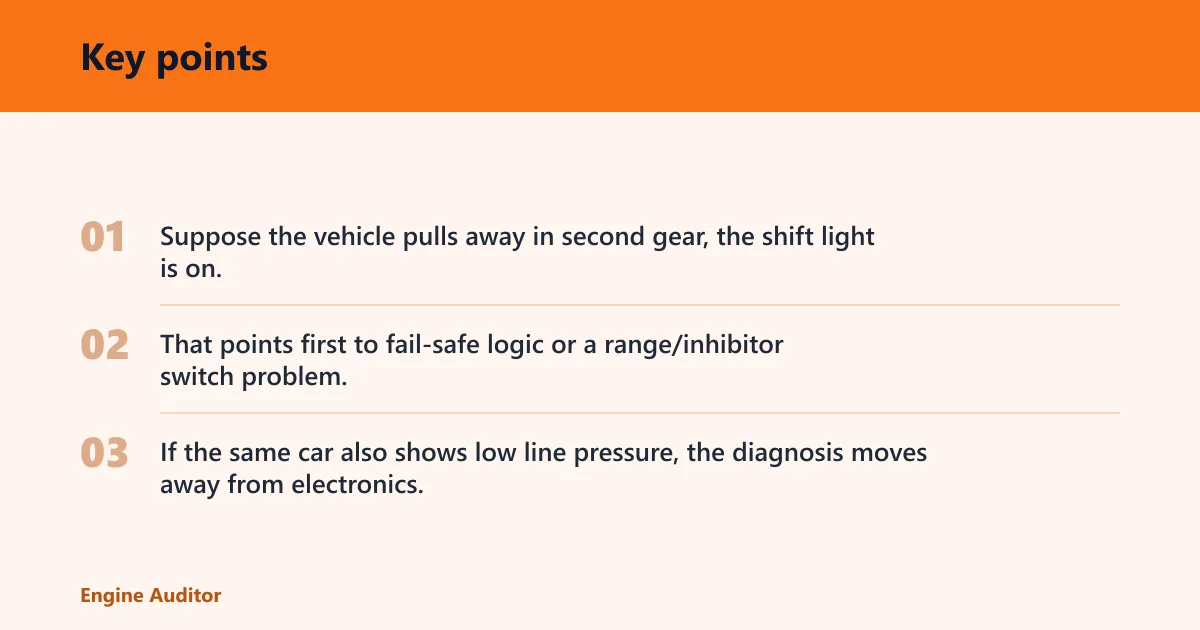
Suppose the vehicle pulls away in second gear, the shift light is on, and the scan tool shows a P0700 plus a range signal mismatch. That points first to fail-safe logic or a range/inhibitor switch problem, not a dead transmission. If the same car also shows low line pressure, the diagnosis moves away from electronics.
Sensor and range-switch faults
Transmission sensors feed the TCM the data it uses to decide when and how to shift. A bad vehicle speed sensor, input/turbine speed sensor, output speed sensor, or range/inhibitor switch can make the module believe the transmission is in the wrong gear or moving at the wrong speed, so it locks the shift strategy.
Vehicle speed, input speed, and output speed sensor checks
Look at live data for the vehicle speed sensor, input speed sensor, and output speed sensor. The readings should make sense relative to each other and to road speed. If one sensor drops out, spikes, or reads zero while the vehicle is moving, the TCM may default to a single gear or set gear ratio faults.
Range/inhibitor switch misreporting
The range/inhibitor switch tells the TCM whether the selector is in park, reverse, neutral, drive, or a manual range. If it misreports, the control unit can block gear changes or refuse reverse and overdrive engagement. That fault often appears as a mismatch between shifter position and scan-tool gear status.
How bad input data can lock shift logic
Bad input data does not need to be dramatic. A noisy sensor signal, loose connector, corroded terminal, or damaged harness can make the TCM distrust the transmission. Once that happens, fail-safe logic may hold one gear to limit damage until the fault clears or is repaired.
Transmission solenoid and hydraulic faults
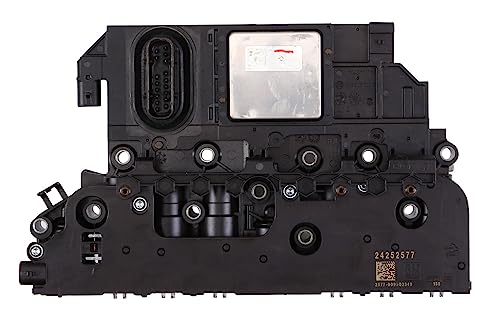
Transmission solenoids route hydraulic fluid to the right clutch packs and shift circuits. If a solenoid sticks, opens, shorts, or receives bad power, the transmission may stay in one gear or shift harshly. Hydraulic pressure problems can produce the same result, which is why pressure testing matters when the electronics look plausible.
How solenoids control fluid routing
Shift solenoids are the valves the TCM uses to direct fluid pressure. If the command is present but the solenoid cannot move fluid correctly, the shift never happens. That can look like an electronic fault because the scan tool sees the command, but the transmission response stays wrong.
Sticking, open-circuit, or shorted solenoids
A sticking solenoid may work intermittently and set erratic codes. An open circuit or shorted solenoid usually shows up in resistance checks or on the scan tool as an electrical fault. Either problem can leave the transmission locked in a default gear because the TCM cannot trust the hydraulic response.
When line pressure testing is the next step
If codes and live data do not explain the symptom, line pressure testing may be needed. Low hydraulic pressure can mimic a sensor problem, and a pump, valve body, or internal leak can prevent proper shifting. That is the point where a simple code read is no longer enough.
What if it is limp mode?
If it is limp mode, the TCM is usually choosing a default gear strategy to protect the transmission from overheating, clutch damage, or uncontrolled shifting. That mode often limits available gears and may light the dash with transmission warnings. It is a protective response, not proof that the entire transmission is ruined.
How the TCM chooses a default gear strategy
The TCM uses sensor data, range input, and module communication to decide shift timing and gear selection. Patent literature for transmission control systems describes using control logic to adjust clutch pressure and torque based on conditions such as grade. When inputs look unreliable, the module can fall back to a safer fixed gear.
What fail-safe mode is trying to protect
Fail-safe mode tries to reduce slip, heat, and clutch abuse. That is why it may still move the vehicle, but only in a limited way. If the underlying cause is a simple sensor or voltage problem, the protection strategy can disappear after the fault is corrected and codes are cleared.
When relearn or programming may be needed
If the TCM is replaced, relearn or programming may be required so it matches the vehicle and adapts shift timing correctly. A battery disconnect may clear temporary fault behavior, but it does not repair a failed sensor, pressure problem, or internal wear. Treat reset attempts as a check, not a fix.
What if the fault is internal?
If the transmission has gear ratio errors, delayed engagement, hard slipping, or no change after the electrical side checks out, think internal damage. Worn clutches, valve body problems, pump wear, or a mechanical failure can force one-gear operation or mimic a sensor fault by making the ratio not match the commanded gear.
Gear ratio errors and mechanical slip
Gear ratio codes are not just electronic noise. They can mean the transmission is applying the wrong elements or slipping under load. If live data says the TCM commanded a shift but the ratio never changes, the issue may be internal rather than a bad sensor.
Pump, valve body, or clutch damage clues
Burnt fluid, delayed forward or reverse engagement, harsh changes, debris in the pan, or whining noises point toward hydraulic or internal mechanical trouble. A weak pump can drop line pressure. A worn valve body can leak pressure. Worn clutches can let the transmission rev without moving as expected.
Why internal faults can mimic sensor problems
Internal faults can confuse the scan path because the TCM only sees the result. If the output speed does not match the commanded gear, the module may blame a sensor or set a ratio code when the real problem is clutch slip, pressure loss, or a failed mechanical element. That is why pressure testing matters.
What to do next in order
- Scan transmission codes, freeze-frame data, and live data before clearing anything.
- Check battery voltage, charging output, and grounds.
- Inspect fluid level, fluid condition, and correct fluid type.
- Compare input speed, output speed, and range status against the symptoms.
- Check solenoid and sensor wiring for damage, corrosion, or loose connectors.
- If electronic checks do not explain the symptom, move to line pressure testing and internal diagnosis.
A common first-timer mistake is clearing codes, disconnecting the battery, and assuming the fault is gone because the light briefly disappears. If the cause is still present, the transmission often returns to one gear after the next drive cycle. Clearing codes without data usually removes the clue, not the problem.
Must-have
These are the items that support the first branch of diagnosis. They help you separate module protection, bad inputs, and a true hydraulic fault before parts are replaced.
 As an Amazon Associate we earn from qualifying purchases. Prices and availability are accurate as of the date shown and are subject to change
FOXWELL Car Scanner NT604 Elite is the core tool here because it reads transmission-related codes and live data, which is exactly what you need to tell limp mode from a bad sensor or solenoid problem. Its AUTOVIN feature helps identify the vehicle quickly. The main drawback is that it is a general diagnostic scanner, so advanced pressure-control testing still requires other tools or a specialist shop.
Nice-to-have
These tools are not mandatory for the first scan, but they add useful proof when the fault moves beyond basic code reading. They matter most when voltage, resistance, or hydraulic pressure needs confirmation.
 As an Amazon Associate we earn from qualifying purchases. Prices and availability are accurate as of the date shown and are subject to change
AstroAI Digital Multimeter is useful for checking battery health, charging output, sensor power, grounds, and solenoid resistance. It supports the electrical side of the decision tree. The limitation is that a multimeter cannot see pressure, shift timing, or valve body behavior, so it solves only part of the diagnosis.
Consumables and spares
These are not routine replacements for every case, but they are useful when the fault moves into hydraulic testing or when the diagnosis needs confirmation beyond scan data.
 As an Amazon Associate we earn from qualifying purchases. Prices and availability are accurate as of the date shown and are subject to change
Master Engine and Transmission Oil Pressure Test Set is the pressure-testing tool that answers the question scan data cannot: is line pressure actually present? Its 14 adapters and dual gauges make it useful across more than one transmission setup. The drawback is that it is specialized gear, so it is only worthwhile once electrical checks have not explained the stuck-gear symptom.
Budget setups
The right setup depends on how deep you want to go. Start with scan data. Add electrical testing if the codes point to sensors or module power. Move to pressure testing only when the first two steps do not explain the fault.
| Setup | What you get | Price | Best for |
|---|---|---|---|
| Starter | FOXWELL Car Scanner NT604 Elite | $135.95 | Reading transmission codes, freeze-frame data, and live gear inputs |
| Mid | FOXWELL scanner + AstroAI multimeter | $171.94 | Electrical diagnosis for sensors, grounds, battery, and solenoids |
| Serious | FOXWELL scanner + AstroAI multimeter + DKwoeshg pressure test set | $214.93 | Full branch-by-branch diagnosis, including line pressure checks |
Frequently asked questions
Why is my car stuck in one gear?
It is usually one of three things: the transmission has entered fail-safe mode, a sensor or range input is wrong, or hydraulic/internal damage is preventing shifts. The quickest way to separate them is to scan transmission codes, check live speed and gear data, and verify fluid and voltage before replacing parts.
Can I keep driving if the transmission is stuck in one gear?
Only if the vehicle moves normally, does not slip, and shows no loud mechanical noise. If it is slipping, refusing to move, or stuck in one gear with warning lights and harsh behavior, do not drive it. Continued driving can overheat the fluid and damage clutches or internal parts.
Is stuck in one gear a limp mode problem?
Often, yes. Limp mode or fail-safe mode commonly limits available gears and stores transmission codes so the vehicle can be moved without deeper damage. But the same symptom can also come from a bad sensor, a range-switch fault, a solenoid problem, low pressure, or internal mechanical failure.
What sensors can make a transmission stay in one gear?
The main ones are the vehicle speed sensor, input/turbine speed sensor, output speed sensor, and the range/inhibitor switch. If any of them sends implausible data, the TCM may freeze shift logic or fall back to fail-safe gear selection. Live data is the best way to confirm that branch.
Can a bad transmission control module cause one-gear operation?
Yes, a failing TCM can cause limp mode, bad shift timing, or communication faults that leave the transmission in one gear. But a TCM should not be the first guess. Check codes, wiring, voltage, sensors, solenoids, and fluid first, because a module often reacts to another fault.
Will disconnecting the battery fix a transmission stuck in one gear?
It may clear temporary fault logic for a short time, but it does not fix the cause. If the same sensor, voltage, hydraulic, or internal fault remains, the transmission usually returns to one gear after the next drive cycle. A module replacement may also need relearn or programming.
What codes should I scan when the transmission is stuck in one gear?
Scan all transmission-related DTCs, especially P07xx codes, gear ratio codes, sensor codes, range switch codes, and communication faults. Look at freeze-frame data too. Codes can point you toward the right branch, but they do not prove the failed part without live data and follow-up checks.
How do I tell if the problem is electrical or internal transmission damage?
Electrical problems usually show bad or missing sensor data, range mismatches, voltage issues, or solenoid codes. Internal damage is more likely when fluid is burnt, pressure is low, gear ratio errors persist, or the transmission slips and bangs under load. Pressure testing is often the divider between the two.
Products related to this article
Sponsored / affiliate links. As an Amazon Associate I earn from qualifying purchases. I may earn additional commission from eligible campaigns.