Transmission Control System Slipping Gears: Diagnosis Guide
True gear slip is most likely when engine speed flares, road speed drops or holds steady, and the symptom repeats in the same gear after you verify fluid level, condition, and live transmission data. Ignore it, and you can overheat clutches, damage hard parts, and turn a sensor or low-fluid fault into a rebuild. This guide separates internal slip from lookalike problems with a stepwise symptom-and-data path.
What slipping gears actually mean


Slip vs flare vs shudder
Slip is a mismatch between engine speed and vehicle speed under load. Flare is a brief RPM rise during an upshift or downshift, often while the next gear engages. Shudder feels like a rapid vibration or mild bucking, especially at steady highway speed, and it often points to the torque converter clutch rather than the gear train.
Why the vehicle may still move
An automatic transmission can keep moving even with a fault because one clutch pack, one solenoid circuit, or the torque converter may still provide partial drive. That is why a symptom can look mild at first and then worsen fast. A basic scanner may even show “No DTCs Found” while the TCM still stores transmission faults.
What symptoms to record before testing
Record the exact gear, speed, throttle position, whether the symptom is hot or cold, and whether it happens under light or heavy load. Note any odor, warning lamp, or change after a fluid service. If the fault appears only in one gear, that detail matters. If it appears only after the fluid warms, that detail matters too.
Say your SUV slips only on the 2-3 shift at highway entry speed, but reverse and first gear are normal. That pattern points away from a blanket rebuild and toward a gear-specific ratio issue, a shift solenoid fault, or a valve body problem that needs testing in the affected gear.
Transmission slip diagnosis matrix
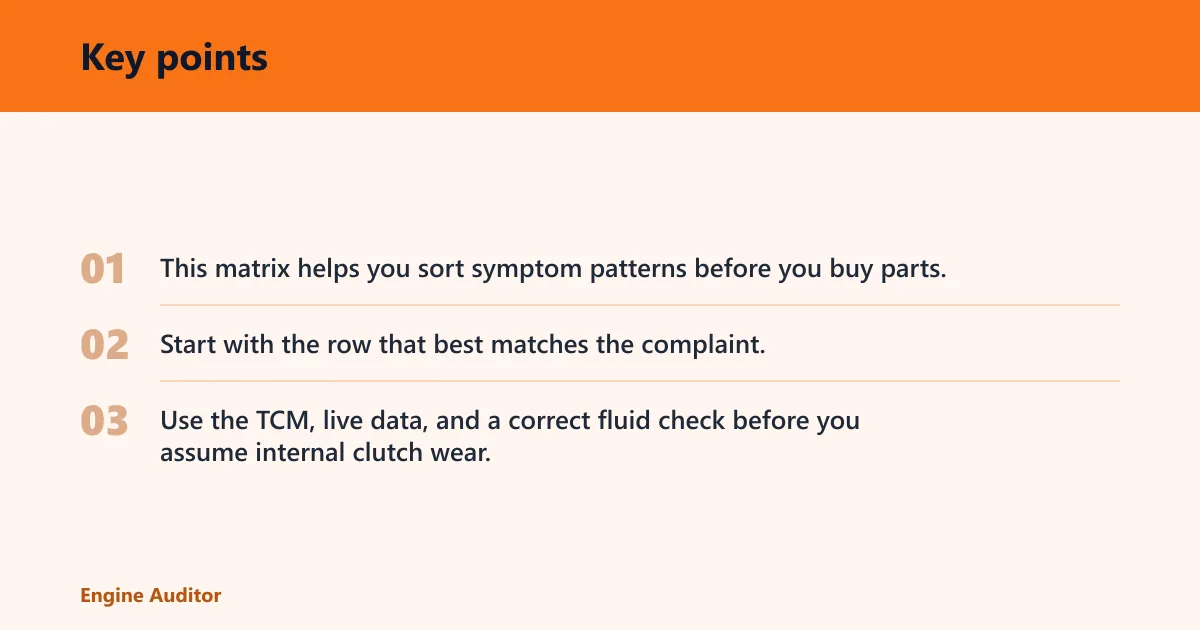
This matrix helps you sort symptom patterns before you buy parts. Start with the row that best matches the complaint, then follow the first test and the next test in order. Use the TCM, live data, and a correct fluid check before you assume internal clutch wear.
| Symptom pattern | Likely subsystem | First test | Likely next test |
|---|---|---|---|
| One gear slips, others feel normal | Shift solenoid, valve body, or one clutch circuit | Read TCM codes and compare commanded gear to actual gear | Check P0731 through P0736 and line pressure in the failing gear |
| Slips only on the 2-3 shift | Shift solenoid or valve body wear | Watch input speed and output speed during the shift | Test the related solenoid circuit and inspect for worn valve body bores |
| Slips only in reverse | Reverse clutch, pressure loss, or valve body feed issue | Check reverse engagement with fluid at the proper level and temperature | Measure line pressure and review reverse-related ratio behavior |
| Hot-only slip after 20 to 30 minutes | Low pressure, aerated fluid, valve body wear, or fluid breakdown | Check transmission fluid temperature and level at operating temperature | Test line pressure when hot and inspect cooler flow |
| Cold-only slip, then improves warm | Sticky valve body, viscous fluid issue, or delayed apply | Confirm exact fluid specification and scan for solenoid codes | Compare live data from cold start to warmed operation |
| Highway shudder at steady cruise | Torque converter clutch | Check TCC slip RPM and related codes | Command TCC on and off with scan data if supported |
| Slip after a fluid service | Wrong fluid, low fill, overfill, or debris moved into the valve body | Verify the exact fluid spec and look for foam, color change, or contamination | Recheck level at operating temperature and inspect for P0730-series codes |
| Burnt smell with dark fluid | Overheated clutches or degraded fluid | Inspect fluid condition and transmission temperature history | Perform pressure and ratio checks before teardown |
| Milky fluid | Contamination, often coolant intrusion | Inspect fluid and cooler system for cross-contamination | Do not continue driving until the source is found |
| Foamy fluid | Low fill, overfill, or aeration | Correct the fluid level at operating temperature | Road test again, then watch line pressure stay steady |
| Slip under heavy throttle only | Marginal pressure, worn clutches, or pump weakness | Compare live data with a loaded road test | Measure line pressure against manufacturer specification |
| Repeated loss of drive | Severe hydraulic fault or internal damage | Stop driving and inspect for codes, fluid loss, and debris | Tow the vehicle for pressure and teardown evaluation |
Is the fluid the first fault to rule out?
Yes. Fluid is the first fault to rule out because low, burnt, wrong-spec, overfilled, foamy, dark, or contaminated fluid can change apply pressure and mimic internal slip. Check the level at the correct temperature, not cold by habit. A bad fluid check can send you down the wrong path fast.
Check level at the right temperature
Follow the procedure for the exact transmission. Many units require the level to be checked with the engine running and the fluid at operating temperature. Transmissions.biz says slip diagnosis should start with fluid level checked correctly. An overfilled unit can aerate fluid. A low unit can starve the pump and reduce pressure.
Read color, smell, foam, and contamination
Burnt or dark fluid points to heat and clutch wear. Milky fluid suggests contamination. Foamy fluid suggests aeration from low fill, overfill, or a pickup issue. A weak smell test is not enough by itself; pair it with level and temperature. Transmission fluid overheating above 250-270°F, depending on OEM, is a concern because heat accelerates breakdown and slip.
Verify the exact fluid spec
Wrong fluid specification can cause slip even when the level is correct. Some transmissions are sensitive to friction modifiers and viscosity. If the fluid was serviced shortly before the symptom started, treat that timing as a clue. A common first-timer mistake is assuming a slipping transmission always needs a full rebuild before checking the gear-position sensor or solenoid wiring.
Suppose the transmission begins to flare after a drain-and-fill, and the dipstick now shows the level a little high. That small overfill can foam the fluid, lower effective pressure, and create a slip complaint that looks mechanical until you correct the fill and retest.
What codes point to slipping gears?
Transmission codes matter because they separate ratio faults, control faults, and converter faults. Read the TCM, not only the engine module. P0700 is a general transmission warning, not the root cause. It tells you to look deeper for the actual transmission codes stored in the TCM.
P0700 and what it does and does not mean
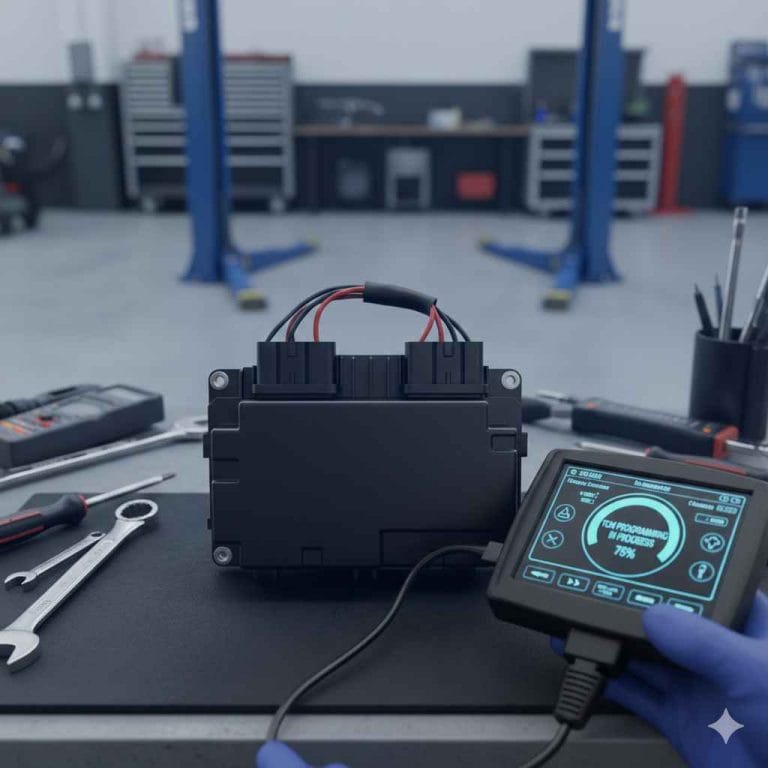
P0700 means the TCM has requested a warning lamp or fault status. It does not identify the failed part by itself. A generic scanner may show only P0700 and miss the transmission-specific code set. LAUNCH notes that generic scanners can report “No DTCs Found” while transmission faults remain active, so module access matters.
Gear ratio codes P0730 through P0736
P0730 through P0736 are incorrect gear ratio codes. APEX lists those codes as slip-related ratio faults, and Car Code Finder lists P0730 for incorrect gear ratio plus P0731 through P0736 for individual gear ratios. These are strong evidence of mechanical slip in a specific gear, not just a vague shift complaint.
Shift solenoid codes P0750 through P0770
P0750 through P0770 often point to shift solenoid faults. Car Code Finder groups those codes with solenoid problems. The fault may be electrical, hydraulic, or a solenoid that is mechanically stuck. A solenoid code can cause slip in one gear or a flare during one shift, so do not jump straight to clutch damage.
Torque converter clutch codes P0740 through P0742
P0740, P0741, and P0742 can point toward torque converter clutch problems. Car Code Finder lists P0741 as torque converter clutch circuit performance or stuck off. Those codes fit highway-speed shudder, slip, or poor lockup more often than true gear-pack slip. The same source says TCC slip RPM should be near zero in full lockup.
Which live data should you read?
Live data gives you the fastest separation between a control fault and internal slip. Read engine RPM and vehicle speed, input speed and output speed, commanded gear versus actual gear, TCC slip RPM, and transmission fluid temperature. These PIDs show whether the transmission is failing to apply, failing to hold, or failing to lock the converter.
Engine RPM and vehicle speed
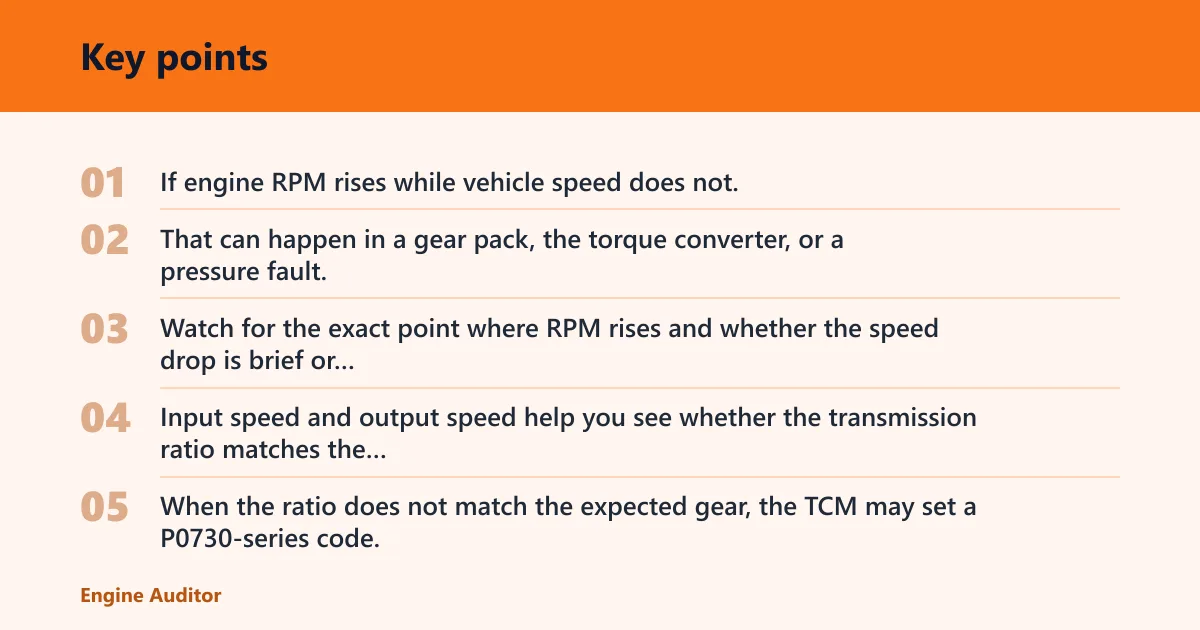
If engine RPM rises while vehicle speed does not, you have a slip event or a loss of drive under load. That can happen in a gear pack, the torque converter, or a pressure fault. Watch for the exact point where RPM rises and whether the speed drop is brief or sustained.
Input speed and output speed
Input speed and output speed help you see whether the transmission ratio matches the gear command. When the ratio does not match the expected gear, the TCM may set a P0730-series code. That mismatch is stronger evidence than a seat-of-the-pants impression because it ties the symptom to the actual gear state.
Commanded gear versus actual gear
Commanded gear versus actual gear is often one of the most useful checks on a capable scan tool. If the TCM commands third gear but the actual gear does not match, look at the ratio code and the related solenoid data. A basic OBD-II reader may not expose this information because it may not access the TCM directly.
TCC slip RPM and transmission fluid temperature
TCC slip RPM should be near zero in full lockup. If it stays elevated at highway cruise, the converter clutch may be slipping or commanded off. Also watch fluid temperature. Heat above about 250-270°F, depending on OEM, can accelerate fluid degradation and clutch slip. Repeated overheating can also point to cooler flow issues.
How do line pressure and valve body checks fit in?
Line pressure testing belongs before any rebuild decision when the symptom is not obviously catastrophic. Pressure should be measured at operating temperature with a gauge and compared against manufacturer specification. Low pressure can come from the pump, regulator, valve body, or filter, and those faults can look like worn clutches.
When to test line pressure
Test line pressure after the fluid check and after you have the codes and live data. If the symptom is gear-specific, hot-only, or load-related, pressure testing can separate a hydraulic fault from a hard-part fault. That is cheaper and cleaner than tearing down a transmission on suspicion alone.
What low pressure can point
Low pressure can trace to a weak pump, a stuck regulator, a clogged filter, or a leak inside the hydraulic circuit. APEX and Transmissions.biz both point to pressure as a core diagnostic step. Kwik Kar also notes that slipping can come from fluid problems, hydraulic or electrical control failures, worn clutches, or a failing torque converter.
Why valve body wear can mimic clutch slip
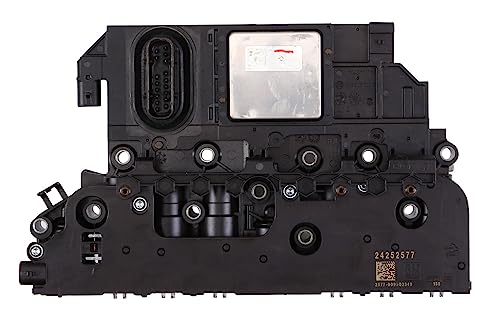
Worn valve body bores can bleed off pressure and mimic clutch failure. That matters because valve body repair may be cheaper than pump replacement or a full rebuild. If pressure is low but the code pattern does not clearly show multiple hard-part failures, inspect the valve body before condemning the gear train.
When the torque converter is the problem
The torque converter is the likely fault when the symptom shows up at highway speed, under light steady throttle, or as a shudder during lockup. That pattern is different from a gear pack slipping under acceleration. Use TCC slip RPM, related codes, and road-test behavior to separate the two.
Highway-speed shudder clues
Highway shudder often feels like a rumble strip or vibration that comes and goes at cruise. It may improve if the TCM releases lockup. If slip is present only during lockup, the converter is a stronger suspect than the gear packs.
How TCC slip differs from internal clutch slip
Internal clutch slip usually shows a ratio error in a specific gear and may worsen under load. TCC slip often appears after the vehicle is already in top gear and steady cruise. That difference matters because a converter issue can feel like transmission slip without damaging every clutch pack in the unit.
When converter faults set related codes
Converter faults often set P0740-series codes, but not always on the first event. If the shudder is brief and the codes are pending, the scan data still matters. Compare TCC slip RPM against commanded lockup, then verify fluid temperature before deciding the converter itself is at fault.
Frequently asked questions
Why is my transmission slipping gears but still driving?
It can still drive because the fault may be partial, gear-specific, or limited to one hydraulic circuit. A transmission can move the vehicle while a clutch pack is weak, a solenoid is sticking, or the torque converter is shuddering. That is why live data and codes matter before any repair decision.
How do I tell if slipping is fluid, solenoid, or internal clutch wear?
Start with fluid level, condition, and specification at the correct temperature. Then read TCM codes and live data. Fluid faults often show foam, wrong level, or heat damage. Solenoid faults often show P0750 through P0770 or gear-specific flare. Internal clutch wear is more likely with P0730 through P0736 and a repeated ratio mismatch.
Can low or burnt transmission fluid cause slipping gears?
Yes. Low fluid can reduce hydraulic apply pressure, and burnt fluid can no longer hold pressure and friction the way it should. That can cause flare, shudder, or a loss of drive. If the fluid is dark, burnt, or foamy, fix the fluid problem first and then retest before assuming hard-part failure.
What should I check before paying for a rebuild?
Check the TCM for transmission-specific codes, review live ratio data, verify fluid level and spec at temperature, and measure line pressure against specification. Also inspect the valve body, because worn bores can mimic clutch failure and may cost less to repair.
Is it safe to drive if the transmission is slipping?
Only for a short, controlled move if the symptom is mild and stable. Stop driving or tow it if there is grinding, a burning smell, repeated loss of drive, or worsening symptoms. Continuing to drive can overheat the clutches, spread debris, and turn a repairable hydraulic fault into a full teardown.
How do I check gear ratio data on a scan tool?
Use a scan tool that can read the TCM and display input speed, output speed, commanded gear, and actual gear. During a road test, compare the ratio data in the failing gear to the expected gear. If the ratio is wrong and a P0730-series code appears, that is evidence of a slip condition in that gear.
Products related to this article
Sponsored / affiliate links. As an Amazon Associate I earn from qualifying purchases. I may earn additional commission from eligible campaigns.