How to Tell If a Starter Is Failing Before It Dies
If the engine cranks slower over several starts, then only clicks, and battery voltage is normal, the starter is likely failing. Ignoring that pattern can leave you stranded with a no-start that gets worse without warning. This guide covers symptom progression and quick exclusion tests so you can separate starter trouble from battery, cable, relay, or flywheel issues.
What you’ll need



- Multimeter with DC voltage range
- Jump starter or jumper cables
- Basic hand tools for battery terminals and starter connections
- Owner’s manual or fuse box diagram
- Flashlight
- Safety glasses and gloves
How do you tell if a starter is failing?
Start with the battery, then listen for one click or a slow crank that repeats over several starts. A starter motor uses high-current electrical power to turn the engine, so intermittent failure often appears before total failure. If the symptom worsens over days, the starter moves higher on the list.
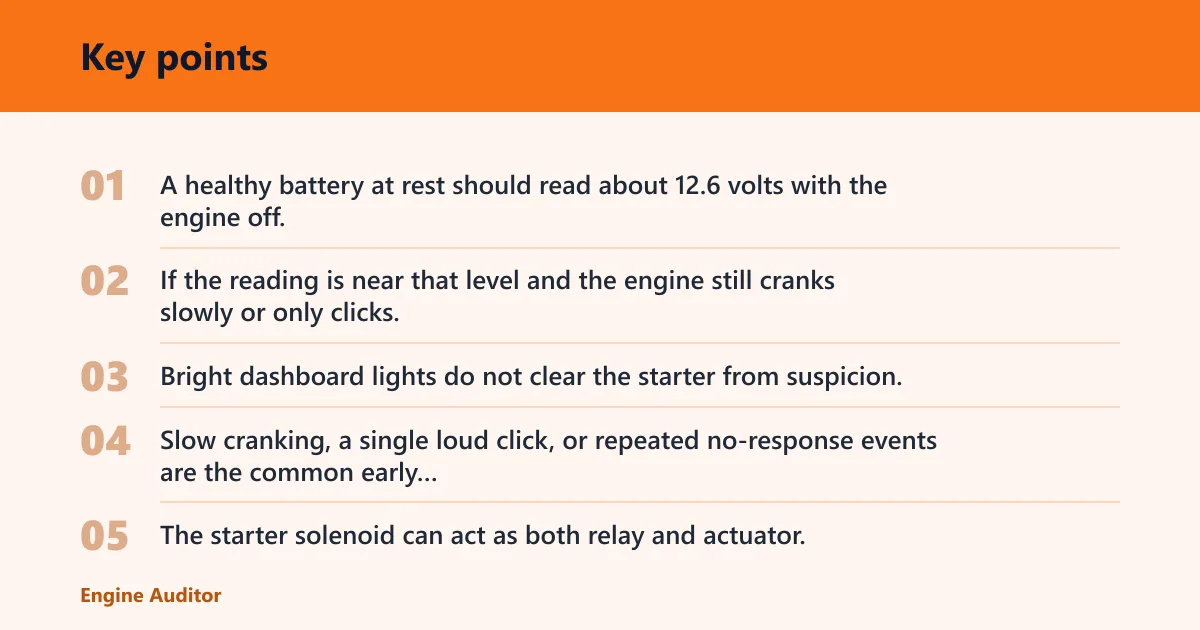
A healthy battery at rest should read about 12.6 volts with the engine off. If the reading is near that level and the engine still cranks slowly or only clicks, you need a closer look at the starter circuit. Bright dashboard lights do not clear the starter from suspicion.
What a failing starter sounds like
Slow cranking, a single loud click, or repeated no-response events are the common early signs. The starter solenoid can act as both relay and actuator, so one click may mean it is trying to close the high-current contacts. Rapid multiple clicks usually point to battery issues rather than starter failure.
Grinding is different. It often means the starter drive gear, also called the Bendix gear, is not meshing cleanly with the flywheel teeth. If that sound appears, stop repeated attempts.
Before you rule out first
Use the jump starter, multimeter, and basic hand tools in that order. A jump start that changes the symptom strongly suggests a power supply problem. If the symptom does not change with a known-good jump source, the starter, solenoid, cable, or flywheel moves up the list.
Look for progression. A starter that begins with slow cranking, then moves to a single click, then no response is generally more suspicious than one isolated no-start. If battery voltage is sound, the trigger signal is present, and the symptom keeps returning, the starter is the likely fault.
Starter failure checklist
| Symptom | Likely starter, battery, or flywheel cause | Next test | Urgency rating |
|---|---|---|---|
| Single loud click, no crank | Starter solenoid contact failure, weak battery, or poor cable connection | Measure battery at rest, then check voltage during cranking | Medium |
| Rapid multiple clicks | Battery issue or low system voltage, less often starter failure | Jump-start the car and retest | Medium |
| Slow cranking that worsens over time | Starter motor wear, battery weakness, or cable voltage drop | Use a multimeter during cranking and inspect terminals | High |
| Grinding during start | Starter drive gear or flywheel tooth damage, or loose mounting bolts | Stop cranking and inspect starter mounting and engagement | Stop cranking |
| Smoke or burning smell | Overheated starter, wiring fault, or seized drive | Stop attempts and inspect the starting circuit | Stop cranking |
| Repeated no-response after several tries | Starter failure, ignition switch signal loss, or relay fault | Check for solenoid trigger voltage at the starter | High |
Why does it click but not start?
One click with no crank usually means the solenoid gets a signal, but the starter motor is not turning the engine. That can come from a weak battery, a bad solenoid contact, or worn starter internals. Rapid clicks point more toward battery voltage collapse than starter failure.
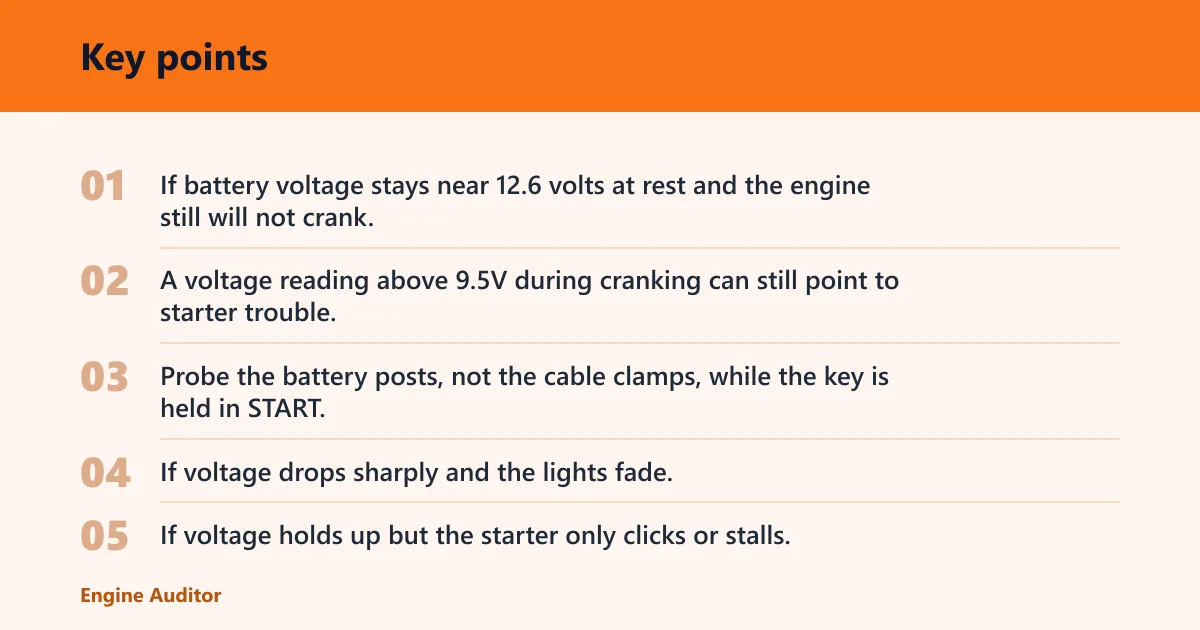
If battery voltage stays near 12.6 volts at rest and the engine still will not crank, measure voltage while someone turns the key to START. A voltage reading above 9.5V during cranking can still point to starter trouble, so do not stop at a battery test alone.
Battery voltage under load
Set the multimeter to DC volts. Probe the battery posts, not the cable clamps, while the key is held in START. If voltage drops sharply and the lights fade, the battery or cables may be the main problem. If voltage holds up but the starter only clicks or stalls, look harder at the starter and solenoid.
Say your sedan shows 12.6 volts at rest, then 10.1 volts during cranking, but the starter still gives only a single click. That pattern points away from a dead battery and toward the starter circuit or the starter itself.
Solenoid contact failure
The starter solenoid both moves the drive gear and closes the high-current circuit. A single click without motor spin can mean the solenoid is not closing its heavy contacts. Confirm the small trigger wire gets a start signal from the ignition switch or relay before replacing the starter assembly.
Ignition switch signal check
Turn the key to START and test the solenoid trigger terminal with a multimeter or test light. If there is no signal there, the ignition switch, relay, fuse, or wiring may be at fault. A starter cannot crank if it never receives the command to engage.
Diagnose the starter in steps
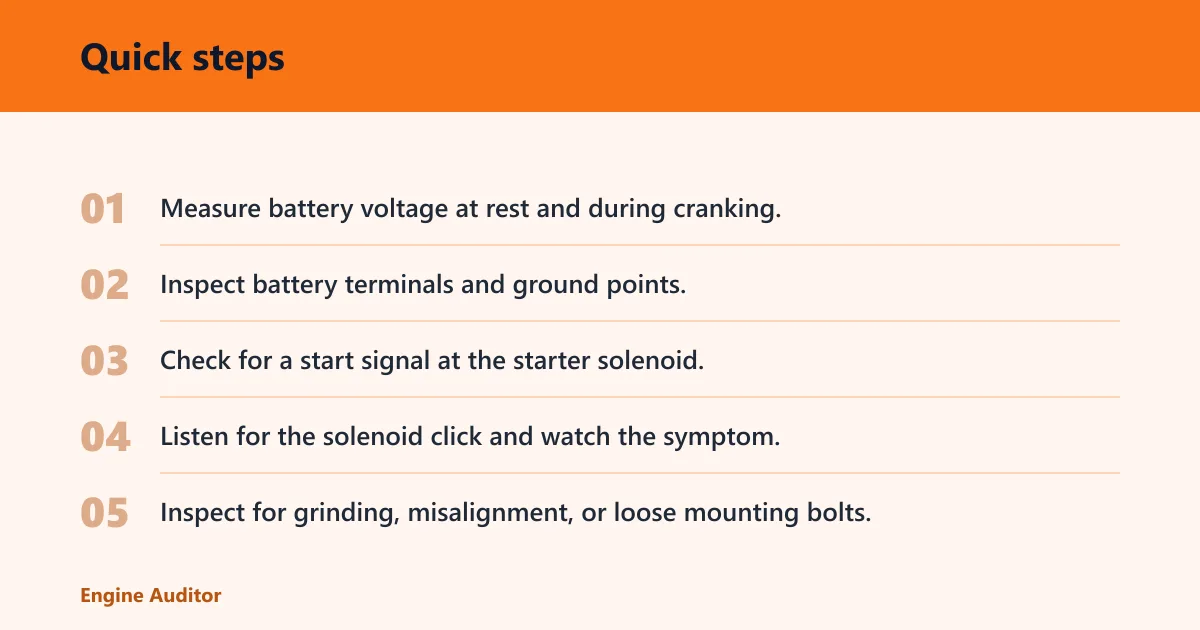
- Measure battery voltage at rest and during cranking. Use the multimeter on the battery posts. A healthy battery at rest should be around 12.6 volts with the engine off.
- Inspect battery terminals and ground points. Clean looseness or corrosion first, because voltage drop can mimic starter failure.
- Check for a start signal at the starter solenoid. Turn the key to START and verify the trigger wire receives power.
- Listen for the solenoid click and watch the symptom. A single click with no crank points to solenoid contact trouble or a worn starter motor.
- Inspect for grinding, misalignment, or loose mounting bolts. Loose mounting bolts can cause the starter to misalign and grind.
- Stop if smoke, burning smell, or repeated grinding appears. Continued cranking can damage the flywheel teeth and may require transmission removal.
What the starter signal test tells you
If the trigger wire gets power but the motor does not spin, the fault is likely inside the starter assembly or at its mounting point. If the trigger wire never gets power, move upstream to the ignition switch, relay, or fuse. That split saves parts and keeps diagnosis focused.
Grinding and flywheel damage
Grinding during starting can mean damage to the starter drive gear or flywheel teeth. The starter drive gear must mesh with the flywheel teeth cleanly, and wear or misalignment can create that sound. Repeated grinding can damage the flywheel enough that transmission removal may be required.
Picture a truck that starts on the second try, then begins grinding on cold mornings only. That pattern can point to a starter drive gear that is hanging up when parts contract, or to a loose starter that shifts under load.
Can a bad starter fail intermittently?
Yes. A starter can fail intermittently before it dies completely, especially when heat soak or cold weather changes its behavior. It may work when cold, then fail hot after a short drive, or it may click once in the morning and start normally later. That pattern fits a starter motor that is wearing out.
Repeated cranking makes the situation worse. If the starter is already weak, every extra attempt can overheat the motor, stress the solenoid, or worsen flywheel damage from misalignment.
Cold starts versus heat-soak failures
Heat-soak failures are often reported after a hot shutdown. The starter may click or spin weakly until the parts cool. Cold-weather failures can look similar but are often made worse by a weak battery, thicker oil, or a tired cable connection. The distinction matters because the fix can change.
If that didn’t work, try this next
- Swap in a known-good jump source and try one start only. If the symptom changes, battery or cable issues move up the list.
- Check the starter relay in the fuse box with the diagram in the owner’s manual. Move it with an identical relay if the box layout allows it.
- Probe the starter trigger wire again while someone turns the key. If there is still no signal, inspect the ignition switch circuit.
- If the starter still clicks or grinds with good voltage and signal, schedule inspection of the starter and flywheel teeth.
Common mistakes
Do not keep turning the key after grinding starts. That can strip the starter drive gear and damage flywheel teeth. Do not trust dashboard brightness alone, because a starter problem can exist even if battery lights stay bright during cranking.
Do not replace the starter before checking voltage and the trigger signal. A weak battery can mimic starter symptoms, and a bad ignition switch can keep the solenoid from engaging at all.
How to diagnose a faulty car starter
Confirm the symptom, check battery state, verify the ignition switch signal, then inspect the starter mount and drive gear. Grinding or repeated no-response cases should move straight to service. A starter that has begun to fail can go from intermittent to complete failure without much warning.
Frequently asked questions
What are the signs of a failing starter?
Common signs include slow cranking, a single loud click, intermittent no-starts, and grinding during engagement. Smoke, a burning smell, or repeated no-response cases are higher risk. A starter can fail in stages, so the symptom often changes before total failure.
Why does my car click but not start?
A single click can mean the solenoid is engaging but the starter motor is not spinning. Rapid multiple clicks usually point to battery voltage problems instead. Check battery voltage at rest, then during cranking, and confirm the solenoid trigger wire gets power.
How can I tell starter problems from battery problems?
Jump-start the car once and see whether the symptom changes. If the engine cranks normally with a jump, the battery or cable path is likely at fault. If the same click, grind, or no-response remains, the starter, solenoid, or flywheel becomes more likely.
Can a bad starter still make dashboard lights come on?
Yes. Bright lights do not prove the starter is healthy. A starter problem can exist even if battery lights stay bright during cranking, because the starter needs high current that the dash circuit does not demand. Use a multimeter during cranking, not just the lights.
What does a grinding sound when starting mean?
Grinding usually means the starter drive gear or Bendix gear is not meshing cleanly with the flywheel teeth. Loose mounting bolts can cause misalignment, and damaged teeth can keep the gears from engaging correctly. Stop cranking at that point to limit further damage.
Can a starter fail intermittently before it dies?
Yes. It may work cold and fail hot, or fail only after several attempts. That pattern often points to worn brushes, weak solenoid contacts, or a drive gear that does not engage reliably. Repeated cranking can turn an intermittent fault into a tow situation.
Products related to this article
Sponsored / affiliate links. As an Amazon Associate I earn from qualifying purchases. I may earn additional commission from eligible campaigns.