Transmission Control System P0740 Code
P0740 usually points to a torque converter clutch circuit fault. The quickest split is this: if the PCM commands lock-up but RPM never drops, suspect the solenoid, wiring, or converter clutch; if it never commands, suspect a control-side fault. Ignoring it can mean heat, shudder, poor fuel economy, and expensive transmission damage. This guide shows the live symptoms, quick electrical checks, and decision path to separate wiring faults from internal lock-up failure.
What P0740 means on a transmission
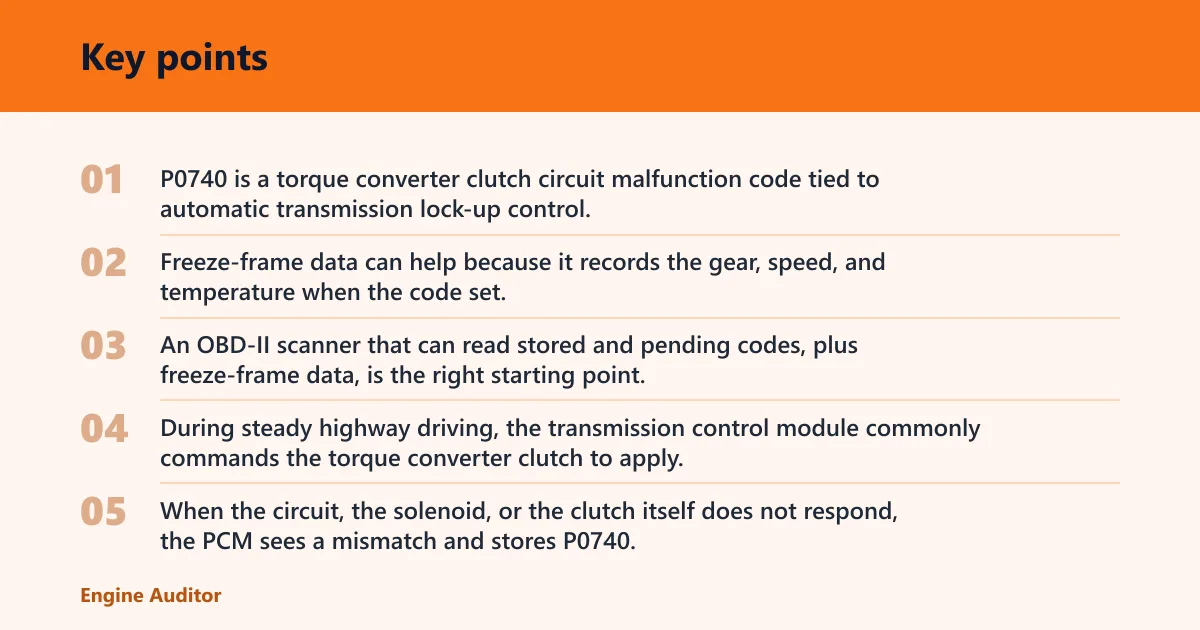


P0740 is a torque converter clutch circuit malfunction code tied to automatic transmission lock-up control. The torque converter clutch improves fuel economy by mechanically locking the engine to the transmission at highway speeds, so the fault matters even if the vehicle still drives normally around town. Freeze-frame data can help because it records the gear, speed, and temperature when the code set.
That context changes the diagnosis. A code that appears at cruise in top gear points in a different direction than one that appears during a cold start, a stop, or a shift event. An OBD-II scanner that can read stored and pending codes, plus freeze-frame data, is the right starting point.
How lock-up control works
During steady highway driving, the transmission control module commonly commands the torque converter clutch to apply. That can reduce slippage inside the torque converter and lower engine speed. When the circuit, the solenoid, or the clutch itself does not respond, the PCM sees a mismatch and stores P0740.
The transmission control module is part of the diagnosis, not an afterthought. If the module never commands lock-up, the problem may be control-side. If it commands lock-up and the engine speed stays high, the fault may sit in the solenoid circuit, fluid flow, or the clutch assembly.
Is P0740 the same as a torque converter clutch problem?
P0740 is related to the torque converter clutch, but it is best treated as a circuit-fault code first, not a blanket verdict on the converter itself. The code tells you the lock-up control circuit did not behave as expected. That can come from wiring, a solenoid, the TCM, low fluid, or internal clutch failure.
That distinction matters because a mechanical clutch problem and an electrical control problem do not start with the same tests. P0740 asks, “Did the command reach the circuit and produce the expected change?” It does not immediately mean the converter is worn out.
How related codes change the diagnosis
Scan for other transmission codes before replacing parts. Look for shift, pressure, or control-module codes that may share a power feed or signal path. A single P0740 can be simple. P0740 with other codes often points to a wiring or module issue that should be fixed first.
Freeze-frame data matters here too. If the code set at highway speed with the transmission hot, that can support a lock-up complaint. If it set at idle or in a low gear, the signal path and module logic deserve more attention than the converter itself.
Common symptoms of a bad torque converter clutch
A faulty torque converter clutch can cause shuddering, a slipping feel, poor fuel economy, stalling, or a near-stall when coming to a stop. The symptoms often show up near the point where lock-up should engage or release, which is why road-speed and gear data help more than a generic code reader alone.
Some drivers notice a brief vibration at cruise. Others feel the engine drop too hard and stumble as the vehicle slows. A bad torque converter can also cause gears to slip, acceleration loss, and strange noises, though those signs are not unique to P0740.
How symptoms separate solenoid trouble from clutch trouble
A solenoid or wiring fault often creates an on-off pattern. Lock-up may fail only when hot, only on bumps, or only under light throttle. An internal clutch fault more often creates consistent shudder, slip, or no lock-up even when the circuit checks out.
Suppose the check engine light comes on after a 20-minute highway drive, the tachometer flutters by 200 to 300 rpm during cruise, and the problem disappears in city traffic. That pattern leans toward lock-up control or clutch slip, not a random engine issue.
Torque converter clutch decision table
| Symptom pattern | Likely fault path | First test | Next step |
|---|---|---|---|
| Fluid level low, dark color, or burnt smell | Hydraulic control problem | Check level and condition with the engine running in Park | Correct the fluid issue, inspect for leaks, then recheck codes |
| P0740 with no lock-up and normal fluid | Solenoid circuit open or short | Test connector voltage and solenoid resistance | Repair wiring or replace the solenoid if readings are out of range |
| Intermittent shudder over bumps or after heat soak | Intermittent wiring or connector fault | Wiggle-test wiring, inspect pins, and check continuity | Repair rubbed-through wires, loose terminals, or corrosion |
| Code persists after electrical tests pass | Internal torque-converter lock-up failure | Review scan data for commanded lock-up versus RPM change | Escalate to transmission shop diagnosis and converter evaluation |
Can low fluid trigger P0740?
Yes. Low or dirty transmission fluid can trigger lock-up complaints because the torque converter clutch depends on healthy hydraulic control. Dark fluid or a burnt smell is a warning sign, and low level can keep the clutch from applying or releasing as designed. That said, fluid service is not a universal fix for P0740.
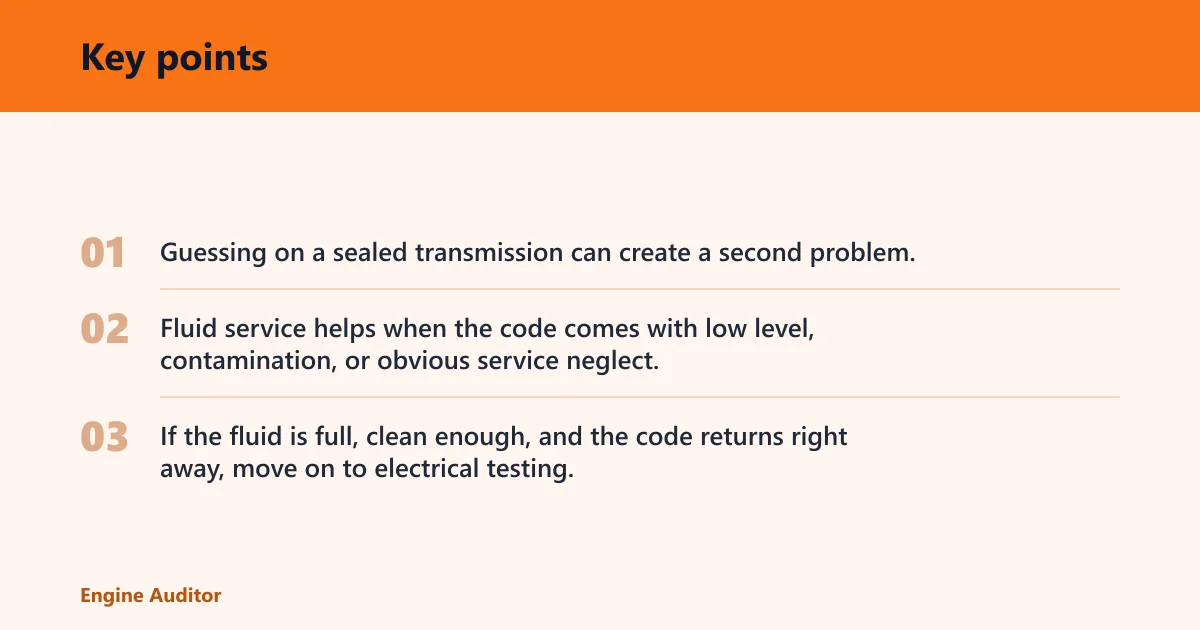
On dipstick-equipped units, check transmission fluid level and condition with the engine running in Park if the manufacturer calls for that method. On sealed or no-dipstick transmissions, follow the correct fill procedure, fluid temperature range, and level-check point for that specific unit. Guessing on a sealed transmission can create a second problem.
When fluid service helps and when it does not
Fluid service helps when the code comes with low level, contamination, or obvious service neglect. It does not fix a failed solenoid coil, a broken wire, or a worn lock-up clutch. If the fluid is full, clean enough, and the code returns right away, move on to electrical testing.
A common first-timer mistake is to clear the code after replacing the solenoid and skip checking the wiring or lockup circuit. That may hide a leak for a short time, but it does nothing for an open circuit or a converter clutch that no longer applies correctly.
How to test the solenoid and wiring
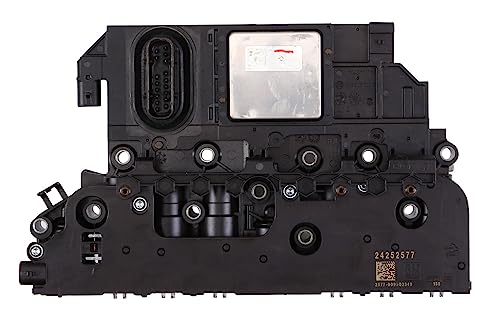
The torque converter clutch solenoid controls transmission fluid flow to the clutch, and it can fail open, shorted, or stick. An OBD-II scanner and a multimeter are the core tools here. The scanner shows code context and live commands. The meter checks voltage, resistance, and wiring continuity.
-
Read codes and freeze-frame data.
Use an OBD-II scanner to capture stored and pending codes before clearing anything. Save speed, gear, coolant temperature, and transmission temperature if the tool provides them, because those values help separate a lock-up fault from a random electrical issue. -
Check for related transmission codes.
Look for shift, pressure, or control-module codes that may share a power feed or signal path. A single P0740 can be simple. P0740 with other codes often points to a wiring or module issue that should be fixed first. -
Measure connector voltage.
Back-probe the solenoid connector and check for about 12V where the circuit is supposed to carry battery voltage. No voltage points toward a feed, fuse, relay, or TCM command problem. Voltage present but no response points toward the solenoid, ground path, or internal circuit. -
Check solenoid resistance.
Disconnect the solenoid and measure resistance with a multimeter. A common guide is 4–8 ohms, though vehicle design changes the exact range. An open reading, near-zero reading, or a number far outside spec supports a bad solenoid or internal wiring fault. -
Inspect continuity and connectors.
Check the wiring for rubbed insulation, fluid intrusion, bent pins, and loose terminals. Intermittent faults often show up only when the wiring is moved, heat-soaked, or under vibration, so a static ohm check can miss them.
Picture a truck that sets P0740 only after a long freeway drive. The solenoid measures within range cold, but the wiring near the transmission case opens when hot. That kind of fault can mimic a bad converter until the wiring is checked under the same conditions that set the code.
When the fault points inside the transmission
If the circuit tests pass, fluid is not the issue, and scan data still shows poor or absent lock-up response, the fault may be inside the transmission or torque converter. A worn lock-up clutch can slip under load, and the converter can fail without always setting a code. That is why a clean electrical result does not close the case.
At this point, the question becomes cost and access. If the unit has a sealed design, the pan is not a simple inspection point, or live data suggests commanded lock-up with no engine-speed change, a transmission shop is the better next step. Internal diagnosis often requires pressure checks, deeper scan data, or teardown decisions that go beyond a driveway repair.
When DIY should stop
Stop DIY diagnosis if the vehicle has repeated P0740 after basic fluid and electrical checks, if the wiring tests are inconclusive, or if the transmission shows slip, overheating, or harsh engagement along with the code. Those signs can mean the repair is no longer a simple solenoid swap.
Professional diagnosis is also the safer call when the unit has no dipstick and the correct level-check procedure is unclear. A wrong fluid level on a sealed transmission can create new lock-up complaints and muddy the original fault.
What is the difference between P0740 and P0741?
P0740 is commonly treated as a circuit-related code for the torque converter clutch control path. P0741 is a performance code. In plain terms, P0740 asks whether the circuit, command, or electrical path failed. P0741 asks whether the clutch performance was off even though the command path may have been present.
That difference changes the next test. P0740 pushes you toward wiring, voltage, resistance, and command checks. P0741 pushes you toward fluid condition, clutch slip, and lock-up performance under load. Low or dirty transmission fluid is listed as the most common cause of P0741, and a faulty torque converter clutch solenoid is the second most common cause.
Why the distinction matters
If you treat P0741 like P0740, you can waste time chasing a wire when the real issue is hydraulic slip. If you treat P0740 like P0741, you can miss an open circuit or shorted solenoid and jump too fast to converter replacement. The code family matters because the diagnosis path changes.
P0743 is another reminder of that split. Diagnosis there includes checking freeze-frame data, and the most common fix is replacing the TCC solenoid or repairing damaged wiring and connectors. The pattern is similar: code context first, parts later.
Frequently asked questions
What does P0740 mean on a transmission?
P0740 means the transmission control system has detected a torque converter clutch circuit malfunction. It points to the lock-up control path, not automatically to a failed converter. The first step is to read stored and pending codes, review freeze-frame data, and see whether the module commanded lock-up when the fault set.
Can I drive with a P0740 code?
Sometimes the vehicle will still move, but driving with P0740 is a risk if the code comes with shudder, slip, heat, or stalling. Continued driving can raise transmission temperature and worsen damage. Short trips to a repair facility are usually less risky than long highway use with an active lock-up fault.
How do you test a torque converter clutch solenoid?
Test the solenoid with scan data and a multimeter. Use the scanner to confirm the command state and check freeze-frame data. Then check connector voltage, which is often about 12V, and measure resistance, which is commonly 4–8 ohms depending on the vehicle. Out-of-range readings point to a failed solenoid or wiring fault.
Will replacing transmission fluid fix P0740?
Fluid service can help if the level is low or the fluid is dirty, dark, or burnt. It will not fix an open circuit, a shorted solenoid, or a worn torque converter clutch. Treat fluid condition as one branch of the diagnosis, not as proof that the code will disappear after a drain-and-fill.
What symptoms does a bad torque converter clutch cause?
A bad torque converter clutch can cause shudder at cruise, slipping feel, poor fuel economy, stalling as you stop, or a near-stall when lock-up fails to release. Some vehicles also set additional transmission codes. The symptom pattern matters, especially whether it happens at highway speed, during deceleration, or only when hot.
Products related to this article
Sponsored / affiliate links. As an Amazon Associate I earn from qualifying purchases. I may earn additional commission from eligible campaigns.