Transmission Control System Codes Besides P0700: Common Examples
P0700 is commonly treated as a generic request for the check-engine light. Transmission-related codes beside it can include gear-ratio, shift-solenoid, torque-converter, speed-sensor, and communication codes, and the subsystem usually points to the first check. Ignore them and you can chase the wrong part, waste time, and risk harder shifting or transmission damage. This guide groups common code examples by subsystem, explains what they usually mean, and shows the fastest first checks.
What a transmission code means
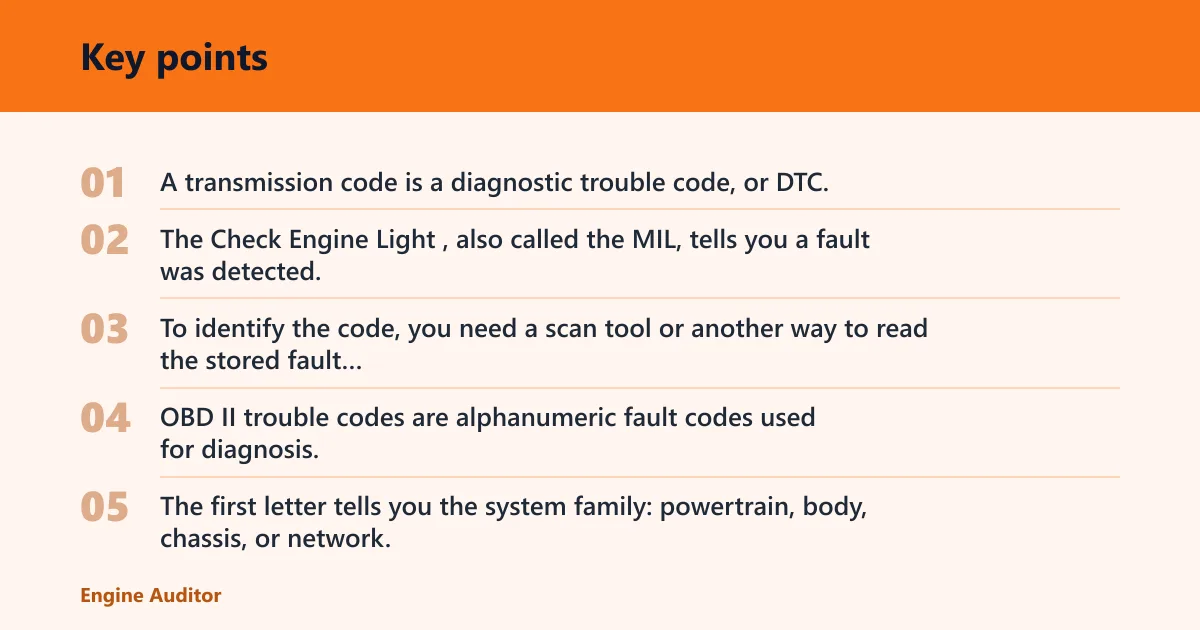


A transmission code is a diagnostic trouble code, or DTC, stored when a component or system fails a self-test. The Check Engine Light, also called the MIL, tells you a fault was detected, not what the exact failed part is. To identify the code, you need a scan tool or another way to read the stored fault information.
OBD II trouble codes are alphanumeric fault codes used for diagnosis. The first letter tells you the system family: powertrain, body, chassis, or network. Transmission-related codes usually appear in the powertrain, or P, family because that family covers engine, transmission, and emissions systems, and many transmission fault details may also appear as manufacturer-specific TCM codes that do not match standard P0xxx examples.
Why a scan tool matters
A scan tool is often the easiest way to know why the light is on. Some vehicles also display messages or transmission warnings that narrow the issue before you even plug in a reader. Some basic code readers may only give the number and not the definition. Some tools can also read TCM codes, which matters because a transmission control module can store faults a simple reader may miss.
Write the codes down before you clear anything. Once the memory is erased, you lose the first clue about what failed first and what failed next. Many auto parts stores and some repair shops will do a free plug-in diagnosis, which helps if you do not own a reader.
P0700 versus a specific code
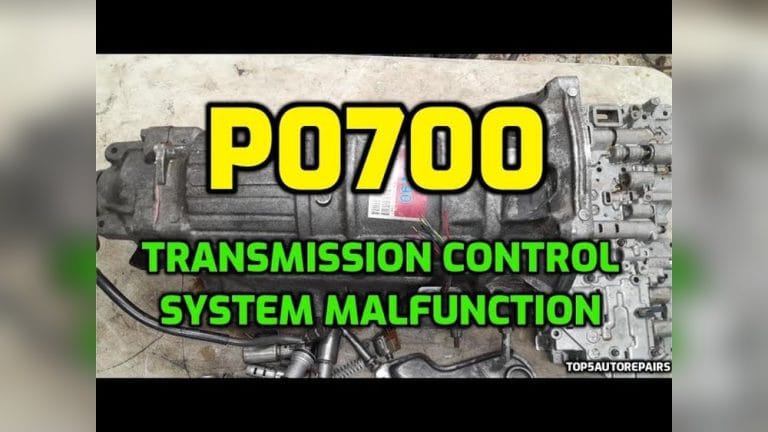
P0700 is not the fault itself. It is a general request from the transmission control side to turn on the MIL because the transmission control module has stored a problem. A specific code, such as a solenoid or speed-sensor code, points to the subsystem that needs the first check.
Picture a scan result that shows P0700 and P0720 together. P0700 tells you the transmission side has a fault. P0720 often points toward the output speed sensor or its circuit. That is much more useful than a single warning light.
Which code families matter most?
The most useful transmission codes are usually powertrain P codes. Within that group, generic codes use a 0 as the second digit, while some manufacturer-specific codes use other second-digit patterns. Generic codes are common to all makes and models; enhanced codes are unique to a particular make or model.
Where TCM codes fit
The transmission control module can store transmission-related faults and communication issues. A basic reader may show only the engine side code, while a better scan tool can read the TCM and pull a more specific transmission code. That difference matters when the light is on but the obvious transmission code is missing.
Network communication codes can also matter when the scan tool cannot talk to the TCM or when the module data is unstable. Those codes belong to the network family, not the transmission family, but they can still affect how the transmission is controlled.
Transmission-code triage map
Use this map to sort the code before you start testing parts. The subsystem column tells you where the first check usually begins, and the severity column gives a practical starting point, not a repair order.
| Code family | Likely subsystem | Typical severity | First diagnostic check |
|---|---|---|---|
| P0715, P0720, P0722 | Sensor | Moderate to high | Inspect input/output speed sensor connector, wiring, and live data |
| P0750 to P0770 | Solenoid | Moderate to high | Check transmission fluid condition, connector pins, and solenoid resistance per service data |
| P0730 | Gear ratio | High | Verify fluid level, check for slip, and compare commanded versus actual gear data |
| P0740 family | Torque converter | Moderate to high | Look at torque converter clutch command, slip data, and wiring to the solenoid |
| P17xx and similar enhanced codes | Pressure | Moderate to high | Check line pressure data, pressure-control solenoid control, and fluid condition |
Sensor-related codes
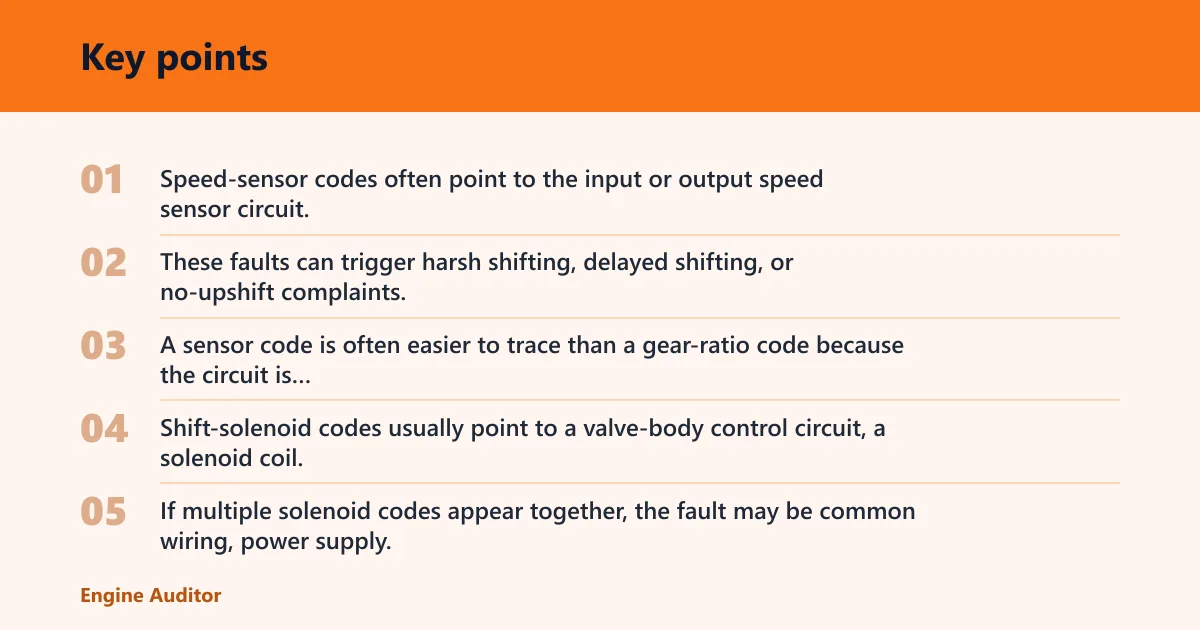
Speed-sensor codes often point to the input or output speed sensor circuit, the connector, or the wiring to it. These faults can trigger harsh shifting, delayed shifting, or no-upshift complaints. A sensor code is often easier to trace than a gear-ratio code because the circuit is narrower.
Solenoid-related codes
Shift-solenoid codes usually point to a valve-body control circuit, a solenoid coil, or contaminated fluid that affects solenoid action. If multiple solenoid codes appear together, the fault may be common wiring, power supply, or a shared internal problem rather than three separate failed parts.
Gear-ratio, pressure, and torque-converter codes
Gear-ratio codes often mean the transmission is not achieving the ratio the module expects in a given gear. Pressure-related codes usually point to line pressure, pressure-control solenoids, or hydraulic leakage. Torque-converter codes often involve clutch slip, clutch command, or the circuit that controls the clutch.
Common codes besides P0700
The codes below are useful starting points when a transmission fault appears. They do not name every possible failure, but they do point you to the subsystem most likely to need the first check. That makes them more useful than a general warning alone.
P0715 and related speed-sensor faults
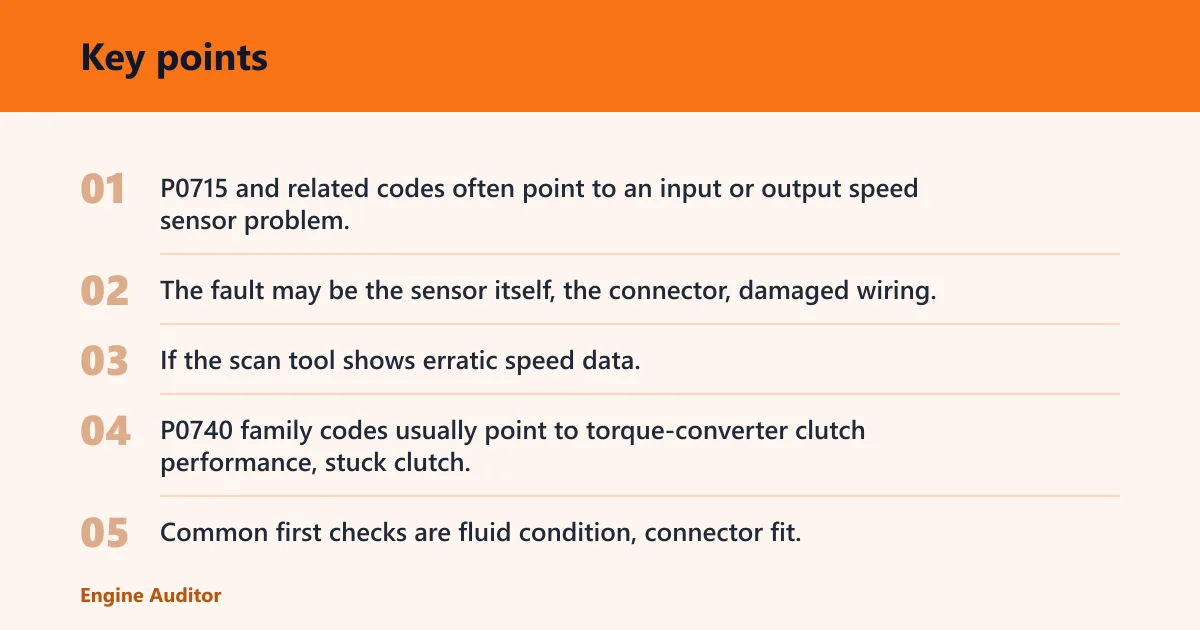
P0715 and related codes often point to an input or output speed sensor problem. The fault may be the sensor itself, the connector, damaged wiring, or debris affecting signal quality. If the scan tool shows erratic speed data, that is a stronger clue than the light by itself.
P0740 family and torque-converter faults
P0740 family codes usually point to torque-converter clutch performance, stuck clutch, or control-circuit issues. Common first checks are fluid condition, connector fit, and whether the scan tool shows the clutch being commanded on and off. A slip complaint under steady cruise often fits this group.
P0750 to P0770 solenoid codes
P0750 to P0770 codes often point to shift-solenoid circuit faults or performance faults. These codes often appear with rough shifts, a stuck gear, or a fail-safe mode. Start with the electrical side first, then move to fluid condition and the valve body if the wiring checks out.
P0730 gear-ratio codes
P0730 is a gear-ratio fault. That means the transmission and the module disagree about what gear ratio the unit is achieving. This can come from slip, a hydraulic problem, a solenoid issue, or a sensor problem. It is a high-priority code because it often reflects a system-level mismatch.
Suppose a compact car sets P0730 after a long highway drive and the transmission feels like it flares between 2nd and 3rd. That code does not prove the gear set is damaged. It does tell you to inspect fluid level, scan for slip data, and look for companion sensor or solenoid codes first.
Which code points to what?
Start with the code family, then move to the subsystem it names or suggests. A sensor code points to signal quality. A solenoid code points to circuit control or hydraulic actuation. A pressure code points to fluid control. A gear-ratio code points to mismatch between expected and actual transmission behavior.
Sensor faults
When a code points to a sensor, check the connector, wiring routing, corrosion, and live data. If the signal drops out or reads unrealistically, the fault may be electrical rather than mechanical. A bad sensor can also create misleading gear-ratio codes, so do not stop at the first code.
Solenoid faults
When a code points to a solenoid, check for power, ground, and continuity before replacing hardware. Fluid contamination can also affect solenoid movement. If several shift-solenoid codes appear together, focus on shared wiring or common feed circuits before replacing multiple parts.
Pressure-control faults
Pressure-control codes often point to line pressure, pressure-control solenoids, or valve-body wear. Low fluid level, wrong fluid, or a clogged filter can contribute. These codes deserve attention because low or unstable pressure can damage clutches and make the transmission slip.
Gear-ratio faults
Gear-ratio codes often show up after the transmission has already been slipping or shifting erratically. Check for related sensor, solenoid, and pressure codes first. A ratio code is often the result of another problem, not the first cause.
What should you check first?
Read every stored code first, including pending codes if your scan tool can show them. Then check whether the TCM has additional faults that the engine side reader missed. After that, sort the codes by subsystem so you can follow the most direct test path.
- Record the code numbers and freeze-frame data before clearing anything.
- Check for related engine, transmission, and network codes together.
- See whether the scan tool can read the TCM, not only the engine computer.
- Inspect fluid level, fluid condition, and visible wiring at the transmission.
- Use the code family to choose the first circuit or subsystem to test.
A common first-timer mistake is clearing a code list after seeing the MIL. That erases the order of events and can make a simple wiring fault look like a hard part failure. If the light returns, the stored pattern is often more useful than a fresh blank scan.
Frequently asked questions
What transmission codes besides P0700 are common?
These are useful because they usually point to a subsystem, which helps you choose the first check faster than a general transmission request code.
What does a transmission code mean on a scan tool?
It means the module has stored a DTC for a transmission-related problem or a related control issue. The scan tool may show only a number, or it may show the definition. If the tool can read the TCM, you may see a more specific fault than the engine computer reports.
Can transmission codes be generic or manufacturer-specific?
Yes. Generic or global codes use a 0 as the second digit, and manufacturer-specific codes can use other second-digit patterns. Generic codes are common across makes and models. Manufacturer-specific codes can point to a fault strategy that only that vehicle line uses.
What is the difference between a P0700 and a specific transmission code?
P0700 is a general request to turn on the MIL because the transmission side has detected a problem. A specific code tells you what subsystem the module thinks is failing, such as a speed sensor, solenoid, pressure-control issue, or gear-ratio mismatch. That specific code is the better starting point.
Which transmission codes usually point to solenoids, sensors, or gear ratio problems?
P0750 to P0770 usually point to shift solenoids. P0715 and related codes usually point to speed sensors. P0730 points to a gear-ratio problem. Those families do not guarantee the exact failed part, but they narrow the first test to the right circuit or operating condition.
Can a transmission code turn on the check engine light?
Yes. A transmission-related DTC can turn on the Check Engine Light or MIL. The light tells you that a fault was detected, not which part failed. For transmission diagnosis, the code is the starting point, and the scan tool data helps separate an electrical fault from a mechanical one.
Do I need a scan tool that can read TCM codes?
Often, yes. A basic reader may miss transmission control module data and only show the engine-side request code. A tool that can read the TCM gives you a better chance of seeing the fault that actually set the light, especially when P0700 appears without a clear follow-up code.
Can I keep driving if I have a transmission code?
Sometimes short trips are possible, but it depends on the code and the symptoms. If the vehicle is slipping, stuck in one gear, or shifting harshly, limit driving and get it checked soon. Continued driving with low pressure or heavy slip can turn a small issue into a larger one.
What other codes should I look for with a transmission problem?
Look for engine codes, transmission codes, and network communication codes together. Engine codes can affect load and shift behavior. Network codes can interrupt module communication. If your scan tool can see live data, compare commanded gear, actual gear, sensor values, and torque-converter status before deciding on the next test.
Products related to this article
Sponsored / affiliate links. As an Amazon Associate I earn from qualifying purchases. I may earn additional commission from eligible campaigns.