P0715 Code: Input Speed Sensor Meaning and Diagnosis
P0715 means the transmission control system is not seeing a valid input speed sensor signal, or the circuit feeding that signal has failed. Ignore it and you can get harsh shifts, no-shift complaints, limp mode, or needless parts replacement. This guide covers the input-speed circuit path, common failure points, and a step-by-step diagnosis before you buy a sensor or transmission parts.
What P0715 means
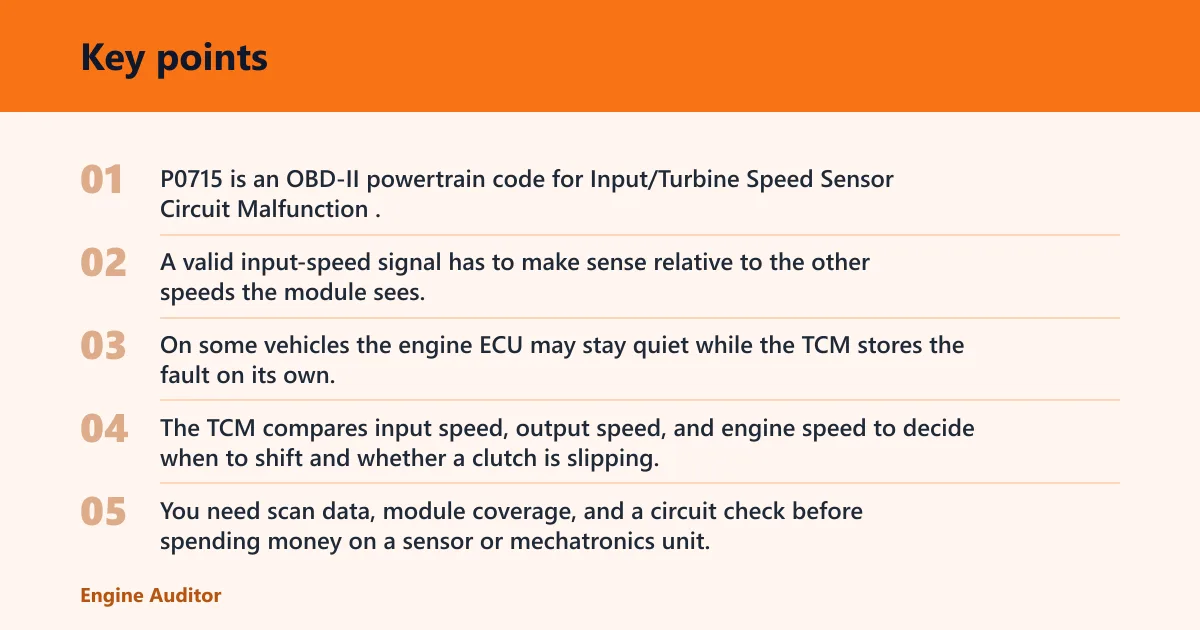


P0715 is an OBD-II powertrain code for Input/Turbine Speed Sensor Circuit Malfunction. The sensor measures how fast the transmission input shaft rotates, and the transmission control module uses that signal with engine speed and output speed to help manage shift timing, clutch slip, and gear ratio checks.
A valid input-speed signal has to make sense relative to the other speeds the module sees. If the signal drops out, sticks at zero, jumps around, or disagrees with engine and output speed in a way that the module cannot reconcile, the TCM can set the code and switch to a protective strategy.
This is why P0715 is not necessarily a sensor-only diagnosis. The fault can be in the sensor, wiring, connector, power or ground supply, the mechatronics unit, or the module that reads the signal. On some vehicles the engine ECU may stay quiet while the TCM stores the fault on its own.
What the TCM does with input speed data
The TCM compares input speed, output speed, and engine speed to decide when to shift and whether a clutch is slipping. If the input signal is missing or implausible, it may suspend normal shift logic, set shift faults, and trigger limp mode. That protects the transmission from further damage, but it also limits drivability.
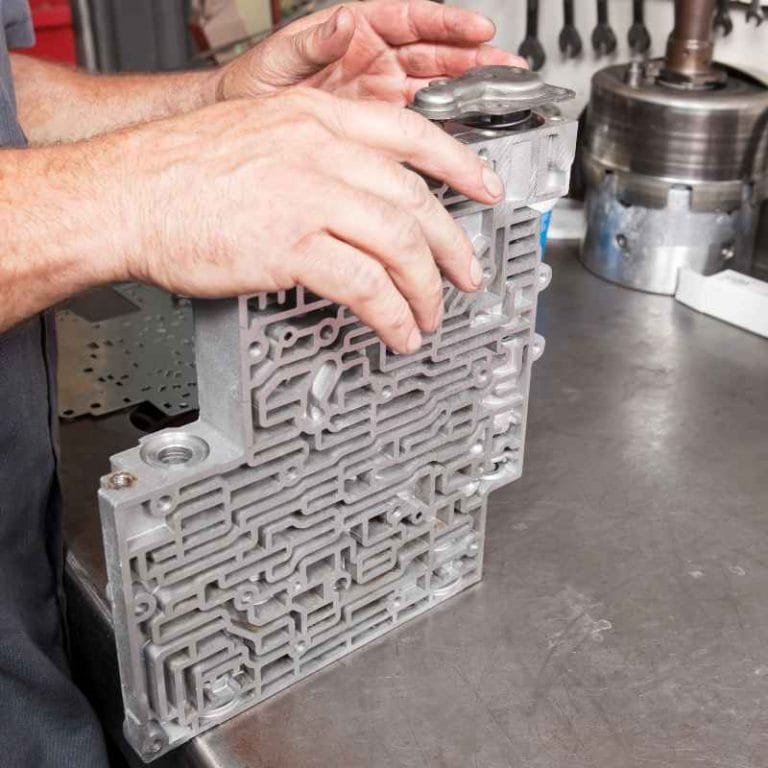
On DSG-type units, the input-speed sensor may be integrated into the mechatronics assembly rather than mounted as a separate, easy-to-swap part. In those cases, the fault path often runs through the control electronics, internal wiring, or the hydraulic/mechatronic section, not just the sensor element itself.
Why the code can set without a bad sensor
Low battery voltage, bad grounds, corrosion, damaged insulation, water intrusion, or an intermittent open or short can all make the module see an implausible signal. Dirty fluid or metal debris can also interfere with sensor operation on wet DSG setups, especially when contamination reaches the mechatronics area.
That is why a code reader alone is not enough. You need scan data, module coverage, and a circuit check before spending money on a sensor or mechatronics unit.
Is P0715 the input speed sensor?
P0715 points to the input/turbine speed sensor circuit, but it does not prove the sensor itself is bad. The failure may be in the sensor, the wiring, the connector, the power or ground path, or the transmission control hardware that processes the signal. Treat it as a signal-path fault first.
Related codes can matter. P0716 and P0717 can shift the diagnosis because they point to different signal behaviors, so it helps to read them before replacing parts. A P0716 or P0717 pattern can suggest a signal range or intermittent performance issue rather than a hard open-circuit failure.
Sensor, wiring, or signal path
The input speed sensor measures transmission input shaft speed. If it loses its reference, loses power or ground, or sees interference from a damaged circuit, the result can look like a failed sensor even when the sensor itself is fine. That is why the wiring and connector deserve the same attention as the part.
Common failure zones include:
- Sensor body or pickup element
- Connector corrosion or loose terminal fit
- Chafed wiring or broken conductors
- Ground splice or battery feed problem
- Mechatronics or TCM internal fault
How related codes change the diagnosis
If P0715 appears alone and live data is dead or frozen, the circuit may have a hard failure. That usually pushes diagnosis toward wiring, connector contact, voltage supply, or internal module processing before the sensor gets replaced.
Say the scan tool shows engine speed around 800 rpm, output speed at zero, and input speed stuck at zero while the vehicle is moving. That pattern points to a missing input signal or failed processing path, not a generic shift complaint.
Symptoms and limp mode
P0715 often brings a warning light, harsh or incorrect shifting, and sometimes limp mode. A missing or implausible signal can trigger limp mode, and the transmission may stay in one gear or limit speed to about 25-45 mph. The fault may clear temporarily after a restart if the problem is intermittent.
Warning lights and shift quality changes
The most common signs are transmission warning lamps, check engine light, delayed shifts, flare, harsh engagement, or a vehicle that feels stuck in a lower gear. The Hummer OBD2 page ties P0715 to shifting problems, which fits the normal symptom pattern for an input-speed circuit fault.
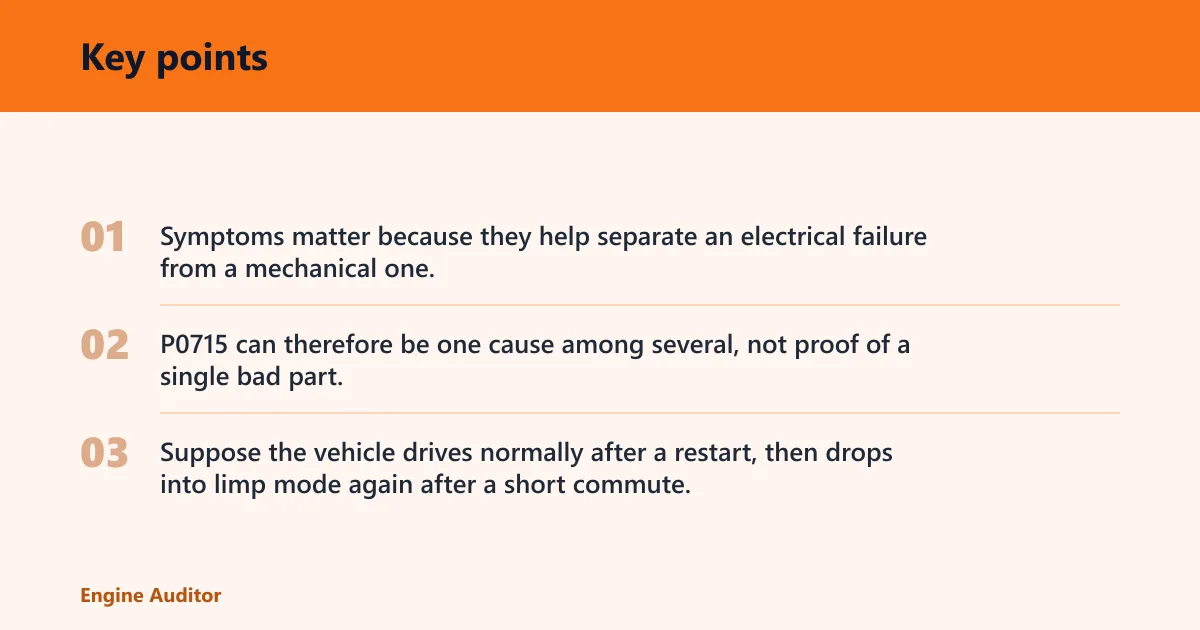
Symptoms matter because they help separate an electrical failure from a mechanical one. A repeatable, constant fault that sets as soon as the key is turned on often points to wiring, power, ground, or module failure. A fault that appears only hot, only wet, or only over bumps is more likely to be intermittent wiring or connector trouble.
When limp mode appears and how it behaves
Limp mode is a protective state. Steer notes that transmission limp mode typically limits speed to 25-45 mph, may leave the car stuck in one gear, and can be triggered by transmission overheating or solenoid failure as well as speed-sensor faults. P0715 can therefore be one cause among several, not proof of a single bad part.
Suppose the vehicle drives normally after a restart, then drops into limp mode again after a short commute. That pattern often suggests a signal dropout, heat-related wiring fault, or a mechatronics issue that returns when the circuit warms up.
What intermittent symptoms usually mean
Intermittent behavior is a clue. A code that clears, comes back on bumps, or returns after rain often points to connector fit, corrosion, water intrusion, or broken wiring inside the loom. A code that returns only under load can point to a weak ground, voltage drop, or an internal control fault that shows up when the module is working harder.
P0715 diagnostic decision table
Use this table to match the symptom pattern to the most likely failure zone and the next test. It is meant to stop guesswork and keep the diagnosis moving in a logical order.
| Symptom pattern | Fault tendency | Live-data behavior | Most likely next inspection step |
|---|---|---|---|
| Constant fault, code returns immediately | Hard circuit problem, module power/ground, or failed sensor supply | Input speed stays at zero or an impossible value | Check battery voltage, module grounds, and sensor circuit power first |
| Intermittent fault after bumps or heat | Loose connector, corroded terminal, broken wire, intermittent open | Input speed drops out, jumps, or freezes briefly | Wiggle-test the wiring and inspect connector pins for corrosion |
| Limp mode present, shifting limited | TCM sees missing or implausible input signal | Input speed does not track engine and output speed | Scan all modules and compare input, output, and engine speed on live data |
| P0715 with P0716 or P0717 | Signal quality problem, not only a dead sensor | Input speed may be unstable, implausible, or range-related | Inspect wiring and mechatronics before replacing the sensor |
| Fault returns after clear, no limp mode yet | Early intermittent dropout or voltage issue | Live data may look normal until the fault repeats | Check battery voltage, grounds, and connector contact under load |
| Wet DSG, dirty fluid, debris present | Mechatronics contamination or internal signal issue | Signal may be noisy, erratic, or inconsistent when hot | Inspect fluid condition and consider mechatronics diagnosis |
What to inspect first
Start with the electrical basics, then move to the transmission-specific parts. That order avoids replacing the wrong component and catches the faults that most often create false sensor codes.
-
Check battery voltage. Low system voltage can create implausible sensor signals. Measure battery state and charging voltage before chasing the transmission circuit, because a weak supply can make the module misread a healthy sensor.
-
Inspect grounds closely. Look for loose, corroded, or damaged ground points and voltage drop at the transmission and module grounds. A poor ground can mimic a sensor fault and can also explain a code that comes back after clearing.
-
Examine the wiring and connector. Check for oil, water, bent pins, green corrosion, loose terminal tension, broken locks, or rubbed-through insulation. Wiring and connectors are common causes of P0715, especially when the code is intermittent.
-
Inspect transmission fluid condition. Look for dirty fluid or metal debris, especially on wet DSG variants where contamination can affect the mechatronics area. If the fluid is contaminated, address that evidence before replacing expensive electronics.
-
Read live data. Use VCDS or ODIS to compare input speed, output speed, and engine speed. The key question is whether the input signal is zero, frozen, jumping, or implausible while the other data make sense.
What bad live data looks like
A healthy input-speed channel should change smoothly with engine and wheel movement. Bad patterns include a flat zero while the vehicle is moving, random spikes, a value that freezes at one number, or a reading that does not fit the gear ratio and road speed. Those patterns point to a circuit or module problem, not just a mechanical shift complaint.
VCDS and ODIS are useful because they let you see whether the failure is real-time and repeatable. If the input speed drops out while the connector is moved or while the wiring flexes, the next test is the circuit, not the sensor body alone.
Mechatronics and TCM faults
Mechatronics or TCM faults are not edge cases. In DSG units, the input-speed circuitry may live inside the mechatronics assembly, so a bad signal path can come from internal electronics or internal wiring rather than an external sensor. The TCM may store P0715 even if the engine ECU does not.
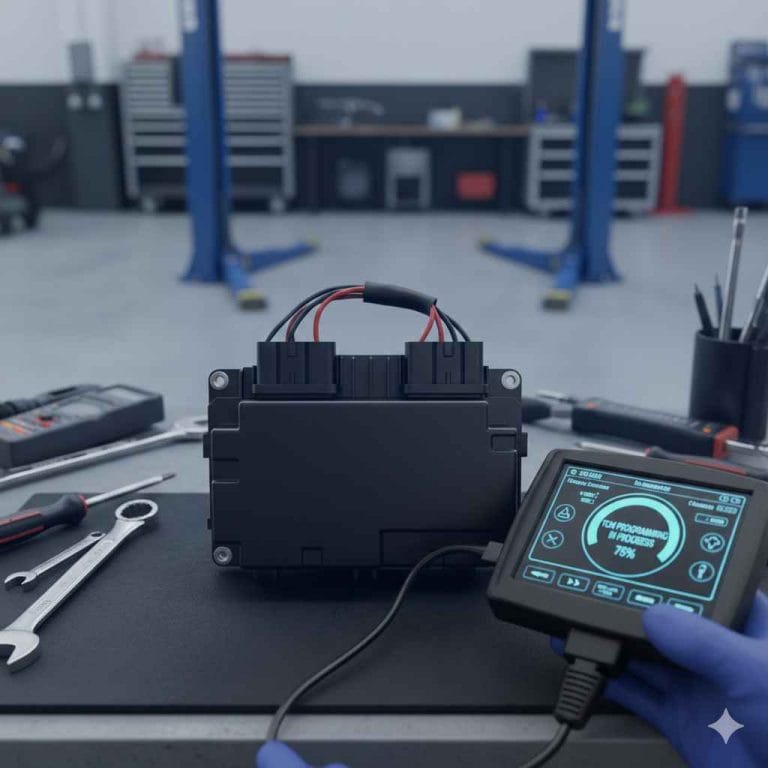
That means the fault tree should include internal module failure when external wiring checks out. Bench testing may be needed when live data is erratic but the wiring and connector test normal. After mechatronics repair, basic setting and adaptation are required on the repaired unit.
When the sensor is not the failure point
If the sensor signal disappears only after the transmission warms up, or if the data fails in a way that matches known mechatronics weak points, the sensor itself may not be the right target. A scan tool that shows no sensible input-speed change across gears, while wiring checks are clean, raises suspicion of the internal control unit.
Bench testing and internal signal faults
Bench testing helps separate an external circuit fault from an internal mechatronics fault. It can confirm whether the module is reading the signal correctly and whether the internal path is stable under conditions the road test cannot isolate. This is especially relevant when P0715 appears with shift complaints but the wiring tests good.
Basic setting and adaptation after repair
After mechatronics repair, basic setting and adaptation are required to restore shift quality and prevent incorrect post-repair behavior. If you skip that process, the transmission may still shift badly even when the original electrical fault is fixed.
-
Repair the confirmed fault. Fix the wiring, connector, sensor, or mechatronics issue that the tests actually point to. Do not skip directly to part replacement without evidence.
-
Clear all codes. Erase P0715 and any related codes from every module that stores them. Then cycle the ignition so the control units can reset their status.
-
Run live-data checks. Confirm that input speed now follows engine and output speed in a believable pattern. Any freeze, dropout, or jump means the repair is incomplete.
-
Perform adaptation. On DSG and mechatronic repairs, carry out the required basic setting and adaptation routine. This step matters because the module needs to relearn control behavior after component work.
-
Road test and rescan. Drive through the conditions that used to trigger the fault, then rescan for P0715, P0716, or P0717. The fix is only confirmed when the code does not return and the live data remains stable.
Can you drive with P0715?
Sometimes, but not for long. If the code is present and the transmission is shifting normally with no limp mode, careful driving to a repair point may be reasonable. If the car is stuck in one gear, limited to about 25-45 mph, or shifting harshly, stop driving and diagnose it immediately.
P0715 is a protective-warning code, not a cosmetic one. Continued driving with a missing or implausible input-speed signal can worsen shift problems and may increase transmission wear if the module cannot control slip correctly.
Risk level by symptom pattern
Low-risk cases are limited to a stored code with no drivability change and clean live data after a restart. Higher-risk cases include limp mode, repeated harsh shifts, or a code that returns quickly after clearing. The highest-risk cases are those with overheating, severe slipping, or no reliable live input-speed signal.
When to stop driving and diagnose immediately
Stop driving if the transmission stays in one gear, the car will not shift correctly, or the warning returns with a dead input-speed reading. Those symptoms mean the control system cannot trust the signal, and that can turn a circuit fault into a more expensive mechanical repair.
What causes P0715 to return after clearing?
When P0715 comes back after clearing, the most common reasons are intermittent wiring faults, voltage or ground problems, or a repair that fixed the symptom but not the cause. It can also return if the mechatronics unit needs adaptation or if an internal signal fault was missed.
That is why a return code should not trigger blind parts swapping. A repeat fault after clearing usually means the underlying problem is still present and needs a circuit-level check under real operating conditions.
Intermittent wiring faults
Broken strands inside the loom, loose pins, and corrosion can pass a static test and fail only when the wiring moves or heat builds. If the code returns after a road test, repeat the inspection while flexing the loom and watching live data for drops or spikes.
Voltage and ground problems
A battery that is weak, undercharged, or paired with poor grounds can create implausible sensor values. If the code clears but returns after starting, shifting, or when electrical loads switch on, test supply voltage and grounds before condemning the sensor.
Incomplete repair or missing adaptation
If a mechatronics unit was replaced or repaired without basic setting and adaptation, the transmission can act wrong even if the original electrical fault is gone. A code that returns with new shift complaints after service often points to an unfinished post-repair process.
Frequently asked questions
What does P0715 mean on a transmission?
P0715 means the transmission control system has detected an input/turbine speed sensor circuit malfunction. In practical terms, the module is not seeing a believable signal from the sensor that reports input shaft speed, so shift logic and ratio checks can fail.
Can I drive with a P0715 code?
You may be able to move the car a short distance if it shifts normally and is not in limp mode, but that should be treated as temporary. If it is stuck in one gear, shifts harshly, or limits speed, stop driving and diagnose it right away.
What causes a P0715 code to come back after clearing it?
Recurring P0715 usually means the root cause was not fixed. Intermittent wiring damage, corrosion, poor grounds, low voltage, or an internal mechatronics fault can all return once the vehicle sees vibration, heat, or normal electrical load again.
Does a bad battery or ground cause P0715?
Yes. Low battery voltage and bad grounds can create implausible sensor signals that the TCM treats as a circuit fault. That is why voltage and ground testing belongs near the start of diagnosis, not after sensor replacement has failed.
What’s the difference between P0715 and P0716?
P0715 is a circuit malfunction code for the input speed signal, while P0716 points to a different signal behavior and changes the diagnostic path. If both appear together, the problem is often a signal-quality or wiring issue rather than a simple dead sensor.
Can wiring or connectors cause an input speed sensor code?
Yes. Wiring, connectors, corrosion, loose terminals, and intermittent opens or shorts are common causes of P0715. A damaged wiring run can make the module see zero, frozen, jumping, or implausible input speed even when the sensor itself is still intact.
Products related to this article
Sponsored / affiliate links. As an Amazon Associate I earn from qualifying purchases. I may earn additional commission from eligible campaigns.
 Transmission Input Speed Sensor 24244544 D74438E Compatible with GM 4L60E 4L65E 4L70E Automatic Transmission 2005-Up ISS Replacement
 XYZIL 12 Pin 4 Speed Transmission Controller Shift Range Selector 8223049 Compatible with JLG Lull 1044C-54 6036 6042 10054 10042 8042 w/ DT06-12S Plug Compatible with Skytrak 4266 4270 4290 Forklift