How to Compare Family Cars for Growing Households
Choose the smallest family car that still fits your next household stage, not just today’s seat count. Judge it in three steps: first, whether the rear bench takes your child seats; second, whether the boot still works with the seats installed; third, whether access, safety tech, and running costs stay manageable as the family grows.
What you’ll need before you compare
- Current household headcount and the next planned stage
- Child-seat models or their published dimensions
- Stroller folded size and weekend bag count
- Boot volume figures in litres behind the rear seats
- Rear-seat measurements: legroom, headroom, and shoulder room
- ISOFIX or LATCH anchor count and seat positions
- Fuel economy figures, insurance quotes, and tyre sizes
- Parking space length and driveway width
-
Define the next household stage. Compare the car against the next 3 stages, not the current one: first child, second child, and possible third-row use. That keeps you from buying for 2 adults and finding a year later that the rear bench, boot, or access path no longer fits daily life.
-
Set a space threshold. Write down the minimum boot volume, rear-seat room, and seat count you need in the worst case. Use the worksheet below to keep the limit visible when you compare trims, since sunroof roofs, battery packs, and third-row seats can cut usable space.
-
Check seat layout first. Count ISOFIX or LATCH positions, inspect middle-seat compatibility, and verify whether 3 child seats can fit across the rear bench. If the middle seat is narrow or raised, a booster may fit but a rear-facing seat may not.
-
Measure the load path. Open the tailgate and look at boot opening height, floor shape, and whether the third row folds flat. A square opening and low sill matter as much as litres, because a stroller, school bags, and a grocery crate need usable shape, not just a large number.
-
Compare running costs. Check fuel economy, insurance, tyre size, and service intervals before choosing the larger vehicle. A heavier model can cost more to fuel and maintain even when purchase price is similar, especially with AWD and larger tyres.
Family growth worksheet
| Current household size | Planned next-stage size | Car-seat count | Stroller size | Weekend luggage volume | Third-row need | Minimum boot-space threshold |
|---|---|---|---|---|---|---|
| 2 adults | 2 adults + 1 infant | 1 rear-facing seat | Compact fold, under 70 cm long | 80-120 L | No | Pass: 450 L behind rear seats / Fail: less than 450 L |
| 2 adults + 1 child | 2 adults + 2 children | 2 seats or 1 seat + 1 booster | Full-size stroller, under 100 cm long | 120-180 L | No | Pass: 500 L behind rear seats / Fail: less than 500 L |
| 2 adults + 2 children | 2 adults + 3 children | 3 seating positions | Double stroller or large single | 180-250 L | Maybe | Pass: 600 L behind rear seats, or a usable third row / Fail: less than 600 L |
| 2 adults + 3 children | 2 adults + 3 children + guest | 3 seats plus spare position | Large stroller, travel system | 250 L or more | Yes | Pass: 700 L with third row folded, or 2 separate cargo zones / Fail: less than 700 L |
How much space will you need next?
Start with the next seat count, then check whether the boot still holds a folded stroller and at least one weekend bag per person. A car can feel roomy for 2 adults and one infant, yet become cramped fast once rear-facing seats, booster buckles, and a larger stroller enter the picture.
First child to third child
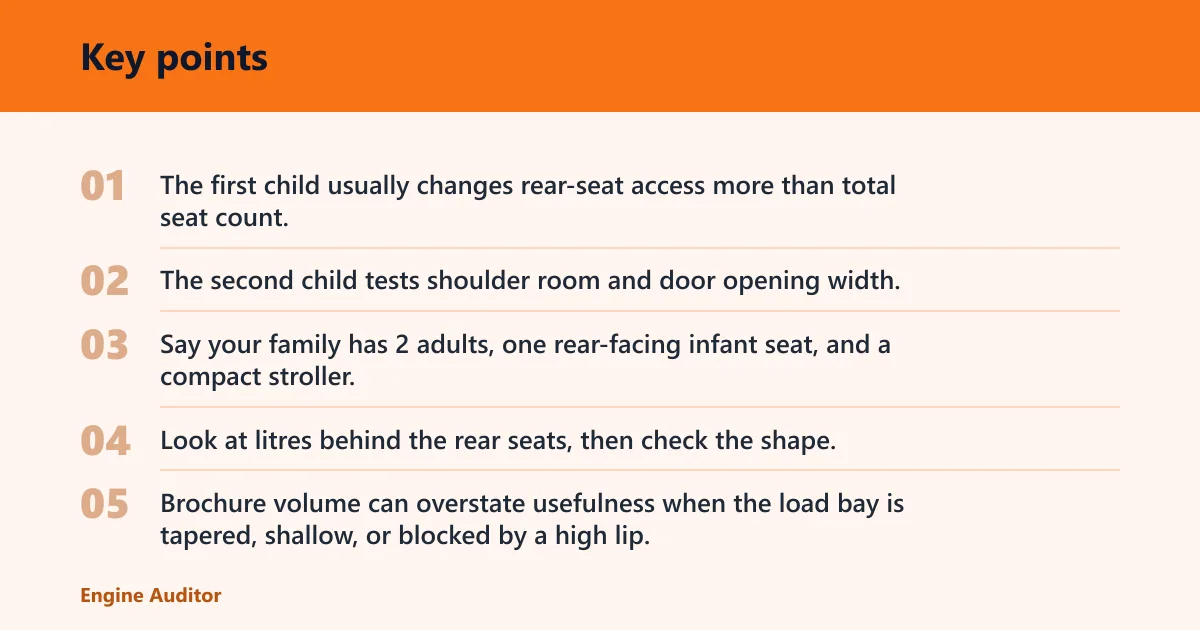
The first child usually changes rear-seat access more than total seat count. The second child tests shoulder room and door opening width. The third child is the hard test: if three seats do not fit across the rear bench with safe buckle access, the vehicle is already at its limit.
Say your family has 2 adults, one rear-facing infant seat, and a compact stroller. A 450-litre boot may work today. Add a second child seat and a larger stroller, and the same car may lose its clear loading path even if the brochure number looks generous.
Boot space and luggage load
Look at litres behind the rear seats, then check the shape. Brochure volume can overstate usefulness when the load bay is tapered, shallow, or blocked by a high lip. A tall, square boot often carries a stroller and school bags better than a deeper but narrow load bay. If a third row is upright, the cargo area can drop sharply, so compare the folded third-row volume too.
For many families, about 500 litres behind the rear seats is a practical floor for two children and regular shopping. If you expect a third child or regular airport trips, set the threshold higher. The number matters less than whether the opening, floor, and lip let you load daily gear without lifting awkwardly.
Which seating layout works best?
Rear bench width, anchor placement, and seat-folding design decide whether a family car works with child seats or only on paper. The best layout is the one that lets you install seats without blocking buckles, rear doors, or the path to a third row.
Rear bench width and child seats
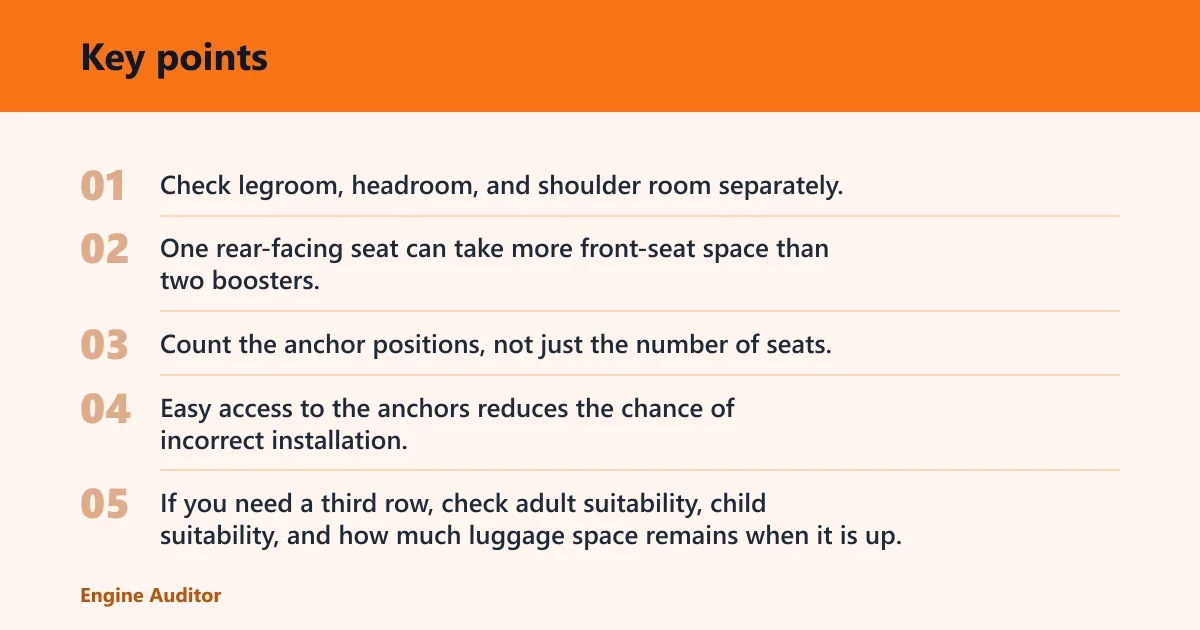
Check legroom, headroom, and shoulder room separately. One rear-facing seat can take more front-seat space than two boosters. If the bench is wide but the shoulder room is tight, three-across fit may still fail because buckles become hard to reach or a child seat overlaps the next one. A true three-across check means the seats can latch securely, the buckles remain reachable, and the doors still close without the outer seats fouling the trim.
ISOFIX and LATCH placement
Count the anchor positions, not just the number of seats. Middle-seat compatibility matters because some benches have anchors only on the outer positions, and some middle seats are too narrow for a proper child-seat base. Easy access to the anchors reduces the chance of incorrect installation. Child-seat anchor layouts and their intended seating positions should be checked against the vehicle spec sheet and the child-seat maker’s fit guidance, not guessed from the badge or body style.
Third-row access and fold-flat use
If you need a third row, check adult suitability, child suitability, and how much luggage space remains when it is up. A third row that folds flat quickly is more useful than one that is hard to stow. Sliding or split-fold rear seats with a 60/40 or 40/20/40 split can make entry easier and keep one side free for cargo. A third row upright is a people-space feature first; when folded, it becomes a cargo feature, so compare both layouts rather than treating the published seat count as the full answer.
Picture a 7-seat car with a usable third row but only about 150 litres left behind it. That may suit short child trips, yet it will not handle a folded stroller and two school bags without folding the row down again.
Is an SUV or minivan better?
For growing households, the better choice is the one that makes loading, buckling, and parking easier every day. An SUV often brings higher seating and AWD options, while a minivan usually gives easier access, a lower floor, and more useful cabin shape for child seats and cargo.
Access and loading workflow
Sliding doors on a minivan usually make school-run buckling simpler in tight spaces. In an SUV, higher sills and taller seat height can help with visibility, but they often make lifting a heavy child seat or a stroller into the boot harder. Workflow matters more than badge or stance.
Parking, visibility, and turning circle
Check the turning circle, rear visibility, and whether the car has parking sensors and a camera. A large family car that is easy to place in a driveway saves time every day. Blind-spot monitoring and rear cross-traffic alert also help when the vehicle is long or has thick rear pillars. These ADAS features support the driver, but they do not replace clear sightlines or an easy loading height.
When an estate or wagon makes more sense
If you want lower fuel use, easier loading, and better road manners, an estate can make sense for 2 children and regular luggage. It often gives a lower boot floor and simpler handling than a taller SUV, though it may lack the third-row option and higher seating position some families want. In practice, a wagon can beat an SUV when the family needs a long, flat cargo area more often than it needs extra ride height.
What should you check before buying?
Check safety tech, fuel use, and seat flexibility together. A family car that scores well on paper but costs more to run, or one that has strong safety equipment but poor access to the third row, can disappoint fast once school runs and weekend trips start.
Safety tech and visibility
Look for automatic emergency braking, blind-spot monitoring, lane-keeping assist, and rear cross-traffic alert. These systems help in traffic and parking lots, but they should sit alongside good outward visibility and a clean camera view, not replace them. Safety ratings from NHTSA, IIHS, Euro NCAP, and NCAP Australia are most useful when you compare similar body styles and trim levels, because equipment can vary by market and version.
Fuel economy and running costs
Compare mpg or L/100 km, then check real-world family-trip use, not only the brochure figure. Add insurance, tyre cost, and maintenance intervals. Government fuel-economy databases and manufacturer spec sheets are the cleanest way to compare published figures, while heavier AWD models may suit snow or rough drives and front-wheel-drive hybrids may better fit urban use and lower running costs. A larger vehicle can also bring larger tyres, which affect replacement cost over time.
Sliding seats, split-folds, and storage
Test 60/40 or 40/20/40 rear seat splits, seat-folding effort, and how much cargo remains with one or two seats up. Sliding rear seats can add knee room or boot space on demand. If moving the seat takes too much force, it will not be used often.
Common mistakes
Many buyers compare only total seats and ignore whether those seats are usable with child seats installed. Others trust a boot volume figure without checking the opening shape or the third-row penalty. A common first-timer mistake is choosing a larger SUV, then finding the school-run parking and loading routine harder than before.
- Do not judge space only by brochure litres.
- Do not assume three rear seats mean three child seats fit safely.
- Do not forget the third-row cargo penalty.
- Do not skip insurance, tyre size, and fuel cost.
- Do not ignore parking, turning circle, and rear visibility.
Frequently asked questions
How do I compare family cars for a growing household?
Start with the next household stage, not the current one. Compare seat count, rear bench width, boot volume behind the rear seats, and whether a stroller still fits when child seats are installed. Then add running costs, parking ease, and third-row access if you may need it.
What size car do I need for 2 adults, 2 kids, and future seating needs?
For 2 adults and 2 children, a car with about 500 litres of boot space behind the rear seats is a practical starting point. If you may add a third child or use boosters later, look for strong rear-seat width, 3-across compatibility, and a folding rear row or a true third row.
Is an SUV or minivan better for a growing family?
A minivan usually wins on access, sliding doors, and usable cabin space. An SUV can suit families that want higher seating or AWD for snow and rough roads. Compare door opening width, boot shape, and parking ease rather than style alone.
How much boot space should a family car have?
For a small family, 450 litres behind the rear seats is a workable floor. For 2 children, 500 litres is safer, and 600 litres or a fold-flat third row helps when luggage grows. The opening shape matters too, since a stroller or school bag stack needs usable width.
What safety features matter most in a family car comparison?
Prioritize automatic emergency braking first, then blind-spot monitoring, lane-keeping assist, and rear cross-traffic alert. Good rear visibility and parking cameras matter as well. Safety ratings from NHTSA, IIHS, Euro NCAP, and NCAP Australia help you compare crash performance, but the daily usefulness of these systems matters more in tight school and parking situations.
How do I compare rear seat space for car seats and boosters?
Check legroom, headroom, shoulder room, and the number and position of ISOFIX or LATCH anchors. Then test whether the middle seat still works with a child seat on either side. If buckles are buried or seats overlap, the bench may be too narrow for your plan.
Products related to this article
Sponsored / affiliate links. As an Amazon Associate I earn from qualifying purchases. I may earn additional commission from eligible campaigns.