Ford Car Vibration at Speed: Tire, Brake, or Suspension?
A Ford vibration at speed often points to tires if it shows up in the steering wheel at about 45–75 mph, brakes if it appears only while braking, and suspension or driveline parts if it’s felt in the seat or floor. If you miss that pattern, you can spend money on the wrong parts while a worn tire, bent wheel, bad rotor, or failing joint keeps getting worse. This guide uses a symptom-first tree for Ford trucks and SUVs, plus the next test for each likely cause.
What the vibration location tells you
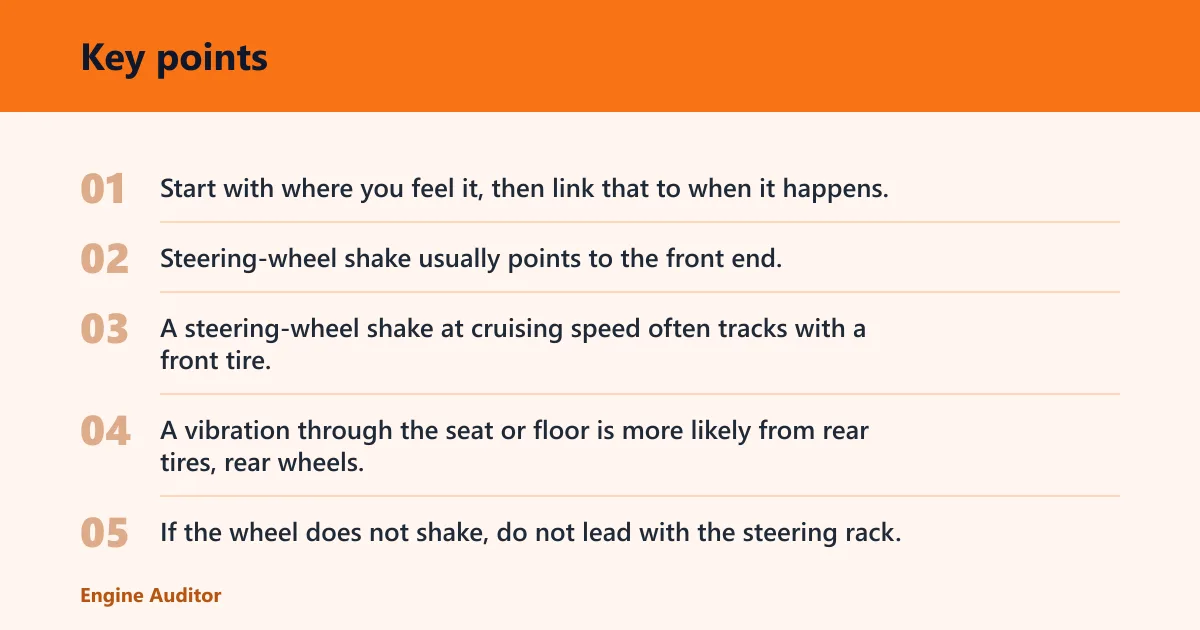


Start with where you feel it, then link that to when it happens. Steering-wheel shake usually points to the front end, seat or floor vibration often points to the rear or driveline, and a shudder that appears only during braking points to the brakes. That split removes a lot of guesswork.
Steering wheel versus seat or floor
A steering-wheel shake at cruising speed often tracks with a front tire, bent front wheel, front brake issue, or front suspension play. A vibration through the seat or floor is more likely from rear tires, rear wheels, rear driveline parts, or an axle fault on FWD and AWD Ford models. If the wheel does not shake, do not lead with the steering rack.
Brake-only versus cruising vibration
If the shake appears only when the brake pedal is applied, common first suspects are rotor runout, rotor thickness variation, or pad deposits. If the vibration is present while holding a steady throttle, brakes move down the list. That distinction matters because a brake-only pulse is a different problem from a balance issue.
Speed band clues
Low-speed wobble can come from a bent wheel, a bad tire, or loose suspension hardware. Highway-speed shake, often around 45 to 75 mph, is commonly associated with wheel and tire problems. A vibration that gets worse under acceleration points more toward an axle or driveshaft issue than a pure tire fault.
Ford vibration diagnostic matrix
Use this table as the first pass before replacing parts. It sorts the symptom pattern, likely cause, first check, and when the car should stop being driven. The matrix works best when you match the vibration location to the trigger and speed band first.
| Symptom location | Occurs while braking or cruising | Speed range | Likely cause | Quick check | Pro diagnosis | Urgency |
|---|---|---|---|---|---|---|
| Steering wheel | Cruising | 45–75 mph | Wheel balance, tire out-of-round, bent wheel | Check tire pressure, missing balance weights, visible wheel dents | Road-force balance and wheel/tire runout check | Usually safe to limp to a shop if the shake is mild |
| Steering wheel | Brake application | Any road speed | Rotor runout, thickness variation, pad deposits | Feel for pulse in the pedal and steering wheel during light braking | Measure rotor runout and thickness variation | Inspect soon; severe pulsation can reduce control |
| Seat or floor | Cruising | 50–80 mph | Rear tire issue, rear wheel imbalance, driveshaft vibration | Swap front and rear tires if the pattern changes | Road-force balance and driveline inspection | Do not ignore if the shake is growing |
| Seat or floor | Acceleration | 30–70 mph | Inner CV joint wear, driveshaft imbalance, axle play | Note whether the vibration fades on coast | Check CV axle angles, boots, and shaft play | High priority on FWD and AWD Ford models |
| Front end with pull | Cruising | Any speed | Alignment issue, control arm bushing wear, ball joint play | Look for uneven tread wear and wandering | Alignment check after suspension inspection | Inspect soon; tire wear can accelerate |
| Steering wheel or body | Cruising or cornering load | Any speed | Wheel bearing play | Listen for a growl that changes in turns | Hub play check with the wheel raised | Urgent if looseness or noise is obvious |
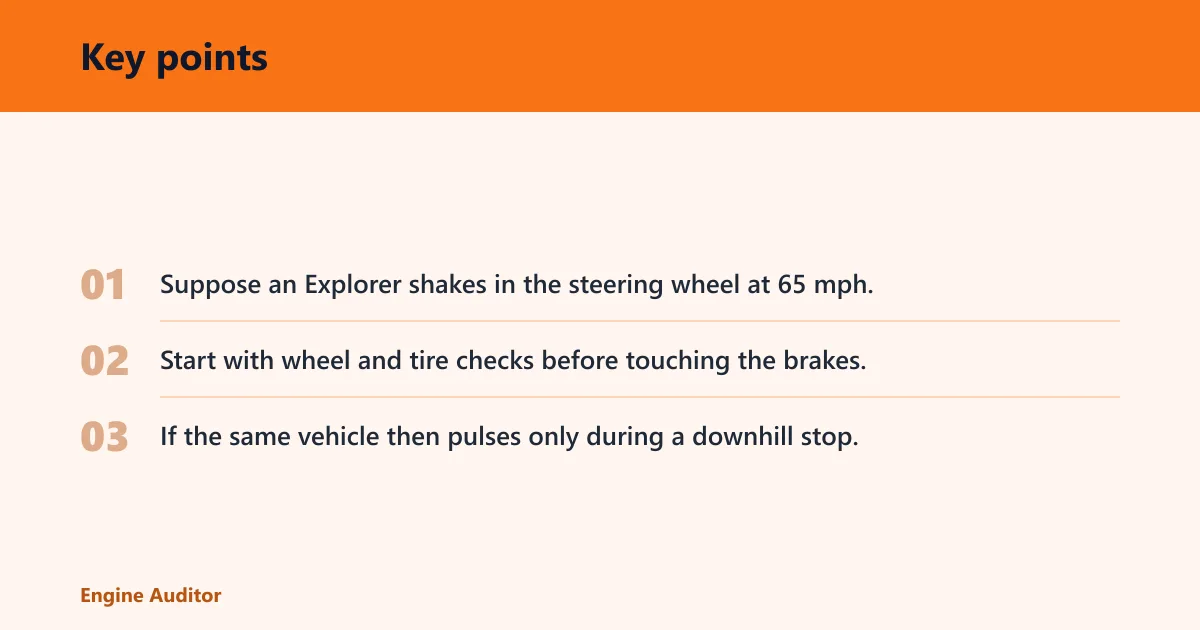
Suppose an Explorer shakes in the steering wheel at 65 mph, but the brake pedal feels normal. Start with wheel and tire checks before touching the brakes. If the same vehicle then pulses only during a downhill stop, the brake path moves to the front of the list.
Why does my Ford shake at highway speed?
Highway-speed shake usually points to the wheel and tire assembly first. On Ford cars, crossovers, and trucks, a balance problem often shows up in the 45–75 mph range, especially if the steering wheel trembles at a steady cruise. Bent wheels, uneven tire wear, and a tire with a shifted belt can produce the same symptom.
Wheel balance and road-force balance
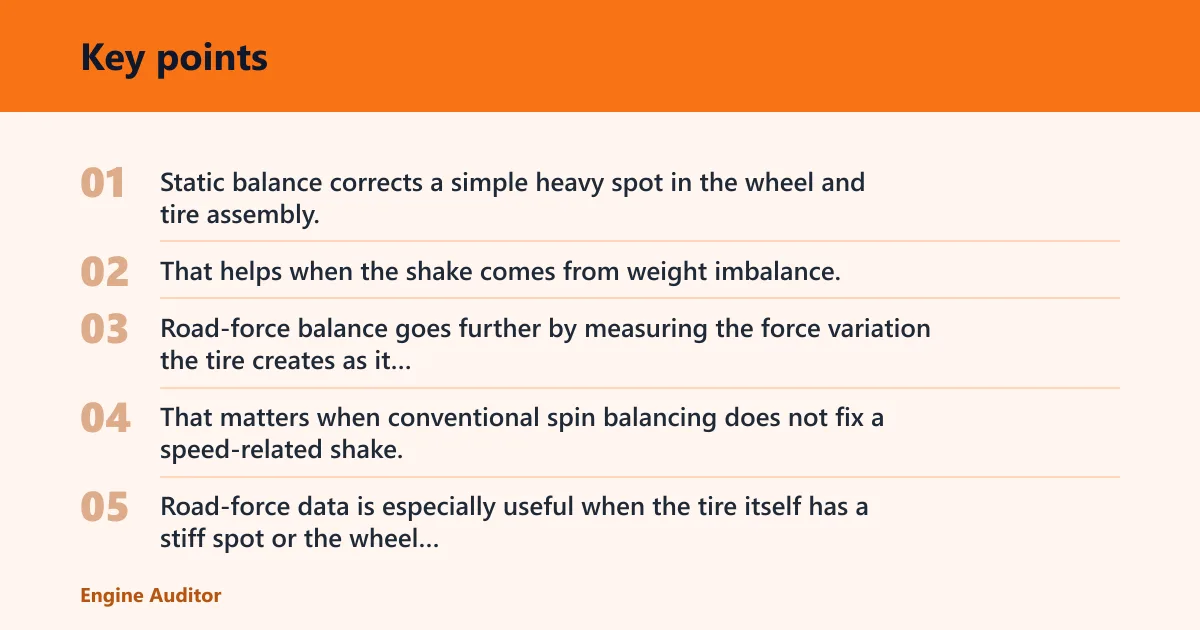
Static balance corrects a simple heavy spot in the wheel and tire assembly. That helps when the shake comes from weight imbalance, and it is usually done with balance weights on the wheel. Road-force balance goes further by measuring the force variation the tire creates as it rolls, often in pounds, and it can expose a tire that looks round in a static machine but still wobbles under load.
That matters when conventional spin balancing does not fix a speed-related shake. Road-force data is especially useful when the tire itself has a stiff spot or the wheel and tire do not match well as an assembly. The whole wheel-and-tire unit matters because the car feels the combined effect, not the parts separately.
Tire faults that mimic bad balance
Tread wear, cupping, and scalloping can create a rhythmic vibration that feels like a balance problem. An out-of-round tire or a separated belt can do the same thing, and a damaged tire may get louder as speed rises. Tire pressure also matters; most Fords list the recommended pressure on the door placard, and an underinflated or overinflated tire can make shake and wear worse.
A common first-timer mistake is to assume the steering wheel shake at 65 mph means the wheels are out of balance, when a separated tire belt is actually the real cause. If the tread has stepped wear or the sidewall has a bulge, balance weights will not cure it. The tire has to pass a visual check before anyone starts adding weight.
Bent wheels and missing weights
A bent wheel can cause vibration that a normal balance check may miss if the wheel is physically damaged. Missing balance weights are easier to spot, and they are a common cause of a new shake after tire service. If the vibration starts right after a rotation or tire replacement, ask the shop to verify the assembly, not just the tires by themselves.
Why does it shake only when braking?
Brake-only vibration usually points to the rotors, pads, or both. If the steering wheel or pedal pulses when you slow down but the car is smooth at cruise, the brake system moves to the top of the list. Tire balance does not usually create a vibration that appears only during braking.
Rotor runout and thickness variation
Rotor runout means the rotor face does not run perfectly true. Thickness variation means the rotor is not the same thickness all the way around. Either problem can create a brake pedal pulse and steering-wheel shake, and the symptom is often more obvious during gentle braking from city speeds or a longer highway stop.
Pad deposits and uneven wear
Brake pads can leave deposits on the rotor surface if the brakes have overheated or sat with a hot pad clamped to one spot. Those deposits can feel like warped rotor symptoms. Uneven pad wear can also make the brake pedal feel rough, and squeal can appear with the vibration if the pad hardware is worn or glazed.
Why this points away from tires is simple: a tire problem shows up while the car is rolling, not only when brake torque is applied. If the car is smooth when coasting but pulses under braking, the brake rotor measurement comes before any tire guesswork.
Which suspension parts should you inspect first?
Inspect the control arm bushings and ball joints first when the shake comes with wander, clunking, or steering looseness. Those parts can let the wheel change angle under load, which creates shimmy that feels like a balance fault. On Ford SUVs and trucks, worn suspension joints often show up as vague steering before they become a hard safety problem.
Control arm bushings
Control arm bushings can crack, tear, or soften with age. When that happens, the wheel can shift under braking or over bumps, which creates shimmy and a wandering feel on the highway. A visual inspection should look for splits, delamination, or grease leakage where the bushing should hold the arm steady.
Ball joints
Ball joint looseness can produce clunking over bumps, steering instability, and a shake that gets worse when the suspension loads up. This is safety-critical wear because the joint carries steering and suspension load at the same time. Any obvious looseness needs prompt attention, especially if the wheel also sits at a strange angle.
How worn suspension can mimic balance problems
Suspension wear does not always create a shake by itself. It can make the tire wear unevenly, and that uneven wear then creates a balance-like vibration. That is why a technician should inspect the suspension before condemning the tire again after a second balance job.
Could the wheel bearing, alignment, or axle be at fault?
Yes. Wheel bearings, alignment, and axle shafts can all create vibration, and Ford front-wheel-drive and all-wheel-drive models are especially worth checking if the symptom changes with load or cornering. If the shake shifts when you turn left or right, or it appears mostly under acceleration, do not stop at tires.
Wheel bearing play
A worn wheel bearing can growl, hum, or rumble, and the noise often changes when the vehicle is loaded in a turn. Play at the hub can let the wheel wobble enough to create vibration. That is one reason bearing checks belong early in the diagnostic order, not after the expensive parts have already been swapped.
Alignment angles
Toe, camber, and caster affect straight-line tracking and tire wear. A bad alignment does not always create a shake by itself, but it can cause pulling, wandering, and the tire wear patterns that lead to vibration later. Check alignment after tire work, suspension work, or any impact that may have bent a component.
Driveshaft and CV axle vibration
On FWD and AWD Ford models, a worn inner CV joint can create vibration under acceleration that fades on coast. A driveshaft fault on rear-wheel-drive trucks can do something similar at a certain speed band. These symptoms are usually load-dependent, which separates them from a simple wheel balance issue.
When is it unsafe to keep driving?
Stop driving and get it inspected immediately if the vibration is severe, the steering is hard to control, the car pulls sharply, a clunk accompanies the shake, or the brake pedal pulses so hard that stopping feels unstable. Mild speed-related vibration is one thing. Rapidly worsening shake or hub play is another.
What to stop for now versus later
- Stop now if a wheel feels loose, the vibration is violent, or a loud growl comes from one corner.
- Stop soon if the steering wheel shakes only at highway speed but the car remains controllable.
- Keep the trip short if brake pulsation is mild but repeatable.
- Do not keep driving on a tire with a bulge, exposed cord, or suspected belt separation.
What to tell the technician
Give the technician the exact symptom pattern: steering wheel, seat, floor, or brake pedal; cruising, braking, or acceleration; and the speed band where it starts. That lets the shop begin with the right inspection order: tire and wheel condition, balance and road-force data, brake rotor measurement, then suspension, bearing, and axle checks if the first steps do not explain it.
Picture a Fusion that shudders only at 62 mph and smooths out below 55 mph. That pattern fits a wheel and tire issue far better than a brake rotor problem. If the same car then pulses only on light braking, the rotor measurement should move to the front of the line.
Frequently asked questions
Why does my Ford vibrate at highway speed?
Highway-speed vibration usually comes from a wheel and tire problem first, especially if it shows up in the steering wheel between about 45 and 75 mph. Bent wheels, missing balance weights, cupped tires, and separated belts are common suspects. If the shake changes under acceleration, add axle or driveline checks.
How do I tell if the vibration is from tires, brakes, or suspension?
Use the trigger. Cruising vibration points to tires, wheels, bearings, or driveline parts. Brake-only pulse points to rotor runout, thickness variation, or pad deposits. Shimmy with wander, clunks, or steering looseness points toward control arm bushings, ball joints, or alignment issues. Where you feel the vibration matters too.
Can unbalanced tires cause shaking only at certain speeds?
Yes. That is one of the most common patterns. A tire and wheel assembly that is out of balance often shakes most in a narrow speed band, commonly around 45 to 75 mph. If the vibration disappears above or below that range, balance, bent wheel, or tire runout rises on the suspect list.
Can bent wheels or bad wheel bearings cause vibration on a Ford?
Yes. A bent wheel can mimic a balance problem, and a worn wheel bearing can create vibration along with a growl or hum that changes when the car corners. Bearing play is a safety issue if it is obvious. A wheel that wobbles by hand or grows noisy in turns needs prompt diagnosis.
What suspension parts should I inspect first for a Ford vibration?
Start with control arm bushings and ball joints. Look for cracked bushings, torn rubber, grease loss, clunking, looseness, and steering wander. Those parts can let the wheel move under load and create a shake that feels like a tire problem. If they are worn, an alignment check usually follows repair.
What should a mechanic check if the vibration is intermittent?
Ask for a symptom-based inspection: tire pressure, tread wear, wheel damage, balance weights, road-force variation, rotor runout, hub play, and axle or driveshaft looseness. Intermittent vibration often needs the road test note attached to the lift check, because load and speed can make the fault appear only under certain conditions.
Products related to this article
Sponsored / affiliate links. As an Amazon Associate I earn from qualifying purchases. I may earn additional commission from eligible campaigns.