Car starts then dies immediately: common causes and fixes
If a car starts then dies immediately, check the key, security light, and fuel prime first: a very quick shutoff often suggests immobilizer or fuel delivery, while dying after a few more seconds may point to air control or idle control. Skipping those checks can send you after the wrong parts and leave the fault untouched. This guide covers quick checks that can help separate security lockout, fuel starvation after prime, and idle-air faults.
This guide is part of our Vehicle troubleshooting guide series.
Why a car starts then dies immediately
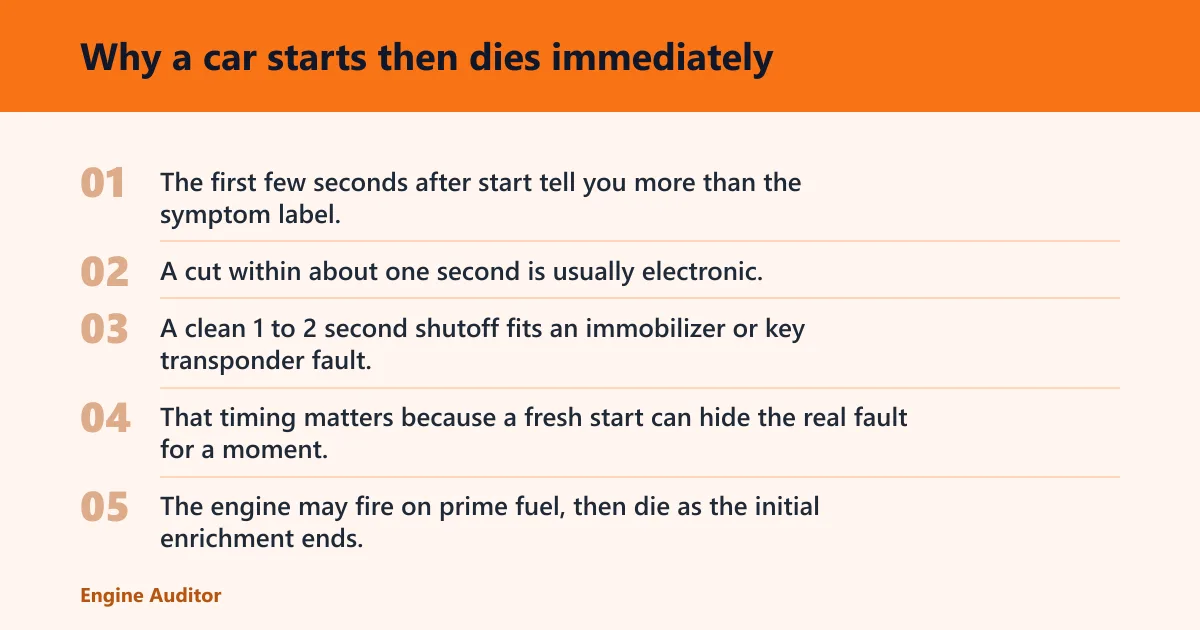


The first few seconds after start tell you more than the symptom label. A cut within about one second is usually electronic, while a stall after a few seconds usually means the engine fired, then lost air control, fuel pressure, or signal control as enrichment ended.
What the first few seconds of running tell you
Use stall timing as the first filter. A clean 1 to 2 second shutoff fits an immobilizer or key transponder fault; 2 to 4 seconds fits fuel pump, clogged filter, or weak relay problems; 5 to 10 seconds points more toward idle air control or throttle carbon; a stall on throttle tip-in points toward airflow metering or a major vacuum leak.
That timing matters because a fresh start can hide the real fault for a moment. The engine may fire on prime fuel, then die as the initial enrichment ends. That is why parts-swapping fails here.
Why stall timing matters more than the symptom name
“Starts then dies” can mean several systems failed in different ways. The timing separates a security lockout from fuel starvation, and both from idle-air failures. A rough rule: instant cutoff is usually electronic, a few seconds often means fuel delivery, and a stall at idle or when letting off the throttle often means air control.
Say your compact sedan starts for two seconds, idles once, then cuts completely with the security light flashing. That pattern points away from a dirty throttle body and toward anti-theft authorization. A different car that starts, runs eight seconds, then fades at a stop sign points much more toward idle-air control or vacuum leakage.
Could the immobilizer be shutting it off?
Yes. An immobilizer can let the engine fire, then cut injectors if the key or RFID handshake fails. Look for a security light or key icon, then try a spare key. On push-to-start systems, a weak key fob battery can affect authorization on some models.
Security light and key icon checks
Many vehicles use an engine immobilizer module with a key fob RFID chip. If the security handshake fails within two seconds, the ECM may cut injectors. VehicleRuns classifies 1 to 3 second stalling as a security or immobilizer pattern, and Car Repair Guru notes that a 1 to 2 second clean shutoff points to immobilizer or key transponder fault.
Watch the cluster closely. A security light staying on, flashing, or showing a key icon during the shutoff is a strong clue. If the engine starts and dies the same way each time, with no stumble or fuel fade, the security path moves up the list.
Spare key and key fob battery tests
Try a spare key first. That is the cleanest driveway test for a chipped-key or transponder issue. On push-to-start vehicles, a weak fob battery can matter, but the car may still authorize if the fob body is pressed directly against the start button area; Car Repair Guru advises that direct contact step for some systems.
Do not confuse a key battery issue with a dead immobilizer module. If the spare key works, the problem is usually in the original key or fob, not the engine.
2-second lockout patterns on push-to-start and keyed systems
A 2-second lockout is a useful clue. Some systems allow the engine to catch, then revoke fuel or ignition authorization almost immediately. If the dash lights behave normally but the engine dies with a near-instant cutoff, focus on the security light, key chip, and fob recognition before touching fuel parts.
Cost and risk box
- Low-cost checks: spare key, fob battery, cluster light review; usually low or no parts cost.
- Likely repair range: key reprogramming, key replacement, immobilizer diagnosis; often moderate.
- Risk if ignored: repeated no-start or stall in traffic, especially on push-to-start cars that cut without warning.
Is fuel delivery dropping out after prime?
It can be. Listen for the fuel pump prime near the rear seat at key-on, then watch whether the engine runs a few seconds and fades. A weak pump, bad relay, or clogged fuel filter can let the engine start on residual pressure, then starve it once the prime is used.
Fuel pump prime sound and relay checks
VehicleRuns lists listening for the fuel pump prime near the rear seat as a first check. If there is no prime sound, the pump relay, fuse, wiring, or pump itself moves up the list. If the prime is present but the engine dies after 2 to 4 seconds, Car Repair Guru treats that as a weak-pump, clogged-filter, or relay pattern.
A pump that runs but cannot hold pressure during start can fool you. The engine may catch on the first spray, then starve as pressure falls.
Fuel filter restriction and weak pump symptoms
A restricted fuel filter can act like a failed pump by limiting flow under load. Many modern vehicles no longer have a routine fuel-filter replacement interval at the same frequency as older cars, so service history matters. If the filter is serviceable and old, restriction belongs in the test plan before replacing the pump.
Weak-pump clues include long crank, a brief run, stumble under throttle, and repeatable die-off when demand rises. Cycling the key may produce a longer run because it refills pressure, but that is a clue, not a fix.
When cycling the key points to pressure loss
Will cycling the key help if fuel pressure is dropping? Yes, briefly. If a second or third key cycle lets the engine run a little longer, that points toward pressure bleed-down, a weak pump, or a relay that is not sustaining operation. It does not prove which part failed, so it should lead to a pressure test next.
Cost and risk box
- Low-cost checks: fuse, relay swap with same-type relay, fuel cap only if there are vapor issues; low cost.
- Likely repair range: pump relay, fuel filter, fuel pump, wiring repair; moderate to higher cost depending on access.
- Risk if ignored: sudden stall in traffic and hot restart failure if pressure keeps falling.
Could air metering or idle control be the problem?
Yes. A dirty throttle body, stuck idle air control valve, MAF contamination, or vacuum leak can let the engine fire and then die once the throttle closes. These faults often show up as stall at idle after startup, or a stall when the throttle is tipped in or released.
Dirty throttle body and idle air control valve faults
A dirty throttle body can cut idle airflow enough that the engine dies when you let off the throttle. Car Repair Guru says a 5 to 10 second hunt-and-die pattern points to a stuck IAC or throttle carbon. VehicleRuns also says holding the throttle slightly open can help identify idle-only stalling.
If the engine stays alive with light throttle but dies the moment the pedal is released, the idle-air side is suspect. That is a different pattern from a security lockout, which usually kills the engine before throttle input matters.
MAF contamination and throttle tip-in stalls
A contaminated mass air flow sensor can send airflow metering errors to the ECM. Car Repair Guru says an immediate stall on throttle input suggests MAF sensor trouble or a major vacuum leak. This often shows up as a stumble or die-off when the throttle is cracked open, not just at idle.
Do not start with MAF cleaning unless the timing fits. A MAF fault is a better match when the engine catches, responds poorly to throttle, and then shuts down as airflow changes.
Vacuum leaks at hoses, intake boots, and manifold seals
A vacuum leak is unmetered air entering the engine. Hissing near hoses, intake manifold joints, or intake boots can point to the leak. A major leak can make the mixture too lean to stay running, especially right after startup when the engine is relying on idle control to stabilize.
Can a vacuum leak make a car die right after starting? Yes. It is a major cause of lean stalling, especially when the engine starts but cannot hold a stable idle. That said, the timing still matters: a brief run with a hard stall on throttle change points more clearly than a vague lean complaint.
Cost and risk box
- Low-cost checks: throttle bore inspection, hose inspection, clamps, obvious boot splits; low to moderate.
- Likely repair range: throttle body cleaning, IAC service or replacement, vacuum hose repair; usually moderate.
- Risk if ignored: stalling at lights, rough idle, and lean running that can overheat the catalyst over time.
How do you rule out sensor or power faults?
Check for crankshaft position sensor dropout and basic power stability before swapping more parts. A bad crank signal can cause a sudden shutoff after the engine starts, while loose battery terminals or voltage drop can reset modules, flicker the dash, and imitate deeper faults.
Crankshaft position sensor signal loss
A crankshaft position sensor fault often causes sudden shutoff rather than a slow fade. The engine may start, then die without a fuel-starvation sound. Scan tool data or codes help here: a correlation between shutoff and crank sensor-related codes is more useful than guessing from the symptom alone.
If the engine dies hot, then restarts after cooling, a heat-related sensor dropout becomes more likely. If it fails only after heat soak, note that pattern before replacing anything.
Battery terminals, voltage drop, and dash reset clues
Loose battery terminals or poor cable connections can mimic engine control failure. Dash flicker, clock resets, and accessory dropout point to voltage instability. Check for terminal looseness and corrosion before blaming an expensive module.
Battery and cable faults can also confuse scan data and make relays chatter. If the electrical system resets during crank or right after start, solve that first.
Cost and risk box
- Low-cost checks: terminal tightness, cable cleanliness, battery voltage stability; usually low cost.
- Likely repair range: crank sensor replacement, harness repair, battery cable replacement; moderate.
- Risk if ignored: intermittent stall, no-start after heat soak, and misleading sensor codes.
Timing-based diagnostic matrix
This matrix turns stall timing into a test order. Start with the first confirmation test, then move to the next step only if the pattern points there. Do not swap parts just because a part is common. Fresh-start enrichment can hide the real cause for a few seconds.
| Stall timing | Most likely system | First confirmation test | No-parts-swap next step |
|---|---|---|---|
| 1 to 2 seconds, clean shutoff | Immobilizer or key transponder | Watch security light or key icon; try a spare key | Use scan data or dealer-level security diagnosis |
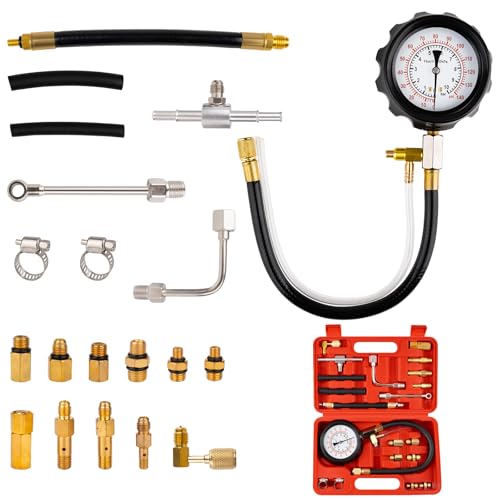
| 2 to 4 seconds, sputter then die | Fuel pump, relay, clogged filter | Listen for pump prime near rear seat | Fuel pressure test during start and key-on cycle |
| 5 to 10 seconds, hunt-and-die | Idle air control or throttle carbon | Hold throttle slightly open | Inspect throttle body and IAC passage for carbon |
| Stalls on throttle tip-in | MAF contamination or major vacuum leak | Check for hissing and inspect intake boots | Scan MAF data and smoke-test intake leaks |
| Sudden shutoff, hot or after heat soak | Crankshaft position sensor or power fault | Look for RPM drop to zero and scan codes | Check wiring, power, and sensor signal |
Cost-and-risk by branch
- Immobilizer: low-cost key checks first; repair can range from key programming to module work; risk is repeat stall or no-start.
- Fuel delivery: relay and filter checks are moderate; pump replacement is often higher; risk is traffic stall and fuel starvation under load.
- Idle-air and air metering: cleaning and hose repair are usually moderate; risk is repeated stall at stops and poor drivability.
- Sensor or power: diagnosis is often moderate; wiring or sensor repair varies; risk is unpredictable shutoff.
What should you check first in the driveway?
Start with the checks that split the fault into the right branch in under 10 minutes: security light, spare key, fuel pump prime, battery terminals, and a quick idle-air clue. Do not replace a pump, throttle body, or sensor before the timing points there. If the stall is immediate, prioritize immobilizer and security checks first.
A 10-minute order of checks
- Look for a security light or key icon during the stall.
- Try a spare key, or press the fob against the start button on push-to-start systems.
- Listen for fuel pump prime near the rear seat at key-on.
- Check battery terminals for looseness and corrosion.
- Try holding the throttle slightly open for idle-only stalls.
- Look and listen for vacuum leaks at hoses and intake joints.
- If available, read codes and live data before touching parts.
What not to replace before testing
A common first-timer mistake is buying a fuel pump because the engine ran for three seconds. That can be fresh-start enrichment, not proof of pump failure. The same caution applies to throttle bodies and MAF sensors. Timing and confirmation come first, because a wrong parts swap can hide the real fault.
When to stop driving and book a repair
Stop driving if the engine dies in traffic, if the battery light or security light appears with the stall, if repeated cycling makes the run time shorter, or if hot-soak stalls are getting worse. A fuel-pressure or security diagnosis is safer than hoping the issue passes.
Frequently asked questions
Why does my car start then die immediately?
An immediate start-then-die event usually points to immobilizer authorization, fuel delivery loss, or a major air/idle fault. The timing matters most: a shutoff in 1 to 3 seconds leans security or fuel, while a longer run that fades near idle leans throttle body, idle control, or a vacuum leak.
Can a bad key fob battery make a car start and then shut off?
Yes, on some push-to-start systems. A weak fob battery can prevent full authorization, though many vehicles still recognize the fob when it is placed close to the start button area. If the spare key works, the key or fob battery moves ahead of fuel or air faults.
How do I tell if it is the fuel pump or immobilizer?
Look at timing and clues. Immobilizer faults often cut the engine in 1 to 2 seconds with a security light or key icon. Fuel pump problems more often give 2 to 4 seconds of sputter, a failed pump prime, or a longer crank-and-die pattern that improves briefly after key cycling.
Can a dirty throttle body cause a car to start then die?
Yes. A dirty throttle body can reduce idle airflow enough that the engine starts and then dies when the throttle closes. That pattern is strongest when the car will stay running only with slight throttle input, or when it hunts and dies in the first 5 to 10 seconds.
Why does my car start for a few seconds and then stall?
That pattern often means the engine fired on prime fuel, then lost either pressure, idle control, or airflow metering. A few seconds of running fits weak fuel supply, a sticky idle air control valve, throttle carbon, or a major vacuum leak more than a pure key authorization failure.
Can a vacuum leak make a car die right after starting?
Yes. A large vacuum leak adds unmetered air and can make the mixture too lean to hold idle. Hissing at intake hoses, boots, or manifold seals is a useful clue. The engine may start, then die as soon as the throttle closes and idle control takes over.
Will cycling the key help if fuel pressure is dropping?
Sometimes for a moment. If the engine runs a little longer after repeated key-on cycles, that suggests pressure loss, a weak pump, or a relay issue. It is a diagnostic clue, not a repair, so the next step should be a fuel pressure test rather than more key cycling.
Products related to this article
Sponsored / affiliate links. As an Amazon Associate I earn from qualifying purchases. I may earn additional commission from eligible campaigns.