Engine Stalls at Idle: How to Find the Real Cause
Start by separating idle-only stall clues from load-related faults: a large vacuum leak, dirty throttle body, low fuel pressure, weak idle control, or misfire will usually leave a repeatable trace in live data. Guessing wrong wastes parts and can hide a lean or ignition fault until the engine dies in traffic. This guide gives a symptom-first path, scan-data checks, and simple tests to identify the real cause before you replace anything.
This guide is part of our Vehicle troubleshooting guide series.
Engine stalls at idle: start here

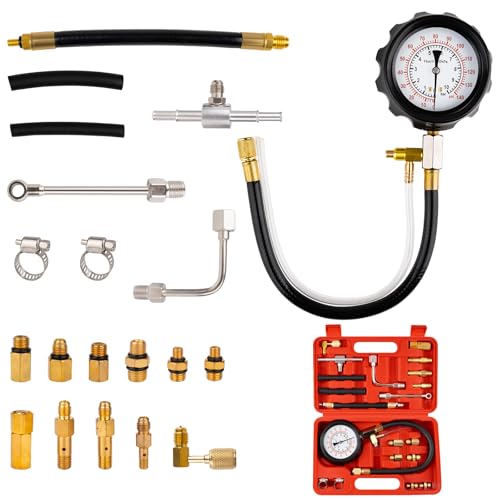
An engine that runs normally off-idle but dies at a stoplight is usually dealing with a low-airflow, low-load problem. At idle, there is little margin for error, so a small vacuum leak, dirty throttle bore, weak fuel supply, or sensor bias can push the mixture or airflow out of range.
That is why the same car may drive fine at cruise yet stall the moment the throttle closes. The fault can be present all the time and only matter at idle, or it can appear only with added load such as shift-to-gear or A/C engagement.
Why park, gear, AC, and decel clues matter
Use the situation when the stall happens as a filter. A stall in park points more toward airflow control, vacuum leak, MAF error, purge flow, or ECT bias. A stall only in gear points toward a low idle reserve, torque-converter load, or an idle speed that is already too low.
If the engine dies only with A/C on, the system may be fine at base idle but unable to recover when the compressor loads the engine. If it dies while rolling to a stop, look hard at throttle closing, decel fuel cut behavior, purge flow, and dirty throttle plates.
The first scan-data check
Scan for stored and pending OBD-II codes first, then check freeze-frame data, fuel trims, misfire counters, and live PIDs at warm idle. That tells you if the engine is lean, rich, misfiring, or simply failing to control idle airflow before you change parts.
Key live data often includes short-term fuel trim, long-term fuel trim, MAF grams per second, coolant temperature, throttle position, commanded idle speed, and misfire counts. The pattern matters more than any single number.
Idle stall diagnosis map
| Symptom pattern | Likely subsystem | Quick test | Confirming scan data | Next action |
|---|---|---|---|---|
| Stalls in park and in gear at warm idle | Vacuum leak, throttle body, MAF, purge valve | Inspect intake boots, PCV hoses, brake booster line; smoke test if available | Positive fuel trims at idle, trims improve off-idle | Fix leak path, then recheck trims before replacing sensors |
| Stalls in gear but not in park | Idle control weak, low idle reserve, torque load issue | Compare idle rpm in park versus drive with foot on brake | Idle target drops too low, IAC counts max out, throttle angle stays low | Clean throttle body, test IAC if equipped, inspect throttle adaptation |
| Stalls cold, then improves warm | ECT sensor, vacuum leak, cold enrichment error | Compare ECT to ambient before start | ECT reads hot on cold start or warms too slowly | Repair sensor circuit or thermostat issue if readings are implausible |
| Stalls warm after idling or in traffic | Purge valve, throttle body carbon, fuel pressure, coils | Pinch purge hose briefly; inspect throttle bore; check fuel pressure | Fuel trims swing lean, misfire counters rise, idle airflow falls | Test purge valve, clean throttle body, verify pressure to spec |
| Stalls when A/C turns on | Idle control, dirty throttle body, low fuel reserve | Turn A/C off and compare idle recovery | Commanded idle rises but actual rpm does not follow | Check throttle control, IAC function, and load response |
| Stalls during decel-to-stop | Throttle closing issue, purge valve, MAF bias, fuel cut logic | Watch rpm and throttle angle as you coast to a stop | Throttle angle sticks, trims swing, or airflow drops too far | Clean throttle body, test purge flow, verify MAF signal |
Is it an air leak or throttle issue?
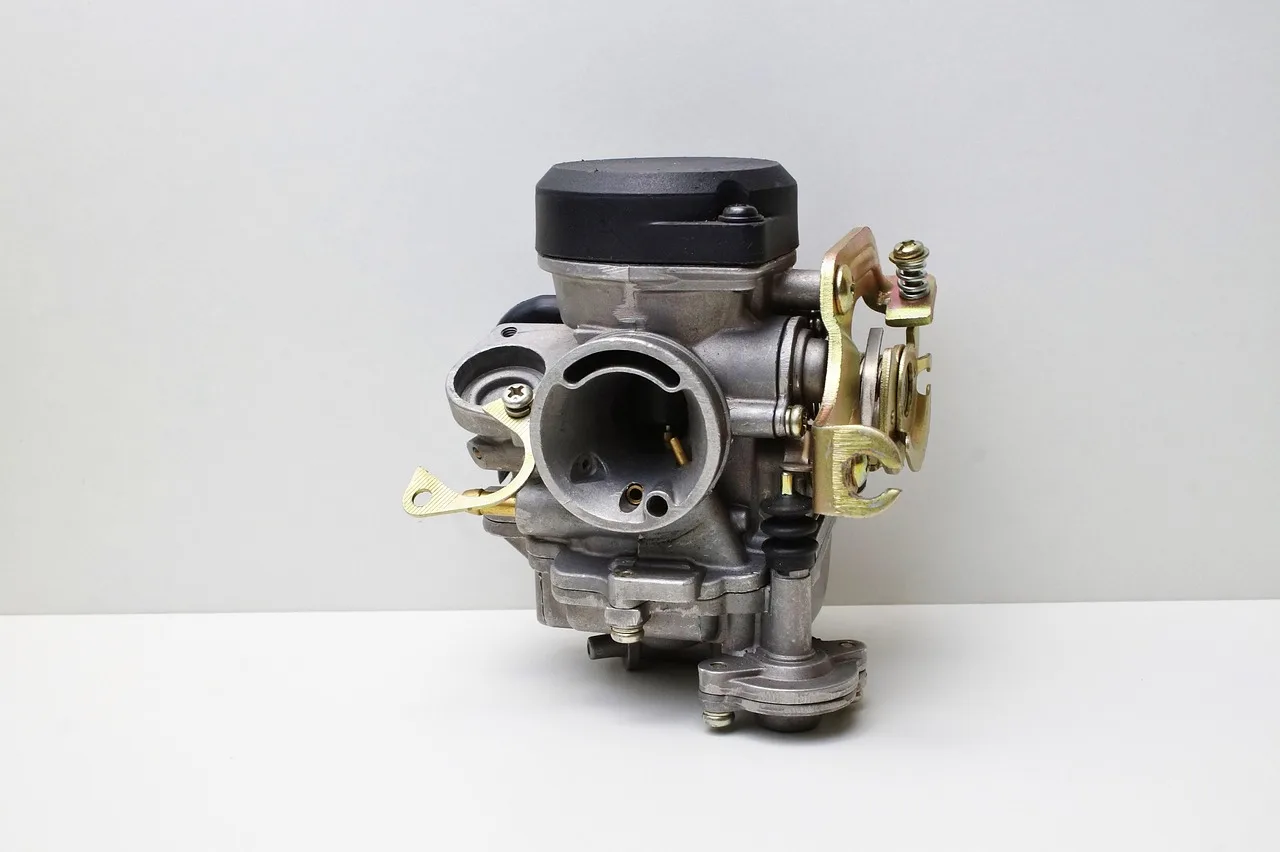
Start with air-related faults because they are common, easy to inspect, and often most visible at idle. Vacuum leaks, a dirty throttle body, a sticky throttle plate, or a weak idle control system can all create a stall only when the engine is trying to meter the smallest amount of air.
Vacuum leak priority points
Focus first on intake hoses, the intake boot, PCV plumbing, and the brake booster line. Those are the highest-value leak points for idle stall diagnosis because they can pull in unmetered air without causing a dramatic off-idle complaint.
Lean idle symptoms often include a rough idle, positive fuel trims, and a stall that improves as rpm rises. A smoke test gives the cleanest confirmation. A careful spray test can also help, but use caution around hot parts and ignition sources.
Picture an SUV that idles fine in park, then stumbles and dies in drive with the brakes applied. A split brake booster hose can look small and still create a large idle-only problem because the leak matters most when manifold vacuum is highest.
Throttle body carbon buildup and sticking plates
A dirty throttle body can make an engine stall at stoplights. Carbon around the blade or bore reduces idle airflow, and a sticking throttle plate can return too slowly when the pedal closes. This shows up on both drive-by-wire and cable systems.
Clean the throttle body before you replace it, then verify whether the plate moves freely. On electronic throttle systems, also watch for throttle angle, commanded idle, and adaptation or relearn concerns after cleaning.
IAC valve faults on older systems
If the vehicle is equipped with an idle air control valve, that part controls bypass air around the throttle plate. A stuck-open IAC can leave the idle too high and unstable; a stuck-closed unit can cause low idle or a stall. Older vehicles are more likely to use this setup.
On many older engines, the IAC can be checked with a scan tool, by watching commanded idle response, or by comparing idle quality with loads on and off. If the engine stalls as soon as accessories engage, an IAC that cannot add bypass air is a strong suspect.
PCV checks that matter at idle
A stuck PCV valve can act like a vacuum leak and admit unmetered air. Check the vacuum routing, look for collapsed or oil-soaked hoses, and use a simple shake or rattle check if the design allows it. Oil consumption clues can support the diagnosis.
If the PCV hose routing is wrong or a hose has softened and cracked, the engine may stall only at idle because that is when manifold vacuum is high enough to pull the leak open.
What sensor data points to idle stall?
Sensor faults at idle are often less about a single dead sensor and more about a reading that is plausible enough to fool the engine computer. The scan tool helps separate a real air or fuel fault from a sensor that is biasing the mixture only at low load.
MAF readings and contamination clues
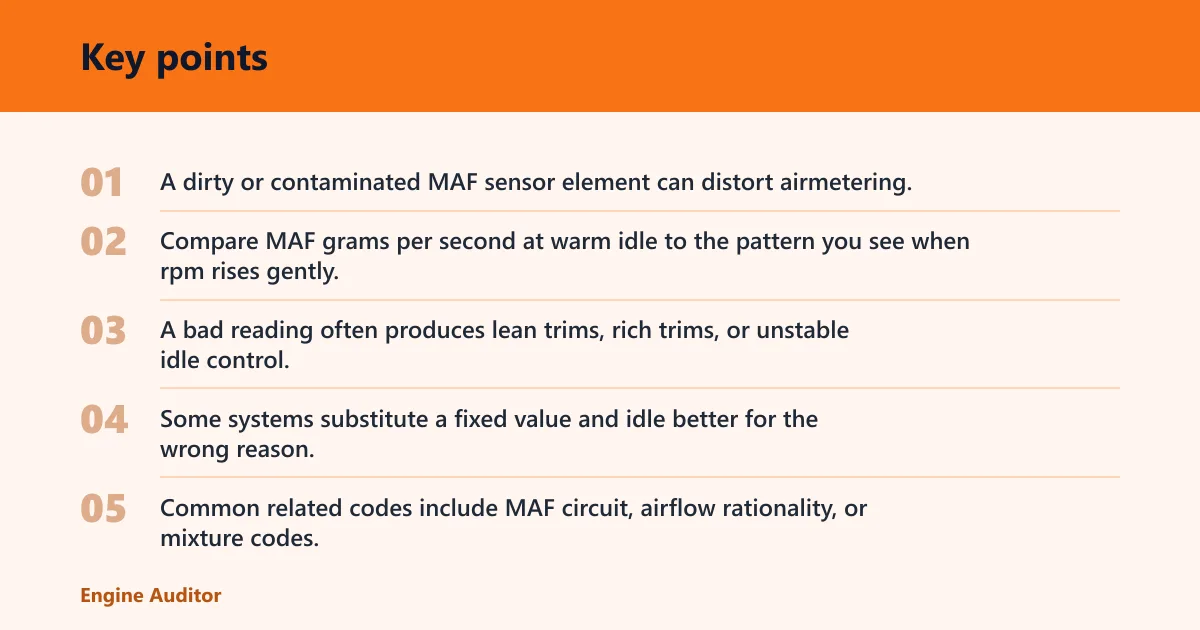
A dirty or contaminated MAF sensor element can distort airmetering, especially at idle where airflow is low and small errors matter more. Compare MAF grams per second at warm idle to the pattern you see when rpm rises gently. A bad reading often produces lean trims, rich trims, or unstable idle control.
The unplug test has limits. Some systems substitute a fixed value and idle better for the wrong reason, while others worsen immediately because the calibration is altered. Use the test only as a clue, not proof. Common related codes include MAF circuit, airflow rationality, or mixture codes.
ECT readings that skew cold or warm fueling
The engine coolant temperature sensor affects cold-start enrichment and warm idle fueling. If the ECT reads falsely hot on a cold engine, the mixture may be too lean to idle. If it reads falsely cold after warmup, fueling may stay too rich and the idle can load up or stall.
Compare ECT on a cold start with ambient temperature before the engine runs. A reading that is far off ambient, or one that changes erratically, deserves wiring and sensor checks before any part swap.
Purge valve behavior and fuel trim shifts
A stuck-open evaporative purge valve can be a hard-to-find intermittent stall source. Extra fuel vapor enters at idle, trims swing, and the fault may show up only after a warm soak or after the purge system starts flowing.
If pinching the purge hose or commanding purge closed changes the idle dramatically, the purge valve deserves attention. Do not replace it just because the engine stumbled once; confirm that purge flow is present when it should not be.
Why unplug tests can mislead
Unplugging a sensor can change the strategy enough to hide the real problem. A disconnected MAF, ECT, or purge circuit may push the computer into a backup mode that improves idle for a while without proving the original part was bad.
Use unplug tests only as one clue. Compare the live data first, then verify whether the symptom changes in the direction you expect. If the data makes no sense, fix wiring, grounds, or connector fit before replacing the sensor.
Could fuel pressure be the cause?
Yes. Fuel pressure problems can show up most clearly at idle, especially when the system is already marginal. Low pressure at idle can cause a lean stall, while a system that barely holds pressure can also stumble after hot soak or during decel-to-stop events.
Low pressure at idle versus under load
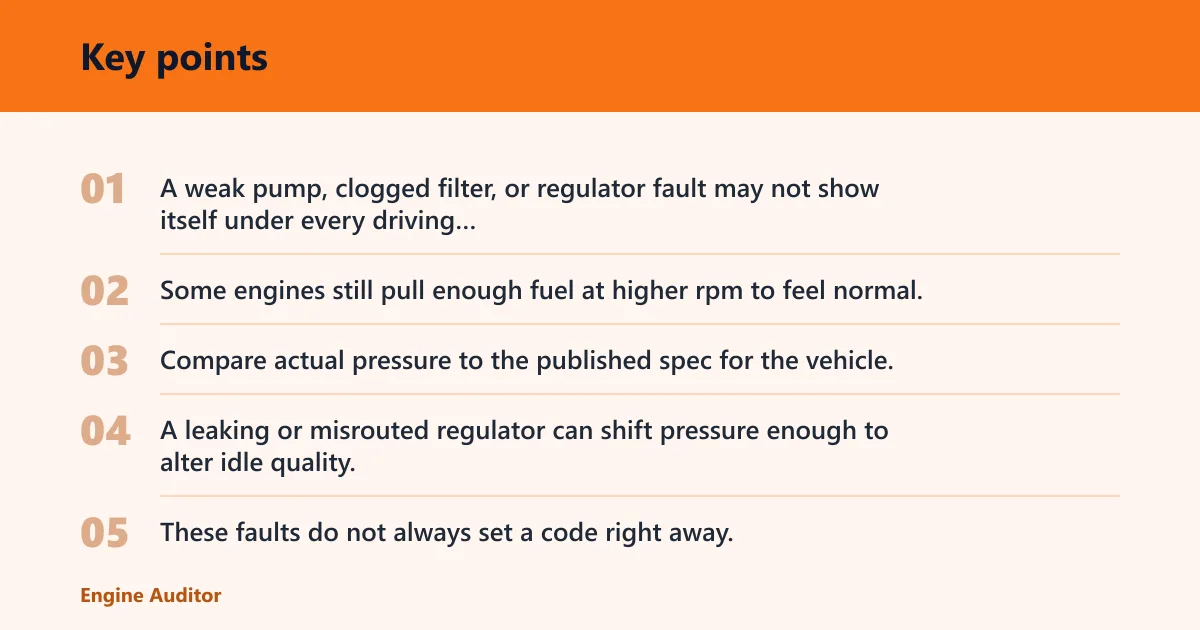
A weak pump, clogged filter, or regulator fault may not show itself under every driving condition. Some engines still pull enough fuel at higher rpm to feel normal, then die when the injector pulse width drops and the margin gets thin at idle.
That is why fuel pressure testing matters. Compare actual pressure to the published spec for the vehicle, and watch how pressure behaves with key on, engine running, and any vacuum reference attached if the regulator uses one.
Clogged filter, weak pump, and regulator faults
A restricted filter can starve the rail. A weak pump can sag after heat soak. A leaking or misrouted regulator can shift pressure enough to alter idle quality. These faults do not always set a code right away, so live pressure data or a gauge test is still useful.
If pressure is borderline rather than obviously low, test it under the conditions that trigger the stall. A car that idles normally in the bay may fail after a hot restart, during a slow stop, or with the A/C on.
What to do when pressure is borderline
Check power supply, grounds, filter condition, and fuel volume before replacing the pump. A borderline reading with no other clue should not send you straight to a fuel pump. Confirm the restriction or delivery loss first.
When spark or misfire is the problem
Ignition faults can cause idle stalls even when the car drives acceptably at speed. At idle, a worn plug, weak coil, or wiring issue can create a misfire that the engine can tolerate under load but not when rpm drops and airflow is low.
Plugs, coils, and wiring checks
Inspect spark plugs for wear, gap issues, oil fouling, and heat damage. Check coil boots, connectors, and wire routing. Loose connectors and poor grounds still matter, especially when the complaint is intermittent and tied to vibration or engine movement.
Load sensitivity helps here. A weak coil may misfire first at idle because spark demand is inconsistent and cylinder filling is uneven, then seem better at cruise. That pattern still counts as a fault.
Using misfire counters at idle
Watch misfire counters on the scan tool while the engine idles in park, then in gear if the stall can be safely reproduced. A rising count on one cylinder points you toward that cylinder’s plug, coil, injector, compression, or wiring before you blame a system-wide sensor fault.
A common first-timer mistake is swapping the spark plugs after a cold idle stumble, then finding the engine still dies every time it comes to a stop. If the misfire counter is climbing, the ignition system deserves attention before air control parts.
Why a car may drive fine and still stall at stoplights
Off-idle airflow and load can mask a weak spark event. Once the throttle closes and the engine drops to idle, that margin disappears. The result can be a car that cruises cleanly but dies at the first red light.
How do I tell if a vacuum leak is the real cause?
Look for idle-only lean signs, especially positive fuel trims that improve as rpm rises. Then inspect the most likely leak points first: intake hoses, intake boot, PCV plumbing, and the brake booster line. A smoke test gives the best confirmation; spray testing can help if used carefully.
What codes usually appear with idle stalling?
Common codes include lean mixture codes, MAF circuit or airflow rationality codes, purge flow codes, throttle body and idle control codes, ECT plausibility codes, and misfire codes. Pending codes matter because an intermittent stall may not set a hard code right away.
When is stalling at idle unsafe to keep driving?
Repeated stalls in traffic are unsafe, and any flashing check-engine light should be treated as an active misfire risk. If the engine dies in intersections, while merging, or whenever you shift into gear, limit driving until the cause is found. Tow it if the stall is frequent or unpredictable.
Frequently asked questions
Why does my engine stall only at idle but drive normally?
Idle leaves the smallest margin for error. A small vacuum leak, dirty throttle body, weak IAC or electronic throttle control, low fuel pressure, or a misfire may be harmless at cruise but enough to kill the engine once airflow and injector demand drop at a stop.
What sensors can cause stalling at idle?
Start with the MAF, ECT, purge valve control, and throttle position or throttle actuator data. A sensor does not need to fail completely to cause a stall; a biased reading at idle can skew fueling or airflow enough to shut the engine down.
Could fuel pressure problems show up only when the engine is idling?
Yes. A weak pump, restricted filter, or regulator issue can be most obvious at idle because the engine has little fuel-demand margin. Compare actual pressure to spec, then verify whether pressure drops when the stall happens or after a hot soak.
How do I test an idle air control valve or electronic throttle issue?
For an IAC-equipped engine, watch commanded versus actual idle response and check whether bypass air changes when loads switch on. For electronic throttle systems, clean the throttle bore, check for sticking, and verify adaptation or commanded throttle angle with the scan tool before replacing parts.
What if the engine stalls in gear but not in park?
That pattern points toward a weak idle reserve, dirty throttle body, IAC problem, or torque-load issue rather than a pure top-speed fuel or ignition fault. Compare rpm and scan data in park and in drive; the part that cannot add enough idle air is the best suspect.
Products related to this article
Sponsored / affiliate links. As an Amazon Associate I earn from qualifying purchases. I may earn additional commission from eligible campaigns.