Car Alignment After Hitting a Curb: Signs You Need It
If your steering wheel sits off-center, the car pulls, or the curb hit was hard enough to scuff the tire or wheel, book an alignment check. A sharp impact can also bend parts that an alignment cannot fix. Ignoring it can destroy tires quickly and hide suspension damage. This guide shows the fastest checks, the symptoms that point to alignment trouble, and the signs you need wheel or suspension inspection instead.
What a curb hit can damage first
The first concern is not alignment. It is tire and wheel damage. A hard curb strike can scuff the sidewall, crack or bend the rim, disturb bead sealing, or knock a suspension part out of position. Speed at impact matters. A slow roll over a curb usually causes less harm than a fast strike with the wheel turned.
Which wheel was struck also matters. A front wheel usually shows steering changes sooner because it guides the car. A rear wheel can still shift toe or camber and cause tire wear without an obvious steering change.
Impact severity and speed at impact
A light brush at parking speed often leaves cosmetic marks only. A hard hit, especially with the wheel turned, can sometimes move toe, bend a rim, or stress a tie rod or control arm. Repeated curb strikes raise the chance of cumulative damage, even if each hit felt minor on its own.
Why AWD, low-profile tires, and performance suspension deserve extra caution
AWD vehicles can hide a problem because they may still track straight while one corner is out of spec. Low-profile tires have less sidewall cushion, so they are more likely to suffer sidewall bulge or rim damage. Performance suspensions usually use stiffer parts and tighter tolerances, so a curb hit can show up quickly in steering feel or tire wear.
Can a curb hit knock alignment out of spec?
Yes. A curb impact can move wheel angles out of spec, most often toe and camber. Harder hits can also affect caster if the impact shifts suspension geometry or bends a part. The alignment numbers on a printout are the proof; a guess based on feel alone is not enough.
Toe, camber, and caster in plain terms
Toe is whether the tires point slightly inward or outward. Too much toe often causes squeal and rapid tire wear. Camber is the tire’s tilt inward or outward at the top, and it often shows up as inner-edge wear or outer-edge wear. Caster affects steering return and straight-line stability, and it is more likely to change after a harder impact.
Front-end alignment vs four-wheel alignment
A front-end alignment adjusts the front wheels only. A four-wheel alignment checks and adjusts all four corners when the rear suspension is adjustable or when the shop needs rear measurements to help set the front correctly. If the curb hit was on a rear wheel, a front-only check can miss the real problem.
Why an alignment printout matters
An alignment printout shows before-and-after values for toe, camber, and caster. That matters because the car can feel “fine” yet still be out of spec. If the shop does not provide numbers, you have no clear proof that the angles were checked and set within the maker’s range.
Curb alignment decision checklist
Use this text-only checklist right after the hit. It separates a mild scuff from a hit that needs more than an alignment. If you are unsure, choose the more cautious path.
| Path | What to inspect | Symptoms and thresholds | Best next move |
|---|---|---|---|
| Drive and monitor | Light cosmetic scuff only; tire holds pressure; no bulge; no rim bend; steering feels normal | No pull on a level road; wheel is centered; no noise or vibration; no fresh wear pattern | Check tire pressure again after 24 hours and watch for new wear or a slow leak |
| Book alignment soon | Visible curb mark on tire or wheel; mild steering change; car drifts slightly; no air loss | Off-center steering wheel; light pull left or right; faint squeal; uneven tire wear or feathering starting to appear | Schedule an alignment check and ask for a printout; inspect for bent rim or suspension play if symptoms persist |
| Stop driving and inspect now | Hard impact, repeated strikes, sidewall bulge, bead damage, bent rim, or air loss | Noise, vibration, steering shake, rapid pressure drop, strong pull, or a wheel that sits visibly crooked | Do not treat this as alignment-only damage; arrange wheel, tire, and suspension inspection before normal driving |
A common mistake is to assume a curb hit caused no damage because the wheel still points straight, even though the car now pulls slightly to one side. Say your front-right wheel clipped a curb at 15 mph, the steering wheel still feels centered, and the car tracks straight. A sidewall bulge on that tire still means stop and inspect now, because the tire can fail even when alignment symptoms are absent.
-
Check tire pressure first. Use a tire pressure gauge on all four tires, including the spare if the vehicle uses one. A sudden drop after the impact points to a leak or bead problem, not an alignment issue.
-
Inspect the sidewall closely. Look for bulges, cuts, cords, or a bubble near the scuffed area. A visible sidewall bulge usually suggests the tire casing is damaged, and the car should not be driven normally.
-
Look at the rim edge. Search for a bent lip, fresh gouges, or a wheel that no longer looks round. A bent rim can cause vibration and air loss that mimic alignment trouble.
-
Check steering feel. Start with the wheel centered on a straight road. If the vehicle drifts or pulls left or right, or the wheel sits off-center while driving straight, alignment damage becomes more likely.
-
Inspect tire wear pattern. Use a tread depth gauge or a close visual check for inner-edge wear, outer-edge wear, cupping, or feathering. Those patterns point to toe or camber problems that should be measured, not guessed.
What symptoms point to alignment damage?
The classic signs are steering wheel centering trouble, vehicle drift, pulling left or right, and uneven tire wear. After a curb hit, these symptoms mean the wheel angles may have moved. The more severe the hit, the less useful it is to “wait and see.”
Off-center steering wheel and vehicle drift
If the steering wheel is not centered when you are driving straight on a level road, toe may be off. If the car drifts without constant correction, one side’s alignment or suspension position may be changed. That does not prove the issue is only alignment, but it is enough to justify a check.
Pulling left or right on a level road
A strong pull can come from toe change, camber change, a damaged tire, or brake drag. Because several faults can cause the same symptom, a simple alignment alone is not the full answer if the pull starts right after a hard curb strike.
Uneven tire wear, inner-edge wear, outer-edge wear, cupping, and feathering
Inner-edge wear often points to too much negative camber or toe error. Outer-edge wear often follows positive camber or aggressive cornering forces. Cupping and feathering usually suggest the tire is not rolling straight or the suspension is moving in a way it should not.
Suppose the left-front tire starts squealing in low-speed turns after a curb hit and the tread looks more worn on the inner edge. That combination fits a geometry problem better than a balance problem, because balance affects vibration more than tire angle.
Is it safe to drive after hitting a curb hard?
Not always. If the hit was hard, if the tire is losing air, if the wheel is bent, or if the steering wheel suddenly feels different, stop driving and inspect now. A curb hit can turn into a tire failure or suspension failure before the next trip.
When to stop driving and inspect now
Stop immediately if you hear a new thump, see a sidewall bulge, notice rapid air loss, feel strong vibration, or see the wheel sitting crooked. Also stop after repeated curb strikes or any impact that forced the car up over the curb rather than just brushing it.
When to book alignment soon
Book an alignment soon if the hit was moderate, the tire and rim look intact, and the car still drives safely but now drifts, pulls, or shows a crooked wheel. That is the lane for a prompt check, not a delayed repair months later.
When you can drive and monitor
You can usually drive and monitor after a light scuff with no pressure loss, no vibration, no pull, and no visible damage. Recheck tire pressure after the tires cool, then watch for new wear or a slow leak over the next few days.
What else can mimic an alignment problem?
Several parts can produce the same symptoms as a bad alignment. A bent rim can cause vibration and a steering shimmy. A damaged tire can pull or thump. A bent tie rod, control arm, ball joint, strut, or subframe can change wheel position enough to look like an alignment fault.
Bent rim signs
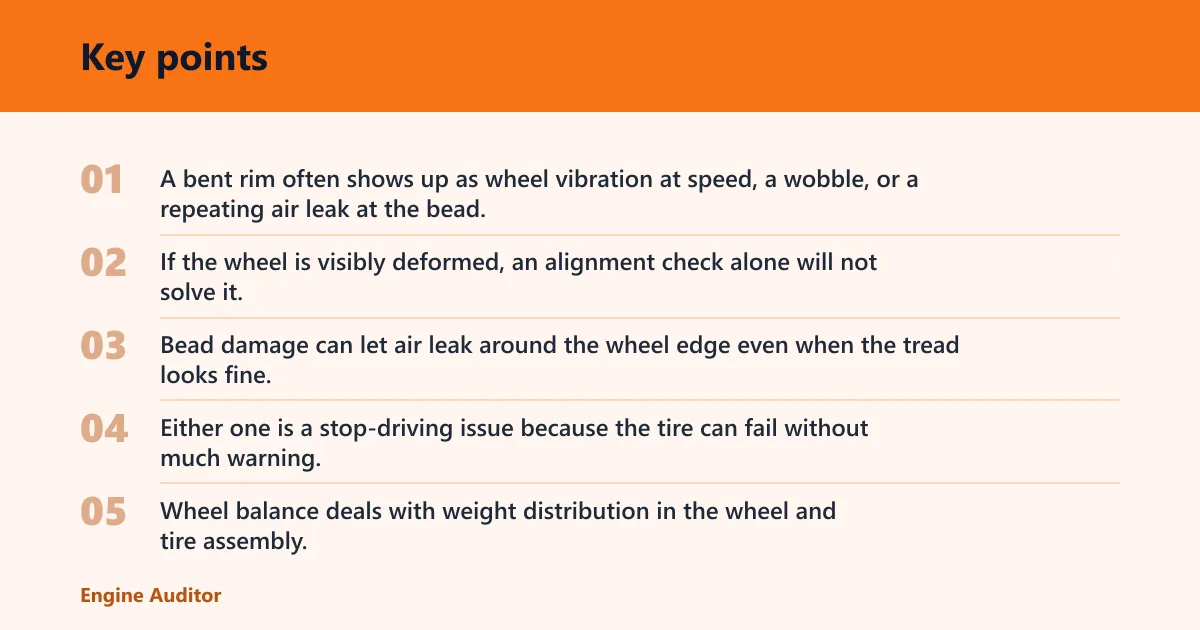
A bent rim often shows up as wheel vibration at speed, a wobble, or a repeating air leak at the bead. If the wheel is visibly deformed, an alignment check alone will not solve it.
Sidewall bulge, bead damage, and air loss
A sidewall bulge is a tire casing failure. Bead damage can let air leak around the wheel edge even when the tread looks fine. Either one is a stop-driving issue because the tire can fail without much warning.
Tie rod, control arm, ball joint, strut, and subframe damage
These parts hold the wheel in position. If a tie rod bends, the toe changes. If a control arm, ball joint, strut, or subframe shifts, the alignment numbers can move far enough that the car will not stay straight even after a basic alignment.
Why wheel balance is different from alignment
Wheel balance deals with weight distribution in the wheel and tire assembly. It helps reduce vibration. Alignment sets the wheel angles so the car tracks straight and the tires wear evenly. If the car pulls or the steering wheel is off-center after a curb hit, balance is not the default fix.
Picture a rear-wheel-drive coupe that clips a curb with the right-front wheel at low speed. If the steering wheel sits 10 degrees off-center afterward, the shop should check alignment and inspect the rim and suspension. If the wheel has a hop at 50 mph, balance may enter the picture too, but only after the tire and rim are proven sound.
How much does a wheel alignment cost after curb damage?
Cost varies by vehicle, shop, and whether you need a front-end or four-wheel alignment. A simple alignment check is usually far cheaper than replacing tires, a bent wheel, or suspension parts after you wait too long. If the curb hit was hard, asking for a check early is the cheaper move.
If the shop finds bent hardware or a damaged tire, the bill rises fast because the fix is no longer just an adjustment. That is why a printout and a hands-on inspection matter; they tell you whether the problem is angle, wheel damage, tire damage, or all three.
How can I tell if my car needs an alignment after hitting a curb?
If the steering wheel is off-center, the car pulls on a level road, or the tires start to wear unevenly after the hit, an alignment check is a good next step. Also inspect the tire and wheel first for bulges, air loss, or a bent rim, because those problems need different repairs.
Can hitting a curb knock my wheels out of alignment?
Yes. A curb impact can shift toe, camber, and sometimes caster, especially if the hit was hard or the wheel was turned. A front wheel often shows the change through steering pull, while a rear wheel may only show tire wear or a vehicle that no longer tracks straight.
What symptoms mean my alignment is off after a curb impact?
The main signs are a crooked steering wheel, drift, pulling left or right, and tire wear that looks uneven from one edge to the other. Squealing in turns, feathering on the tread, and cupping can also point to geometry trouble, though a bent rim or tire fault can look similar.
Do I need an alignment or a wheel balance after hitting a curb?
An alignment addresses steering pull, drift, and tire angle. Wheel balance addresses vibration from uneven weight in the wheel and tire assembly. After a curb hit, alignment is usually the first question. Balance matters if the wheel shakes at speed, but it does not correct a crooked steering wheel.
What should I inspect first after hitting a curb?
Start with tire pressure, then check the sidewall, rim edge, and bead area for bulges, cuts, dents, or air loss. After that, note any steering change, new vibration, or pull on a level road. Those first checks tell you whether it is safe to drive or whether you need immediate inspection.
Frequently asked questions
Can a curb hit damage the tire or wheel even if the car drives straight?
Yes. A tire can have bead damage or a sidewall bulge, and a wheel can be bent, while the car still feels mostly normal. That is why a straight drive does not clear the tire or wheel. Look for air loss, visible distortion, or a new vibration before deciding it is fine.
How long can I drive with a bad alignment after hitting a curb?
There is no safe mileage target to rely on. If the hit was hard, or if you notice pull, off-center steering, noise, vibration, or uneven wear, treat it as urgent. Even a short delay can scrub tires faster and let a bent or loose part get worse.
Products related to this article
Sponsored / affiliate links. As an Amazon Associate I earn from qualifying purchases. I may earn additional commission from eligible campaigns.