What Is Wheel Alignment and How Does It Affect Tires?
Wheel alignment sets toe, camber, and caster so the tires point and sit at the correct angles. If a car pulls, the steering wheel sits off-center, or tires wear on one edge, alignment is a likely cause. Left alone, it can wear tread quickly, reduce fuel economy, and make the car wander. This guide maps tire wear and driving symptoms to alignment, balance, pressure, and suspension fixes.
What wheel alignment does


Wheel alignment adjusts suspension geometry to the manufacturer’s specifications, not the tires themselves. That geometry sets how each tire meets the road, how the steering wheel centers, and how the car tracks in a straight line. Some vehicles need a two-wheel alignment, while others need a four-wheel alignment based on design.
Two-wheel vs four-wheel alignment
A two-wheel alignment is often called a front-end alignment, and it focuses on the front axle. A four-wheel alignment adjusts the front and rear wheels together, which matters on many cars with independent rear suspension or rear adjusters. The correct procedure depends on the vehicle, not a shop’s preference.
Why alignment affects tire contact and tread life
Proper alignment helps tires make full, even contact with the road surface. When the angles drift, one part of the tread carries more load and scrubs more often. Misalignment can shorten tire life by thousands of miles if left uncorrected, and that wear usually shows up before the tire reaches legal depth.
How does wheel alignment affect tire wear?
Wheel alignment changes how the tread meets the pavement. If camber tips the tire too far in or out, wear moves to one edge. If toe is off, the tire drags slightly as it rolls and can wear quickly across the full tread or develop feathering. Caster mainly changes steering feel.
Inner-edge wear and outer-edge wear
Camber is the inward or outward tilt of the tire when viewed from the front. Too much negative camber can wear the inner edge first, while too much positive camber can contribute to outer-edge wear first. If one side of the tread looks shaved while the rest still has depth, camber is a strong suspect.
Toe wear and feathering
Toe refers to the direction the tires point relative to each other when viewed from above. Toe misalignment can contribute to feathering and faster tread wear. It often creates feathering, where the tread blocks feel smooth in one direction and sharp in the other, plus rapid tread loss.
Caster and steering feel
Caster is the steering-axis tilt, and it affects steering stability and return to center. It does not usually create a clean wear pattern by itself the way toe or camber can. Instead, it often shows up as a car that feels darty, resists straight tracking, or does not self-center well after a turn.
Say your front tires have a sawtooth feel across the tread, and the steering wheel sits straight only on smooth pavement. That pattern points more toward toe than toward balance. If the inside and outside edges are also uneven, camber and toe may both need adjustment.
Which alignment angle is causing the symptom?
Start with the wear pattern, then match it to the angle most likely to create it. Camber changes edge wear. Toe changes how the tread scrubs and often causes feathering. Caster mainly changes how the wheel returns to center and how steady the car feels at speed.
Camber: wheel tilt from the front
Look at the wheel from the front of the car. If the top leans inward or outward too far, camber is out of range. That angle matters most when you see one-sided wear on the inner or outer edge, even if the steering wheel still feels centered.
Toe: tire direction from above
Look down at the tires from above. If they point slightly toward each other or away from each other too much, toe is off. Because toe drags the tire as it rolls, it can eat tread quickly and produce feathering long before the driver notices a strong pull.
Caster: steering stability and return to center
Caster is the angle of the steering axis, and it helps the wheels return to center after a turn. A caster problem usually shows up as poor straight-line stability, a wheel that does not return smoothly, or a car that feels nervous at highway speed rather than obvious edge wear.
Alignment symptom decoder
This table links the symptom you can see or feel to the angle most often involved. It also shows a quick driveway check so you can separate alignment from balancing, pressure errors, or worn suspension parts before you book a service.
| Symptom | Likely angle | Quick driveway check | More likely cause |
|---|---|---|---|
| Inner-edge wear on one or both front tires | Camber, sometimes toe | Run a hand across the tread and compare inner and outer edges | Alignment |
| Outer-edge wear on one tire | Camber | Check whether the outer shoulder is more worn than the center and inner edge | Alignment |
| Feathering across the tread blocks | Toe | Rub your hand across the tread in both directions; one direction feels sharper | Alignment |
| Pulling to one side with even tire pressure | Camber or toe | Check pressure in all tires and see whether the pull stays on a flat road | Alignment |
| Steering wheel off-center on a straight road | Toe | Notice whether the wheel sits crooked even though the car tracks straight | Alignment |
| Vibration at speed without edge wear | None of the alignment angles first | Check tire pressure and wheel balance before assuming alignment | Balance or tire pressure |
| Cupping or scalloping | Usually not alignment first | Inspect shocks, struts, and tire pressure; bounce wear often points to suspension | Suspension wear |
A common first-timer mistake is blaming alignment for every steering complaint. If the wheel shakes at 55 mph but the car tracks straight and the tread wears evenly, balancing is more likely than alignment. If the pull changes after one tire is inflated to the correct pressure, pressure was part of the problem.
How do you tell alignment from balance or pressure?
Wheel alignment and wheel balancing are different services. Alignment changes tracking angle and wheel position in space. Balancing corrects weight distribution in the tire-wheel assembly, and it addresses vibration, not tracking angle. Tire pressure can also mimic alignment trouble by changing how the car pulls and how the tread wears.
Wheel balancing vs wheel alignment
Balance problems usually show up as vibration in the steering wheel, seat, or floor at a certain speed. Alignment problems usually show up as pull, off-center steering, or edge wear. A car can need both services, but one does not replace the other.
Tire pressure checks that can mimic alignment trouble
Low pressure can make a tire wear faster at the shoulders and can make the car drift. Overinflation can wear the center more than the edges. Before assuming alignment, check all four tires cold with the pressure listed on the vehicle placard, then compare both front tires and both rear tires.
When vibration points to suspension wear instead
If the car still vibrates after balancing, the source may be a bent wheel, a bad tire, loose suspension parts, or worn bushings. Cupping or scalloping often points to shocks or struts that are no longer controlling wheel motion. Alignment can be part of the fix, but it is not the first answer to every vibration.
What happens during a wheel alignment?
During a wheel alignment, the technician checks the current angles against manufacturer specifications, inspects for worn parts that could prevent correct settings, and then adjusts what the vehicle allows. The service may include front only or all four wheels. It should not be a blind adjustment without inspection.
What a technician checks before adjusting angles
A proper check starts with tire pressure, tire condition, wheel damage, and suspension play. Ball joints, tie-rod ends, control-arm bushings, struts, and steering parts all affect whether the car can hold an alignment. If parts are loose or bent, the angles may not stay in spec.
What gets adjusted and what does not
The technician adjusts suspension geometry, not the tire carcass itself. Alignment changes camber, toe, and sometimes caster within the vehicle’s available range. It does not fix a bent wheel, worn shocks, a separated tire belt, or a failed suspension joint, and it does not replace balancing.
What to expect after the service
After the service, the steering wheel should sit closer to center, the car should track straighter, and the tires should contact the road more evenly. Some vehicles need a road test and a printout of the before-and-after angles. If a worn part is still present, the symptom may return quickly.
- Confirm the tire pressures match the placard.
- Inspect tread for inner-edge wear, outer-edge wear, feathering, or cupping.
- Look for bent wheels, loose steering parts, or uneven ride height.
- Request the correct alignment type for the vehicle, front-end or four-wheel.
- Ask for a before-and-after printout of the measured angles.
When should you get an alignment?
Get an alignment after pothole or curb impacts, after suspension or steering work, when installing new tires, or when uneven wear appears. Annual alignment inspection is also recommended even if no symptoms appear. You do not need to wait for a loud clunk or obvious pull before checking it.
After potholes, curbs, and impact events
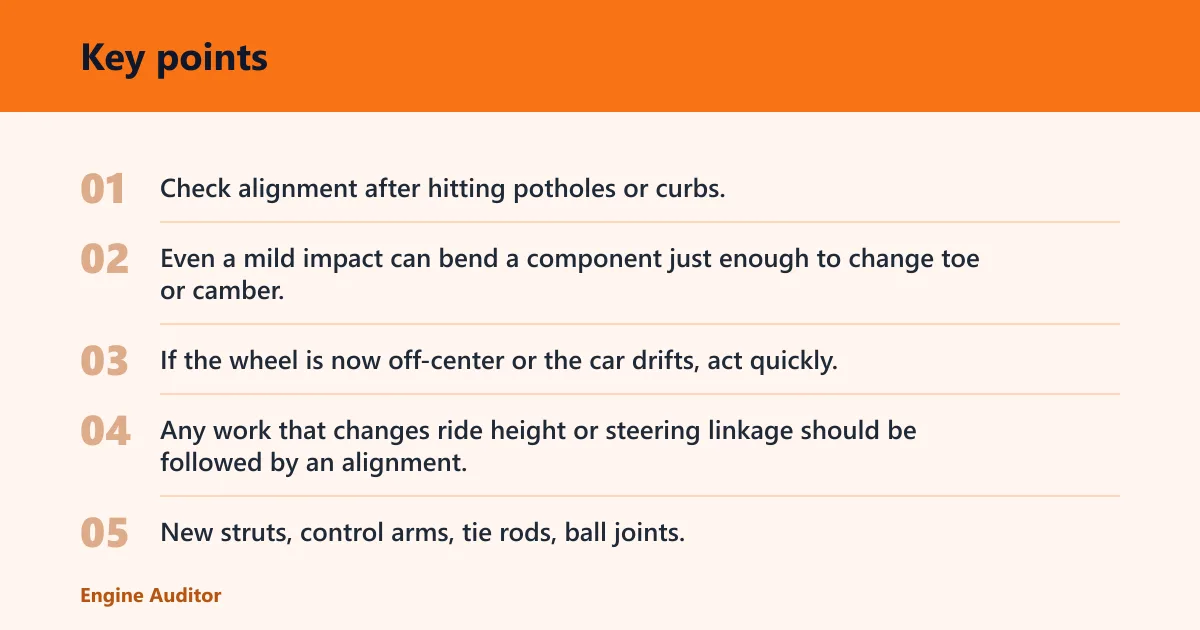
Check alignment after hitting potholes or curbs, because a sudden hit can shift suspension geometry without obvious body damage. Even a mild impact can bend a component just enough to change toe or camber. If the wheel is now off-center or the car drifts, act quickly.
After suspension repairs or steering work
Any work that changes ride height or steering linkage should be followed by an alignment. New struts, control arms, tie rods, ball joints, or steering racks can alter the original angles. If the shop replaces a worn part and skips the alignment, the old wear pattern can continue.
With new tires or uneven wear
New tires are a smart time to check alignment because fresh tread can disappear quickly if the geometry is off. If the old tires wore on one edge, the new set may repeat the same damage. Alignment is also worth checking if you rotate tires and the wear pattern stays on the same corner.
Suppose a front-wheel-drive sedan gets a right-front pothole hit and then drives straight with no visible damage. That car may still need an alignment because the front wheels do most of the driving and steering work, so a small toe change can show up as rapid wear before the driver notices a strong pull.
Vehicle-type differences: front-wheel-drive, rear-wheel-drive, and all-wheel-drive
Front-wheel-drive vehicles often show front tire wear first because the front tires steer and drive. Rear-wheel-drive vehicles may wear the rear tires differently, especially if the rear suspension carries the geometry problem. All-wheel-drive vehicles can be more sensitive to uneven tire size and wear, so matching tire condition matters before and after alignment.
Impact event quick checks
This mini-table helps you choose the next step after a common trigger. If the event happened and the steering changed, do not wait for the wear to become visible. If the event happened but the car still feels normal, an inspection is still the safer call.
| Event | Recommended next action | Urgency |
|---|---|---|
| Pothole | Check tire pressure, wheel condition, and alignment | Same week |
| Curb strike | Inspect for tire damage, bent wheel, and steering pull; schedule alignment | Immediately if the wheel is off-center or the car drifts |
| New tires | Request an alignment check before the tread starts to wear unevenly | At installation or soon after |
Frequently asked questions
What is wheel alignment?
Wheel alignment is the adjustment of suspension angles so the wheels meet manufacturer specifications. It changes how the tires sit and point, which affects tracking, steering wheel centering, and tire wear. It does not repair damaged tires, and it does not correct vibration caused by unbalanced wheels.
How does tire alignment work?
Tire alignment works by measuring camber, toe, and caster, then adjusting the suspension until those angles fall within spec. The technician uses the vehicle’s designed adjustment points, which may differ by model. Some vehicles need a front-end service, while others require a four-wheel procedure.
What is the difference between wheel alignment vs wheel balance?
Alignment changes where the wheels point and how they sit. Balancing corrects uneven weight distribution in the tire-wheel assembly. Alignment problems usually cause pull, off-center steering, and edge wear, while balance problems usually cause speed-related vibration. They are separate services, though a car may need both.
What is the difference between tire rotation vs wheel alignment?
Tire rotation moves tires to different positions so wear evens out across the set. Alignment changes the suspension geometry that created the wear in the first place. Rotation can spread wear more evenly for a while, but it does not fix toe, camber, or caster problems.
When should I get a wheel alignment after hitting a curb?
Get it checked right after a curb hit if the steering wheel turns off-center, the car pulls, or a tire looks damaged. Even if the car still drives straight, the impact can shift toe or camber enough to shorten tire life. A quick inspection is worth it.
Products related to this article
Sponsored / affiliate links. As an Amazon Associate I earn from qualifying purchases. I may earn additional commission from eligible campaigns.