How to Make Your Car Battery Last Longer
To help a 12V car battery last longer, keep it charged, limit repeated short trips, and fix charging or parasitic-draw problems early; consider replacement if it repeatedly drops below about 12.4 volts or struggles after charging. Ignore those habits and you risk slow cranking, dead-starts, and an expensive tow. This guide covers the few maintenance steps that matter and how to tell battery wear from alternator or drain issues.
What shortens a 12V battery?

- No multimeter required for setup
- Pull fuses and watch the current drop
- Shows voltage and current directly
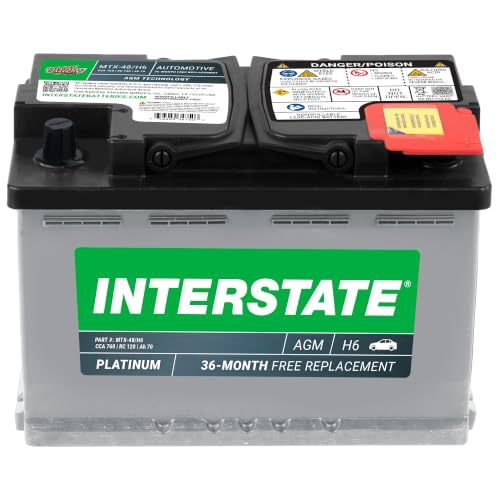
A 12V starter battery is typically a lead-acid battery. Its main job is to start the engine and run accessories when the engine is off. Heat, vibration, repeated deep discharge, and standby drain shorten life. Most batteries age out first, then fail. Typical service life is often in the 3-5 year range, though climate and use pattern can move that up or down (Consumer Reports, AAA, and most major battery makers give similar guidance).
How long should a car battery last?
For a standard 12V starter battery, “how long it lasts” is usually a question of wear plus usage pattern, not mileage alone. A battery can weaken early if it is repeatedly left partly discharged, exposed to high heat, or asked to recover from lots of short trips. That is why a 4-year-old battery may still test well while a newer one can fail early under harsh conditions.
Battery state of charge means how full the battery is compared with its usable capacity. A fully charged lead-acid battery typically reads around 12.6 volts at rest, while roughly 12.4 volts suggests the battery is partly discharged and may need charging soon rather than immediate replacement. Voltage alone is only a rough snapshot; a load test matters more when the battery is weak under starting demand. That is the point where a battery can look “okay” at rest but still fail when the starter draws current.
What you’ll need
- Battery terminal brush or cable brush
- Protective gloves and eye protection
- Smart battery maintainer for stored vehicles
- Basic multimeter or scan tool for quick checks
- Access to a load test at a parts store or repair shop
What habits help a 12V battery last longer?
The biggest battery-saving habits are simple: keep the battery charged, avoid deep discharge, and reduce the time the car spends sitting. A healthy charging pattern is more important than trying to “baby” the battery in any other way.
How to keep charge up
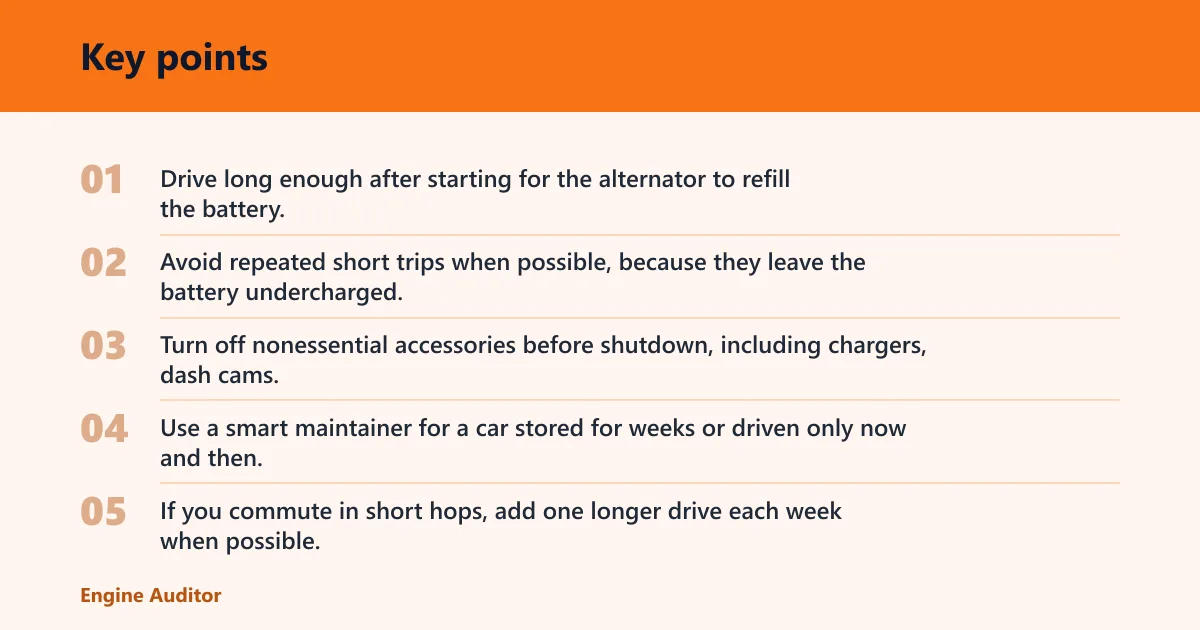
- Drive long enough after starting for the alternator to refill the battery.
- Avoid repeated short trips when possible, because they leave the battery undercharged.
- Turn off nonessential accessories before shutdown, including chargers, dash cams, and cabin lights.
- Use a smart maintainer for a car stored for weeks or driven only now and then.
Battery state of charge matters because low charge raises sulfation risk in lead-acid batteries. A battery that stays partly discharged for long periods wears faster than one that is kept charged as often as practical.
Short trips are the classic battery killer because they use more starting energy than they return. The battery gives power to crank the engine, then the drive ends before the system has enough time to replenish that energy. Stop-start traffic can be harder on the battery than regular highway use because restarts add load while charging time stays limited.
Picture a car that is driven for about 8 minutes to work and about 8 minutes home, rather than for a longer steady-speed drive. That pattern is far tougher on the battery than a 40-minute drive at steady speed. The difference is recharge time, not miles alone.
Use these habits for common driver patterns
- If you commute in short hops, add one longer drive each week when possible.
- If the car sits for days, connect a compatible smart maintainer instead of letting it drift down.
- If winter or heat is extreme, expect weaker cranking and plan for extra charging care.
- If the car is stored seasonally, disconnect only if the owner manual allows it and the battery setup supports it.
Extreme heat speeds battery wear. Cold reduces cranking performance, especially when the battery is already partially discharged. Parking in shade or a garage helps limit temperature swings, which matter most for older batteries. For more on cold-weather starting, see engineauditor.com/cold-weather-car-battery/.
What signs point to charging, drain, or battery trouble?
Corrosion at the terminals raises resistance. Loose cable connections reduce starting power. Cleaning the terminals helps charge transfer, but that fix only helps if the connection is the problem.
- Turn the vehicle off and inspect the terminals for white, blue, or green buildup.
- Clean the terminals with a brush, then tighten the cable clamps so they do not twist by hand.
- Check for warning lights, dimming, or repeated low-voltage starts that point to charging trouble.
- Have the charging system checked if the battery keeps going flat after normal driving.
The alternator should charge the battery while driving. Undercharging or overcharging can shorten battery life. A failing alternator can also look like a bad battery, so do not replace the battery first if the car keeps losing charge soon after a drive. Basic alternator checks start with battery voltage at rest and then voltage with the engine running; if charging voltage stays too low or too high, the alternator or regulator may be the issue rather than the battery.
When standby drain is the real problem
Some vehicles draw power while parked. Keyless entry, dash cams, phone chargers, and aftermarket accessories can flatten a battery if the draw is excessive. That needs a parasitic current test, not guesswork. If the battery dies after sitting but starts normally after charging, the battery may be getting drained rather than simply worn out.
Suppose a sedan starts fine on Friday, sits until Monday, and then needs a jump. If the battery and alternator test out, the next step is a parasitic drain check. The battery is often just the part that gets drained first.
How do you test a battery before replacing it?
Testing works best in layers: check state of charge, inspect the connections, then use a load test if the battery is weak or the problem keeps returning. Resting voltage can tell you whether the battery is charged, but it cannot prove the battery can supply current under load.
As a rule of thumb, about 12.4 volts at rest suggests a partially charged battery, not necessarily a failed one. If the car starts slowly, the battery is older, or the battery keeps going flat after normal use, a load test is the more useful next step. A weak load-test result is a stronger reason to replace than voltage alone.
Age also matters. Batteries in the 3-5 year range deserve closer attention, especially if starting gets slower in hot weather or after the car sits. If the battery is older and the test is weak, replacement is usually the practical answer. If it still passes, the real issue may be charging, drain, or driving pattern.
Car battery decision table
| Symptom | Likely cause | Quick check | Next step | Use a maintainer, get a load test, or replace? |
|---|---|---|---|---|
| No-start after sitting | Parasitic drain, weak charge, or an aging battery | Measure resting voltage, then try a known-good jump and watch whether it restarts after a short drive | Check for standby draw if it goes flat again after sitting | Use a maintainer for storage; get a load test if the battery is not old; replace if it fails the test |
| Slow cranking | Low state of charge, terminal corrosion, weak battery, or charging fault | Inspect and clean terminals, then retest starting | Check alternator output and battery condition | Get a load test; replace only if the battery fails or keeps slipping after charging |
| Repeated jump-starts | Battery wear, undercharging, or parasitic drain | See whether the car starts normally after a full charge and a longer drive | Diagnose the charging system and standby draw before buying a new battery | Get a load test; use a maintainer if the car sits; replace if test results and symptoms line up |
| Battery older than 3-5 years | Normal wear is likely adding up | Ask for a load test rather than relying on voltage alone | Replace if capacity is low or the battery no longer holds charge after a proper drive | Get a load test first; replace if the test is weak or failure is recurring |
| Corrosion at terminals | High resistance at the connection | Clean the posts and clamps, then tighten them | Retest starting and charging before assuming battery failure | Do not replace first; use a maintainer only if the car also sits for long periods |
| Car driven infrequently | Battery not fully recharging between uses | Check how long it sits between starts | Use a smart maintainer if the car is parked for weeks | Use a maintainer; get a load test if charging still seems weak; replace only if it fails the test |
EVs and hybrids: why the advice is different
Electric vehicles and hybrids have a different battery setup, so the starter-battery advice above does not apply the same way. EVs use a large traction battery for propulsion, while most still also have a separate 12V battery for computers, locks, lights, and accessory power. Hybrids also combine a traction battery with a 12V system, so a no-start can still come from the small 12V battery even if the high-voltage battery is healthy.
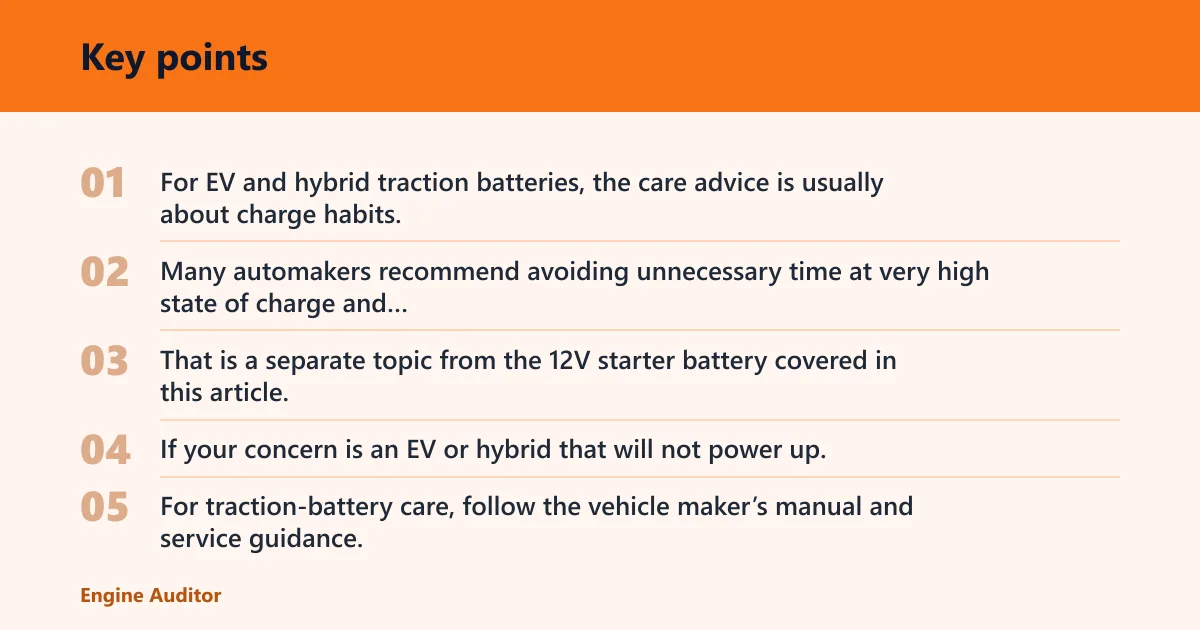
For EV and hybrid traction batteries, the care advice is usually about charge habits, heat management, and following the manufacturer’s guidance for storage and daily charging. Many automakers recommend avoiding unnecessary time at very high state of charge and avoiding long-term storage at very low state of charge. That is a separate topic from the 12V starter battery covered in this article.
If your concern is an EV or hybrid that will not power up, it is worth checking whether the 12V system is weak before assuming the traction battery has failed. For traction-battery care, follow the vehicle maker’s manual and service guidance; for the 12V side, use the same charge-maintenance and parasitic-draw checks described above.
Frequently asked questions
How long do a car battery last?
Most 12V starter batteries last several years, but age depends on heat, driving pattern, and how often the battery is deeply discharged. A battery in a hot climate with many short trips usually ages faster than one that gets regular charging and moderate use.
What to do to make my battery last longer
Use the car often enough to recharge it, keep the terminals clean, and stop unnecessary parasitic draw from chargers or add-on gear. If the car sits for weeks, connect a compatible smart maintainer. If it still goes flat, ask for a parasitic current test.
Can a car battery last for 10 years?
It can happen, but it is uncommon for a typical 12V starter battery. Heat, vibration, short trips, and standby drain usually wear the battery out earlier. If a battery is approaching that age, test it rather than assuming it still has useful reserve.
Why do car batteries last so long?
They last longer when the car is driven regularly, kept charged, and protected from heat and drain. Lead-acid batteries do best when they are not left partly discharged for long periods. Good charging habits matter more than mileage alone.
My car battery is dead, what should I do?
If the battery is dead, start with the simplest safe checks: verify the terminals are tight and clean, try a jump only if you know the vehicle’s jump-start procedure, and then determine whether the battery recharges and stays charged. If it dies again after a normal drive or after sitting, the issue may be battery age, alternator output, or parasitic drain. If the battery is old and fails a load test, replacement is usually the right move.
What about RC car batteries?
RC car batteries are a different topic. They are usually lithium-based or nickel-based packs, not 12V starter batteries, and they use different charging rules, storage habits, and failure signs. The advice in this article is for automotive 12V starter batteries and, separately, the 12V systems in EVs and hybrids.
Products related to this article
Sponsored / affiliate links. As an Amazon Associate I earn from qualifying purchases. I may earn additional commission from eligible campaigns.