How to Store a Car for Weeks or Months Without Damage
This article emphasizes manufacturer guidance first, because storage instructions vary by model, battery type, and climate.
For storage under 4 weeks, charge the battery fully, set tire pressure to the door placard, close the fuel cap, and park in a dry, covered spot; past 4 weeks, add a maintainer, protect the fuel system, and block moisture and pests. Skip those steps and you risk a dead battery, flat spots, stale fuel, corrosion, and a no-start when you return. This guide splits weeks vs. months storage by vehicle type and gives an essential-first checklist for gas, diesel, hybrid, EV, motorcycle, and classic cars.
For owner-specific exceptions, check your owner’s manual before you disconnect anything or set a storage charge level. Manufacturers can override the general rules below for battery management, parking-brake use, hybrid/EV state of charge, and storage intervals. See also our battery maintainer selection guide, fuel stabilizer guide, tire flat-spot prevention guide, rodent-proofing a garage, brake fluid basics, EV storage tips, and restart checklist.
What you’ll need
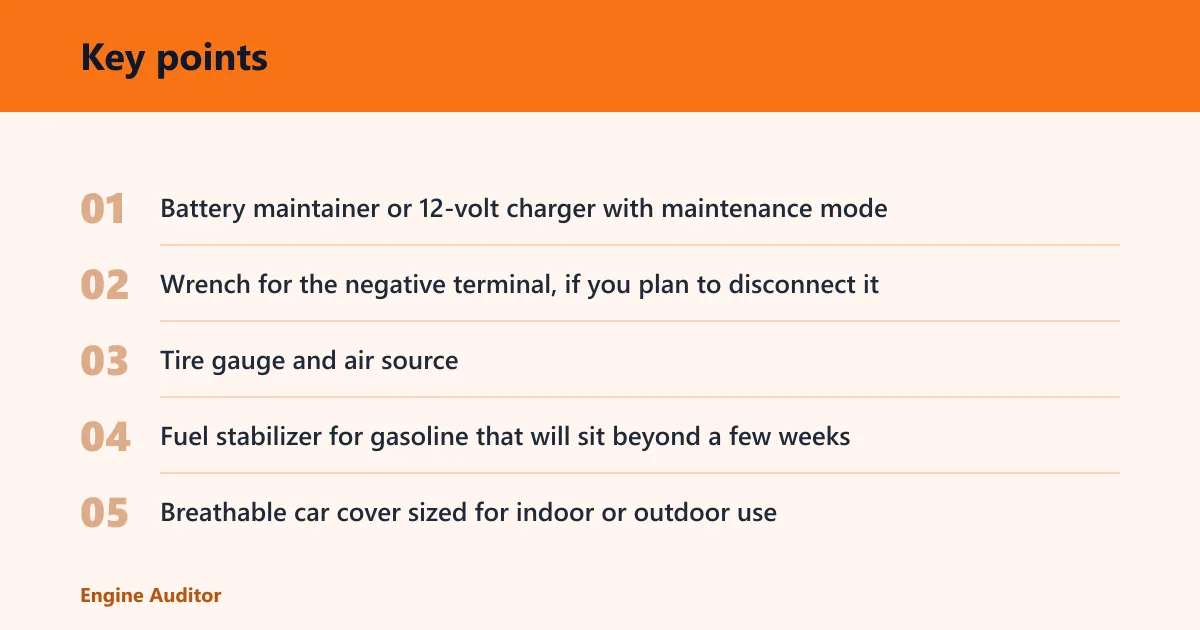



- Battery maintainer or 12-volt charger with maintenance mode
- Wrench for the negative terminal, if you plan to disconnect it
- Tire gauge and air source
- Fuel stabilizer for gasoline that will sit beyond a few weeks
- Breathable car cover sized for indoor or outdoor use
- Microfiber towels and a safe wash soap for clean paint
- Desiccant packs or a dehumidifier for enclosed storage
- Rodent deterrents and sealing materials for obvious openings
- Flashlight for the restart inspection
How should you prepare the car before storage?
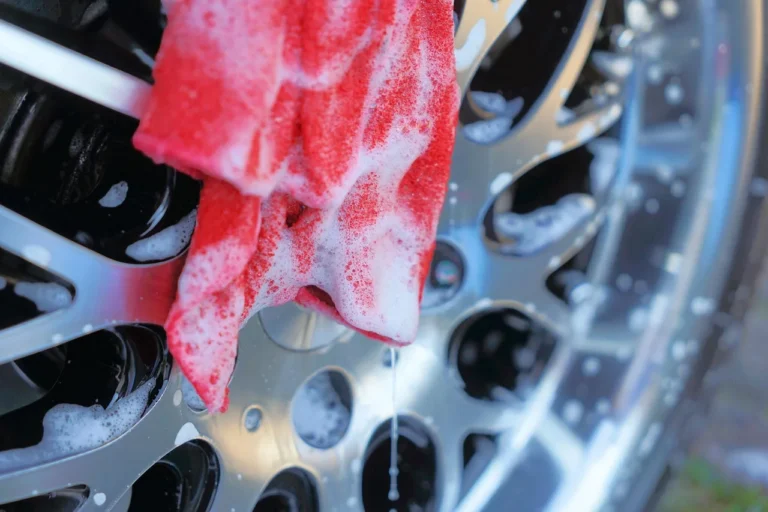
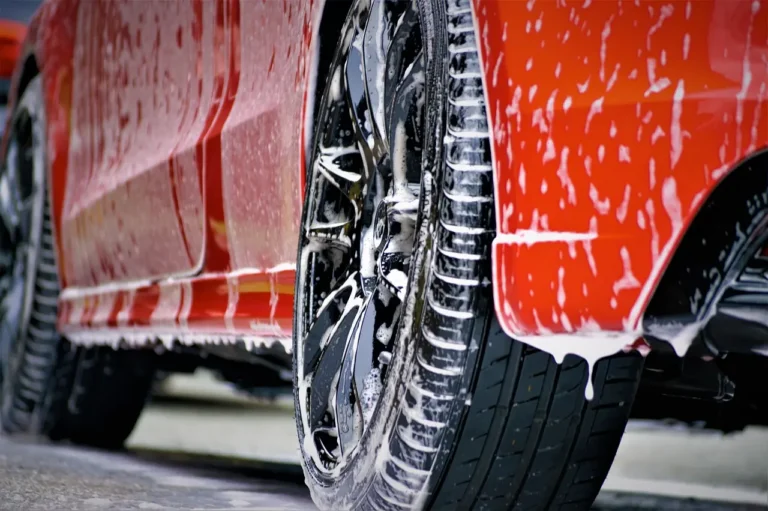
Clean the car, remove food and trash, set the tires to the door-jamb pressure or placard pressure, and park in a dry, secure spot. For storage longer than a month, cut moisture, limit pest access, and reduce battery drain before you walk away. That matters more than cosmetic detailing.
- Wash the exterior and dry it fully.
- Remove snacks, wrappers, and loose fabric from the cabin.
- Check tire pressure, coolant level, oil level, and washer fluid.
- Choose a clean, stable surface with limited sun and low pest exposure.
- Close windows, sunroof, and fuel cap tightly.
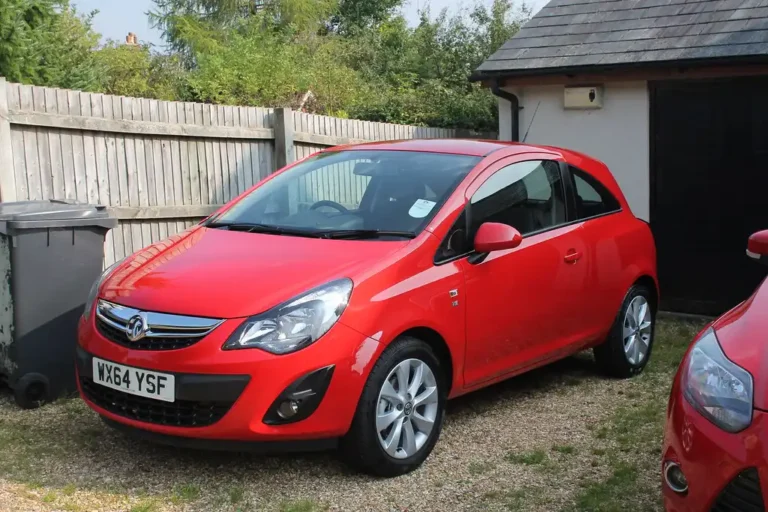
Say your sedan will sit in a driveway for six weeks. A clean cover and full tire pressure help, but the bigger risk is battery drain and stale fuel, so those need attention before the keys go away.
Storage checklist by duration
| Item | 1-4 weeks | 1-3 months | 3+ months | Only if applicable |
|---|---|---|---|---|
| Battery | Charge fully; disconnect negative terminal if parasitic drain is high | Use a battery maintainer or disconnect negative terminal | Use a maintainer, or disconnect and recharge before restart | Hybrids and EVs: follow the maker’s storage SOC limits; classics may need more frequent charging |
| Fuel | Keep tank near full | Add fuel stabilizer if fuel will age in the tank | Full tank plus stabilizer; minimize ethanol-related degradation | Diesels: also protect against moisture and microbial growth in long sits |
| Tires | Set to placard pressure | Overinflate by 2-4 psi if the car will sit still | Use jack stands or tire cradles if storage is very long | Motorcycles and classics with bias tires need careful pressure checks |
| Fluids | Verify levels | Top off washer fluid with freeze-safe mix if needed | Check brake fluid age and coolant level before storage | Track or classic cars may need oil timing reviewed by the service schedule |
| Pests | Remove attractants | Block obvious entry points and use deterrents | Seal intake, exhaust, and cabin-access openings carefully | All types if stored in barns, garages, or self storage units |
| Cover | Optional indoors | Use breathable cover if dust is likely | Use fitted, breathable cover indoors or outdoors | Outdoor storage needs weather-rated fit and tie-downs |
| Restart | Visual check before driving | Check tire pressure, warning lights, and leaks | Inspect brakes, battery state, and fluid levels before moving | Hybrids, EVs, diesels, and classics may need extra system checks |
How do you protect the battery and fuel system?
For most gas cars, a fully charged 12-volt battery is the first line of defense. If the car will sit beyond a few weeks, use a battery maintainer. If storage is short and parasitic drain is low, disconnecting the negative terminal can be enough. Fuel should stay as fresh as possible, and a full tank slows condensation. This aligns with manufacturer storage guidance for 12-volt systems, including recommendations from owners’ manuals and battery-maintainer makers such as NOCO and Battery Tender, which emphasize maintenance charging rather than repeated deep discharges.
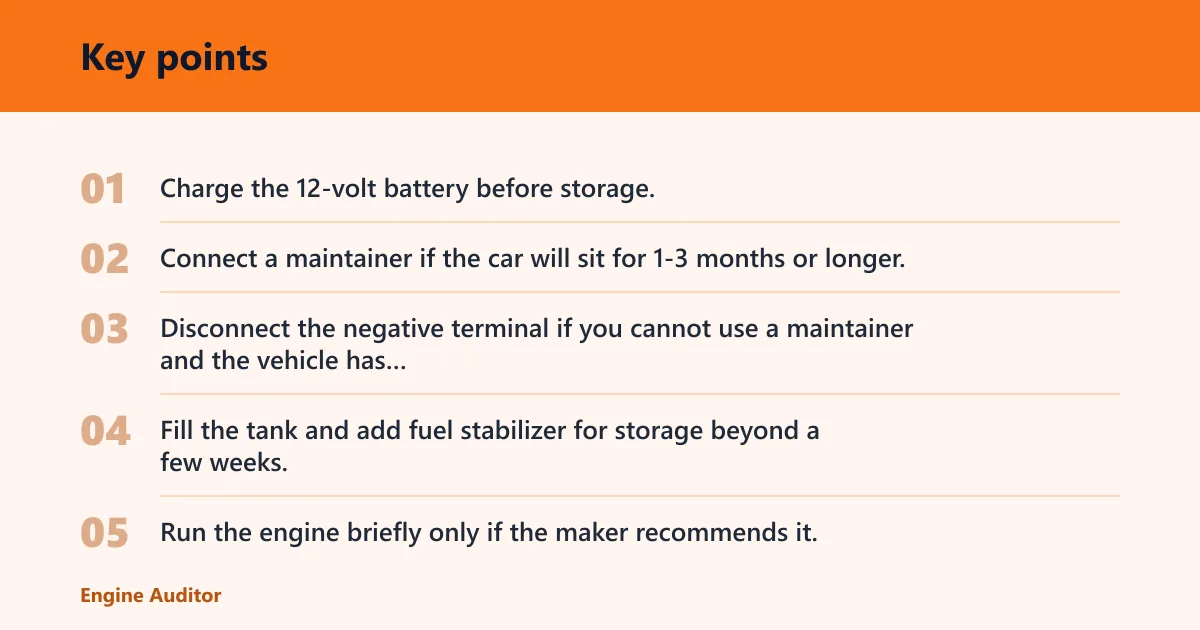
- Charge the 12-volt battery before storage.
- Connect a maintainer if the car will sit for 1-3 months or longer.
- Disconnect the negative terminal if you cannot use a maintainer and the vehicle has normal memory-loss tolerance.
- Fill the tank and add fuel stabilizer for storage beyond a few weeks.
- Run the engine briefly only if the maker recommends it; short idling does not refresh old fuel in a meaningful way.
Ethanol-blended fuel absorbs moisture and degrades faster than fresh fuel. That is why a full tank and stabilizer matter more as storage stretches from weeks into months, especially for vehicles with sensitive injectors or high-pressure pumps. Follow the stabilizer product label for dosage and run time, and defer to the vehicle manual if it warns against additives or specifies a different storage interval. For gasoline storage principles, see the U.S. Department of Energy and small-engine guidance from EPA/consumer manufacturers that stress stabilized fuel for extended downtime.
Hybrid, EV, diesel, and classic cars need different attention. Hybrids and EVs should be stored at the state of charge the maker lists, often neither full nor empty. Many manufacturers recommend roughly 40% to 60% state of charge for long storage, but the exact number varies by battery chemistry and model; use the owner’s manual, not a rule of thumb. Diesels benefit from clean fuel and moisture control. Classics may have higher parasitic drain, older seals, and carbureted fuel systems that age differently.
How do you keep tires, brakes, and fluids from sitting damage?
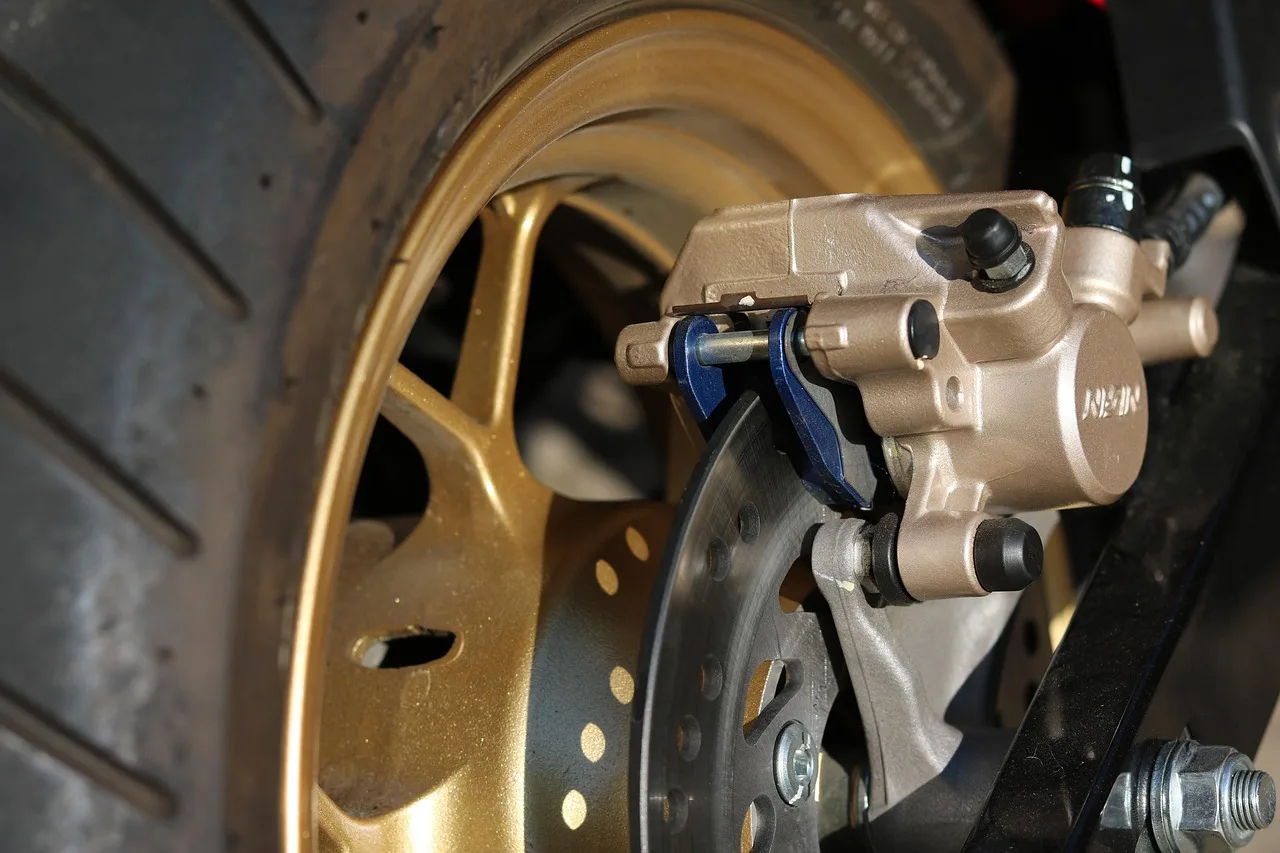
Set tire pressure correctly, then decide whether the car will roll or stay parked. Flat-spotting becomes more likely the longer the car sits in one position. Brake rotors can rust quickly in damp air, and the parking brake can stick pads or shoes if it stays engaged too long. For brake-system care, the safest default is to follow the owner’s manual: many manufacturers advise leaving the parking brake off during long storage if the surface is level and wheel chocks can be used.
- Inflate tires to placard pressure for short storage.
- Add 2-4 psi above placard pressure if the car will sit for 1-3 months, then recheck before driving.
- Use jack stands or tire cradles for 3+ months if the car can sit safely without load on the tires.
- Leave the parking brake off for long storage when the surface allows it.
- Check oil, coolant, brake fluid, and washer fluid before storage.
Brake fluid absorbs moisture over time, which matters more during long storage in humid places. Washer fluid can freeze and crack parts if the mix is wrong for the season. If an oil change is nearly due, do it before storage rather than leaving old oil in the crankcase for months. For brake fluid basics and storage-related moisture concerns, see our brake fluid basics page and your vehicle’s service schedule.
Picture a coupe stored in an unheated garage for four months. If the tires start at 28 psi but the placard calls for 35 psi, the first drive can reveal vibration from flat-spotting and a low-pressure warning light. Set pressure before storage, not after the tire has already taken a set.
How often should you move a stored car?
For most vehicles, do not move it on a fixed calendar if you can avoid it; instead, prepare it properly and let it sit undisturbed until the next planned restart inspection. If the car is outside or parked on soft tires, a brief reposition every few weeks can help reduce one-sided load and moisture accumulation, but only if you can move it fully enough to change tire contact points and do so safely. Short idling alone is not a substitute for movement: it does not recharge the battery well, may not fully warm the drivetrain, and can add condensation to the exhaust and oil.
- Move it only if you can do a full, safe reposition, not just a startup-and-shutdown.
- If you must move it, drive far enough to change tire contact points and dry the brakes.
- Avoid repeated brief idle sessions; they are not a meaningful storage maintenance routine.
- Do not move it at all if roads are salted, the brakes are already rusty, or the storage area is unsafe.
- Follow the owner’s manual if the maker gives a different procedure for hybrids, EVs, or performance cars.
If the car is on jack stands, in a sealed indoor space, or stored for a long term with a maintainer and proper tire pressure, leaving it alone is often better than creating avoidable wear. The exception is a vehicle manual that explicitly calls for periodic operation or a storage-mode procedure.
Is a car cover bad for indoor storage?
Not necessarily. A fitted, breathable indoor cover is usually helpful for dust control and light scuff protection. The problem is using the wrong cover: plastic sheeting traps moisture, loose covers can rub on paint, and any cover put on a dirty car can create abrasive wear. For indoor storage, the best choice is a clean, breathable cover sized to the vehicle and kept dry.
- Use a breathable fitted indoor cover if dust is the main issue.
- Avoid plastic or non-breathable covers that can trap condensation.
- Never cover a dirty car unless the cover maker specifically allows it and the surface is clean enough to avoid abrasion.
- Replace a cover that smells musty, holds moisture, or has embedded grit.
- Do not use a cover as a substitute for garage humidity control or pest prevention.
Failure cases are common: a cover over damp paint can trap moisture and haze trim; a loose cover can flap and micro-scratch edges; a dusty cover can act like sandpaper. If the garage is clean and dry, an indoor breathable cover is a plus. If the space is humid or rodents are active, fix those problems first.
How do you keep mold and rodents out?
Dry, sealed storage matters as much as fuel and battery care. Rodents enter through small openings, then chew cabin filter material, insulation, and wiring. Moisture and trapped air create mildew on carpets, headliners, and seals. Use clean surfaces, breathable materials, and careful sealing instead of plastic wrap. For a full pest-control approach, see our rodent-proofing a garage guide.
- Clean the garage, storage unit, or parking area before the car goes in.
- Block obvious rodent entry points near doors, vents, and wall gaps.
- Protect the intake and exhaust with covers that cannot be forgotten when the car returns to service.
- Use breathable cover fabric, not airtight plastic, for indoor storage.
- Place desiccant packs in the cabin or trunk if humidity is high.
Do not place bait where pets, children, or non-target animals can reach it. If rodent pressure is high, traps outside the vehicle envelope are safer than loose poison inside the cabin or engine bay. Wiring damage often starts at the cowl, underhood insulation, or behind the glove box.
A common first-timer mistake is covering a dusty car with a tight indoor cover. Dust and grit act like sandpaper when the cover shifts, so clean paint first and use a cover that fits without rubbing on mirrors, badges, or sharp trim edges.
What should you do before the first drive?
Before the first drive after months of storage, inspect for leaks, low fluids, tire pressure loss, pest damage, and warning lights. Start the car only after a full visual check, then move it slowly while listening for brake drag, flat-spot vibration, or odd noises from the engine bay or wheel wells. If the vehicle is an EV or hybrid, use the storage and restart steps in the owner’s manual and our EV storage tips guide.
- Check under the car for oil, coolant, fuel, or transmission fluid leaks.
- Inspect belts, hoses, and wiring for chew marks or cracking.
- Verify tire pressure and look for bulges or sidewall damage.
- Start the engine and confirm normal warning-light behavior.
- Release the brake and test pedal feel before joining traffic.
After storage, rotor rust is common and usually clears after a few gentle stops. If the brake pedal feels soft, the steering feels off, or a warning light stays on, stop and sort that out before a longer drive. That is especially important after 3+ months.
Common mistakes
- Using a dirty cover on dirty paint, which can scratch clearcoat and trim.
- Leaving the parking brake set for months, which can stick pads or shoes.
- Skipping the restart inspection after long storage.
- Assuming a short idle will refresh old fuel or charge the battery enough.
- Ignoring humidity in a closed garage, which invites mildew.
Prevention is simple here: write the restart steps on a tag and place it on the steering wheel, so the inspection happens before the car moves.
Frequently asked questions
How do I store a car for a month without damaging it?
Wash it, set tire pressure to the door placard, close the fuel cap, and park it in a dry spot. For a month, a full battery and low parasitic drain usually matter more than elaborate preparation. If the car sits outside, use a fitted breathable cover and check for standing water.
Should I disconnect the battery when storing a car for weeks?
For a few weeks, disconnecting the negative terminal is reasonable if the car has noticeable parasitic drain or no maintainer available. Reconnect with the ignition off, then reset clocks, radio presets, and any learned settings. If the car has sensitive modules, a maintainer is usually the safer choice. Check the owner’s manual for vehicles with stop-start systems, memory seats, telematics, or battery monitoring modules, because some models require a register/reset procedure after disconnecting power.
How much fuel should I leave in the tank before storage?
Leave the tank near full. A fuller tank leaves less air space for moisture and slows fuel aging, which helps when storage goes beyond a few weeks. If the fuel will sit for 1-3 months or longer, add stabilizer and drive briefly to move treated fuel through the system.
Do I need to inflate tires more before storing a car?
For short storage, set them to the placard pressure. For 1-3 months, a modest increase of 2-4 psi can help offset slow loss, then recheck before driving. For 3+ months, use jack stands or tire cradles if the car can be supported safely. This is especially important for performance tires and low-profile sidewalls, which are more sensitive to flat-spotting.
Should I use a trickle charger for long-term storage?
Yes, if the battery will sit for more than a few weeks and the outlet is safe. A maintainer is better than a basic charger because it holds state of charge without overcharging. For hybrids and EVs, follow the storage charge range in the owner’s manual instead of guessing. Many makers recommend a mid-range state of charge and periodic checks rather than leaving the pack full or empty.
How do I keep mold and rodents out of a stored car?
Keep the storage area dry, clean, and sealed as much as possible. Remove food, use breathable covers, block obvious entry points, and protect the intake and exhaust. Desiccant packs help in damp spaces. Avoid loose bait inside the car, especially where pets or children could reach it.
Sources
- Vehicle owner’s manuals and storage sections from major automakers, including battery-disconnect instructions, storage state-of-charge guidance, parking-brake notes, and restart procedures.
- Battery maintainer manufacturer guidance, including NOCO and Battery Tender documentation on maintenance charging and long-term battery care.
- U.S. Department of Energy fuel storage and fuel quality guidance for gasoline aging and moisture control.
- Environmental and manufacturer guidance on stabilized gasoline for extended storage.
- Tire and vehicle-storage guidance from automotive service organizations on preventing flat spots and verifying pressure before use.
- Brake and corrosion guidance from automotive service references on rotor rust, brake-fluid moisture absorption, and post-storage inspection.
Products related to this article
Sponsored / affiliate links. As an Amazon Associate I earn from qualifying purchases. I may earn additional commission from eligible campaigns.