
How Much Does Car Ownership Cost Each Month? Breakdown
Many car owners spend roughly $600 to $1,000 a month all-in, but your real number is annual ownership cost divided by 12 plus sinking funds for repairs, tires, registration, and replacement. I use that method because it catches the bills that do not land every month. Guess low, and you get surprise bills, overdue maintenance, and a car that loses value faster than your budget can absorb. This guide shows how to build a monthly budget from mileage, financing, insurance, fuel, and vehicle age.
What counts as car ownership cost?
Car ownership cost is the full monthly cost of keeping a vehicle on the road, not just the gas bill. It includes fixed costs that stay the same whether you drive 2,000 miles or 20,000, variable costs that rise with use, and monthly reserves for bills that arrive irregularly. When I build a budget, I put every one of those lines in the same place.
Fixed costs: what stays the same each month
Fixed costs include insurance, license and registration fees, taxes, depreciation, and finance charges. Fixed costs do not change based on driving amount. For many drivers, depreciation is one of the largest fixed ownership costs, especially on newer cars and vehicles with strong early-year value loss.
Variable costs: what rises with mileage
Variable costs include gasoline, maintenance, and tires. These costs involve the physical operation of the vehicle, so more miles usually mean more fuel burned, more wear on parts, and faster tire use. A driver who doubles mileage should expect variable costs to rise with it.
Why depreciation belongs in the total
Depreciation is easy to miss because it does not leave your checking account each month like fuel does. Still, it is real ownership cost. If a car loses value faster than the budget allows, the owner pays for that loss later when trading in, selling, or refinancing.
According to usafacts.org — The cost analysis only began including maintenance, repairs, and tires in 2017.
How much does car ownership cost per month?
The Bureau of Transportation Statistics reports an annual car ownership cost of $12,182 in 2023, based on 15,000 miles of driving. Spread across a year, that works out to roughly $1,000 per month before you adjust for your own mileage, vehicle age, financing, and local price differences.
The 2023 BTS benchmark at 15,000 miles
The data comes from the Bureau of Transportation Statistics dataset on the average cost of owning and operating an automobile, which extends back to 1975. The 2023 figure is useful as a benchmark, but it is not a personal budget. A low-mileage driver and a long-commute driver will not land on the same monthly cost.
What that annual number looks like per month
A simple monthly conversion is the annual total divided by 12. Using $12,182, the result is about $1,015 a month. That figure is only the starting point. A better budget adds sinking funds for repairs, tires, registration, taxes, and other expenses that do not hit every month.
Why the average can mislead your budget
The 15,000-mile benchmark can flatter some drivers and distort others. If you drive far less, your fuel and wear costs should be lower, but fixed costs still land on the budget. If you drive more, the average can leave you short on gas, tires, brake work, and repair reserves.
| Item | Annual cost | Monthly cost | Notes |
|---|---|---|---|
| BTS ownership benchmark | $12,182 | $1,015 | Based on 15,000 miles |
| Implied monthly reserve | — | $1,015 | Good starting point, not a personal total |
Which monthly car costs change with mileage?
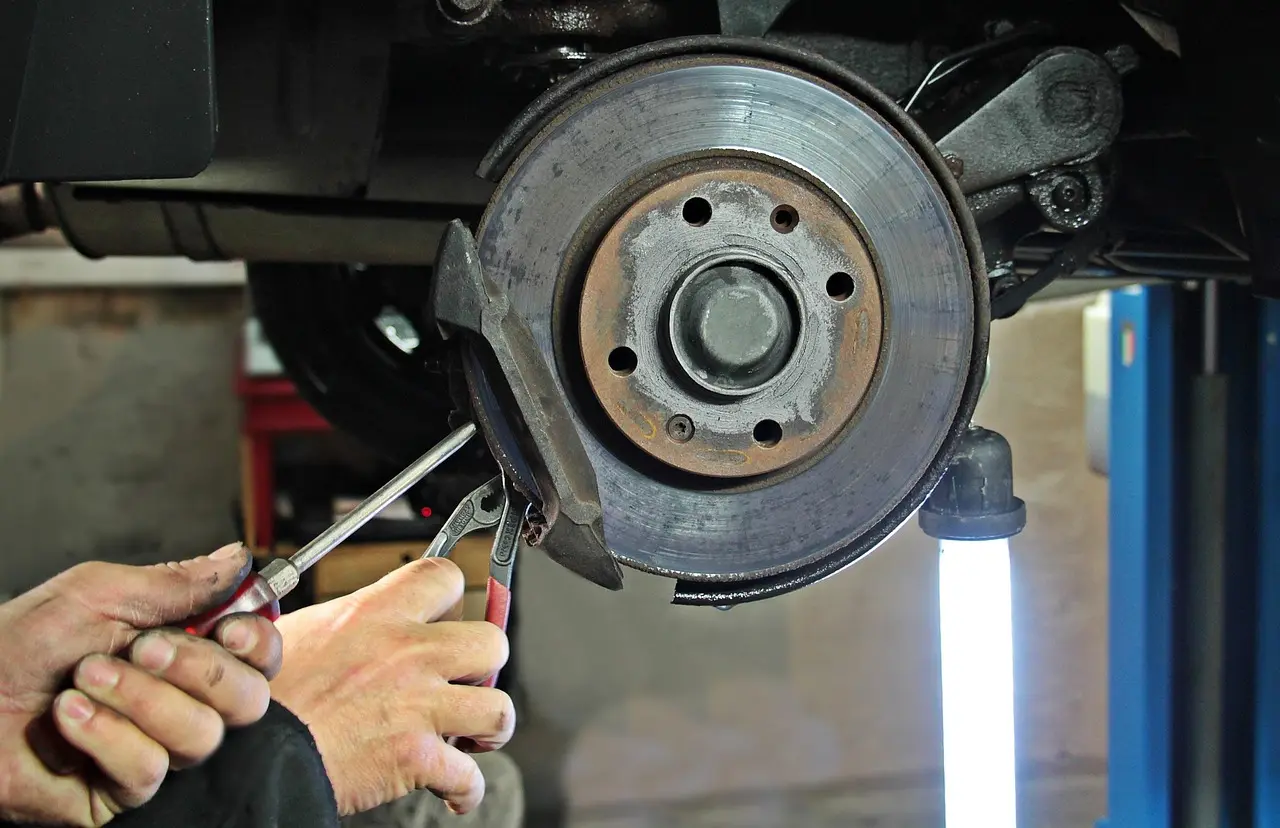
Fuel, maintenance, and tire wear change most with mileage. Fixed costs still exist, but they do not climb just because the odometer does. That is why commuters, delivery drivers, and weekend drivers need different monthly budgets even when they own the same make and model.
Fuel costs by low, average, and high mileage
Gasoline prices rose by 10% to 15% after inflation adjustment from July 2019 to July 2023. That means mileage matters more now because each extra mile eats a larger share of the budget. A 7,500-mile driver will usually spend far less on fuel than a 20,000-mile driver.
How maintenance and tire wear scale with driving
Maintenance, repairs, and tires were added to the cost analysis only beginning in 2017, which is one reason older ownership summaries can feel incomplete. More miles usually mean more oil changes, brakes, alignment checks, and tread loss. Tire replacement can turn a quiet month into an expensive one fast.
Why commuters and weekend drivers should budget differently
A commuter racks up miles on schedule, so wear is steady and predictable. A weekend driver may spend less on fuel, but the car can still age out by time, not distance. Rubber, fluids, and batteries do not care whether the odometer climbs quickly or slowly.
| Driver type | Mileage pattern | Monthly variable cost trend | Budget note |
|---|---|---|---|
| Low-mileage | Under 8,000 miles a year | Lower fuel, lower wear | Keep fixed costs and reserves intact |
| Average-mileage | Around 15,000 miles a year | Middle of the road | Use the BTS benchmark as a base |
| High-mileage | Over 20,000 miles a year | Higher fuel, faster wear | Increase sinking funds for tires and repairs |
How much should you budget for insurance, gas, and maintenance?

Insurance, gas, and maintenance are the core monthly car lines for most budgets. Insurance is usually the biggest fixed expense, gas is the easiest variable cost to estimate, and maintenance should be treated as a monthly reserve even when the mechanic bill shows up only a few times a year. I split those three first when I map out a car budget.
Insurance as the biggest fixed expense for many drivers
Motor vehicle insurance rates rose by about 54% between 2020 and 2024. That jump matters because insurance does not track mileage in a simple way. It belongs in the fixed-cost section, and it should be reviewed separately from fuel or repair spending.
Gas as the easiest variable cost to estimate
Fuel is usually the first variable line to estimate because it rises with use and is easy to scale by miles driven. Drivers who know their monthly mileage can build a practical gas line faster than any other part of the budget. More miles mean more dollars at the pump.
Maintenance, repairs, and tires as monthly reserves
Monthly reserves are the fix for surprise bills. Set aside money each month for oil changes, brake work, alignments, batteries, and tire replacement. If the budget ignores repairs until something fails, the owner ends up raiding savings or putting a routine car expense on credit.
| Cost line | Budget type | Why it matters |
|---|---|---|
| Insurance | Fixed | Often the largest recurring bill |
| Gas | Variable | Moves with mileage and fuel prices |
| Maintenance | Variable plus reserve | Routine service and wear items |
| Tires | Reserve | Replaced on mileage and age |
How do depreciation and financing change your monthly cost?
Depreciation and finance charges can make a newer car far more expensive each month than a paid-off older car. Depreciation is one of the largest fixed ownership costs, and loan or lease charges add a cash payment on top of the value loss. Older cars still cost money, just in different places.
Depreciation on newer cars
Depreciation hits hardest early in ownership. A newer car can lose value quickly even if it is driven carefully and maintained well. That means the monthly cost is not only the payment or insurance bill; it also includes the value that disappears while the car sits in the driveway.
Finance charges on loans and leases
Finance charges are part of fixed costs because they do not move with mileage. They depend on loan balance, interest rate, and term. A lower payment can hide a higher total cost if the loan runs long or carries expensive interest.
Why older paid-off cars still have monthly costs
A paid-off car removes the loan payment, but it does not erase insurance, fuel, maintenance, tires, taxes, or registration. Older cars often need a bigger repair reserve because aging parts fail on their own schedule. That is where a sinking fund protects the budget.
What car ownership costs get missed in budgets?
Many budgets miss registration, taxes, and repair reserves. They also forget tires, brakes, batteries, and the cost of replacing worn parts before a breakdown. Those items may not be monthly bills, but they are still monthly expenses when spread across the year. I see that gap a lot when people first write out a car budget.
Registration, taxes, and fees
License and registration fees and taxes are fixed ownership costs, but many drivers treat them like one-time annoyances. They are better handled as monthly sinking-fund items. That way, the annual bill arrives as a planned transfer instead of a budget shock.
Repairs that do not happen every month
Repairs are irregular, not imaginary. A car may go months with no big bill, then need brakes, a battery, or suspension work in the same quarter. Monthly reserves smooth that cycle so the owner does not have to guess which month will be expensive.
Replacement savings for tires, brakes, and battery
Tires and brakes wear by miles and time. Batteries age by time more than mileage. A monthly sinking fund for replacement parts keeps these costs from piling up all at once. That reserve is the difference between a budget that survives and one that gets raided every few months.
Monthly car cost worksheet and sample calculations
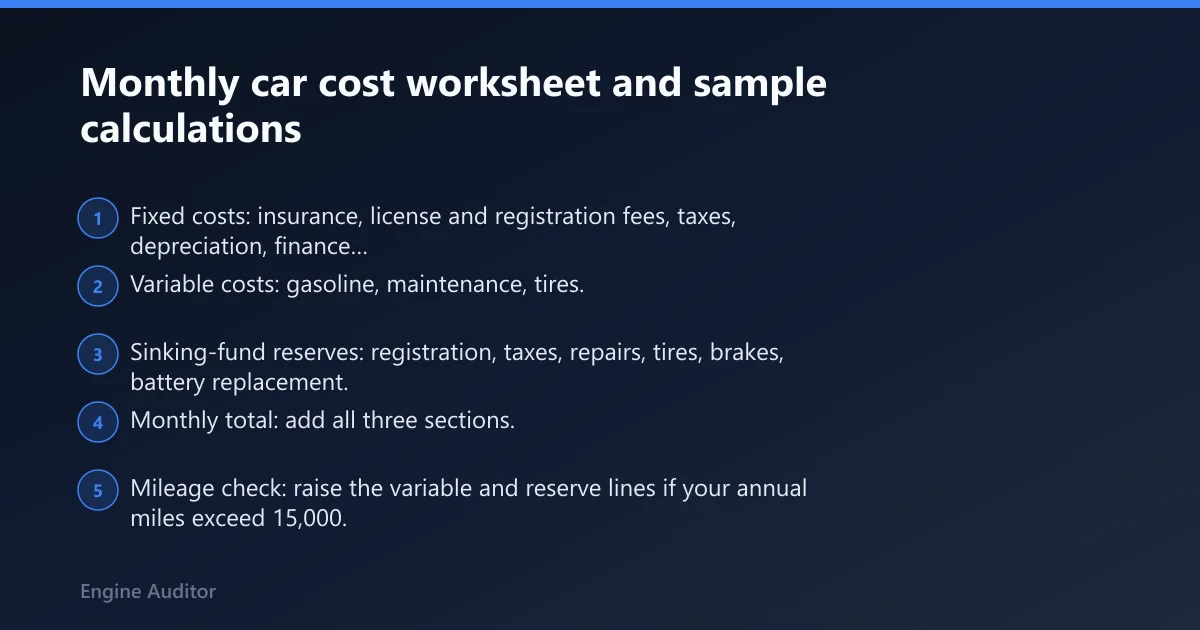
Use this worksheet to turn the annual average into a personal monthly sinking-fund budget. Start with fixed costs, add variable costs based on mileage, then add monthly reserve lines for irregular bills. The goal is a number you can fund every month without surprises.
Fill-in budget template for your own car
- Fixed costs: insurance, license and registration fees, taxes, depreciation, finance charges.
- Variable costs: gasoline, maintenance, tires.
- Sinking-fund reserves: registration, taxes, repairs, tires, brakes, battery replacement.
- Monthly total: add all three sections.
- Mileage check: raise the variable and reserve lines if your annual miles exceed 15,000.
| Worksheet line | Monthly amount | Your amount |
|---|---|---|
| Insurance | fixed | |
| License and registration | fixed reserve | |
| Taxes | fixed reserve | |
| Depreciation | fixed | |
| Finance charges | fixed | |
| Gasoline | variable | |
| Maintenance | variable reserve | |
| Tires | variable reserve | |
| Repairs reserve | sinking fund | |
| Total | monthly car budget |
Sample budget for a low-mileage driver
A low-mileage driver usually spends less on fuel and tire wear, but fixed costs still dominate the budget. If the car is older and paid off, depreciation and finance charges may shrink while insurance, registration, and repair reserves remain. That is why low mileage does not equal low total cost.
Sample budget for an average driver
An average driver can start with the 2023 BTS benchmark of $12,182 a year, or about $1,015 a month. From there, split the total into fixed and variable buckets, then add a small monthly reserve for registration, taxes, and repairs. This is the cleanest all-in planning number for many households.
Sample budget for a high-mileage driver
A high-mileage driver should expect higher fuel spending, more maintenance, and faster tire replacement. The annual average based on 15,000 miles will usually understate true use if the car is driven for long commutes or work. In that case, move the monthly reserve upward before the bills arrive.
Frequently asked questions
how much does car maintenance cost per month
Car maintenance cost per month depends on mileage, age, and repair history. A good budget line treats maintenance as a reserve, not a surprise. Drivers who rack up more miles should set aside more each month because fluids, brakes, and wear items age faster with use.
how much does owning a car cost per month
Owning a car can cost about $1,015 a month if you use the 2023 annual benchmark of $12,182 divided by 12. That number should be adjusted for your mileage, insurance, financing, and vehicle age. Lower use reduces some costs, but fixed costs still stay in place.
what is included in monthly car ownership costs
Monthly car ownership costs should include insurance, license and registration fees, taxes, depreciation, finance charges, gas, maintenance, tires, and a repair reserve. Fixed costs do not change with miles driven. Variable costs rise as the car is used more.
how much should I budget for insurance, gas, and maintenance
Budget insurance as a fixed line, gas as a mileage-based line, and maintenance as a monthly reserve. Insurance has risen sharply in recent years, gas tracks driving distance, and maintenance should be funded every month even if the shop invoice comes later.
what car ownership costs get missed in budgets
Registration, taxes, repairs, tires, brakes, and battery replacement are the costs most often missed. They do not arrive on the same day each month, so they are easy to ignore. A sinking fund fixes that problem by spreading the cost evenly over the year.
how do fixed and variable car costs differ
Fixed car costs stay the same no matter how much you drive. Variable costs rise with mileage and vehicle use. Insurance, depreciation, and finance charges are fixed. Gasoline, maintenance, and tires are variable because they depend on how far the car travels.
Products related to this article
Sponsored / affiliate links. As an Amazon Associate I earn from qualifying purchases. I may earn additional commission from eligible campaigns.