How Do I Test a Car Thermostat?
Warm the engine and watch the upper radiator hose. If it stays cool until the gauge is close to normal, then turns hot, the thermostat is opening. If it warms right away, suspect stuck open. If it never warms, suspect stuck closed or low coolant. Ignore it and you can overheat the engine, lose cabin heat, or buy the wrong part. This guide shows a safe test sequence that separates thermostat faults from air pockets, low coolant, radiator-flow problems, and P0128 lookalikes.
What a thermostat does in the cooling system

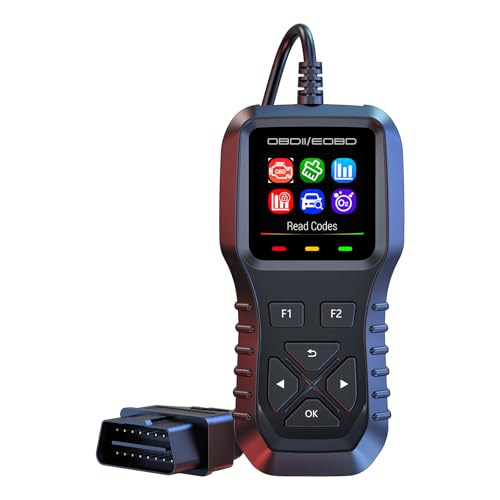
- Shows live data streaming
- Reads and clears OBD2 codes
- Includes battery and readiness checks
A car thermostat is a temperature-controlled valve that regulates coolant flow between the engine and radiator. Many thermostats begin operating around 180°F to 210°F, but not all open at the same point. A stuck-closed thermostat can drive overheating. A thermostat that stays open can keep the engine too cool.
Weak cabin heat, a low or slow-rising temperature gauge, or a gauge that swings up and down can all point to thermostat trouble. They can also point to low coolant, trapped air, an engine coolant temperature sensor fault, or a leak at the thermostat housing gasket.
What you’ll need
- Safety glasses
- Gloves
- A scan tool or code reader for P0128 and live coolant temperature data
- An infrared thermometer, if available
- A drain pan or bucket for coolant catch
- Basic hand tools for hose clamps and thermostat housing bolts
- Replacement coolant, if top-up is needed
- A new thermostat and gasket, if removal becomes necessary
How do you test it without removing it?
Start with a cold engine and keep the radiator cap closed. Watch the gauge, the upper radiator hose, and the heater output as the engine warms. A healthy thermostat keeps the upper hose cool at first, then opens and lets hot coolant flow. If the hose warms too soon, too late, or in pulses, keep diagnosing before replacing parts.
Follow the warm-up sequence
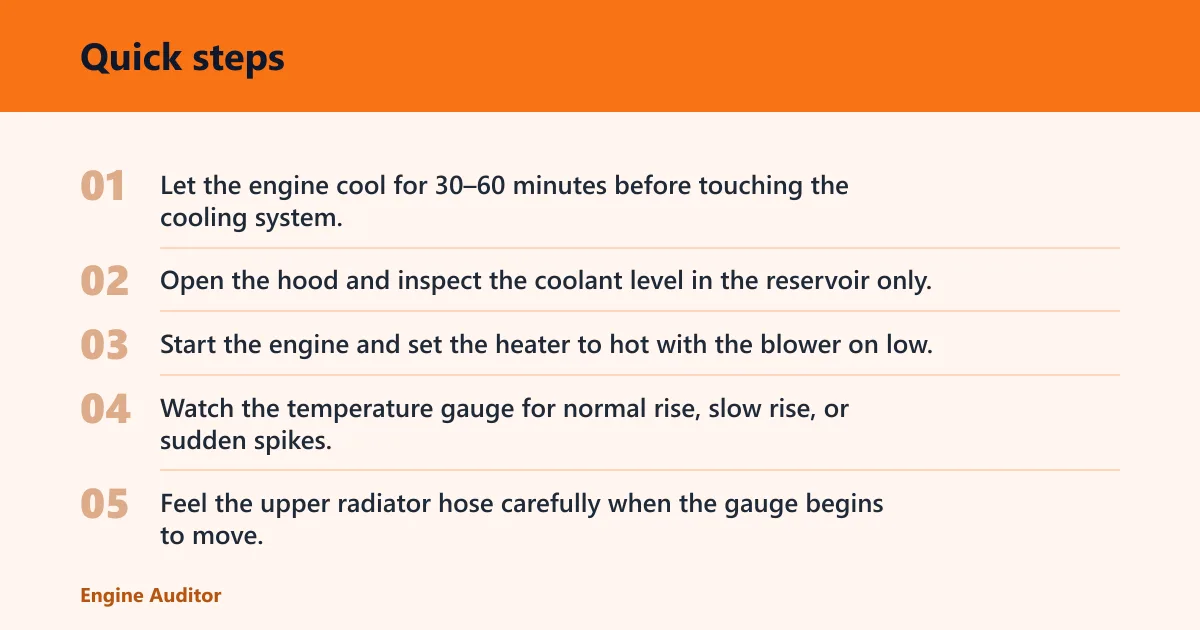
- Let the engine cool for 30–60 minutes before touching the cooling system.
- Open the hood and inspect the coolant level in the reservoir only.
- Start the engine and set the heater to hot with the blower on low.
- Watch the temperature gauge for normal rise, slow rise, or sudden spikes.
- Feel the upper radiator hose carefully when the gauge begins to move.
- Use an OBD-II scan tool to check live coolant temperature and P0128 if the vehicle has a check engine light.
What normal looks like
On a cold start, the upper hose should usually stay cool for a short period, then heat up once the thermostat opens. Cabin heat should arrive after the engine begins warming, not immediately. If the hose heats right away and the gauge stays low, the thermostat may be stuck open. If the hose stays cool while the gauge climbs hard, suspect stuck closed or low coolant.
What do the symptoms tell you?
The pattern matters more than any single symptom. A gauge that sits low on a long drive, weak heater output, and P0128 often point to a thermostat that stays open. A gauge that climbs past the 3/4 mark, with hot hoses and poor circulation, points more toward stuck closed or a coolant-flow problem. Fluctuation suggests a sticking thermostat, air pocket, or sensor issue.
Suppose the check engine light is on and the scan tool shows P0128 after a cold start that never reaches normal temperature. That is a strong clue, but not proof. Low coolant level, trapped air, a bad engine coolant temperature sensor, or damaged wiring can produce the same complaint.
Picture a sedan that idles for 10 minutes, the gauge stays low, the heater blows lukewarm air, and the upper hose warms within a minute of startup. That pattern fits a thermostat that stays open better than an overheating fault.
Thermostat diagnostic decision table
| Observed symptom | Quickest test to run | Likely outcome |
|---|---|---|
| Gauge stays low, heater is weak, P0128 is stored | Scan live ECT data and compare hose warm-up from a cold start | Thermostat stuck open |
| Gauge climbs past the 3/4 mark, upper hose stays cool, heater drops out | Check coolant level in the reservoir, then inspect for trapped air or blockage | Thermostat stuck closed |
| Gauge rises and falls, heat comes and goes | Check ECT data, coolant level, and housing leaks before removing parts | Likely another cooling-system fault |
| Coolant drips near the thermostat area | Inspect the thermostat housing gasket and nearby hoses | Likely another cooling-system fault |
| Safe to continue diagnosing | Stop and tow |
|---|---|
| Gauge is low, engine is not overheating, and coolant level is steady | Gauge sits past the 3/4 mark and keeps climbing |
| P0128 is stored but the engine runs normally and no boiling is present | Steam, boiling coolant, or visible leaks appear |
| Heater output is weak but temperature stays in a safe range | Temperature warning light comes on or the engine starts misfiring from heat |
How do you test a thermostat by hand?
Remove the thermostat only after the engine has cooled and the system is safe to open. A bench test can check whether the valve opens in hot water near its rated temperature and closes again as it cools. That is different from in-car diagnosis, which checks coolant flow, gauge behavior, and sensor data while the thermostat stays installed.
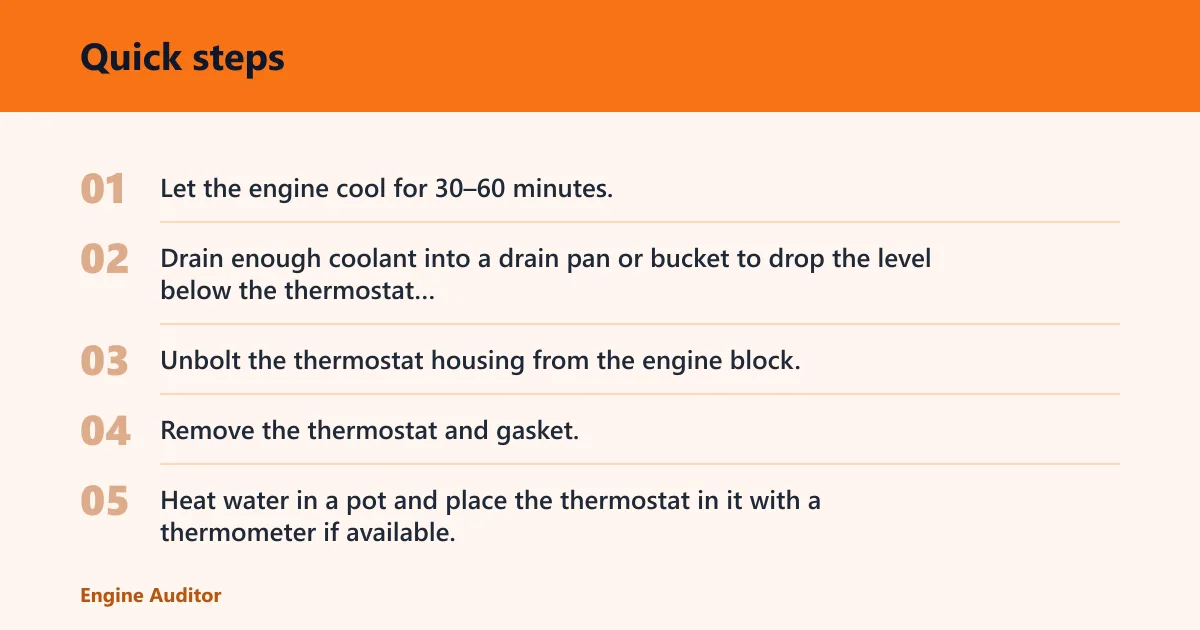
Remove and bench-test it
- Let the engine cool for 30–60 minutes.
- Drain enough coolant into a drain pan or bucket to drop the level below the thermostat housing.
- Unbolt the thermostat housing from the engine block.
- Remove the thermostat and gasket.
- Heat water in a pot and place the thermostat in it with a thermometer if available.
- Watch for the valve to begin opening near its rated temperature.
- Remove it and let it cool; it should close again as the water temperature drops.
Inspect the housing and gasket
Check the thermostat housing for cracks, corrosion, and gasket damage. A leak at the housing can drop coolant level and imitate thermostat failure. If coolant has leaked out before the housing is loosened, replace the radiator cap only after the engine is cool and the system is not pressurized. Never open a hot radiator cap.
What should you do before removing a car thermostat?
Before removal, confirm coolant level, check for trapped air, and read ECT data if a scan tool is available. Hot coolant can spray and cause severe burns. The radiator cap must stay closed while the engine is hot. If the level is low, top up in measured amounts and recheck rather than guessing at the cause.
Use a measured top-up
- Open the reservoir only after the engine has cooled.
- Add coolant in 250 mL increments.
- Recheck the level, then look for leaks, hose softness, or bubbling.
- Bleed air according to the vehicle procedure if the system has a bleed screw or bleed port.
- Retest the warm-up pattern before ordering parts.
Common mistakes
Do not open a hot cooling system. Do not treat every P0128 code as a failed thermostat. Do not ignore low coolant, air pockets, an ECT sensor fault, or a leak at the thermostat housing. Those faults can mimic thermostat symptoms and lead to an unnecessary replacement.
Another common mistake is mixing up the two test methods. In-car diagnosis checks how the engine warms up. Bench testing checks whether the removed thermostat opens in hot water. If you skip the first step, you can replace a good thermostat and miss the real fault.
Frequently asked questions
How do I check if my car thermostat is working?
Watch a cold start. The upper radiator hose should stay cool at first, then get hot as the engine warms. If the hose heats immediately, suspect stuck open. If the gauge climbs hard and the hose stays cool, suspect stuck closed or low coolant. A scan tool can confirm live coolant temperature.
How do you test a car thermostat without removing it?
Use a cold-engine warm-up test. Start the car, set the heater to hot, and watch the gauge, upper hose, and cabin heat. Pair that with OBD-II live data and P0128 codes. If the hose warms too soon or never warms, the thermostat is the leading suspect, but not the only one.
How do I test a car thermostat by hand?
Remove it only after the engine has cooled. Place the thermostat in hot water and watch for it to open near its rated temperature, which is often around 180°F to 210°F depending on the design. If it does not open or close correctly, replacement is the next step.
How do I tell if my car thermostat is bad?
Look for a matched pattern, not one clue. Overheating with a gauge past the 3/4 mark points toward stuck closed. Slow warm-up, weak cabin heat, and P0128 point toward a thermostat that stays open. Fluctuating readings often suggest a sticking thermostat, low coolant, trapped air, or sensor trouble.
What temperature should a car thermostat open at?
Many thermostats begin opening in the 180°F to 210°F range. That range is common, but not universal. The correct opening point depends on the vehicle and the replacement part, so check the thermostat rating or service data before judging the bench test.
Can a bad thermostat cause overheating or poor heater performance?
Yes. A stuck-closed thermostat can restrict coolant flow and cause overheating. A thermostat that stays open can keep the engine too cool, which often weakens cabin heat. If the heater is cold and the gauge stays low, low coolant, air in the system, or an ECT fault still need to be checked.
How do I test a thermostat in a car versus the thermostat housing?
Test the thermostat in the car by watching warm-up behavior, hose temperature, and live coolant data. Test the housing by checking for leaks, corrosion, and a damaged gasket after removal. A housing leak can cause low coolant and false thermostat symptoms even when the valve itself works.
How do you test a thermostat?
In a car, test it by watching warm-up behavior and scan-tool data. Off the car, test it in hot water and check whether it opens and closes near its rated temperature. Those are different checks, and both matter if you want to avoid replacing the wrong part.
Products related to this article
Sponsored / affiliate links. As an Amazon Associate I earn from qualifying purchases. I may earn additional commission from eligible campaigns.