What Is the Difference Between Tire and Wheel Bearing Noise?
Tire noise usually changes with road surface and stays similar in turns; wheel bearing noise often gets louder or quieter when you load one side of the car in a turn. Guessing wrong can waste money on tires or miss a bearing that is getting worse. This guide shows the surface-sensitivity test and the load-sensitivity test so you can tell them apart before you replace parts.
How to tell tire noise from bearing noise on the road


The main trade-off is simple. Tire roar tracks pavement texture first, while wheel bearing noise tracks vehicle speed and corner load first. Both can sound like a hum or drone from the cabin, and both can be confused with road noise, so you need a road test before you buy parts.
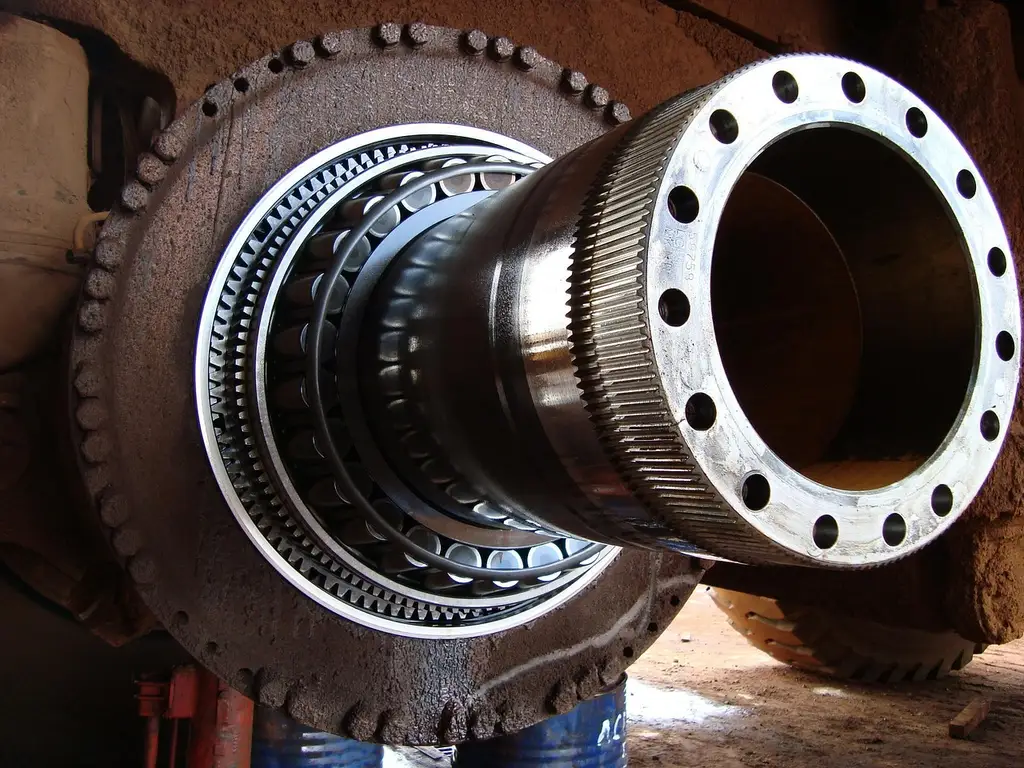
A wheel bearing supports wheel rotation, and when it wears, it can growl, rumble, or grind. Tire tread wear can also make a steady roar, especially with cupping, feathering, or uneven shoulder wear. Noise alone is not enough; wheel-end vibration can be hard to isolate by ear alone.
What the sound usually feels like from the driver’s seat
From inside the car, tire noise often sounds like a broad road drone that stays in one band of speed. A bad bearing more often feels like a hum or growl that rises with vehicle speed and may seem to move with weight transfer. That difference matters because engine rpm is not the right reference point.
If the noise is steady at cruise and changes little with throttle, put speed first in the diagnosis. Then compare two surfaces and two steering loads. That gives a cleaner answer than replacing the noisiest-looking tire or the nearest hub.
How speed, pavement, and steering load split the diagnosis
Vehicle speed is the key discriminator because both tire noise and bearing noise can rise as the car goes faster. The difference is what changes the sound most. Tire noise changes more with road surface. Bearing noise often changes more when one side is loaded in a turn.
That is why a road test on fresh blacktop and rough asphalt is useful. It is also why a gentle left turn and right turn can point to the noisy side of a bearing. If the sound shifts with surface but not much with steering, tire tread gets more suspicious.
Side-by-side comparison
| Clue | Tire noise | Wheel bearing noise |
|---|---|---|
| Common sound | Road roar, hum, or drone | Hum, growl, rumble, or grind |
| Road surface effect | Changes more with pavement texture | Usually changes less with pavement texture |
| Speed effect | Rises with speed, often steadily | Rises with vehicle speed and may get louder at cruise |
| Turning effect | Usually changes little with gentle turns | Can get louder when one side is loaded in a turn |
| Typical next test | Tread inspection and tire rotation | Lift inspection and wheel play check |
Suppose a crossover starts humming at 35 mph and the sound gets much louder on coarse pavement but barely changes in a left or right lane shift. That pattern points toward the tires first, especially if the tread shows cupping across the shoulder blocks. A bearing is still possible, but the surface clue matters.
How does road surface change the noise?
Road surface is one of the cleanest ways to separate tire roar from bearing hum. Fresh blacktop, rough asphalt, and concrete grooves can all change the sound level, but tire noise tends to react more strongly. That is why a quick surface comparison belongs in the first road test.
Rough asphalt versus fresh blacktop
Fresh blacktop may sound quieter and smoother than rough asphalt. If the noise drops on smoother pavement and rises on rough pavement, tire tread is a strong suspect. F1 says brake noise often originates between the tire and the connection to the chassis, and that zone can carry sound into the cabin in a way that seems larger than it is.
F8 makes the comparison practical: fresh blacktop versus rough asphalt is a diagnostic clue. Use the same speed on both surfaces if possible. If the sound changes a lot with pavement but not much with steering, start with tire inspection before hub replacement.
Concrete grooves and tire roar
Concrete grooves can make tire roar seem louder. Some tread blocks follow the groove pattern and create a louder hum that may seem like wheel-end noise. That effect can be sharp enough to sound like road roar inside the cabin even when the bearing is fine.
That is why a sound that only shows up on grooved concrete is not enough to condemn a bearing. Compare the same speed on another surface. If the sound calms down on fresh blacktop, the tire side of the diagnosis becomes stronger.
What changes point toward tread wear
Cupped tread is a common reason a tire may sound like a bearing. Feathering and uneven shoulder wear can do the same. These patterns make the tread blocks slap the road in a repeating way, which creates a hum or drone that can rise with speed and vary with surface texture.
Look closely at the tread before ordering hubs. If one tire has visible cupping or sawtooth wear and the noise changes most on rough pavement, rotate the tires next rather than replacing a bearing first. That keeps the diagnosis tied to the actual symptom pattern.
Does turning change the noise?
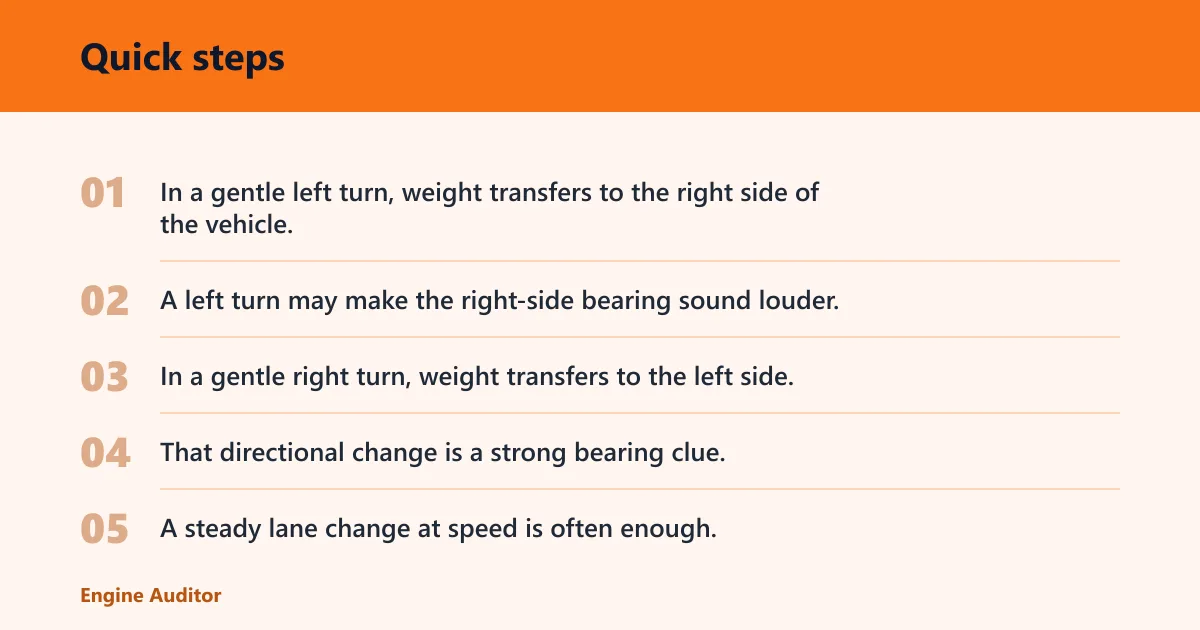
Yes, and that is the second half of the test. A wheel bearing often gets louder when corner load shifts onto the damaged side, while tire noise usually changes less with gentle steering input. A left turn can make the right-side bearing louder, and a right turn can make the left-side bearing louder.
Left turn versus right turn load transfer
In a gentle left turn, weight transfers to the right side of the vehicle. A left turn may make the right-side bearing sound louder. In a gentle right turn, weight transfers to the left side, and F5 says that can make the left-side bearing louder. That directional change is a strong bearing clue.
Keep the turn gentle. A steady lane change at speed is often enough. You are listening for a noise that grows with load on one side and fades when the load moves away. That response is more useful than trying to hear the exact wheel from the driver’s seat.
Why a worn bearing may grow louder on one side
A worn bearing can change sound when load is added because the wheel is no longer running smoothly under side force. The sound may move from a mild hum to a rumble or growl. In advanced wear, a grinding note can appear, and steering play may start to show up.
If the noise changes directionally, do not assume the loud side is the bad side without checking the load pattern. The outside wheel in a turn usually carries more load. That is why the louder side often points to the bearing opposite the turn direction.
Why tire noise usually changes less with steering input
Tire roar usually follows the road more than the steering wheel. A gentle lane change may shift the sound a little, but it often does not create the clear left-right pattern that a bearing does. If steering input makes little difference and pavement type makes a large difference, the tires move up the list.
A common first-timer mistake is to hear a drone on the highway and blame the nearest front wheel. Rear tires and rear bearings can both send sound forward through the cabin. Listen for whether the noise shifts with the turn itself, not only with where it seems to come from.
Tire noise diagnosis table
This table gives a quick decision aid. Use it after a surface comparison and a few gentle lane changes. It helps separate tire roar, bearing hum, and mixed cases where both a tire and a bearing may be contributing.
| Sound type | Road surface response | Turning response | Likely cause | Next test |
|---|---|---|---|---|
| Low hum or drone | Changes a lot between rough asphalt and fresh blacktop | Changes little in gentle turns | Tire roar from tread wear | Inspect tread for cupping, feathering, or shoulder wear; then rotate tires |
| Growl or rumble | Changes less with pavement type than with speed | Gets louder in one turn direction | Wheel bearing wear | Lift the vehicle and check wheel play |
| Roar that seems tied to one wheel | Varies with concrete grooves and rough asphalt | May change only a little | Cupped tire or uneven tread pattern | Rotate tires and retest on the same road |
| Grinding note at speed | Can be present on all surfaces | Often louder when loaded in a turn | Advanced bearing wear | Inspect soon; check for looseness and hub damage |
What else can sound similar?
Several conditions can mimic one another. Cupped tires, wheel-end looseness, and some hub assemblies can all sound like a noisy bearing. Brake noise can also live near the tire-to-chassis area, so the location of the sound inside the cabin is not enough by itself.
Cupped, feathered, and uneven shoulder wear
Tire tread wear patterns matter because they change how the tread hits the road. Cupping creates repeated dips. Feathering leaves a sawtooth edge. Uneven shoulder wear can make one side of the tread do more work and create a steady hum that rises with speed.
If the tread is visibly worn in one of those patterns, rotate the tires before replacing a hub. Tire rotation can move the sound if the tires are the cause. If the noise moves with the tire, that is a strong confirmation.
Wheel play and hub assembly clues
Wheel play means looseness when the vehicle is lifted. That is a physical check, not an ear test. If a wheel rocks when grasped at the top and bottom, a worn bearing or hub problem becomes more likely, and the repair may involve the hub assembly rather than a separate bearing.
Many modern vehicles use a sealed hub assembly. On those vehicles, the bearing may be replaced as a unit instead of as a serviceable bearing. That changes the repair decision, but not the diagnosis process. First confirm the source, then decide whether the hub is the service part.
How tire rotation helps isolate the source
Rotation is useful when the tread condition looks suspicious but the noise is not clear. If the sound changes location after rotation, tire-related noise moves to the top of the list. If the sound stays in the same corner and keeps following speed and load, the bearing deserves closer inspection.
- Check the tread for cupping, feathering, and shoulder wear.
- Drive the car on rough asphalt and fresh blacktop at the same speed.
- Make a gentle left turn and a gentle right turn.
- Rotate the tires if the surface response points to tread noise.
- Lift the vehicle and check for wheel play if the sound follows load.
Choose tire noise if… / Choose wheel bearing noise if…
Replace tires first when tread wear and pavement sensitivity point that way. Inspect the bearing first when the noise tracks with speed and corner load. If the symptoms are mixed, use the condition of the tread, the turning response, and wheel play to decide which path deserves attention first.
Choose tire noise if…
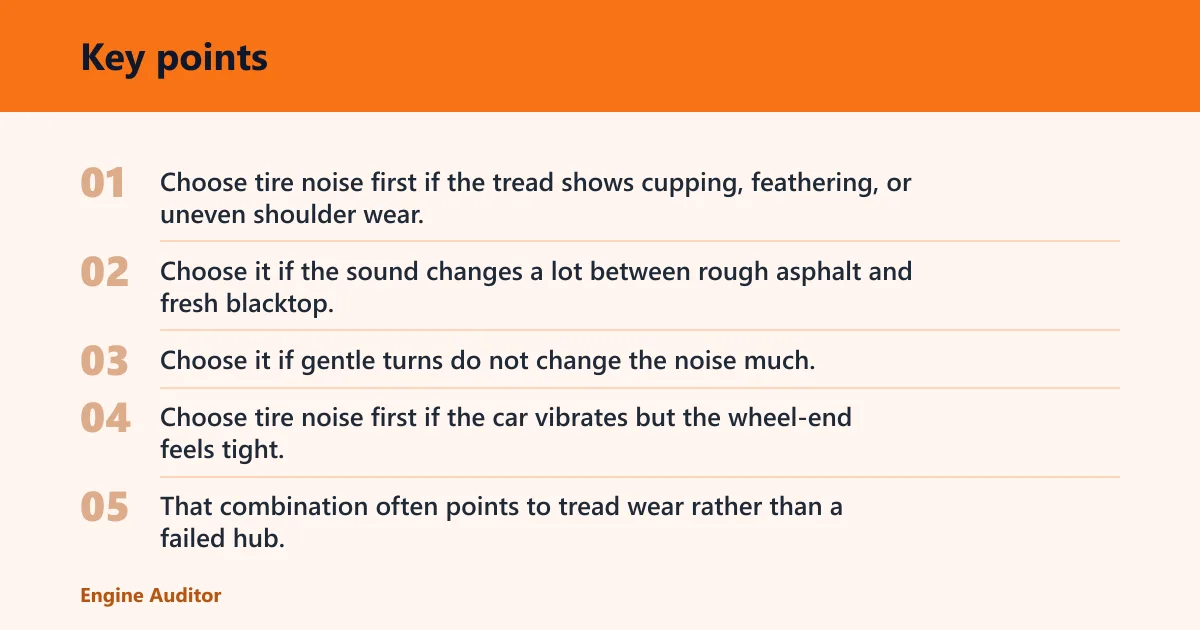
Choose tire noise first if the tread shows cupping, feathering, or uneven shoulder wear. Choose it if the sound changes a lot between rough asphalt and fresh blacktop. Choose it if gentle turns do not change the noise much, and a tire rotation is likely to move the symptom.
Choose tire noise first if the car vibrates but the wheel-end feels tight. That combination often points to tread wear rather than a failed hub. A good rotation test can save you from replacing a bearing that is still serviceable.
Choose wheel bearing noise if…
Choose wheel bearing noise first if the sound rises with vehicle speed and gets louder in one turn direction. Choose it if the noise sounds like a growl, rumble, or grind rather than a plain road hum. Choose it if wheel play shows up when the vehicle is lifted.
Choose bearing inspection first if the sound is getting worse, the steering feel is changing, or the noise is tied to load transfer. If the vehicle has a sealed hub assembly, the repair may be a unit replacement, so a clean diagnosis matters before ordering parts.
Say your sedan develops a steady hum at 50 mph, the sound gets louder in a left turn, and the right-front wheel shows a little play when lifted. That combination points strongly toward the right-front bearing, not the tires. A tread scan still matters, but the turning load clue is the stronger one.
Suppose a compact SUV gets loud on coarse concrete, quiets on fresh blacktop, and stays nearly unchanged in gentle lane changes. The tires become the first suspect, especially if the front tread shows cupping. In that case, rotation and tread inspection come before hub replacement.
Stop driving and get help fast if the noise becomes a grind, the wheel feels loose, or the sound changes sharply in a short time. A bearing that is failing can affect steering play and wheel-end safety. If the sound is severe or growing, treat it as a near-term inspection, not a wait-and-see issue.
Frequently asked questions
How can I tell if a humming noise is my tires or wheel bearing?
Compare two road surfaces and two steering loads. Tire noise usually changes more with pavement texture, especially between rough asphalt and fresh blacktop. Wheel bearing noise often changes more in a gentle left or right turn. If the noise follows speed and load more than surface, inspect the bearing first.
Does wheel bearing noise get louder when turning?
Often, yes. A left turn can make the right-side bearing louder, and a right turn can make the left-side bearing louder. That happens because corner load shifts onto one side of the car. If the sound changes clearly with turn direction, the bearing becomes a stronger suspect than the tires.
Does tire noise change with road surface?
Yes. Tire noise changes more with road surface than bearing noise does. Rough asphalt can make a tired tread sound much louder, while fresh blacktop may quiet it. Concrete grooves can also amplify tire roar. If the sound changes a lot with pavement and little with steering, tread wear is likely.
Can cupped tires sound like a bad wheel bearing?
Yes. Cupped tread can create a hum or roar that sounds close to a failing bearing, especially at highway speed. The difference is that cupped tires usually react more to road texture than to turning load. A tread inspection and tire rotation are the best next steps before hub replacement.
Is it safe to drive with a wheel bearing humming?
Sometimes it is still drivable for a short period, but the risk rises if the noise is getting worse, the wheel has play, or the sound changes into a grind. A humming bearing can progress. If steering feel changes or looseness appears, schedule an inspection quickly and avoid long trips.
How do I test which wheel bearing is noisy?
Use the load test. Drive at a steady speed, then make a gentle left turn and a gentle right turn. If the noise gets louder on one side, the opposite bearing may be the culprit. Then lift the vehicle and check for wheel play. That combination is stronger than ear alone.
Will rotating tires help diagnose the noise?
Yes. Tire rotation can move a tire-related noise to a different corner of the vehicle. If the hum changes location after rotation, the tires are a likely source. If the noise stays tied to the same wheel end and still follows speed and load, inspect the bearing or hub assembly next.
Products related to this article
Sponsored / affiliate links. As an Amazon Associate I earn from qualifying purchases. I may earn additional commission from eligible campaigns.