Can You Drive Without a Thermostat?
Yes, you can sometimes drive briefly without a thermostat, but only as a short limp-home move if the engine stays near normal temperature and the heater and radiator behave normally. Any overheating, rapid temperature swings, or coolant loss means stop. Ignore it, and you can overheat the engine, crack parts, or turn a cheap fix into an expensive repair. This guide shows when to drive, when to tow, and how to separate thermostat faults from other cooling-system problems.
What the thermostat does

The engine thermostat controls coolant flow so the engine reaches operating temperature quickly, then sends coolant through the radiator once heat rises enough. That warm-up control matters because fuel economy, emissions, cabin heat, and wear all change when the engine runs too cold.
Coolant flow and warm-up
When the engine is cold, the thermostat stays closed and coolant mostly circulates through the bypass path inside the engine. That limits radiator flow and lets the metal parts heat up faster. Once the coolant reaches opening temperature, the thermostat opens and sends more flow through the radiator to hold a stable operating range.
If the thermostat is missing, coolant can move through the system with less control. That uncontrolled flow often slows warm-up and can keep the engine below its best operating range, especially in cooler weather.
What happens when it sticks open or closed
A thermostat stuck open usually acts like a constant overcooling problem. The engine may take too long to warm up, the heater may feel weak, and the temperature gauge may sit low at highway speed. A thermostat stuck closed can keep coolant from reaching the radiator properly, so the engine may overheat quickly.
Those two failures do not look the same. A stuck-open thermostat tends to create a cold-running complaint. A stuck-closed thermostat tends to create a hot-running emergency.
Can you drive without a thermostat?
A car can run without a thermostat, but that is a poor setup for regular use. Without one, the engine may run too cold, especially in cooler weather, which can reduce fuel economy, lower overall performance, weaken cabin heat, and increase emissions. Short, careful driving may be possible if temperature stays steady, but it is not a good long-term setup.
What happens if it is removed
With the thermostat removed, coolant flow is less regulated. That can delay warm-up, keep the engine out of its normal temperature range, and leave the heater output low. In winter, the problem is easier to notice because the engine loses heat to cold air faster than it can build it.
Say your compact car idles fine on a 45-degree morning, but the temperature gauge barely rises on the drive to work and the cabin air stays cool at highway speed. That pattern points more toward missing or stuck-open thermostat behavior than a true overheating fault.
When it is only a short limp-home move
Drive only if the temperature gauge climbs to normal and stays there, the heater produces steady warm air, and the coolant level is full. That is a narrow case where a missing thermostat may be treated as a temporary limp-home setup. Even then, keep the trip short and plan a proper repair.
Stop using the car if the gauge swings up and down, the heater turns cold at speed, or you have to add coolant. Those signs point away from a simple thermostat problem and toward a fault that can damage the engine quickly.
Can a bad thermostat cause no heat?
Yes. A bad thermostat can cause weak heater output because the engine may never reach the temperature the heater core needs for strong cabin heat. That is most obvious in cold weather, when the engine loses heat faster and the fan may blow lukewarm air for a long time. Low coolant or trapped air can cause the same symptom.
Why winter driving makes it obvious
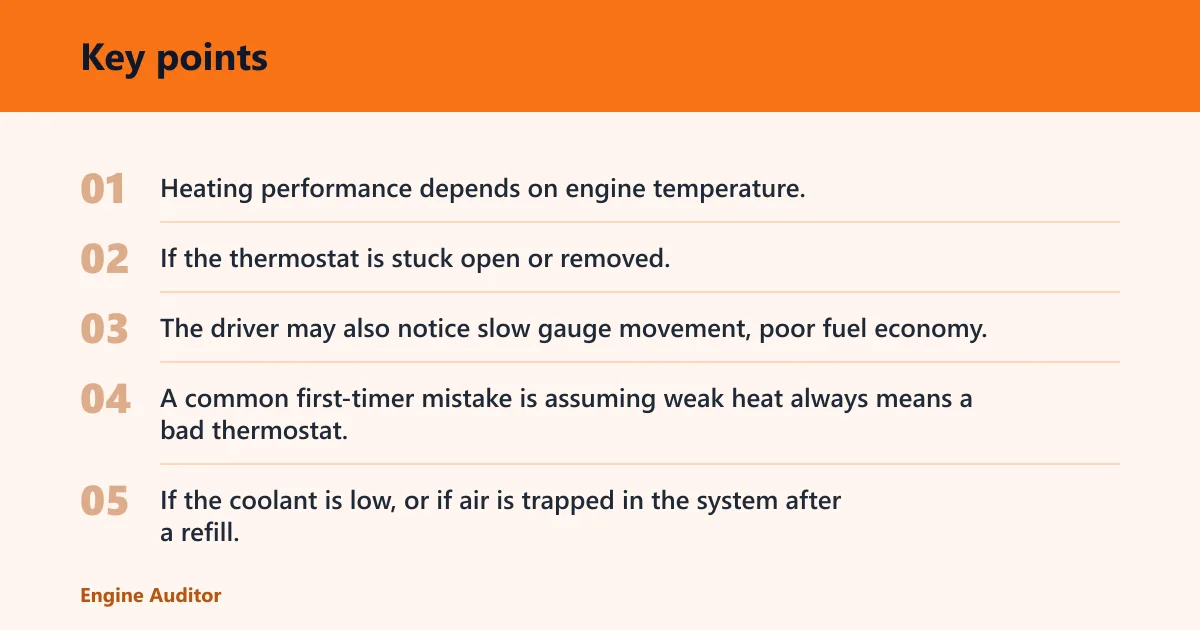
Heating performance depends on engine temperature. If the thermostat is stuck open or removed, coolant may never get hot enough for strong defrost or cabin heat. The driver may also notice slow gauge movement, poor fuel economy, and an engine that feels flat during warm-up.
A common first-timer mistake is assuming weak heat always means a bad thermostat. If the coolant is low, or if air is trapped in the system after a refill, the heater can blow cold even with a good thermostat. Check the coolant level first, then look for temperature stability.
When low coolant is the real cause
Low coolant often causes a heater complaint that looks like thermostat trouble. The heater core may not stay full, so the dash vents blow cold even though the engine itself may be getting hot. Air pockets can do the same thing, especially after a coolant leak or recent service.
If the level is low in the reservoir or the radiator, do not assume the thermostat is the only fault. A missing thermostat does not explain a leak, and a stuck-open thermostat does not usually make coolant disappear.
Thermostat drive table
| symptom pattern | likely thermostat state | recommended next action |
|---|---|---|
| Gauge stays below normal, cabin heat is weak, and the car warms up slowly in cool weather | missing or stuck open | Limp only if the gauge stays stable and coolant is full; otherwise schedule repair soon |
| Gauge climbs fast, warning light comes on, or steam appears from the engine bay | stuck closed | Tow the car; stop driving immediately |
| Heat is weak after a coolant refill, temperature bounces, and the reservoir level changes after shutdown | possibly air pocket or low coolant, not just thermostat | Check coolant level and bleed air only if the engine is cool; inspect for leaks before more driving |
| Temperature is normal at idle but rises in traffic, with the radiator fan not coming on when hot | thermostat may be fine; fan fault more likely | Do not keep driving if it overheats; diagnose fan, relay, fuse, or coolant-flow problems |
| Gauge sits near normal, heater works, and no coolant loss is present after a thermostat removal | missing thermostat | Short limp-home driving only; restore the thermostat before regular use |
How to check it cold and warm
Use the engine state first. Cold clues and warm clues point to different faults, and that keeps you from replacing the wrong part. The thermostat is only one piece of the cooling system, so pair the symptom with coolant level, radiator fan operation, and gauge behavior.
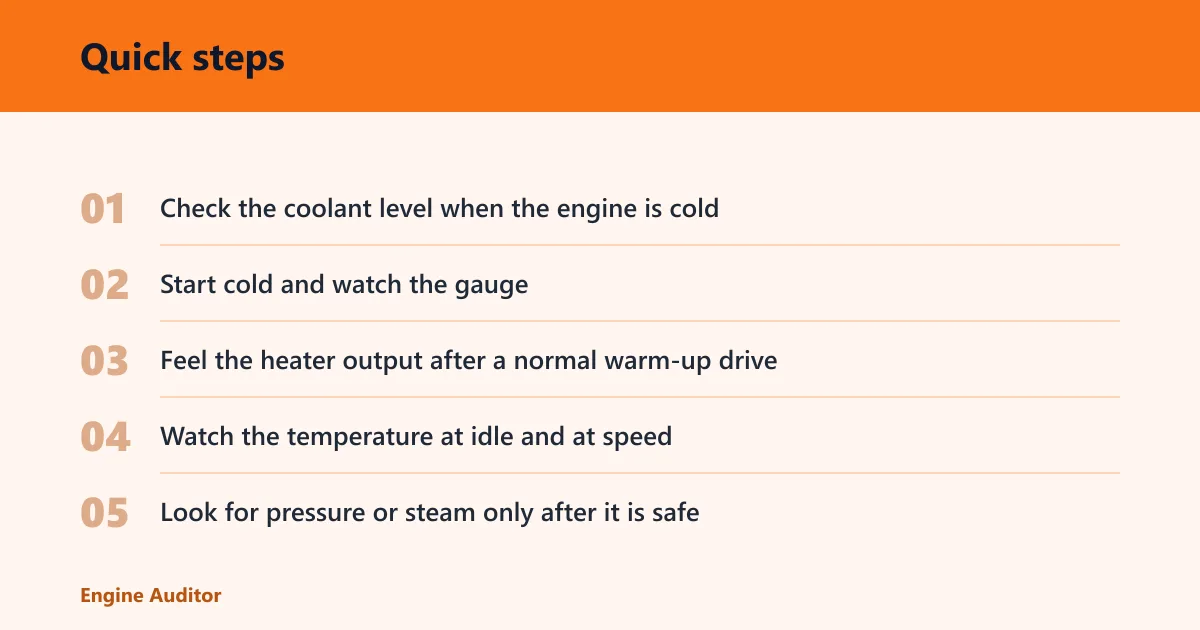
- Check the coolant level when the engine is cold. A low reservoir or empty radiator points to a leak or a refill problem before it points to the thermostat.
- Start cold and watch the gauge. A very slow rise can fit a missing or stuck-open thermostat. A quick climb toward hot can fit a stuck-closed thermostat or another flow restriction.
- Feel the heater output after a normal warm-up drive. Weak heat with a stable low gauge suggests overcooling. Weak heat with a rising gauge suggests low coolant or trapped air.
- Watch the temperature at idle and at speed. If it heats up in traffic but cools down on the road, the fan may be the issue. If it never warms up, the thermostat may be missing or stuck open.
- Look for pressure or steam only after it is safe. Steam, boiling, or a hard upper hose with a hot gauge means stop driving immediately.
Simple checks that point away from the thermostat
If the radiator fan runs constantly from a cold start, or if the temperature rises only when stopped in traffic, the thermostat is not the only suspect. If the heater blows cold right after a coolant refill, trapped air is a strong possibility. If the upper hose stays cold while the gauge climbs, coolant is not moving as it should.
Do not open the cooling system when it is hot. Wait until the engine is fully cool, then check level, hoses, and signs of leakage before deciding whether the thermostat is actually at fault.
Why running too cold matters
Running too cold hurts more than comfort. Fuel economy drops because the engine management system stays in warm-up strategy longer and the mixture may stay richer than normal. Emissions also rise when the engine cannot hold its designed temperature range. The result is poorer efficiency and more pollution.
Cabin heat and drivability
Cabin heat depends on engine temperature. If the thermostat is removed or stuck open, the heater core may never get enough hot coolant for proper output. That matters most in cold weather, where slow warm-up can make defrost weak and the interior uncomfortable for a long drive.
Suppose a midsize sedan starts fine, but after 15 minutes on a 30-degree morning the gauge still reads low and the vents never get truly hot. That pattern fits overcooling much better than a fan fault, because a fan problem usually shows up as overheating rather than chronic low heat.
Long-term wear from overcooling
Continuous overcooling can stress engine components. Long-term operation without a thermostat can lead to costly repairs, because repeated cold running is hard on oil control, combustion quality, and related parts. The warning here is simple: a car may run, but that does not make the setup healthy.
The thermostat also supports fuel efficiency. Removing it may keep the engine away from the temperature the calibration expects, which can affect fuel trims and emissions-readiness monitors on some vehicles. That does not always create a dashboard warning, but it can still mean the engine is not operating as designed.
Frequently asked questions
Can I drive with a bad thermostat?
Sometimes, but only as a short limp-home move. If the thermostat is stuck open or removed and the gauge stays stable, a short trip may be acceptable. If it is stuck closed, or if the engine overheats, do not keep driving.
Can a car run without a thermostat?
Yes. It can physically run, but that does not mean it is operating correctly. Running too cold can hurt fuel economy, emissions, and cabin heat. Long-term operation without a thermostat can also lead to costly repairs from continuous overcooling.
Will a car overheat without a thermostat?
It can, but missing a thermostat more often causes underheating than overheating. Overheating usually points to a stuck-closed thermostat, low coolant, trapped air, a blocked radiator, or a fan problem. If the gauge climbs fast, stop driving right away.
Will a bad thermostat cause no heat?
Yes, especially if the thermostat is stuck open or removed. The engine may never get hot enough for strong heater output. But low coolant and air pockets can create the same symptom, so check the coolant level before blaming the thermostat alone.
Do you need a thermostat?
Yes, for normal operation. The thermostat helps the engine reach and hold the correct temperature, which supports fuel efficiency, emissions control, cabin heat, and engine life. Removing it may let the engine run, but it is not a healthy long-term setup.
Products related to this article
Sponsored / affiliate links. As an Amazon Associate I earn from qualifying purchases. I may earn additional commission from eligible campaigns.