How much does car electrical repair usually cost? Explained
Car electrical repair can cost roughly $100–$400 for battery, fuse, relay, or alternator basics, around $500–$1,500 for wiring or module faults, and $2,000 or more for harness or control-unit jobs. I have seen the wrong symptom pattern turn into repeat part swaps, dead-battery tow bills, and repairs that still fail. This guide shows how to estimate the bill from the symptom pattern, then match it to low-, mid-, and high-cost fixes.
The first split is diagnosis versus repair. A shop may charge for testing even if no parts are replaced, and that bill often decides whether the quote feels clear or turns into a surprise. If the symptoms point to an easy fix, the full bill stays near the low end. If the problem is intermittent, buried in wiring, or tied to a module, the bill climbs fast.
How much does car electrical repair usually cost?


What makes one quote cheap and another expensive?
Labor time drives the biggest spread. A battery swap can take minutes. A charging-system test, a no-start trace, or a harness fault can take hours because the technician has to prove the failure before changing parts. Parts also move the total, especially when the job needs coding, programming, or deep disassembly.
Shops price the risk differently too. If the fault is obvious, the estimate is clean. If a short comes and goes, or a connector has heat damage, the repair path can change after the first test. Two cars with the same dashboard light can land in very different brackets.
According to Auto Electrical Repair Cost Guide — Wiring harness repair is listed at $200—$800.
What counts as an auto electrical repair?
Auto electrical repair includes the battery, charging system, starter, fuses, relays, wiring, sensors, ignition parts, and control modules. A dead battery is only one piece of that picture. Many “electrical” complaints turn out to be sensor faults, damaged wiring, or a failed module that is disturbing the whole circuit.
Battery, charging, starting, and wiring problems
Dim lights, slow cranking, repeated jump-starts, blown fuses, and a burning smell from wiring all fit this group. Some are simple wear items. Others point to a short circuit, corroded cable, or a charging system that is not keeping the battery up.
When a symptom is really a sensor or module fault
Rough running, stalling, hesitation, and warning lights can come from an oxygen sensor, mass airflow sensor, throttle position sensor, crankshaft position sensor, or ECU/PCM issue. Those often get described as “electrical” even when the battery is fine. That is why the symptom pattern matters before any part is replaced.
How diagnosis is billed before repairs
Electrical diagnosis is often billed separately, and that is normal when the shop has to test the circuit before quoting the fix. A proper diagnostic visit usually includes battery and charging checks, fuse inspection, scan-tool readings, voltage-drop testing, and confirmation of the failed branch. Electrical short diagnosis is listed at $80–$200.
What a proper diagnostic visit should include
The technician should verify the complaint, inspect the obvious power and ground points, check for stored codes, and isolate whether the failure is upstream or downstream. For intermittent faults, the process may include wiggle testing, load testing, and heat checks because a bad connection can pass one minute and fail the next.
When diagnosis is separate from the repair bill
Diagnosis is usually separate when no repair is approved, or when the first test only narrows the problem. Some shops roll the fee into the repair if the job is done there. Others keep it separate so the customer can compare quotes without mixing testing time with parts and labor.
Use symptoms to narrow the likely repair
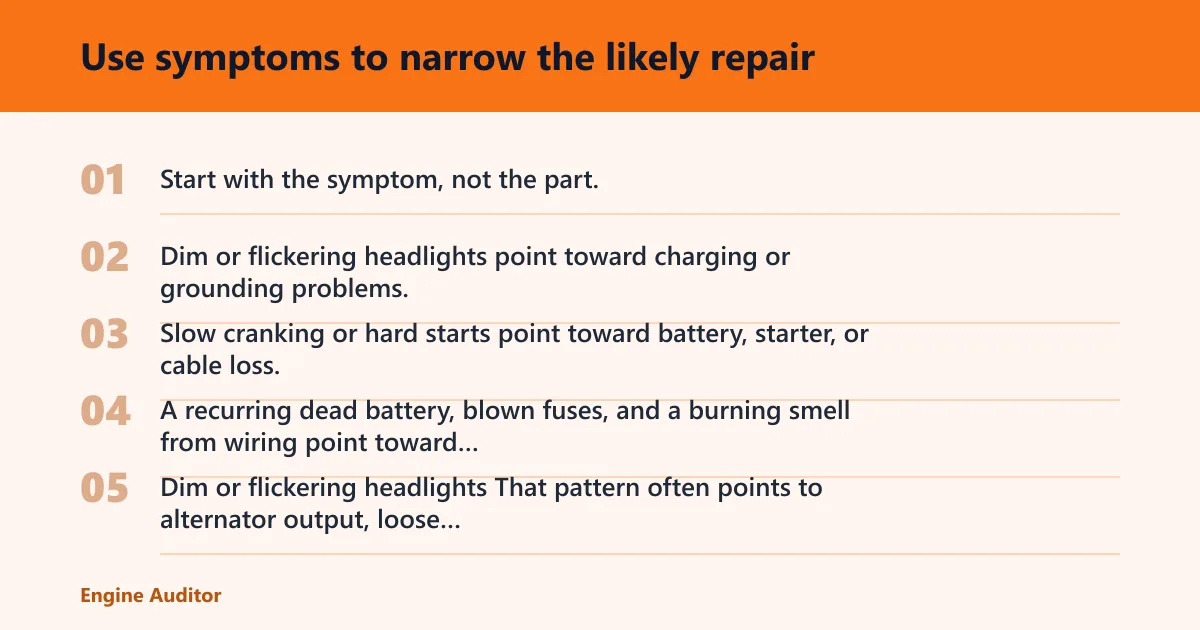
Start with the symptom, not the part. Dim or flickering headlights point toward charging or grounding problems. Slow cranking or hard starts point toward battery, starter, or cable loss. A recurring dead battery, blown fuses, and a burning smell from wiring point toward parasitic draw, short circuits, or harness damage.
Dim or flickering headlights
That pattern often points to alternator output, loose battery terminals, weak grounds, or a belt-driven charging issue. If the lights brighten with engine speed, the charging system moves higher on the list. If the problem happens with the engine off too, the battery or connections may be the first place to test.
Slow cranking, hard starts, and no-crank
Slow crank with a good battery often points to the starter, cable resistance, or a weak connection. A no-crank complaint can also come from the starter relay, ignition switch, neutral safety circuit, or a security-related module issue. Shops usually confirm battery health before condemning the starter.
Recurring dead battery, blown fuses, and burning smell
A battery that keeps dying can mean a bad alternator, parasitic draw, corroded wiring, or a module that stays awake. Repeated blown fuses point toward a short. Burning smell from wiring is a red flag for heat damage, melted insulation, or a connector that has been overloaded.
Proof asset: symptom-to-cost estimator table
Use this table as a quote filter. Start with the complaint, match it to the likely fault area, ask the shop what it will test first, then compare the repair range to the estimate you received. The diagnosis line matters because a low parts quote can still turn into a larger bill once labor and testing are included.
| Complaint | Likely fault area | Likely first test | Realistic low-to-high repair range |
|---|---|---|---|
| Dim or flickering headlights | Alternator, battery, grounds, belt drive | Charging-system and voltage-drop test | $100–$700 |
| Slow cranking or hard starts | Battery, starter, cables, relay | Battery load test and starter current check | $100–$600 |
| Recurring dead battery | Battery, alternator, parasitic draw, module | Parasitic draw and charging test | $80–$1,500 |
| Blown fuses | Short circuit, wiring, fuse box, component load | Circuit isolation and fuse-box inspection | $100–$800 |
| Burning smell from wiring | Wiring, connector, fuse box, overloaded circuit | Visual inspection and thermal damage check | $200–$1,500+ |
Battery, alternator, and starter costs
The three most common starting and charging repairs sit in separate price bands. Standard battery replacement is listed at $100—$250. AGM or premium battery replacement is listed at $200—$400. Alternator replacement is listed at $300, $700. Starter motor replacement is listed at $250, $600.
Battery replacement: standard vs AGM pricing
A standard battery usually covers the cheapest end of the bill. AGM or premium batteries cost more because the battery itself costs more and some vehicles need extra care with fitment or programming. Common battery symptoms include slow cranking, repeated jump-starts, dim lights, and a battery that drops voltage after sitting.
Alternator replacement cost and labor drivers
The alternator keeps the battery charged while the engine runs. When it fails, the car may drive for a short time and then die, or the lights may flicker as voltage falls. The price climbs when the alternator is buried under intake parts, belts, or covers that add labor time.
Starter motor replacement and next checks
Starter problems usually show up as a click, a single weak spin, or a full no-crank. A good shop still checks the battery, cables, relay, and ignition circuit before replacing the starter. That avoids paying for a part when the real issue is voltage loss in the feed or ground.
Why is my car electrical repair quote so high?
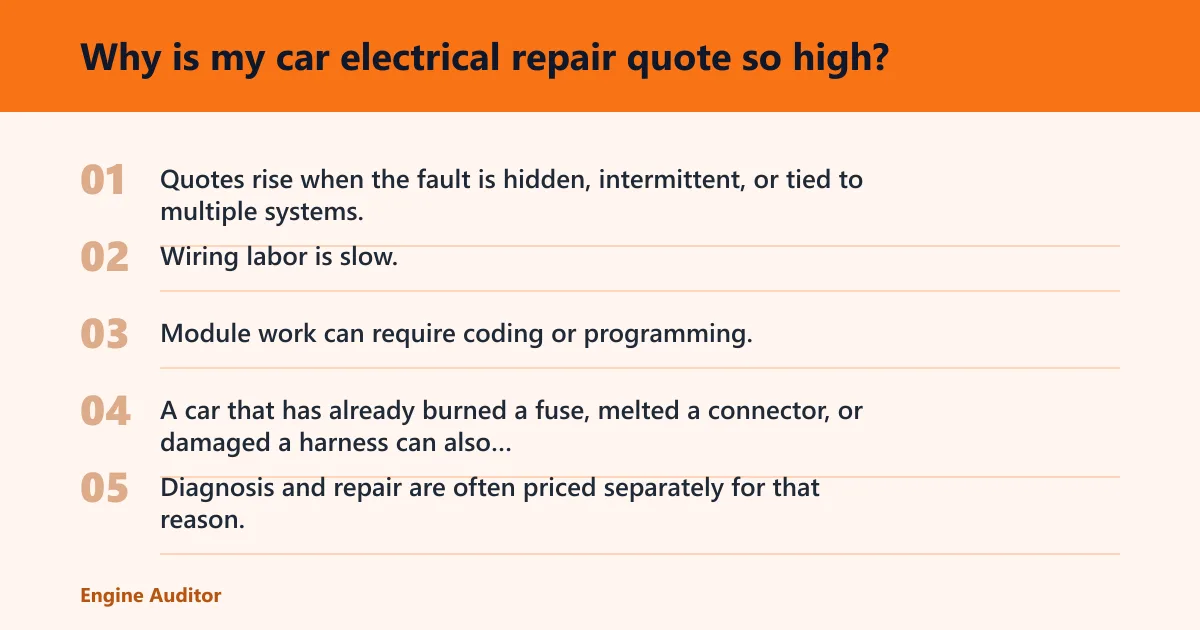
Quotes rise when the fault is hidden, intermittent, or tied to multiple systems. Wiring labor is slow. Module work can require coding or programming. A car that has already burned a fuse, melted a connector, or damaged a harness can also need more teardown than the first estimate suggested. Diagnosis and repair are often priced separately for that reason.
Wiring repair: splice, section repair, or replacement
Wiring repair is listed at $200, $800. That range covers damaged wire repair, section replacement, or a full harness run when the damage is too spread out for a clean splice. The decision comes down to insulation damage, corrosion, connector condition, and whether the repaired section will hold under heat and vibration.
Fuse box repair or replacement cost
Fuse box repair or replace is listed at $100, $400. A blown fuse alone is often the symptom, not the fault. If the box is heat damaged, corroded, or has a failing internal bus, replacement may be the right call. If the issue is only a single blown fuse, the real work is finding what overloaded the circuit.
Electrical short diagnosis workflow and pricing
An electrical short diagnosis is listed at $80, $200. The workflow usually starts with the fuse map, then branch isolation, then component unplugging and voltage checks until the short disappears. That can be quick on an obvious fault and time-consuming when the problem hides inside a harness or under trim.
Do electrical problems usually start with the battery or alternator?
They often start with the battery only because it is the easiest weak point to notice, but the alternator is just as common when the engine is running and the battery keeps going flat. Shops usually test the battery first, then the alternator output, then cable and ground condition before moving deeper.
How shops usually test that path
The normal path is battery state-of-health, cranking voltage, charging voltage, and then parasitic draw if the car dies while parked. That sequence keeps a shop from replacing a good alternator when the real problem is a weak battery or a drain that appears after the car is off.
What car electrical repairs are cheap versus expensive?
The cheapest electrical repairs are usually battery replacement, a blown fuse fix, relay work, or a simple sensor swap. The expensive end starts when the vehicle needs harness repair, module replacement, or extended troubleshooting. Labor, access, and programming are what push the bill upward, not only the part price.
Sensors and modules
O2 sensor replacement is listed at $150, $400. Mass Airflow Sensor replacement is listed at $150, $350. Throttle Position Sensor replacement is listed at $100, $250. Crankshaft Position Sensor replacement is listed at $120, $300. ECU or PCM replacement is listed at $500, $1500. Those parts often sit behind drivability complaints that feel electrical, even when the battery is fine.
Ignition components
Spark plug replacement is often a lower-ticket maintenance item, but ignition coil failure can create rough running, misfires, and hard starts that look electrical from the driver’s seat. Distributor replacement, on older vehicles that still use one, can also move the bill higher because access and calibration may add labor.
Can a fuse box repair fix an electrical problem?
Yes, if the fuse box is the failed point. A bad fuse box can create no-starts, dead circuits, intermittent accessories, or repeated blown fuses. If the problem is only a weak fuse or relay, the repair may be simple. If the box has heat damage or internal failure, replacement is usually the better fix.
How fuse problems differ from short problems
A blown fuse is a symptom of excess current. The fuse box may be innocent, or it may be the part that failed after the overload. The technician still has to find the reason the fuse opened, because replacing the fuse without finding the short usually ends with the same failure again.
How much does electric car maintenance cost?
How much does electric car maintenance cost depends on whether the question is about an EV battery system, a 12V accessory issue, or routine service. EVs still have 12V electrical faults, but their maintenance frame is different from gasoline cars because there is no alternator, starter, or ignition tune-up in the usual sense.
how much does electric car service cost
how much does electric car service cost is better answered by the exact service item. Brake work, cabin filters, tires, coolant service, software updates, and 12V battery replacement do not price the same way as a gasoline-car electrical repair. If the issue is a warning light or no-start, ask whether the concern is high-voltage, 12V, or control software before comparing quotes.
how much does electric car maintenance cost
how much does electric car maintenance cost should be treated as a separate search from car electrical repair. EV owners should ask for a diagnosis that identifies the affected system first. If the problem is truly in the 12V side, the quote may look similar to a conventional car. If it involves traction-battery or inverter work, the frame changes completely.
Frequently asked questions
How much does car electrical repair usually cost?
Most basic electrical repairs land around $100–$400, while wiring or module problems often move to $500–$1,500 or more. The biggest variable is whether the quote includes diagnosis, because testing can be a separate line item before any part is installed.
Why is my car electrical repair quote so high?
High quotes usually mean long diagnosis time, hard-to-reach parts, wiring damage, or module programming. A cheap part can still produce a high bill if the technician has to remove trim, test several branches, or confirm an intermittent short before the repair can be trusted.
How much does an alternator replacement cost?
Alternator replacement is listed at $300, $700. The spread comes from labor access, belt or bracket removal, and whether the charging fault is confirmed before replacement. If the battery was drained by a dead alternator, some shops also test the battery before handing the car back.
How much does a starter motor replacement cost?
Starter motor replacement is listed at $250, $600. A no-crank symptom can point to the starter, but good shops still check the battery, cables, relay, and grounds first. That avoids replacing a starter when the fault is actually voltage loss elsewhere in the circuit.
How much does wiring repair cost?
Wiring repair is listed at $200, $800. Small splice repairs sit near the low end, while larger section repairs or full harness replacement move higher. Heat damage, corrosion, and hidden routing behind trim are the main reasons the estimate grows.
Do electrical problems usually start with the battery or alternator?
They can start with either one. Shops usually test the battery first, then the alternator, then look for a draw or cable issue if the failure repeats. Slow cranking, dim lights, and a battery that keeps dying are the clues that decide which path gets checked first.
Products related to this article
Sponsored / affiliate links. As an Amazon Associate I earn from qualifying purchases. I may earn additional commission from eligible campaigns.