How to Check a Car Fuse Without Pulling Every Fuse
Check a car fuse in place by touching the two exposed test points with a test light or multimeter; if one side has power and the other side does not, that fuse is blown. Skip this step and you can waste time pulling the wrong fuses or miss the real fault. This guide shows a zero-pull workflow, from symptom tracing to the exact in-box fuse check.
This guide is part of our Car electrical troubleshooting guide series.
What you’ll need
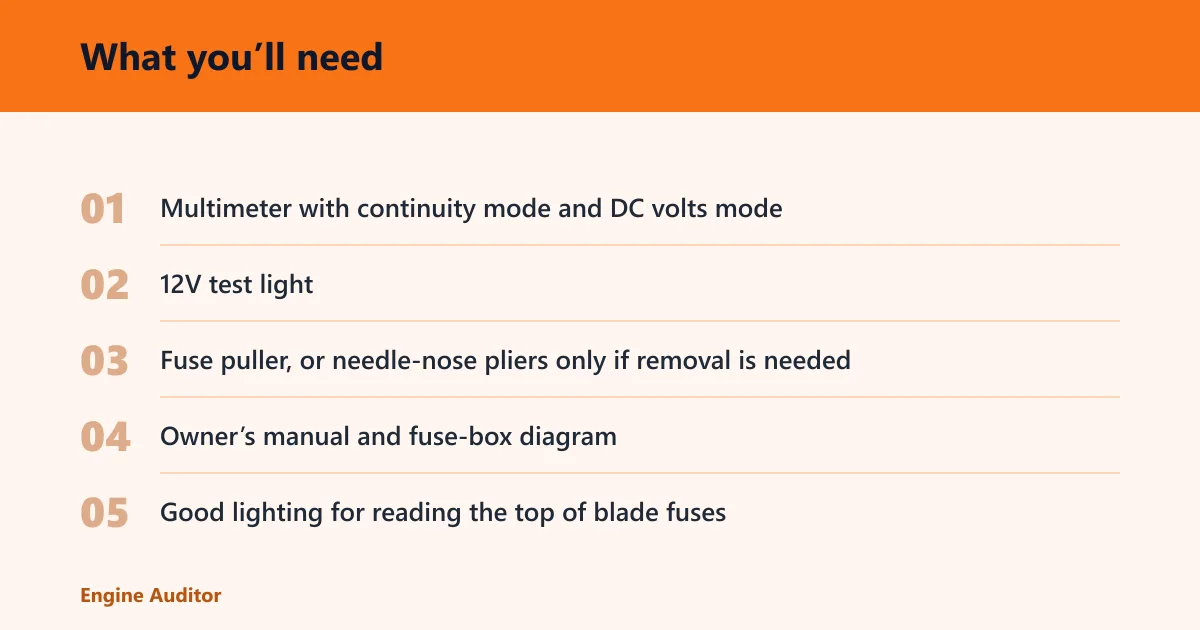


- Multimeter with continuity mode and DC volts mode
- 12V test light
- Fuse puller, or needle-nose pliers only if removal is needed
- Owner’s manual and fuse-box diagram
- Good lighting for reading the top of blade fuses
Start with the symptom, then find the suspect circuit
A dead accessory usually points to one circuit, not the entire fuse box. Start with the failed item, then narrow the search to a cabin fuse box or an under-hood fuse box. Use the owner’s manual or the fuse-box lid legend to match the circuit label and fuse rating exactly.
How to find the right fuse box and fuse location quickly
- Match the failed item to the label in the owner’s manual or lid diagram.
- Check cabin locations first for interior power items, then under-hood locations for high-current systems.
- Note the fuse number, circuit name, and amperage before probing anything.
Say your radio and power outlets both quit at the same time. The diagram may point to an accessory or ACC circuit in the interior box, while a blower motor problem often sends you to the under-hood panel. The map saves time before any fuse is removed.
How do you check a car fuse without pulling it out?
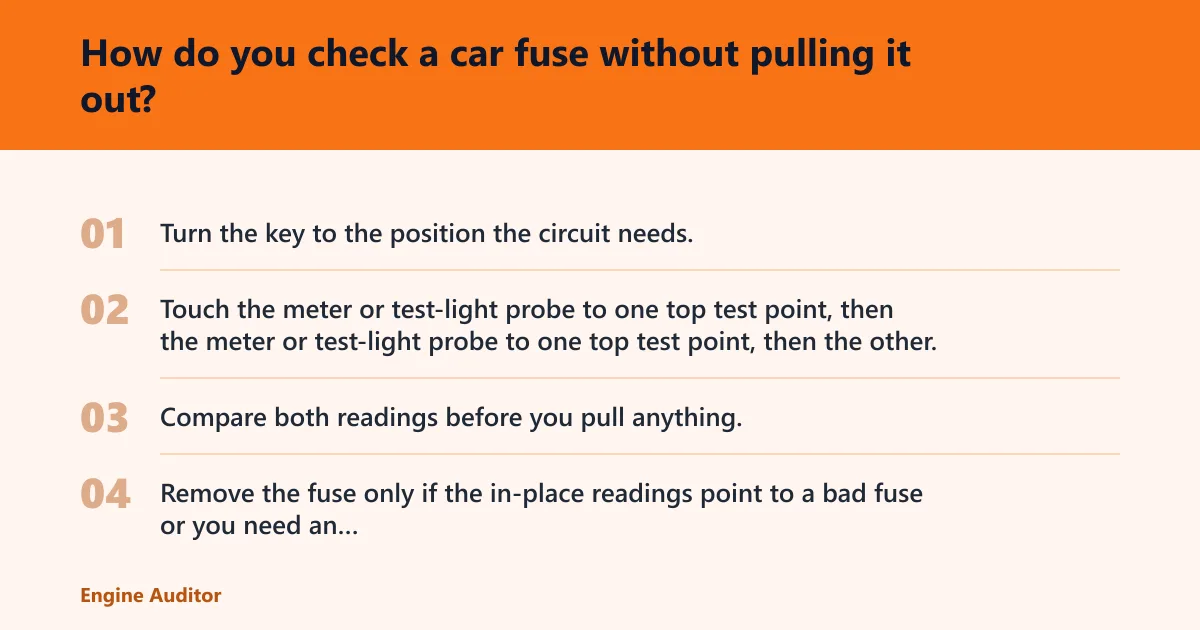
Set the key state the circuit needs, then probe the two exposed test points on top of the blade fuse. Read both sides before removing anything. If the input and output do not match, the fuse or the feed path is the next suspect.
- Turn the key to the position the circuit needs, because some slots are live only with ignition on.
- Touch the meter or test-light probe to one top test point, then the other.
- Compare both readings before you pull anything.
- Remove the fuse only if the in-place readings point to a bad fuse or you need an off-vehicle continuity check.
In-place fuse test matrix
| Case | Power-in side | Power-out side | What it means | Best next step |
|---|---|---|---|---|
| Blown fuse | 12V or test light on | No voltage or no light | The fuse link is open | Replace with the same amperage rating |
| Good fuse with power on both sides | 12V or light on | 12V or light on | Fuse is passing power | Move to the load, connector, or wiring |
| Good fuse with no upstream power | No voltage or no light | No voltage or no light | No feed is reaching the slot | Trace the upstream supply, relay, or ignition feed |
Use DC volts on an installed fuse to check for power. Use continuity mode only after removal, or when the meter cannot give a clear live-circuit reading. On a 12V system, a healthy fuse feed should usually show battery voltage at both test points when the circuit is powered.
How can I tell if a car fuse is blown from the top?
Blade fuses have two exposed test points on top, and many also have a visible metal link through the plastic. A blown fuse often has a broken or melted strip, but the top test points are the faster check because they show whether power passes through the installed fuse.
Look at both top points, not only the clear window. A fuse can look intact and still fail under load, or a bad upstream feed can make a good fuse look guilty if you inspect only one side.
How to read a good fuse, a blown fuse, and no upstream power
- Probe one top test point with the meter red lead or test-light tip.
- Probe the other test point with the black lead or ground reference.
- Record both readings before deciding the fuse is bad.
Key-on versus key-off matters. A socket or accessory fuse may show voltage only with ignition on, while some memory circuits stay live all the time. If both points read dead, the slot may simply not be powered at that key position.
Can you test automotive fuses with a multimeter?
Yes. A multimeter is the better tool for a precise in-place diagnosis because it can show voltage on each side of the fuse, then continuity after you remove it. Continuity mode confirms the fuse element is intact, while DC volts confirms that the slot is actually receiving power.
Back-probing the top test points is usually enough for installed testing. If the fuse is out of the vehicle, set the meter to continuity mode and check for a beep or near-zero resistance across the blade terminals.
What setting should a multimeter be on to test a car fuse?
Set the meter to DC volts for an installed fuse. Set it to continuity mode for a removed fuse. On a 12V vehicle, continuity mode is not a substitute for a live-circuit voltage check, because it cannot tell you whether power reaches the fuse slot.
Use the black lead on a known ground and the red lead on each top test point. If the meter reads battery voltage on both sides, the fuse is doing its job. If it reads voltage on one side only, the fuse is blown.
Is a test light better than a multimeter for checking car fuses?
A test light is faster for quick 12V checks, and a multimeter is better for separating a blown fuse from a dead feed. A test light can confirm power at the fuse slot, but it cannot show exact voltage or small voltage drops the way a meter can.
Use the test light for a fast back-probe on the fuse’s top points. Use the multimeter when the circuit is intermittent, when one side reads dead, or when you need to know whether power is missing upstream.
When a fuse looks good but the circuit still does not work
- Check for power on the input side of the fuse slot.
- Inspect the load-side connector, wiring, and device.
- Replace any blown fuse with the exact same amperage rating.
- Trace repeated failures as an overload or short, not as a fuse-box problem.
Suppose a 15A cigarette-lighter fuse looks perfect, yet the socket is dead. If both top points show no voltage with the key on, the problem is upstream of the fuse. If both points show power, the fault is likely in the socket, ground, or device.
Can you check fuses in a car without a fuse puller?
Yes. You only need a fuse puller when removal is required, and many fuse boxes store one in the lid or the vehicle’s tool kit. If the fuse must come out, a plastic puller is safer than metal pliers because it reduces the chance of shorting adjacent terminals.
Needle-nose pliers can work in a pinch, but only with the key off and careful grip on the fuse body. For zero-pull diagnosis, stay on the top test points and avoid opening every slot.
What if the fuse looks good but the circuit still doesn’t work?
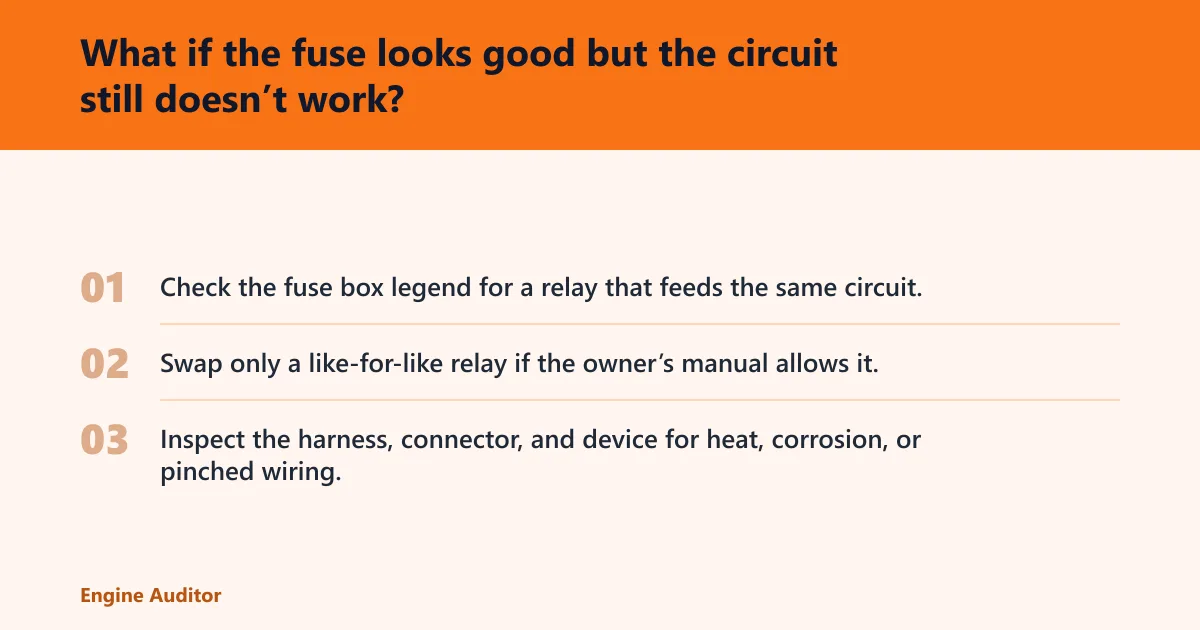
A fuse can look good and still be innocent. If the slot has no upstream power, the fault is before the fuse; if the fuse has power on both sides, the problem is on the load side. Repeated blowing usually points to a short or overload in the circuit.
If that didn’t work, try this next
- Check the fuse box legend for a relay that feeds the same circuit.
- Swap only a like-for-like relay if the owner’s manual allows it.
- Inspect the harness, connector, and device for heat, corrosion, or pinched wiring.
Use the exact amperage rating listed for the original fuse. Common blade values often include 5A, 10A, 15A, 20A, and 30A, and the color coding can vary by rating. Overfusing can damage the wiring before the fuse opens.
Common mistakes
These errors waste time and can lead to the wrong repair. The fix is usually a better reading path, not more fuse pulling.
- Pulling half the fuse box before checking the suspect circuit
- Using continuity mode on a live circuit
- Reading only one test point on top of the fuse
- Assuming a clear plastic window proves the fuse is healthy
- Installing the wrong amperage fuse
Prevention
Keep a small note of the fuse number, rating, and circuit label in the glove box or phone. That makes the next diagnosis faster and cuts down on unnecessary fuse removal.
Frequently asked questions
How do you check a blade fuse while it’s still installed?
Probe the two exposed test points on top of the blade fuse with a multimeter set to DC volts or a 12V test light. One powered side and one dead side means the fuse is blown. Power on both sides means the fuse is passing current and the fault is elsewhere.
How can I tell if a car fuse is blown from the top?
Use the top test points instead of the plastic window. A blown fuse usually shows voltage or light on the input side and nothing on the output side. If both sides are dead, check whether that circuit is supposed to be live with the key on before calling the fuse bad.
Can you test automotive fuses with a multimeter?
Yes. Set the meter to DC volts for installed fuses and continuity mode for removed fuses. On a 12V vehicle, a good live fuse should show battery voltage at both test points. Continuity mode should only be used when the fuse is out of circuit.
Can you check fuses in a car without a fuse puller?
Yes. A fuse puller is only needed if you must remove the fuse. For in-place testing, a meter probe or test light is enough. If removal is unavoidable, a plastic fuse puller is safer than metal pliers because it lowers the chance of an accidental short.
What setting should a multimeter be on to test a car fuse?
Use DC volts on an installed fuse and continuity mode on a removed fuse. That split matters because voltage tells you whether power reaches the slot, while continuity only tells you whether the fuse element is intact. Both readings together give a complete diagnosis.
How do I find the right fuse box and fuse location quickly?
Check the owner’s manual and the fuse-box lid legend first. Match the failed accessory to the circuit label, then look in the cabin box or under-hood box based on the system involved. The diagram usually lists the fuse number, rating, and circuit name.
What if the fuse looks good but the circuit still doesn’t work?
Check the input side of the fuse slot first. If no power reaches the slot, the fault is upstream. If both sides show power, move to the load, connector, ground, or relay. Repeatedly blown fuses usually point to an underlying short or overload.
Is a test light better than a multimeter for checking car fuses?
A test light is faster for a quick yes-or-no power check, but a multimeter gives clearer evidence. Use the test light for a fast back-probe on the fuse top, then use the meter if the reading is unclear or you need to separate a blown fuse from a dead feed.
Products related to this article
Sponsored / affiliate links. As an Amazon Associate I earn from qualifying purchases. I may earn additional commission from eligible campaigns.
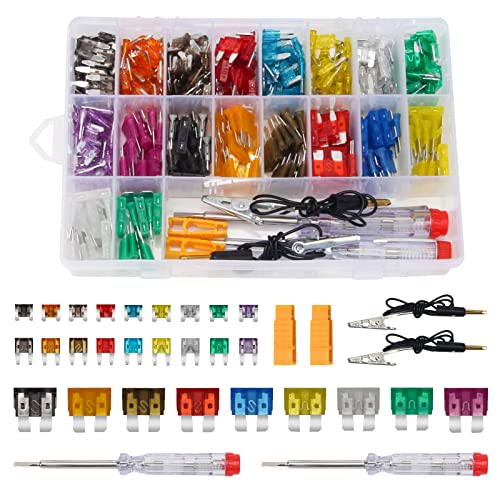 306 PCS Car Fuses Assortment Kit, With 2 Car Fuse Tester and 2 Fuse Puller, Ahier Blade-type Automotive Fuses Replacement Fuses Standard & Mini & Low Profile Mini (2A/5A/10A/15A/20A/25A/30A/35A) (306)
 Innfeeltech 25 Pcs Standard Size Automotive Fuse, Flat Car Fuse 3A with 2 Plastic Clips for Car, Truck and Motorbike