Car Keeps Blowing Fuses: Common Causes and Fast Fixes
A car that keeps blowing fuses usually has a short to ground, a circuit drawing too much current, or a failed component. The fastest rule is this: replace the fuse once, then diagnose the circuit; if it blows again, stop guessing. Ignoring it can strand you, damage wiring, or overheat the fuse box. This guide shows how blow timing and load behavior point to the likely wire path or part.
This guide is part of our Car electrical troubleshooting guide series.
Why the same fuse keeps blowing
A fuse protects the circuit, not the root cause. If the new fuse fails again, the problem is still in the wire path, connector, branch, or component on that circuit. Blade fuses have a clear housing for visual inspection, but they can fail without visible damage, so the failure pattern matters as much as the fuse itself.
Use the fuse amperage rating printed on the blade fuse and on the fuse-box chart. Ratings are shown in amps like 10A or 15A, and the fuse must match the OEM circuit specification. Do not up-rate it. A larger-than-needed fuse can let damaged wiring overheat before it opens.
What the failure pattern tells you
Timing is the shortcut. An immediate blow often points toward a short circuit. A blow only when a switch, motor, or accessory turns on points more toward overload or a failing component. A blow after heat, vibration, or road movement often points to a wire rubbing metal, a loose connector, or a wiring run pinched at a body pass-through.
Say your 15A power outlet fuse survives key-on, then blows when a phone charger and tire inflator run at the same time. That pattern points to circuit overload, not a dead short. Suppose a 10A wiper fuse blows only when the steering wheel is turned fully left. That points toward a wiring run pinched near the column or dash pass-through, or insulation rubbed through at a moving joint.
Decision table: symptom, likely cause, fastest test, and risk
| Symptom timing | Likely cause | Fastest test | Common location | DIY risk level |
|---|---|---|---|---|
| Blows instantly at key on | Short circuit to ground; bare wire touching metal | Remove the load, then check continuity from fuse output to ground with a digital multimeter | Wire bends, sharp brackets, metal pass-throughs | Medium |
| Blows only when a motor or switch turns on | Failed electrical component or circuit overload | Unplug the load and see whether the fuse holds; use a test light or meter to confirm power | Window motor, blower fan, fuel pump connector, accessory wiring | Medium to high |
| Blows after heat or road vibration | Intermittent short, worn insulation, loose connector | Wiggle test the wire run while watching continuity or test-light behavior | Door jambs, under-seat wiring, hatch hinges, engine bay clips | Medium |
| Blows after aftermarket accessory use | Circuit overload from added draw | Disconnect the add-on and retry; compare draw to the circuit rating | Dash panel, power outlet, fuse-tap installs | Low to medium |
| Blows on a high-current system | Failed component or wiring fault on a safety-critical circuit | Stop at power checks; avoid repeated fuse swaps | ABS, cooling fan, fuel pump | High |
Why does my car keep blowing the same fuse?
The same fuse keeps blowing because the circuit is still asking for more current than the fuse can safely pass. That can happen from a short circuit, a circuit overload, or a component that is drawing too much current. The repeating failure tells you the fault is still active.
Short circuit clues
A short circuit happens when a bare conductor touches metal and sends current to ground. Worn insulation, rodent damage, and pinch points can all create that path. The fuse usually fails immediately, often before the circuit gets a chance to run normally.
Look for chafed insulation where the wire run crosses brackets, hinges, or metal edges. Follow the wire path from the fuse box to the load, then inspect any spot where movement, heat, or a sharp edge could have cut through the jacket.
Overload clues
A circuit overload is different from a dead short. The wiring is intact, but too much current is being pulled on one circuit. Aftermarket accessories are a frequent cause, especially dashcams, phone chargers, extra lights, and audio systems added without upgraded wiring or a dedicated circuit.
An overload often shows up under heavy use rather than at rest. The fuse may survive until several devices run together, or until a motor works harder than usual. That pattern points to load, not bare metal contact.
Failed component clues
A failed electrical component can draw excessive current and blow the fuse after brief operation. A faulty power window motor is a known example. Fuel pumps and blower fans can do the same, and the problem may come and go depending on temperature, speed, or internal wear.
Intermittent parts can pass a quick test and fail later. That is why a circuit that works once in the bay may still blow on the road. Heat and load change the electrical demand.
How to check the fuse box and fuse itself
Start at the fuse box, then prove the fuse and circuit condition before replacing parts. A digital multimeter in continuity mode can help confirm a fuse failure, and a test light can quickly check for power at the fuse terminals. Use the lid diagram or owner’s manual to identify the correct circuit.
Find the right fuse box and diagram
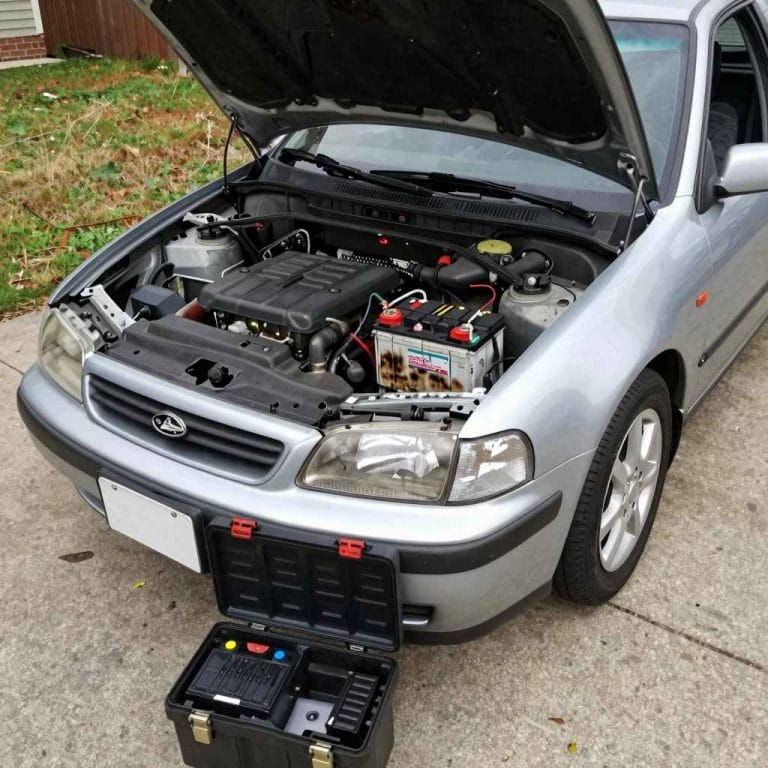
Common fuse-box locations are under the dash and in the engine bay. The interior fuse box commonly sits on the driver’s side under the dashboard. A second fuse box is often under the hood near the battery, and it usually protects different circuit groups.
Check the fuse-box lid diagram first, then confirm with the owner’s manual. Do not guess by fuse color alone. Color helps identify amperage, but it does not prove you have the right circuit.
Inspect the blade fuse
Blade fuses are color-coded by amperage and have a clear body for visual inspection. In many blade fuses, tan, brown, red, blue, and yellow are commonly used for around 5A, 7.5A, 10A, 15A, and 20A, respectively. A fuse can look intact yet still have zero continuity.
Pull the fuse with a fuse puller and inspect the metal link inside. If the link is broken or darkened, replace it once with the exact OEM rating. If it looks fine, do not stop there.
Confirm with a digital multimeter or test light
Set a digital multimeter to continuity mode and test across the two fuse blades when the fuse is out. No continuity means the fuse is bad even if the body looks normal. You can also use a test light to confirm power at both sides of the installed fuse.
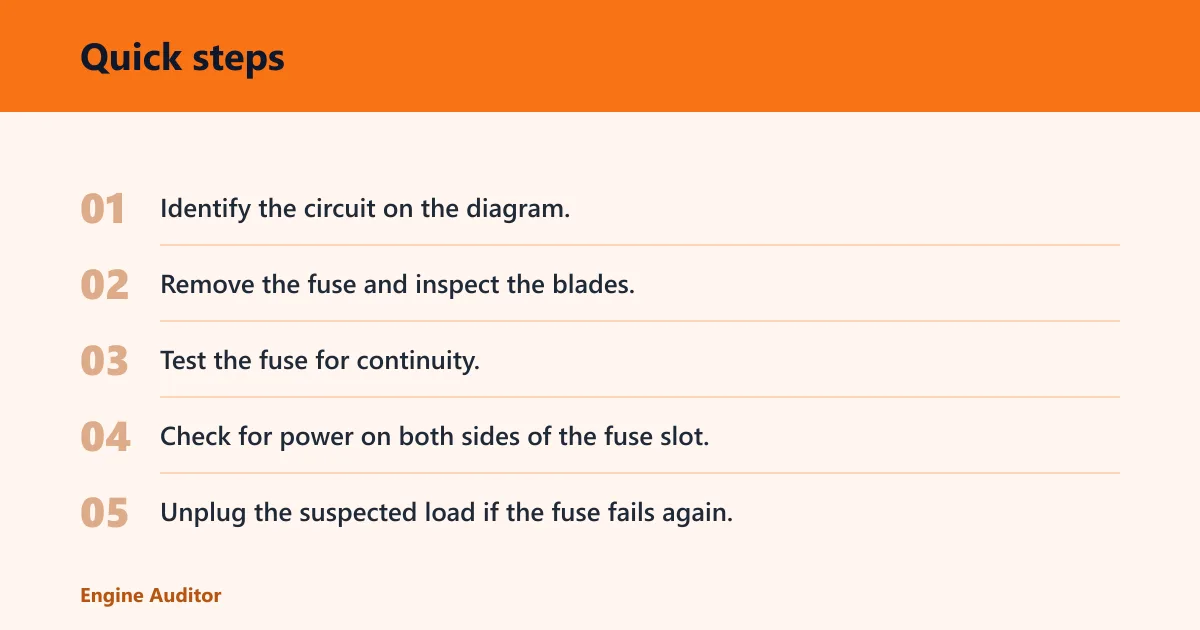
- Identify the circuit on the diagram.
- Remove the fuse and inspect the blades.
- Test the fuse for continuity.
- Check for power on both sides of the fuse slot.
- Unplug the suspected load if the fuse fails again.
How do you find a short circuit that keeps blowing a fuse?
Start with the wire path, not random parts. A short usually sits where the wire run bends, rubs, or passes through metal. Use a circuit tracer if the run is long or buried inside a wiring bundle, because it can help follow the wiring to the branch or connector where the fault lives.
Trace common wire-run pinch points
Look at door jamb boots, hood hinges, seat tracks, trunk hinges, and any place a wire run passes through sheet metal. Pinch points are especially likely after repairs, trim removal, or a panel that closes against the loom. Movement-related shorts often show up only when the body flexes.
Check connectors and ground contact points
Disconnect each connector on the circuit and inspect for bent pins, corrosion, and loose locks. A damaged connector can arc under load or push a conductor against a grounded shell. Ground points should be clean and tight, because poor contact can create strange current paths and repeat fuse failures.
Look for rodent damage and worn insulation
Rodent damage often leaves short sections of missing insulation or scattered bite marks on the wire run. Worn insulation shows up where a wire has rubbed a bracket or moved against another loom. Inspect the entire branch where the fuse feeds the load, not just the visible section near the fuse box.
Can a bad component keep blowing a fuse?
Yes. A bad component can draw more current than spec and keep blowing a fuse, especially if it is partially seized or internally damaged. Window motors, fuel pumps, and blower fans are frequent examples. These parts may fail after brief operation, or only when they heat up.
Window motor faults
A faulty power window motor can draw excessive current and blow a fuse. If the fuse survives when the switch is untouched but fails when the window starts moving, the motor, regulator, or a jammed track becomes the likely path. A slow window that gets worse before the fuse fails is a strong clue.
Fuel pump faults
Fuel pump circuits are high-risk. If the fuse blows during prime or shortly after startup, stop at basic checks. Repeated swaps can hide a short inside the pump, a damaged connector, or a wiring fault near the tank. These circuits deserve caution because a mistake can affect starting and fuel delivery.
Blower fan faults
A blower fan that blows a fuse after a few minutes often points to a tired motor, stuck debris in the fan wheel, or a wiring fault near the resistor or control module. If speed changes affect when the fuse blows, that pattern helps separate motor load from wiring damage.
Why intermittent parts can pass one test and fail later
Heat raises resistance and can push a weak part over the edge. Vibration can open a cracked conductor or move a wire run into contact with metal. That is why a part may test normal at rest and still fail during a drive cycle. Recreate the conditions, not just the static layout.
Are aftermarket accessories overloading the circuit?
Aftermarket accessories can overload a factory circuit if the wiring is not upgraded. Dashcams, phone chargers, extra lights, and audio systems are typical suspects. If the fuse started blowing after an add-on was installed, remove that load first and test the circuit again before replacing factory parts.
Dashcams and chargers
Small accessories can still cause trouble when several share the same outlet or fuse tap. A power outlet circuit may handle one low-draw device, then fail when a charger, cooler, and inflator run together. A dedicated circuit is often the right fix if the load is no longer small.
Extra lights and audio gear
Extra lights and audio amplifiers can exceed the factory circuit’s rating if the new wiring did not include the correct relay, fuse, or gauge. The safest approach is to compare the accessory draw against the circuit specification and move the accessory to its own fused feed when needed.
What tools do I need to diagnose a blown fuse?
A basic diagnostic kit includes an assorted blade fuse kit, a fuse puller, and a 12V test light or multimeter. A digital multimeter is the better choice for continuity mode and voltage checks. A test light is a fast alternative for verifying fuse and circuit power.
Practical tool order
Start with the fuse puller and a known-correct replacement fuse. Move to the test light for quick power checks, then use the multimeter for continuity and voltage confirmation. Add a circuit tracer if the fault seems buried in a long wiring run or body branch.
Frequently asked questions
How do I tell if the fuse is actually bad or the circuit is the problem?
Pull the fuse and test it for continuity with a digital multimeter. A fuse can look intact yet still have zero continuity. If the fuse tests good, check for power at the slot and then unplug the load. That separates a bad fuse from a circuit fault.
Is it safe to replace a blown fuse with a higher amp fuse?
No. The fuse amperage rating must match the OEM circuit specification. Up-rating the fuse can let damaged wiring overheat before the fuse opens. If a 10A fuse blows, do not install a 15A or 20A fuse to “see what happens.”
Where are the fuse boxes in a car?
Most vehicles have an interior fuse box under the dashboard and an under-hood fuse box near the battery. The interior fuse box commonly sits on the driver’s side under the dashboard. Use the lid diagram or owner’s manual to match the fuse to the circuit.
Products related to this article
Sponsored / affiliate links. As an Amazon Associate I earn from qualifying purchases. I may earn additional commission from eligible campaigns.