Best Battery for Honda Civic: Fit and Performance
The best fit for most 2006-and-newer Honda Civics is a Group 51R AGM battery, especially if the car has stop-start, short-trip use, or winter starts. That choice matches Civic fitment, handles repeated cranking better than basic flooded lead-acid, and helps prevent slow cranking and early battery wear.
Required group sizes and power ratings

Quick picks for Civic batteries
Choose by use pattern first. Fit comes before chemistry, and chemistry comes before headline CCA.
- Best for short trips and traffic: Group 51R AGM, or EFB where the owner manual calls for it.
- Best for cold-weather starting: Group 51R with the highest CCA you can buy within the correct tray and terminal layout.
- Best for lower cost in a non-stop-start Civic: Group 51R flooded lead-acid, if the car is not asking for EFB or AGM.
- Best for long service life under stop-start use: Group 51R AGM with strong reserve capacity.
What battery fits your Honda Civic?
Begin with the case size and terminal layout, not the sticker on the box. Honda Civic commonly uses Group 51R, and the battery must match the engine bay, hold-down, and cable position. Some Honda applications use Group 35 or 24F, but those are not the usual Civic fitment.
Check the battery group size first
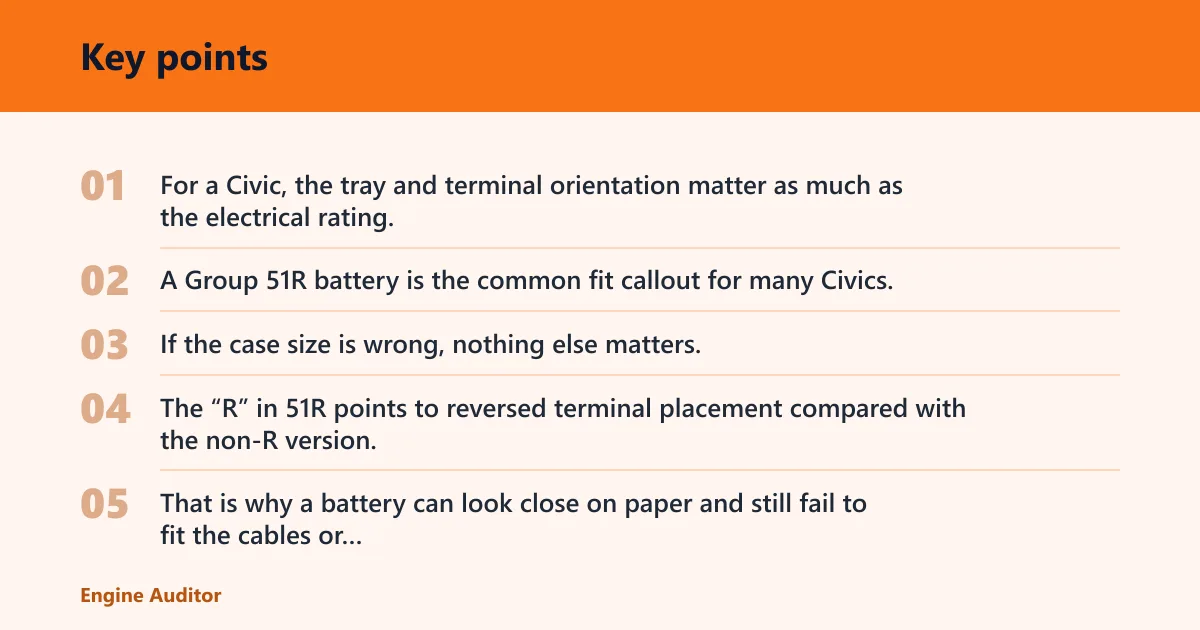
For a Civic, the tray and terminal orientation matter as much as the electrical rating. A Group 51R battery is the common fit callout for many Civics, while some Honda applications use Group 35 or 24F. If the case size is wrong, nothing else matters.
Match terminal layout and tray clearance
The “R” in 51R points to reversed terminal placement compared with the non-R version. That is why a battery can look close on paper and still fail to fit the cables or hold-down. Confirm tray length, height, and post orientation against the vehicle manual before buying.
Gasoline, diesel, and hybrid differences
Honda Civic gasoline models, diesel models, and hybrid models can need different replacement logic. A hybrid Civic still has a 12V battery for accessories and control systems, even though it also has a traction battery. Do not assume the hybrid battery is the part that needs replacement.
Suppose a Civic owner has a sedan with stop-start and mostly city driving. A Group 51R AGM battery is the safer fit than a basic flooded unit because the car can ask for many restarts in one commute. A different owner with an older non-stop-start Civic and longer highway trips may not need AGM at all.
Civic battery fitment matrix
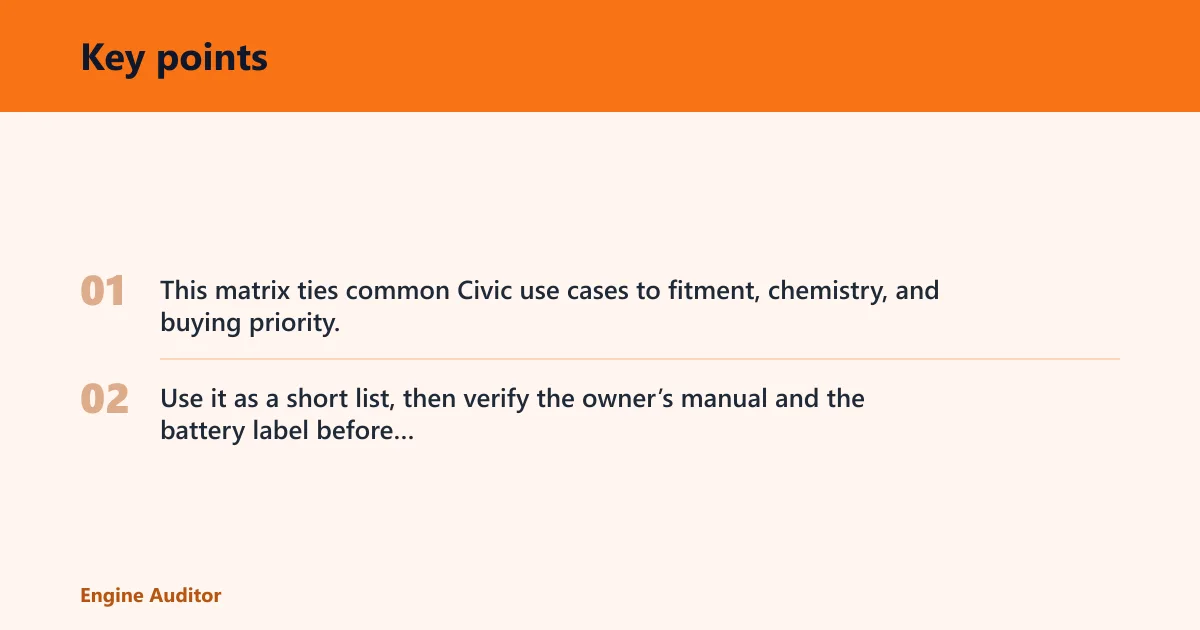
This matrix ties common Civic use cases to fitment, chemistry, and buying priority. Use it as a short list, then verify the owner’s manual and the battery label before purchase.
| Common Civic use case | Battery group size | Chemistry recommendation | Minimum CCA target | Reserve-capacity priority | Buy this if / avoid this if |
|---|---|---|---|---|---|
| Most 2006-and-newer gasoline Civics, mixed driving | 51R | AGM, or EFB if the car was built for it | At least the vehicle spec, with margin for winter use | Medium to high | Buy this if: you want stronger cycling tolerance. Avoid this if: your manual calls only for a basic flooded battery and you do only long highway trips. |
| Older non-stop-start Civic, steady highway use | 51R | Flooded lead-acid | Meet the factory spec | Medium | Buy this if: price matters more than extra cycle life. Avoid this if: you face frequent short trips, traffic idling, or winter starts. |
| Stop-start Civic with short trips and traffic | 51R | AGM | Meet or exceed factory spec | High | Buy this if: start-stop stays active and the battery sees repeated restarts. Avoid this if: you plan to save money with a standard flooded battery. |
| Civic in a cold climate | 51R | AGM preferred; EFB next | Higher CCA within the correct fitment | High | Buy this if: winter starts are a concern. Avoid this if: the battery label looks good but the CCA is low for your climate. |
| Hybrid Civic 12V replacement | Check the exact model listing; often still a compact fit | AGM usually makes sense for accessory load and cycling | Use the vehicle spec | High | Buy this if: you are replacing the separate 12V battery. Avoid this if: you are confusing it with the traction battery. |
| Some Honda applications, not the usual Civic fit | 35 or 24F | Match the vehicle callout | Use the vehicle spec | Medium to high | Buy this if: the owner’s manual or battery label names that size. Avoid this if: you are guessing based on case shape alone. |
AGM, EFB, or flooded lead-acid?
Flooded lead-acid is enough when the Civic has no stop-start system, no heavy accessory load, and mostly steady driving. EFB is a middle-ground option for cars that cycle the battery more often. AGM is worth the extra cost when stop-start, short trips, or cold weather wear down a standard battery faster.
When flooded lead-acid is enough
If your Civic is older, does not use start-stop, and spends most of its life on longer drives, a standard flooded battery can be the right buy. It is the low-cost choice. It is also the one most likely to fall behind if the car sees many restarts or long idle periods.
When EFB is the right middle ground
EFB works well when the vehicle needs more cycling strength than a basic flooded battery can give, but the owner does not want to pay for AGM. Honda Civic batteries may be EFB or AGM from the factory, so check what the car originally used before stepping down.
When AGM is worth the extra cost
AGM earns its keep when the battery faces repeated crank cycles, accessory draw, and shorter charging windows. Start-stop can create dozens of crank cycles during one commute. Standard batteries may fail faster in that use because sulfation builds up faster than the battery can recover.
Cold weather also changes the equation. CCA drops when the battery is needed most, so an AGM with healthy reserve capacity can make winter starts more dependable than a bargain flooded unit that only meets the bare minimum on paper.
Do you need a start-stop battery for Honda Civic?
If your Civic has idle stop-start, use a battery built for that duty. The system shuts the engine off at stops, then asks for rapid restarts, which creates micro-cycling stress and shortens usable battery life. A normal battery can work for a while, but it often wears out sooner.
Why idle stop-start stresses the battery
Idle stop-start saves fuel, but it also asks the battery to restart the engine again and again. That repeated cycling is harder on a standard flooded battery than on EFB or AGM, which are built to handle the extra workload.
What micro-cycling does to service life
Every engine stop and restart pulls the battery through another shallow cycle. That adds up. The result is often earlier sulfation, slower charging recovery, and a shorter usable life than a comparable battery in a non-stop-start Civic.
When a warning message points to battery wear
A Start-Stop unavailable warning is not proof of a bad battery by itself, but it is a useful clue. If the message appears along with slow cranking, dim lights, or trouble after short trips, the battery may no longer have enough reserve to support the system.
Civic battery warning signs
Battery failures usually show up in starting speed, dashboard messages, or visible case damage. If the case is swollen, replace the battery soon. If the engine cranks slowly or the electronics dim at idle, the battery may be losing capacity even if the car still starts.
Slow cranking and dim electronics
A sluggish start is one of the clearest warning signs. If the starter turns slowly and the interior lights or infotainment dim when accessories are on, the battery may be losing both CCA and reserve capacity.
Start-Stop unavailable warning
On a Civic with stop-start, the system may disable itself when battery state of charge drops too low. That warning often shows up before a no-start event. Treat it as a sign to check battery condition, charging behavior, and terminal cleanliness.
Swollen case, age, and storage issues
A swollen battery case points to heat damage, overcharging, or internal failure. Stored batteries also need attention. Honda recommends charging if battery voltage is 12.4 volts or less, and Honda generator batteries should be kept fully charged for maximum life.
How to choose and replace it
Short trips, traffic, heat, and winter use all push the Civic battery harder. The right choice depends on how the car is driven, not just on the label price. After replacement, keep the terminals clean, check voltage regularly, and use a maintainer for stored vehicles.
Short trips, traffic, heat, and winter use
Short drives reduce charging time. Traffic increases restart events. Heat shortens battery life. Winter reduces CCA when starting power is needed most. If your Civic sees any two of those patterns regularly, AGM becomes easier to justify.
A common first-timer mistake is buying the cheapest Group 51R battery that fits the tray, then wondering why the start-stop system drops out in winter. The size is correct, but the chemistry and reserve capacity are not a good match for the driving pattern.
Charging, terminal cleaning, and voltage checks
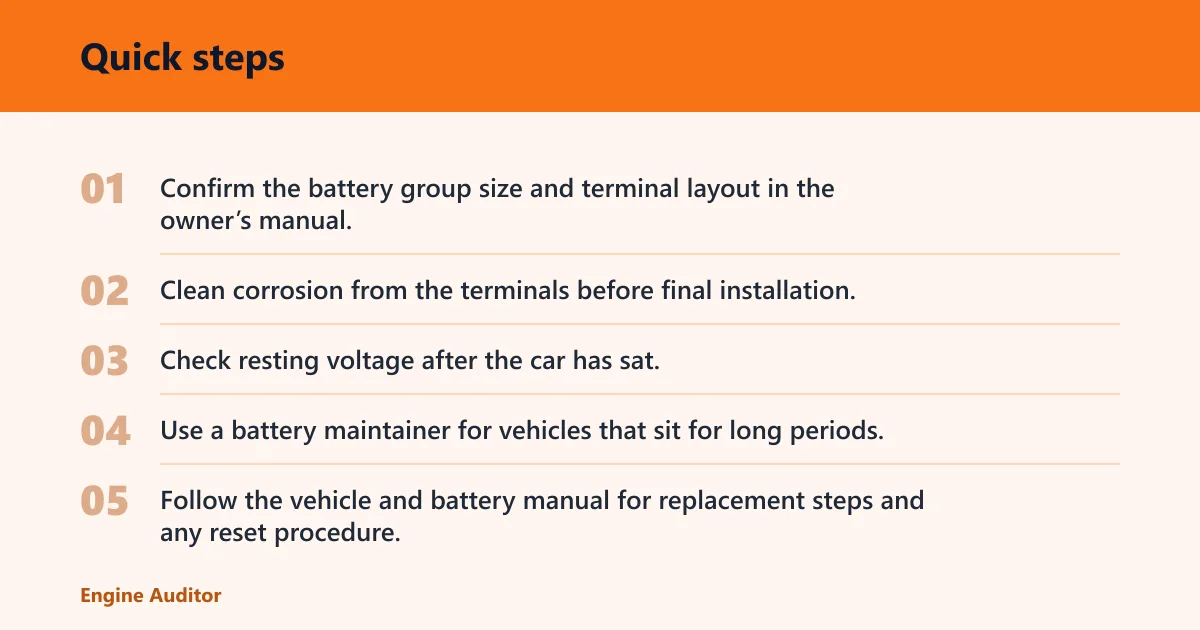
- Confirm the battery group size and terminal layout in the owner’s manual.
- Clean corrosion from the terminals before final installation.
- Check resting voltage after the car has sat, and charge the battery if voltage is 12.4 volts or less.
- Use a battery maintainer for vehicles that sit for long periods.
- Follow the vehicle and battery manual for replacement steps and any reset procedure.
Installation notes and manual-based reset steps
After replacement, some Civics may need a reset or relearn for battery management and stop-start behavior. Do not guess at the sequence. Follow the vehicle manual, and if the model has a battery registration or initialization step, complete it exactly as directed.
Safety note: follow the vehicle and product manual, never work under a vehicle held only by a jack, never exceed the vehicle’s rated roof, hitch, or tow limit, keep items out of airbag zones and the driver’s view, and check local laws.
Frequently asked questions
What battery size fits my Honda Civic?
Many 2006-and-newer Honda Civics use Group 51R. Some Honda applications use Group 35 or 24F, but the Civic fit must still match the engine bay, hold-down, and terminal layout. Check the owner’s manual and the old battery label before buying a replacement.
Should I buy AGM or lead-acid for a Honda Civic?
AGM is commonly recommended for Civics with stop-start, frequent short trips, traffic-heavy use, or a need for better winter reliability. Choose flooded lead-acid if the car is older, has no stop-start system, and mostly sees longer drives. The right answer depends on cycling demand, not just on price.
Is a 51R battery correct for my Civic?
For many Civics, yes. Honda Civic commonly uses battery group 51R. The catch is fitment details: the battery still has to match the tray, cable reach, and terminal orientation. If the manual lists another size, use that callout instead of forcing a near match.
What battery specs do Civic gas and diesel models use?
Some sources list Honda Civic gasoline models at about 44Ah to 45Ah, while diesel models are listed at about 60Ah. Those figures should be checked against the exact vehicle listing, because fitment and factory equipment can change by market and drivetrain.
How do I know if my Civic battery is failing?
Look for slow cranking, dimming electronics, a Start-Stop unavailable warning, or a swollen battery case. Age and storage matter too. If the battery sits for long periods and voltage falls to 12.4 volts or less, it is worth charging and retesting before it fails outright.
Can I upgrade to a better battery for Honda Civic?
Yes, if the upgrade stays within the correct case size and terminal layout. AGM is the most useful upgrade for short trips, traffic, cold weather, and stop-start use. Do not chase a bigger battery unless the tray and cables can accept it without modification.
What battery capacity does a Honda Civic usually need?
There is no single Civic capacity number that fits every market and drivetrain. The common answer is a compact Group 51R battery with capacity set by the exact model, engine, and stop-start equipment. Use the vehicle label or manual for the final spec, then choose the best chemistry around it.
Products related to this article
Sponsored / affiliate links. As an Amazon Associate I earn from qualifying purchases. I may earn additional commission from eligible campaigns.