Ford Transmission Fluid Change Interval Explained
For most Ford automatics, transmission-fluid service is commonly due around 30,000–60,000 miles in severe use and about 60,000–100,000 miles in normal use; follow the owner’s manual and the Ford maintenance schedule for sealed 8- and 10-speed units. Skipping it can mean harsh shifts, heat damage, and a repair bill far higher than a drain-and-fill. This guide breaks down Ford intervals by transmission type and shortens the mileage for towing, idling, and hot-weather driving.
Matching fluid service intervals to driving conditions


Ford does not use one mileage number across every transmission. The right interval depends on the transmission family, the model year, the fluid spec in the maintenance schedule, and how hard the vehicle works. A city commuter and a tow vehicle should not be treated the same.
Why one mileage number does not fit every Ford
Transmission fluid is a viscous oil that cuts wear and helps control heat. On a Ford automatic, that job changes with torque load, heat, and shift activity. A truck that tows, idles in traffic, or climbs grades ages its fluid faster than a lightly loaded vehicle on long highway runs.
That is why broad advice such as “change it at 100,000 miles” is too blunt for Ford ownership. Most transmission fluid is designed to last for up to 100,000 miles, but that does not mean every Ford should wait that long. Some severe-use schedules call for service much sooner.
How to read the maintenance schedule and transmission code
Start with the owner’s manual and the Ford maintenance schedule, then identify the exact transmission listed for your vehicle. The schedule should tell you whether the unit has a normal-service interval, a severe-service interval, or a fluid check that differs from service replacement. Use the manual before any generic advice.
Ford automatics, dual-clutch transmissions, and CVTs do not all share the same fluid or the same service logic. Some modern sealed units need a specific fill procedure and may not use a dipstick. Others do allow a level check under the hood with a dipstick.
Normal service versus severe service
Normal service is steady commuting with moderate loads and limited heat buildup. Severe service includes towing, hauling, repeated short trips, stop-and-go traffic, mountain driving, and hot-climate use. Those conditions shorten fluid life because they raise temperature and increase clutch and gear wear.
A practical rule is simple: if the transmission spends more time under heat or load than a commuter car does, shorten the interval. Do not wait for a warning light. Fluid condition can decline long before that.
Which driving habits shorten the interval?
Towing, high temperatures, and repeated low-speed operation all push Ford transmission fluid toward earlier service. If any one of those is common, use the severe-service schedule in the manual instead of the normal mileage number. If several apply at once, plan on the shorter end of that range.
Towing and hauling
Towing adds heat and load. Hauling heavy cargo does the same, even without a trailer. Ford maintenance schedules commonly treat this as severe service, so the interval should be shortened compared with a light-duty commuter vehicle. If the transmission hunts for gears or runs hot on grades, that is another reason to shorten the interval.
Mountain driving and high heat
Long climbs, repeated descents, and summer heat all stress automatic transmission fluid. Heat is the main enemy here. If the vehicle regularly sees steep grades or hot-weather operation, service should move earlier than the normal schedule, especially on units that already run near their thermal limit.
Short-trip and stop-and-go use
Short trips can be hard on fluid because the transmission may never fully warm up, while stop-and-go traffic creates constant heat cycles. Urban driving with long idle periods belongs in the severe-use bucket. A commuter that sees nothing but short hops can need earlier service than a highway-driven vehicle with more miles.
Ford interval matrix
This matrix turns driving pattern into a service decision. It is not a substitute for the owner’s manual, but it is a better starting point than a single Ford-wide mileage number.
| Use case | Service timing | What to watch |
|---|---|---|
| Normal commuting | Use the manual’s normal-service interval; many Ford owners will land in the 60,000–100,000 mile window | Follow the exact transmission fluid approval and check for any schedule note that shortens service |
| Towing and hauling | Use the severe-service interval; many schedules pull this down to 30,000–60,000 miles | Heat, gear hunting, and heavy load are signs to service sooner |
| Hot-climate and stop-and-go use | Use the severe-service interval; shorten further if heat, idling, or short trips are frequent | Delayed engagement, harsh shifts, and darkened fluid matter more here |
| Mountain driving | Use the severe-service interval; service on the earlier side if grades are frequent | Watch for flare, shudder, and burnt odor after repeated climbs |
Say your Ford pickup tows a trailer through summer traffic and then climbs a long grade on weekends. That is severe service on multiple counts, so waiting for a normal-service mileage number is the wrong call. The manual’s shortened interval is the safer one.
How to tell when fluid is overdue
Overdue transmission fluid often shows itself through behavior before it shows up on paper. Shudder, delayed engagement, flare between shifts, harsh changes, slipping, dark fluid, and a burnt odor all suggest the fluid has lost useful properties. Those signs matter more than color alone.
Shudder, flare, and delayed shifts
Shudder under light throttle, a pause before drive or reverse engages, or engine flare between shifts can point to degraded fluid or a level problem. On a Ford, do not dismiss these as normal aging. They can be the first clue that service is overdue or that the fluid spec is wrong.
Suppose a crossover begins to hesitate when shifting from park into reverse after a week of short trips. If the fluid level is correct and the manual calls for a service interval already past due, that symptom should move transmission service up the list rather than down it.
Odor, dark fluid, and contamination
Fluid color can help, but it is not a universal pass or fail test. Look for darkening, cloudiness, burnt odor, or visible contamination instead of relying on color alone.
Metal debris in the pan also matters. A small amount of fine material can be normal wear, but larger chips or heavy sludge deserve attention. If the pan shows debris, service should not stop at a simple refill.
When symptoms mean you should stop waiting
If the transmission shudders, slips, bangs into gear, or smells burnt, do not keep stretching the interval. Those symptoms can point to heat damage or low fluid quality. Continued driving may turn a service job into a repair job.
Drain and fill or flush?
The right method depends on the transmission design and Ford service information. A drain-and-fill is often the conservative choice, while a flush may be used only when the manual or service document calls for it. More fluid replacement is not automatically better.
What Ford service information usually decides
Ford service guidance should decide the method first. Some units are designed for a pan drain and refill. Others need a fill procedure at a specific temperature, a scan tool, or a service-level check. If the manual does not call for a flush, do not assume one is needed.
When a pan drop makes sense
A pan removal can make sense when the transmission design allows it and when debris inspection is part of the job. That gives a chance to check for wear material and, where the design uses one, replace the gasket. Some Ford designs do not use a traditional replaceable gasket, so confirm the exact pan design before buying parts.
The pan is also where a drain plug may be located on some models. If the pan must come off, the correct sealant or gasket type depends on the transmission, not on a generic Ford rule.
Why sealed units need a different approach
Sealed Ford transmissions can need special fill ports, temperature checks, or a shop procedure to confirm level. They may not have a dipstick under the hood. On those units, a flush versus drain-and-fill decision should come from the service information, not from a universal rule of thumb.
Check fluid and pan
Some Ford units allow a simple level check under the hood with a dipstick, while others require a different method. Before opening anything, verify the transmission type and the fluid-check procedure in the owner’s manual. Do not assume every Ford has the same layout.
Dipstick location and level check
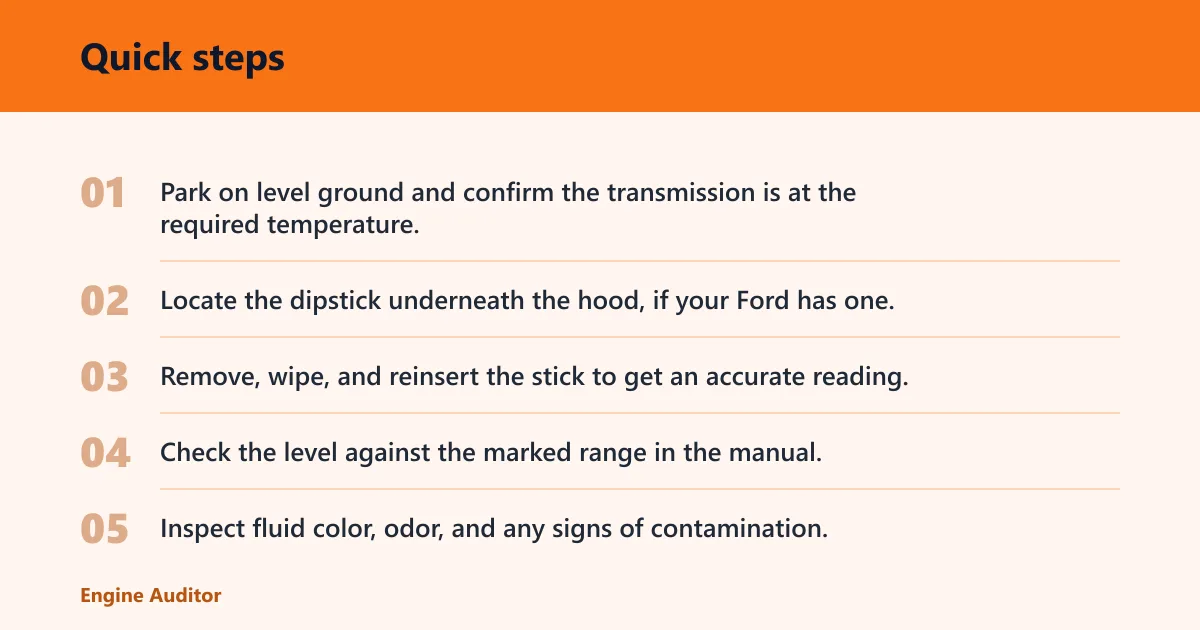
Where equipped, the dipstick is checked underneath the hood. The fluid should be checked at the specified temperature and with the engine running or off only if the manual says so. A quick glance is not enough; the correct procedure matters.
- Park on level ground and confirm the transmission is at the required temperature.
- Locate the dipstick underneath the hood, if your Ford has one.
- Remove, wipe, and reinsert the stick to get an accurate reading.
- Check the level against the marked range in the manual.
- Inspect fluid color, odor, and any signs of contamination.
Pan removal, drain plug, and debris inspection
If the transmission has a drain plug, drain the old fluid into a pan and inspect what comes out. If there is no plug, the pan may need to come off. Look for metal debris, sludge, or gasket condition during that inspection. Replace only the parts that the transmission design actually uses.
Basic tools usually include a socket set, a drain pan, and a funnel. The parts list often includes transmission fluid and, on some designs, a transmission gasket. The job can be beginner level and take about half an hour on a straightforward setup, but sealed units are a different story.
What to confirm before refilling
Before refilling, confirm the exact fluid approval, the fill quantity procedure, and whether the transmission needs a temperature-based level check. Ford does not use one universal ATF for every model. Using the wrong fluid spec can create shift problems even when the level is correct.
Ford fluid spec and service records
Ford fluid choice should match the exact approval in the manual. Service records matter because they show mileage, date, fluid type, and method. That record helps the next service land on time instead of late.
Match the exact fluid approval
Do not buy fluid by color or by the label “universal.” Use the exact spec or approval listed for the transmission code. That matters on automatic transmissions, dual-clutch units, and CVTs where Ford uses them. The wrong fluid can change shift feel, clutch behavior, and heat control.
Record mileage, date, and service type
Write down the mileage, date, and whether the job was a drain-and-fill, pan service, or shop-level level check. That helps confirm the next interval under the Ford maintenance schedule. It also helps when a symptom appears later and you need to know whether the fluid was already overdue.
When to use the owner’s manual over generic advice
Use the owner’s manual whenever there is a conflict. Generic mileage charts are too broad for Ford. If the manual calls for severe-service timing, a specific transmission fluid approval, or a special filling procedure, that overrides any blanket advice.
How much does a Ford transmission fluid change cost? Actual cost varies by model, service method, fluid spec, and region, and sealed or pan-drop jobs can cost more than a simple drain-and-fill. (Thedrive)
Frequently asked questions
How often should I change Ford transmission fluid?
Use the owner’s manual first.
Does Ford recommend transmission fluid changes by mileage or by condition?
Ford maintenance schedules are usually mileage based, but they also separate normal service from severe service. Condition matters too. Shudder, delayed engagement, flare, harsh shifts, dark fluid, or a burnt smell should move service earlier, even if the mileage number has not been reached.
Is Ford transmission fluid a lifetime fluid?
No single answer fits every Ford. Some owners hear “lifetime,” but the manual and maintenance schedule are the only safe references. Many transmissions still need service, and severe-use schedules shorten the interval well before the broad 100,000-mile figure.
What signs mean my Ford transmission fluid is overdue?
Watch for shudder, delayed shifts, flare, slipping, harsh engagement, darkened fluid, contamination, or a burnt odor. Those signs suggest the fluid is no longer doing its job well. If they appear, service should move forward, not wait for the next routine interval.
Can I check Ford transmission fluid level myself?
Yes, on Ford units that have a dipstick, the check is done underneath the hood. But some sealed transmissions require a different procedure or shop-level level check. Always follow the manual for temperature, engine state, and any special fill steps.
Is a transmission fluid flush better than a drain and fill on a Ford?
Not automatically. The correct method depends on the transmission design and Ford service information. Some units call for a simple drain-and-fill or pan service, while others require a specific fill procedure. A flush is only right when the manual or service data calls for it.
What happens if I ignore transmission fluid service on a Ford?
Old fluid loses its ability to cut wear and control heat. That can lead to harsher shifts, delayed engagement, slipping, and eventually expensive transmission damage. If you are already seeing those symptoms, waiting longer can turn a service item into a major repair.
Products related to this article
Sponsored / affiliate links. As an Amazon Associate I earn from qualifying purchases. I may earn additional commission from eligible campaigns.