Plug-in hybrid vs hybrid: Which vehicle type makes sense?
Choose a hybrid if you cannot charge at home or work, or if most drives stay within about 40 miles a day; choose a plug-in hybrid only if you can plug in regularly and your commute fits its electric range. Miss that rule and a PHEV can add cost and weight without much fuel savings. This guide compares charging access, daily mileage, commuting, apartment life, and road-trip use so you can pick the right powertrain.
Plug-in hybrid vs hybrid: the real difference
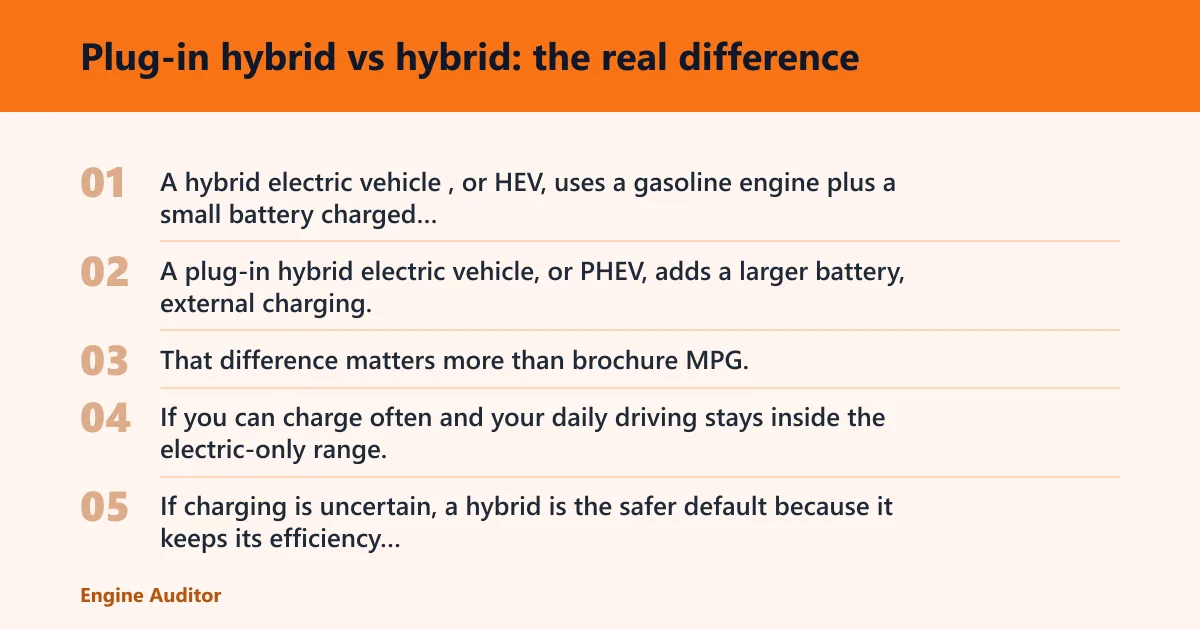
The trade-off is straightforward. A hybrid electric vehicle, or HEV, uses a gasoline engine plus a small battery charged by the engine and regenerative braking, so it does not need to be plugged in. A plug-in hybrid electric vehicle, or PHEV, adds a larger battery, external charging, and some electric-only driving before it switches to hybrid operation.
That difference matters more than brochure MPG. If you can charge often and your daily driving stays inside the electric-only range, a PHEV can run many trips on electricity. If charging is uncertain, a hybrid is the safer default because it keeps its efficiency without asking you to plug in.
| Decision factor | Plug-in hybrid | hybrid: Which vehicle type makes sense | Winner |
|---|---|---|---|
| Charging access | Needs regular charging to deliver its full value | No external charging required | Hybrid |
| Electric-only use | About 10 to 70 miles, depending on model | Very limited electric driving only | Plug-in hybrid |
| Battery size and packaging | Battery is roughly 10 to 20 times larger than a hybrid battery | Battery is typically around 1 kilowatt-hour | Hybrid |
| Fit for mixed driving | Can be efficient, but only if charged often | Efficient without changing behavior | Hybrid |
| Best fit for short charged commutes | Strong fit when charging is reliable | Good, but not as efficient on electricity-free trips | Plug-in hybrid |
Charging access changes the answer
A hybrid suits drivers who do not want their routine shaped by a charging cord. A PHEV suits drivers who can treat charging as part of normal parking, at home or at work. If the cord is optional in practice, the hybrid keeps the easier ownership pattern.
Battery size and packaging are not minor details
A hybrid battery is small, around 1 kilowatt-hour, while a PHEV battery is roughly 10 to 20 times larger. That larger pack adds weight and takes space, which is part of why PHEVs cost more and can lose some efficiency once the battery is empty. (caranddriver.com)
Fuel economy depends on how you drive it
Hybrid efficiency is built into the system. A PHEV’s efficiency depends on whether you recharge often enough to replace gasoline miles with electric miles. Without that habit, the larger battery turns into extra mass that must be carried on every trip.
📊 A hybrid’s battery is typically around 1 kilowatt-hour in size. Source: Hybrids vs. Plug-In Hybrids: Pros and Cons.
How each powertrain works in traffic and around town
Both powertrains use regenerative braking, which converts slowing energy into electricity and helps refill the battery. That makes stop-and-go driving better than steady high-speed cruising for both types.
Why hybrids do well in city driving
City traffic gives a hybrid repeated chances to recover energy through braking and to shut the engine off at low loads. That is why hybrids often return strong city fuel economy without any charging routine. For drivers with short trips, errands, and uncertain parking, that consistency is a major advantage.
Why PHEVs can be very efficient on short, charged trips
On a short commute that fits within the electric-only range, a PHEV can behave more like an EV for a while. The fuel savings are real only when those miles are replaced with charged electricity. Once the battery is depleted, the vehicle reverts to hybrid behavior and the advantage narrows.
How far can a plug-in hybrid drive on electricity alone?
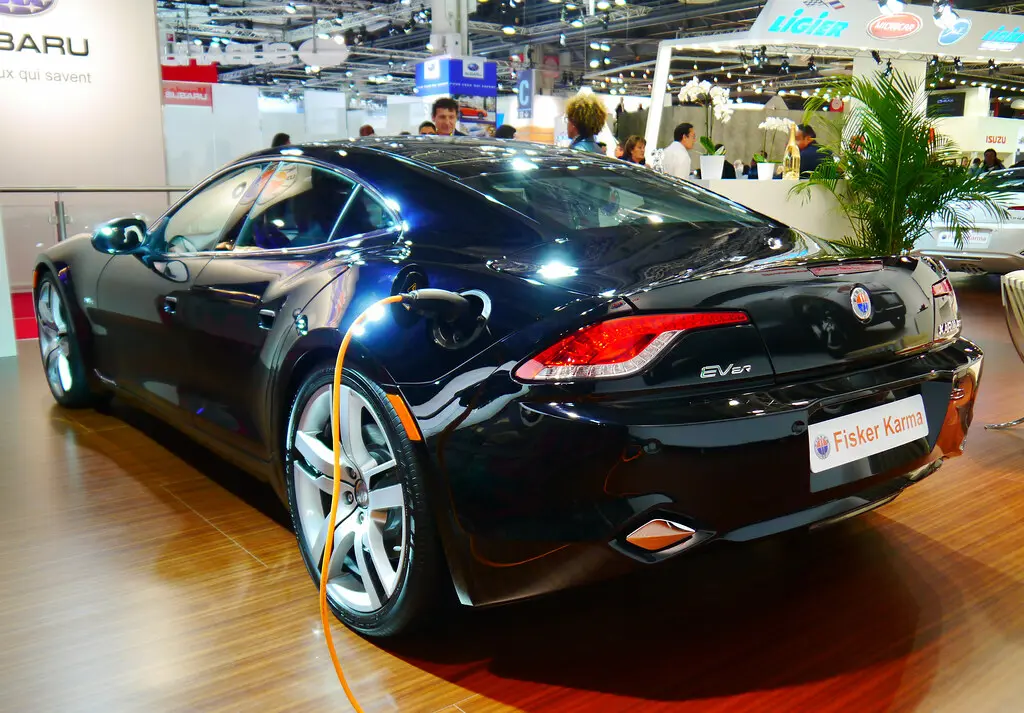
A plug-in hybrid can usually drive about 10 to 70 miles on electricity alone, depending on the model and battery size. That range may be enough for some commutes and school runs, but it is not a universal fit. The real question is whether your daily driving lands inside that band most of the time.
Why commute length matters more than brochure MPG
If your round trip is around 20 miles and you can recharge regularly, a PHEV may use little gasoline. If your daily driving is around 60 miles and charging is inconsistent, the battery may cover only part of the trip, and the gas engine may handle the rest. In that case, the PHEV loses much of its advantage.
What happens after the battery is depleted
After the battery runs down, a PHEV does not stop working. It switches to hybrid operation and keeps driving on gasoline and electric assist. The important point is that the empty-battery version of a PHEV is no longer an electric-first vehicle; it is a heavier hybrid that still needs fuel.
Do plug-in hybrids need to be charged every day?
They do not need daily charging to function, but daily charging is what makes them make sense for many buyers. If you can top up often, the battery gets used the way the vehicle was designed to be used. If you rarely plug in, you are carrying extra battery weight without getting the electric miles that justify it.
Level 1 charging vs Level 2 charging
Level 1 charging uses a 110-volt cord from a standard garage outlet, and PHEV batteries may charge overnight in 10 to 12 hours on that setup. Level 2 charging is typically three times faster than Level 1 for PHEVs. Level 1 can be enough for some owners; Level 2 is helpful, but it is not mandatory for every PHEV shopper.
- Estimate your round-trip commute in miles.
- Check whether you can charge at home, at work, or both.
- Compare that routine with the PHEV’s electric-only range.
- Decide whether charging will happen often enough to matter.
What happens if you skip charging often
If you treat a PHEV like a regular hybrid and never plug it in, fuel use rises relative to what the car could have delivered with regular charging. That is the common failure case. The vehicle still works, but it no longer earns back its extra battery cost and weight through electric driving.
Are plug-in hybrids worth it if I cannot charge at home?
Usually not, unless you have reliable charging at work or another dependable routine. Apartment living, street parking, and unstable public charging access are all reasons to lean toward a hybrid. A PHEV only pays off when charging is convenient enough that you actually use it.
Apartment living and unreliable access
If you cannot count on a home outlet or garage space, a PHEV becomes a gamble. You may still own a capable car, but the electric range becomes sporadic instead of useful. In that situation, a hybrid gives you most of the efficiency benefit with far less hassle.
Charging at work and public charging as substitutes
Workplace charging can make a PHEV sensible even without home charging, provided the plug is available consistently. Public charging can also help, but only if it fits your schedule and parking pattern. If access is unpredictable, do not plan the purchase around it.
Say your commute is 28 miles round trip and your office parking garage has dependable charging every weekday. A PHEV can cover much of that drive on electricity alone and still keep gasoline backup for longer weekend trips. If that garage charger disappears, the same car becomes harder to justify.
Choose a hybrid if… / choose a plug-in hybrid if…
Choose a hybrid when you want fuel savings without depending on charging access. Choose a plug-in hybrid when charging is routine and your daily mileage fits inside the electric-only range often enough to matter. The wrong answer here usually comes from ignoring parking and commute reality.
Choose a hybrid if…
- You cannot charge at home or work with any consistency.
- Your driving is mixed, with errands, school runs, and longer trips in the same week.
- Your commute often exceeds the PHEV’s electric-only range.
- You want simpler ownership and fewer planning steps.
Choose a plug-in hybrid if…
- You can plug in regularly, even if that is only overnight on Level 1 power.
- Your daily commute usually fits inside the electric-only range band.
- You want most short trips to be electric without giving up gasoline backup.
- You are willing to manage charging as part of normal parking.
Decision matrix: commute, charging access, and road trips
Use this matrix first. It ties the choice to daily mileage and charging access, then checks whether road-trip frequency changes the answer. The right pick depends less on theory and more on whether the vehicle will actually be charged often enough to change your fuel use.
| Situation | Better choice | Why | When it backfires |
|---|---|---|---|
| Short commute, home charging available | Plug-in hybrid | Daily electric use is realistic if the commute fits the range | Backfires if you stop charging and carry the battery weight for nothing |
| Long commute, no home charging | Hybrid | Efficient without depending on a plug | Backfires only if you expected EV-like driving without charging access |
| Frequent road trips | Hybrid | Less planning, no need to seek chargers on every stop | Backfires if your daily driving is very short and you ignored charging at home |
| Mostly city driving, reliable charger at home or work | Plug-in hybrid | Stop-and-go traffic and short trips can be covered by electricity more often | Backfires if the charging routine is inconsistent |
| Apartment dweller, uncertain charging, mixed miles | Hybrid | Best fit when charging access is the weak link | Backfires only if you had dependable charging elsewhere and did not use it |
Scenario check: what goes wrong for the wrong buyer
A common first-timer mistake is buying a PHEV for the electric range, then discovering that street parking and a 55-mile daily drive leave the battery half-used and the engine working anyway. The car still functions well, but the economics no longer favor the plug-in model.
What is the difference between a hybrid and a plug-in hybrid?
A hybrid uses a gasoline engine, a small battery, and regenerative braking to improve fuel economy without external charging. A plug-in hybrid adds a larger battery that can be charged from the grid and can drive on electricity alone for a limited distance before acting like a regular hybrid.
The practical difference is ownership behavior. A hybrid asks nothing special from you. A plug-in hybrid asks you to charge often enough that the battery gets used instead of hauled around.
Which is better for commuting, a hybrid or plug-in hybrid?
A plug-in hybrid is better for commuting only when the commute fits its electric-only range and you can recharge often. A hybrid is better when charging is uncertain, the commute is longer than the battery range, or you want efficiency without thinking about plug-in habits.
Do plug-in hybrids need to be charged every day?
No, but regular charging is what makes them worth considering. Daily charging helps a PHEV replace gasoline miles with electric miles, while sporadic charging turns it into a heavier hybrid with less benefit. Level 1 charging can be enough for overnight top-ups in many cases.
Are plug-in hybrids worth it if I cannot charge at home?
Usually not. If home charging is impossible and work charging is unreliable, a hybrid is the safer buy because it delivers its efficiency without relying on plug access. A PHEV can still work, but only if another charging routine is genuinely dependable.
Which vehicle type makes sense if I mostly drive in the city?
If you mostly drive in the city and can charge regularly, a plug-in hybrid can be a strong fit because short trips and stop-and-go traffic give the battery many chances to do the work. If you cannot charge, a hybrid still does well in city traffic thanks to regenerative braking and its self-charging system.
Which vehicle type makes sense for road trips?
A hybrid is usually the easier road-trip choice because it does not require charging stops to keep its efficiency. A plug-in hybrid still works on long trips, but its electric range matters less once the battery is depleted. Frequent travelers often value the simpler routine of a hybrid.
Do hybrids save more fuel than regular gas cars?
Yes. A hybrid generally uses less fuel than a conventional gasoline car because it recaptures braking energy, shuts the engine off more often, and uses electric assist at low speeds. The gain is especially clear in city driving, where stop-and-go traffic gives the system more chances to help.
What are the downsides of plug-in hybrid batteries and extra weight?
The main downsides are cost, mass, and packaging. A PHEV battery is larger than a hybrid battery, so it adds weight and can take up space that might otherwise go to cargo or cabin packaging. If the battery is not charged often, that extra hardware delivers less return.
Is a plug-in hybrid basically an electric car with a gas engine?
No. A plug-in hybrid is better described as a part-time EV with a gasoline backup. It can drive on electricity alone for short distances, but once that range is used up, it behaves like a hybrid. A full EV is designed around electric driving all the time.
Products related to this article
Sponsored / affiliate links. As an Amazon Associate I earn from qualifying purchases. I may earn additional commission from eligible campaigns.